service VOLVO XC70 2003 User Guide
[x] Cancel search | Manufacturer: VOLVO, Model Year: 2003, Model line: XC70, Model: VOLVO XC70 2003Pages: 257, PDF Size: 5.33 MB
Page 77 of 257
2003 VOLVO XC70
1. Press : the LED AUT comes on. The Air quality sensor is now activated.
2. Press
: no LED is lighted. Recirculation not activated.
3. Press
: the LED MAN comes on. Recirculation is now activated.
You can switch between these three functions by repeatedly pressing
Keep the following in mind:
l Make it a rule to have the Air quality sensor activated at all times.
l Recirculation is limited in cold climates to avoid misting up.
l If misting occurs, you should deactivate the Air quality sensor.
l If the windows mist up, you can also use the windshield and side window \
defroster functions. See
page 49.
l The filter should be changed at the intervals listed in the Warranty and\
Service Records Information
booklet. However, if the car is used in a severely contaminated environm\
ent, it may be necessary to
change the filter more frequently.
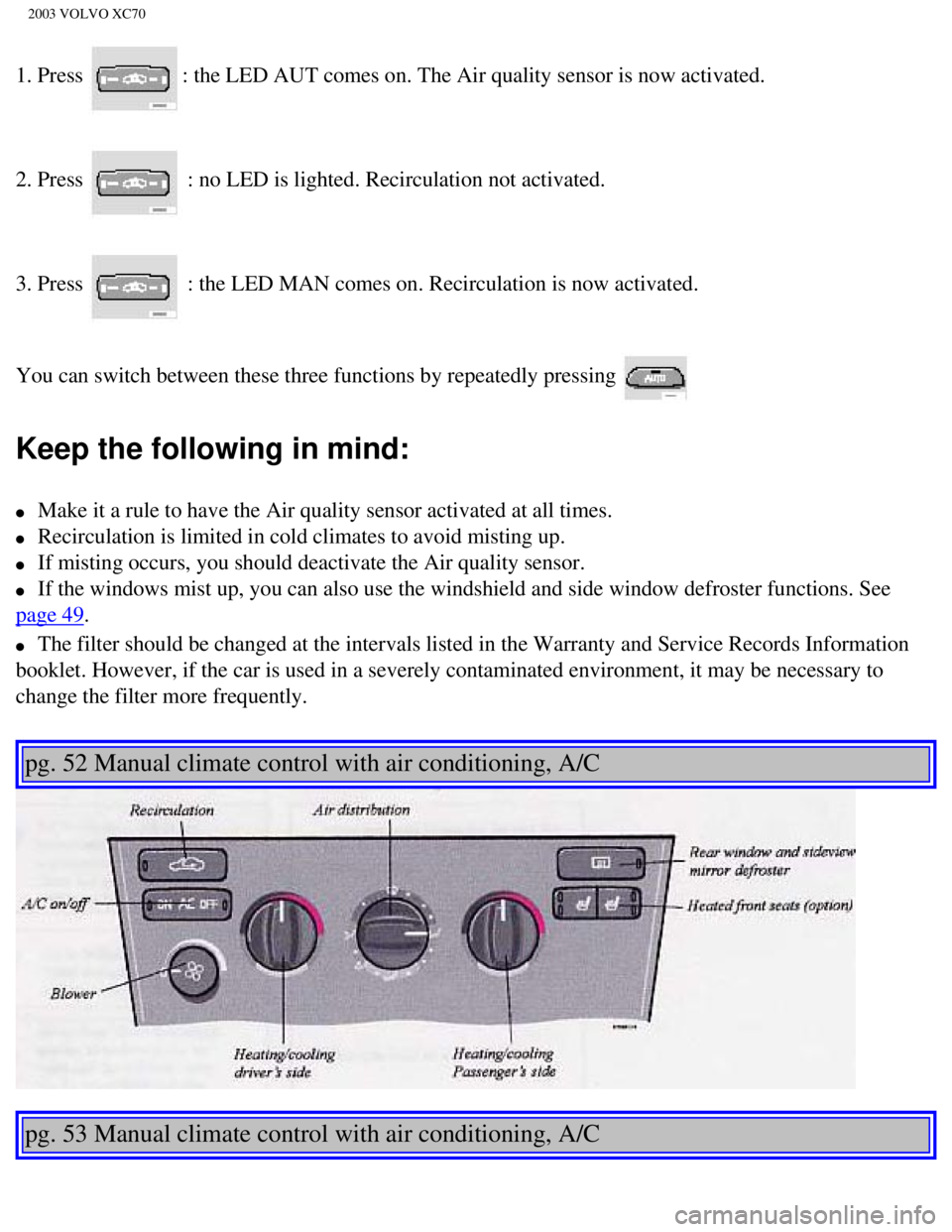
pg. 52 Manual climate control with air conditioning, A/C
pg. 53 Manual climate control with air conditioning, A/C
file:///K|/ownersdocs/2003/2003_XC70/03xc70_03.htm (9 of 12)12/30/2006\
4:17:55 PM
Page 114 of 257

2003 VOLVO XC70
Two keys are provided with your car; a master key and a service key. The\
master key, the remote
control, and the central locking button may all be used to lock and unlo\
ck all of your car's locks.
The service key will operate only the driver's door and the ignition swi\
tch. It is intended to help deter
unwanted entry into the glove compartment and trunk.
Turn the key once to unlock the driver's door and the fuel filler door.
Turn the key again (within 10 seconds) to unlock all doors and the tailgate. One turn with the key
towards lock in the drivers door locks all doors and tailgate.
Use the switch on the front door armrests to lock/unlock the car from th\
e inside. WARNING!
If the doors are locked while driving, this may hinder rapid access to t\
he occupants of the car in the
event of an accident. (Also see information on "Child safety locks"). \
NOTE: To help prevent accidentally locking the keys in the car, the central lo\
cking system is designed
to unlock the doors immediately if the key is left in the ignition switc\
h, the car is locked using the lock
button on the door and the door is then closed. A sound from the lock will be audible at this time.
Please note that this function will not unlock the doors if the engine i\
s running.
Immobilizer (start inhibitor)
Each of the keys supplied with your car contains a coded transmitter. Th\
e code in the key is transmitted
to an antenna in the ignition switch where it is compared to the code st\
ored in the start inhibitor module.
The car will start only with a properly coded key. If you misplace a key\
, take the other keys to an
authorized Volvo retailer for reprogramming as an antitheft measure.
*This key operates only driver's door and ignition switch/steering wheel\
lock.
This device complies with part 15 of the FCC rules. Operation is subject\
to the following condition: (1)
This device may not cause harmful interference, and (2) this device mu\
st accept any interference
received, including interference that may cause undesired operation.
file:///K|/ownersdocs/2003/2003_XC70/03xc70_05.htm (2 of 11)12/30/2006\
4:17:58 PM
Page 125 of 257

2003 VOLVO XC70
Winter driving 104
Long distance trips 105
Three-way catalytic converter 106
pg. 84 Fuel requirements
Fuel requirements
Octane rating: Volvo engines are designed for optimum performance on unleaded premium\
gasoline
with an octane rating AKI of 91, or above. AKI (ANTI KNOCK INDEX) is a\
n average of the Research
Octane Number, RON, and the Motor Octane Number, MON. (RON + MON/2). T\
he minimum octane
requirement is AKI 87 (RON 91).
Deposit control gasoline (detergent additives)
Volvo recommends the use of gasoline containing deposit control additive\
s. These additives have shown
to be effective in keeping injectors and intake valves clean. Consistent\
use of deposit control gasolines
will help ensure good driveability and fuel economy. If you are not sure\
whether the gasoline contains
deposit control additives, check with the service station operator.
Unleaded fuel
Each Volvo has a three-way catalytic converter and must use only unleade\
d gasoline. U.S. and Canadian
regulations require that pumps delivering unleaded gasoline be labelled \
"UNLEADED". Only these
pumps have nozzles which fit your car's filler inlet. It is unlawful to \
dispense leaded fuel into a vehicle
labelled "unleaded gasoline only". Leaded gasoline damages the three-way\
catalytic converter and the
heated oxygen sensor system. Repeated use of leaded gasoline will lessen\
the effectiveness of the
emission control system and could result in loss of emission warranty co\
verage. State and local vehicle
inspection programs will make detection of misfueling easier, possibly r\
esulting in emission test failure
for misfueled vehicles.
NOTE: Some U.S. and Canadian gasolines contain an octane enhancing additive ca\
lled methyl-
cyclopentadienyl manganese tricarbonyl (MMT). If such fuels are used, \
your Emission Control System
performance may be affected, and the Check Engine light (malfunction in\
dicator lamp) located on your
instrument panel may light. If this occurs, please return your vehicle t\
o an authorized Volvo retailer for
service.
Gasoline containing alcohol and ethers
"Oxygenated fuels"
file:///K|/ownersdocs/2003/2003_XC70/03xc70_06a.htm (2 of 22)12/30/200\
6 4:17:59 PM
Page 126 of 257

2003 VOLVO XC70
Some fuel suppliers sell gasoline containing "oxygenates" which are usua\
lly alcohols or ethers. In some
areas, state or local laws require that the service pump be marked indic\
ating use of alcohols or ethers.
However, there are areas in which the pumps are unmarked. If you are not\
sure whether there is alcohol
or ethers in the gasoline you buy, check with the service station operat\
or. To meet seasonal air quality
standards, some areas require the use of "oxygenated" fuel.
Volvo allows the use of the following "oxygenated fuels; however, the oc\
tane ratings listed on this page
must still be met.
Alcohol - Ethanol: Fuels containing up to 10% ethanol by volume may be used. Ethanol may al\
so be
referred to as Ethyl alcohol, or "Gasohol".
Ethers - MTBE: Fuels containing up to 15% MTBE may be used.
CAUTION! Do not use gasolines containing methanol (methyl alcohol, wood alcohol\
). This practice
can result in vehicle performance deterioration and can damage critical \
parts in the fuel system. Such
damage may not be covered under the New Vehicle Limited Warranty.
pg. 85 Fuel requirements
Carbon Monoxide - Important Warning
Carbon monoxide is a poisonous, colorless, and odorless gas. It is prese\
nt in all exhaust gases. If you
ever smell exhaust fumes inside the vehicle, make sure the passenger com\
partment is ventilated, and
immediately return the vehicle to your retailer for correction.
Fuel Formulations
Do not use gasoline that contains lead as a knock inhibitor, and do not \
use lead additives. Besides
damaging the exhaust emission control systems on your car, lead has been\
strongly linked to certain
forms of cancer.
Many fuels contain benzene as a solvent. Unburned benzene has been stron\
gly linked to certain forms of
cancer. If you live in an area where you must fill your own gas tank, ta\
ke precautions. These may
include:
l standing upwind away from the filler nozzle while refueling
l refueling only at gas stations with vapor recovery systems that fully se\
al the mouth of the filler neck
during refueling
l wear neoprene gloves while handling a fuel filler nozzle.
Use of Additives
file:///K|/ownersdocs/2003/2003_XC70/03xc70_06a.htm (3 of 22)12/30/200\
6 4:17:59 PM
Page 128 of 257

2003 VOLVO XC70
NOTE: During a transitional period, a small number of service stations may sti\
ll have fuel nozzles that
are not compatible with the fuel filler neck on cars equipped with the e\
vaporative control system. Please
refer to
page 130 for additional information.
CAUTION:
l Do not refuel with the engine running *. Turn the ignition off or to pos\
ition I. If the ignition is on, an
incorrect reading could occur in the fuel gauge.
l After refueling, close the fuel filler cap by turning it clockwise until\
it clicks into place *.
l Allow for fuel expansion by not overfilling the tank. Overfilling could \
also cause damage to the
emission control systems.
l Avoid spilling gasoline when refueling. In addition to causing damage to\
the environment, gasolines
containing alcohol can cause damage to painted surfaces, which may not b\
e covered under the New
Vehicle Limited Warranty.
l Do not use gasolines containing methanol (methyl alcohol, wood alcohol)\
. This practice can result in
vehicle performance deterioration and can damage critical parts in the f\
uel system. Such damage may
not be covered under the New Vehicle Limited Warranty.
* If the fuel filler cap is not closed tightly or if the engine is runni\
ng when the car is refueled, the Check
Engine light (malfunction indicator lamp) may indicate a fault. Howeve\
r, your vehicle's performance
will not be affected. Use only Volvo original or approved fuel filler ca\
ps.
pg. 87 Starting the engine
Starting the engine
1. Fasten the seat belt.
WARNING!
Before starting, check that the seat, steering wheel and mirrors adjuste\
d properly. Make sure the brake
pedal can be depressed completely. Adjust the seat if necessary. See
page 56.
2. Apply the parking brake, if not already set. The gear selector (automatic transmission) is locked in
the (P)ark position (SHIFT-LOCK). Manual transmission: the clutch must be fully depressed.
3. Without touching the accelerator pedal, turn the ignition key* to the starting position. Allow the
starter to operate for up to 10 seconds. Release the key as soon as the \
engine starts. If the engine fails to
start, repeat this step.
file:///K|/ownersdocs/2003/2003_XC70/03xc70_06a.htm (5 of 22)12/30/200\
6 4:17:59 PM
Page 140 of 257

2003 VOLVO XC70
lower with the air conditioning on and the windows closed than with the \
air conditioning off and the
windows open.
l Using the onboard trip computer's fuel consumption modes can help you le\
arn how to drive more
economically.
Other factors that decrease gas mileage are:
l Dirty air cleaner
l Dirty engine oil and clogged oil filter
l Dragging brakes
l Incorrect front end alignment Some of the above mentioned items and othe\
rs are checked at the
standard Maintenance Service intervals.
NOTE: Vehicles equipped with automatic transmissions should use (D)rive as o\
ften as possible and
avoid using "kick-down" to help improve fuel economy. Vehicles equipped \
with manual transmissions
should use fifth gear at highway speeds. At other times, choose the high\
est gear that still allows smooth
acceleration.
Weight distribution affects handling
At the specified curb weight your car has a tendency to understeer, whic\
h means that the steering wheel
has to be turned more than might seem appropriate for the curvature of a\
bend. This ensures good
stability and reduces the risk of rear wheel skid. Remember that these p\
roperties can alter with the
vehicle load. The heavier the load on the rear of the vehicle (e.g., he\
avily loaded (max. 220 lbs, 100 kg)
cargo area or when towing a trailer, the less the tendency to understeer\
.
Handling, roadholding
Vehicle load, tire design and inflation pressure all affect vehicle hand\
ling. Therefore, check that the tires
are inflated to the recommended pressure according to the vehicle load. \
See "Tire pressure" section.
Loads should be distributed so that capacity weight or maximum permissib\
le axle loads are not
exceeded.
pg. 96 Points to remember
Cooling system
The risk for engine overheating is greatest, especially in hot weather, \
when:
l Towing a trailer up steep inclines for prolonged periods at wide open th\
rottle and low engine rpm.
l Stopping the engine suddenly after high speed driving (so-called "after\
-boiling" can occur).
l To avoid overheating, the following rules should be followed: Do not dri\
ve for prolonged periods at
file:///K|/ownersdocs/2003/2003_XC70/03xc70_06a.htm (17 of 22)12/30/20\
06 4:18:00 PM
Page 154 of 257

2003 VOLVO XC70
pg. 105 Long distance trips
Before a long distance trip
It is always worthwhile to have your car checked at a Volvo retailer bef\
ore driving long distances. Your
retailer will also be able to supply you with bulbs, fuses, spark plugs \
and wiper blades for your use in the
event that problems occur.
As a minimum, the following items should be checked before any long trip\
:
l Check that engine runs smoothly and that fuel consumption is normal.
l Check for fuel, oil, and fluid leakage.
l Check condition of accessory drive belts.
l Check transmission oil level*.
l Check state of the battery's charge.
l Examine tires carefully (the spare tire as well), and replace those th\
at are worn. Check tire pressures.
l The brakes, front wheel alignment, and steering gear should be checked b\
y your Volvo retailer only.
l Check all lights, including high beams.
l Reflective warning triangles are legal requirement in some countries.
l Have a word with your Volvo retailer if you intend to drive in countries\
where it may be difficult to
obtain the correct fuel.
l Consider your destination. If you will be driving through an area where \
snow or ice are likely to
occur, consider snow tires.
* To prevent injury from contact with hot surfaces, do not inspect your \
car's transmission fluid yourself.
Have your car's transmission fluid level inspected by a qualified Volvo \
service technician.
pg. 106 Three-way catalytic converters
file:///K|/ownersdocs/2003/2003_XC70/03xc70_06b.htm (9 of 10)12/30/200\
6 4:18:00 PM
Page 161 of 257

2003 VOLVO XC70
Uniform tire quality grading
ALL PASSENGER CAR TIRES MUST CONFORM TO FEDERAL SAFETY REQUIREMENTS
IN ADDITION TO THESE GRADES
Quality grades can be found, where applicable, on the tire sidewall betw\
een the tread shoulder and
maximum section width. For example:
Treadwear 200 Traction AA Temperature A
TREADWEAR
The treadwear grade is a comparative rating based on the wear rate of th\
e tire when tested under
controlled conditions on a specified government test course. For example\
, a tire graded 150 would wear
one and one half (1 1/2) times as well on the government course as a t\
ire graded 100. The relative
performance of tires depends upon the actual conditions of their use, ho\
wever, and many depart
significantly from the norm due to variation in driving habits, service \
practices and differences in road
characteristics and climate.
TRACTION
The traction grades, from highest to lowest, are AA, A, B, and C, as mea\
sured under controlled
conditions on specified government test surfaces of asphalt and concrete\
. A tire marked C may have
poor traction performance. WARNING!
The traction grade assigned to this tire is based on braking (straight-\
ahead) traction tests and is not a
measure of cornering (turning) traction.
TEMPERATURE
The temperature grades are AA (the highest), A, B, and C, representing\
the tire's resistance to the
generation of heat and its ability to dissipate heat when tested under c\
ontrolled conditions on a specified
indoor laboratory test wheel. Sustained high temperature can cause the m\
aterial of the tire to degenerate
and reduce tire life, and excessive temperature can lead to sudden tire \
failure. The grade C corresponds
to a minimum level of performance which all passenger car tires must mee\
t under the Federal Motor
Safety Standard No. 109. Grades B and A represent higher levels of perfo\
rmance on the laboratory test
wheel than the minimum required by law.
file:///K|/ownersdocs/2003/2003_XC70/03xc70_07.htm (6 of 10)12/30/2006\
4:18:01 PM
Page 166 of 257
2003 VOLVO XC70
2 0 0 3
VOLVO XC70
Chapter 8 - Maintenance/Servicing
pg. 115 Maintenance/Servicing
Fuses 116
Replacing bulbs 120
Paint touch up 126
Washing the car 127
Cleaning the upholstery 128
Maintenance service, Warranty 129
Fuel/emissions systems 130
Drive belt, Air pump system, Coolant 131
Emissions maintenance 132
Washer fluid reservoir, Hoisting the
car 133
Opening the hood, Engine
compartment 134
Engine oil 135
Power steering/Brake fluid reservoirs 137
Battery maintenance 138
Replacing wiper blades 140
file:///K|/ownersdocs/2003/2003_XC70/03xc70_08a.htm (1 of 21)12/30/200\
6 4:18:03 PM
Page 185 of 257
.
Cleaning the upholstery
l The fabric can be cleaned")
2003 VOLVO XC70
l Do not polish or wax your car in direct sunlight (the surface of the ca\
r should not be warmer than
113° F (45° C).
Cleaning the upholstery
l The fabric can be cleaned with soapy water or a detergent. For more difficult spot\
s caused by oil, ice
cream, shoe polish, grease, etc., use a clothing/fabric stain remover.
l The plastic in the upholstery can be cleaned with a soft cloth and mild soap soluti\
on.
l Leather upholstery/suede-like upholstery (alcanteraTM) can be cleaned with a soft cloth and mild
soap solution. For more difficult spots, Volvo offers a leather care kit\
.
l Under no circumstances should gasoline, naphtha or similar cleaning agen\
ts be used on the
plastic or the leather since these can cause damage.
Cleaning the seat belts
Clean only with lukewarm water and mild soap solution.
Cleaning floor mats
The floor mats should be vacuumed or brushed clean regularly, especially\
during winter, when they
should be taken out for drying. Spots on textile mats can be removed wit\
h a mild detergent.
Stain removal
l Take extra care when removing stains such as ink or lipstick since the c\
oloring can spread.
l Use solvents sparingly. Too much solvent can damage the seat padding.
l Start from the outside of the stain and work toward the center.
pg. 129 Maintenance service, Warranty
Maintenance service
Volvo advises you to follow the service program outlined in the Warranty\
and Service Records
Information booklet. This maintenance program contains inspections and s\
ervices necessary for the
proper function of your car. The maintenance services contain several ch\
ecks which require special
instruments and tools and therefore must be performed by a qualified tec\
hnician. To keep your Volvo in
top condition, specify time-tested and proven Genuine Volvo Parts and Ac\
cessories.
The Federal Clean Air Act - U.S.
file:///K|/ownersdocs/2003/2003_XC70/03xc70_08a.htm (20 of 21)12/30/20\
06 4:18:03 PM