steering wheel VOLVO XC70 2003 User Guide
[x] Cancel search | Manufacturer: VOLVO, Model Year: 2003, Model line: XC70, Model: VOLVO XC70 2003Pages: 257, PDF Size: 5.33 MB
Page 128 of 257

2003 VOLVO XC70
NOTE: During a transitional period, a small number of service stations may sti\
ll have fuel nozzles that
are not compatible with the fuel filler neck on cars equipped with the e\
vaporative control system. Please
refer to
page 130 for additional information.
CAUTION:
l Do not refuel with the engine running *. Turn the ignition off or to pos\
ition I. If the ignition is on, an
incorrect reading could occur in the fuel gauge.
l After refueling, close the fuel filler cap by turning it clockwise until\
it clicks into place *.
l Allow for fuel expansion by not overfilling the tank. Overfilling could \
also cause damage to the
emission control systems.
l Avoid spilling gasoline when refueling. In addition to causing damage to\
the environment, gasolines
containing alcohol can cause damage to painted surfaces, which may not b\
e covered under the New
Vehicle Limited Warranty.
l Do not use gasolines containing methanol (methyl alcohol, wood alcohol)\
. This practice can result in
vehicle performance deterioration and can damage critical parts in the f\
uel system. Such damage may
not be covered under the New Vehicle Limited Warranty.
* If the fuel filler cap is not closed tightly or if the engine is runni\
ng when the car is refueled, the Check
Engine light (malfunction indicator lamp) may indicate a fault. Howeve\
r, your vehicle's performance
will not be affected. Use only Volvo original or approved fuel filler ca\
ps.
pg. 87 Starting the engine
Starting the engine
1. Fasten the seat belt.
WARNING!
Before starting, check that the seat, steering wheel and mirrors adjuste\
d properly. Make sure the brake
pedal can be depressed completely. Adjust the seat if necessary. See
page 56.
2. Apply the parking brake, if not already set. The gear selector (automatic transmission) is locked in
the (P)ark position (SHIFT-LOCK). Manual transmission: the clutch must be fully depressed.
3. Without touching the accelerator pedal, turn the ignition key* to the starting position. Allow the
starter to operate for up to 10 seconds. Release the key as soon as the \
engine starts. If the engine fails to
start, repeat this step.
file:///K|/ownersdocs/2003/2003_XC70/03xc70_06a.htm (5 of 22)12/30/200\
6 4:17:59 PM
Page 140 of 257

2003 VOLVO XC70
lower with the air conditioning on and the windows closed than with the \
air conditioning off and the
windows open.
l Using the onboard trip computer's fuel consumption modes can help you le\
arn how to drive more
economically.
Other factors that decrease gas mileage are:
l Dirty air cleaner
l Dirty engine oil and clogged oil filter
l Dragging brakes
l Incorrect front end alignment Some of the above mentioned items and othe\
rs are checked at the
standard Maintenance Service intervals.
NOTE: Vehicles equipped with automatic transmissions should use (D)rive as o\
ften as possible and
avoid using "kick-down" to help improve fuel economy. Vehicles equipped \
with manual transmissions
should use fifth gear at highway speeds. At other times, choose the high\
est gear that still allows smooth
acceleration.
Weight distribution affects handling
At the specified curb weight your car has a tendency to understeer, whic\
h means that the steering wheel
has to be turned more than might seem appropriate for the curvature of a\
bend. This ensures good
stability and reduces the risk of rear wheel skid. Remember that these p\
roperties can alter with the
vehicle load. The heavier the load on the rear of the vehicle (e.g., he\
avily loaded (max. 220 lbs, 100 kg)
cargo area or when towing a trailer, the less the tendency to understeer\
.
Handling, roadholding
Vehicle load, tire design and inflation pressure all affect vehicle hand\
ling. Therefore, check that the tires
are inflated to the recommended pressure according to the vehicle load. \
See "Tire pressure" section.
Loads should be distributed so that capacity weight or maximum permissib\
le axle loads are not
exceeded.
pg. 96 Points to remember
Cooling system
The risk for engine overheating is greatest, especially in hot weather, \
when:
l Towing a trailer up steep inclines for prolonged periods at wide open th\
rottle and low engine rpm.
l Stopping the engine suddenly after high speed driving (so-called "after\
-boiling" can occur).
l To avoid overheating, the following rules should be followed: Do not dri\
ve for prolonged periods at
file:///K|/ownersdocs/2003/2003_XC70/03xc70_06a.htm (17 of 22)12/30/20\
06 4:18:00 PM
Page 147 of 257

2003 VOLVO XC70
Rear towing eyelet
Precautions when the car is in tow
l The steering wheel must be unlocked. Turn the ignition key to position I\
or II.
l The gear selector must be in position N.
l Maximum speed: 50 mph (80 km/h)
l Maximum distance with front wheels on ground: 50 miles (80 km).
l While the car is being towed, try to keep the tow rope taut at all times\
.
l Cars with an automatic transmission should only be towed in forward dire\
ction.
CAUTION:
l Please check with state and local authorities before attempting this typ\
e of towing, as vehicles being
towed are subject to regulations regarding maximum towing speed, length \
and type of towing device,
lighting, etc.
l If the car's battery is dead, do not attempt to start the vehicle by pus\
hing or pulling it as this will
damage the three-way catalytic converter(s). The engine must be jump s\
tarted using an auxiliary battery
(see
page 103).
l If the car is being towed on a flat bed truck, the towing eyelets must n\
ot be used to secure the car on
the flat bed. Consult the tow truck operator.
WARNING!
l Remember that the power brakes and power steering will not function when\
engine is not running.
The braking and steering systems will function but the brake pedal press\
ure required is 3 - 4 times
above normal and greater steering effort must be exerted.
l The towing eyelets must not be used for pulling another vehicle out of a\
ditch or for any similar
purpose involving severe strain.
l Do not use the towing eyelets to pull the car up onto a flat bed tow tru\
ck.
pg. 100 Vehicle towing information
file:///K|/ownersdocs/2003/2003_XC70/03xc70_06b.htm (2 of 10)12/30/200\
6 4:18:00 PM
Page 154 of 257

2003 VOLVO XC70
pg. 105 Long distance trips
Before a long distance trip
It is always worthwhile to have your car checked at a Volvo retailer bef\
ore driving long distances. Your
retailer will also be able to supply you with bulbs, fuses, spark plugs \
and wiper blades for your use in the
event that problems occur.
As a minimum, the following items should be checked before any long trip\
:
l Check that engine runs smoothly and that fuel consumption is normal.
l Check for fuel, oil, and fluid leakage.
l Check condition of accessory drive belts.
l Check transmission oil level*.
l Check state of the battery's charge.
l Examine tires carefully (the spare tire as well), and replace those th\
at are worn. Check tire pressures.
l The brakes, front wheel alignment, and steering gear should be checked b\
y your Volvo retailer only.
l Check all lights, including high beams.
l Reflective warning triangles are legal requirement in some countries.
l Have a word with your Volvo retailer if you intend to drive in countries\
where it may be difficult to
obtain the correct fuel.
l Consider your destination. If you will be driving through an area where \
snow or ice are likely to
occur, consider snow tires.
* To prevent injury from contact with hot surfaces, do not inspect your \
car's transmission fluid yourself.
Have your car's transmission fluid level inspected by a qualified Volvo \
service technician.
pg. 106 Three-way catalytic converters
file:///K|/ownersdocs/2003/2003_XC70/03xc70_06b.htm (9 of 10)12/30/200\
6 4:18:00 PM
Page 170 of 257
2003 VOLVO XC70
Location Amperage
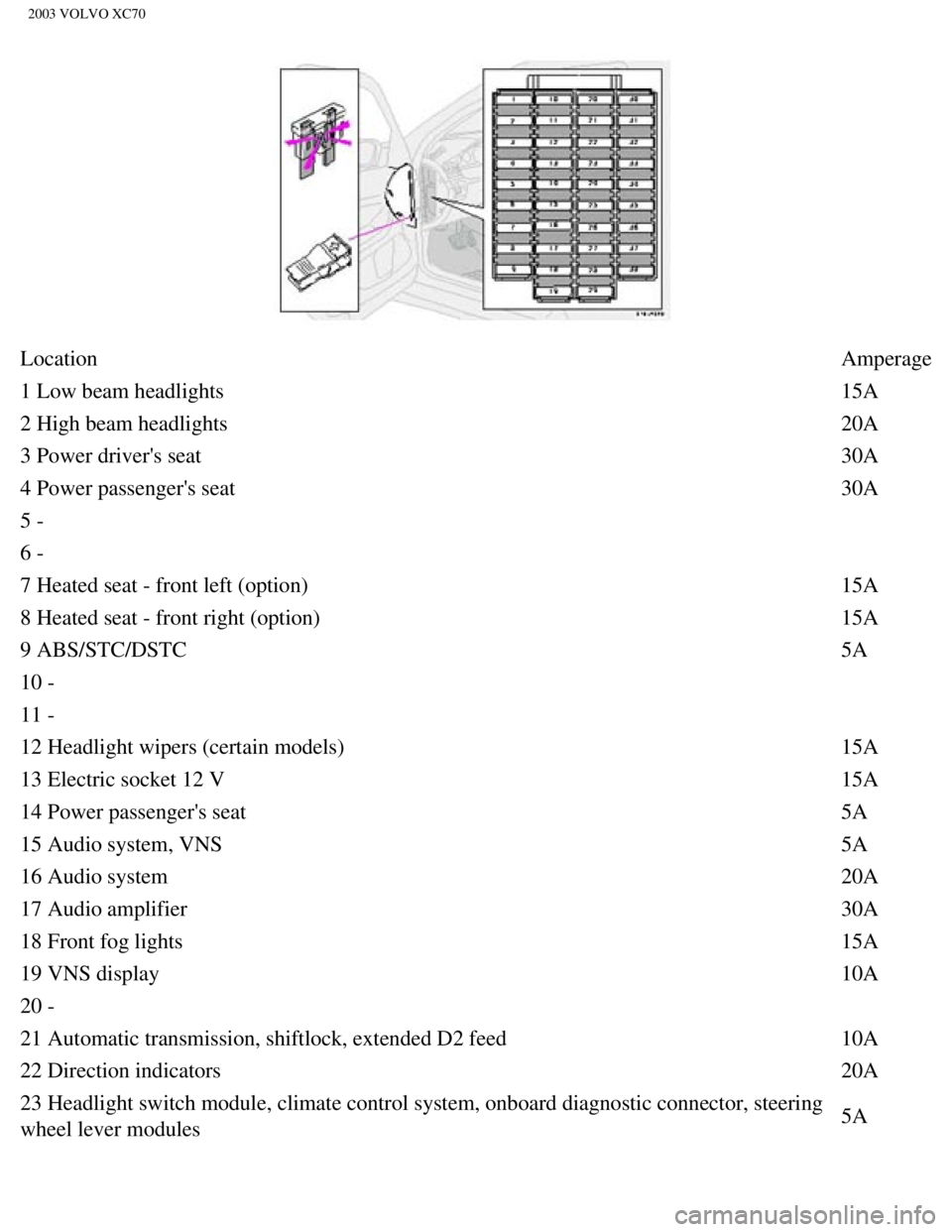
1 Low beam headlights 15A
2 High beam headlights 20A
3 Power driver's seat 30A
4 Power passenger's seat 30A
5 -
6 -
7 Heated seat - front left (option) 15A
8 Heated seat - front right (option) 15A
9 ABS/STC/DSTC 5A
10 -
11 -
12 Headlight wipers (certain models) 15A
13 Electric socket 12 V 15A
14 Power passenger's seat 5A
15 Audio system, VNS 5A
16 Audio system 20A
17 Audio amplifier 30A
18 Front fog lights 15A
19 VNS display 10A
20 -
21 Automatic transmission, shiftlock, extended D2 feed 10A
22 Direction indicators 20A
23 Headlight switch module, climate control system, onboard diagnostic c\
onnector, steering
wheel lever modules 5A
file:///K|/ownersdocs/2003/2003_XC70/03xc70_08a.htm (5 of 21)12/30/200\
6 4:18:03 PM
Page 197 of 257

2003 VOLVO XC70
Fluid type: ATF
Replace: No fluid change required
NOTE: If a problem should occur in the power steering system or if the car ha\
s no electrical current and
must be towed, it is still possible to steer the car. However, keep in m\
ind that greater effort will be
required to turn the steering wheel.
Brake fluid
The brake fluid should always be above the MIN mark on the side of the r\
eservoir. Check, without
removing the cap, that there is sufficient fluid in the reservoir.
Fluid type: DOT 4+ boiling point >536°F(280°C), P/N 9437433
Replace: Every second year or 30,000 miles (48,000 km). The fluid shou\
ld be replaced once a year or
every 15,000 miles (24,000 km) when driving under extremely hard condi\
tions (mountain driving, etc.)
Always entrust brake fluid changing to an authorized Volvo retailer.
pg. 138 Battery maintenance
Battery maintenance
The battery in your car is located under the floor of the cargo area.
Driving habits and conditions, climate, the number of starts, etc. all a\
ffect the service life and function of
the battery. In order for your battery to perform satisfactorily, keep t\
he following in mind:
file:///K|/ownersdocs/2003/2003_XC70/03xc70_08b.htm (11 of 16)12/30/20\
06 4:18:04 PM
Page 210 of 257

2003 VOLVO XC70
Coolant: Volvo original coolant/antifreeze
All specifications are subject to change without prior notice.
Power steering fluid
ATF fluid
Volume: 0.95 US qts (0.9 liters)
Brake fluid
DOT 4+ boiling point >536°F(280°C), P/N 9437433
Volume: 0.64 US qts (0.6 liters)
Climate control system - refrigerant (R 134a)
Oil: PAG
Volume: 2.2 lbs (1,000 g) R134a
Fuel
Minimum octane requirement - AKI 87 (RON 91)
Volume (fuel tank): 18.5 US gals (70 liters) or 19 US gals (72 liters) on models equippe\
d with All
Wheel Drive.
Washer fluid reservoir
Volume: 4.7 US qts (4.5 liters)
All specifications are subject to change without prior notice.
pg. 147 Fuel system, Distributor ignition system, Suspension
Fuel system
The engine is equipped with a multiport fuel injection system.
file:///K|/ownersdocs/2003/2003_XC70/03xc70_09.htm (8 of 11)12/30/2006\
4:18:05 PM
Page 211 of 257

2003 VOLVO XC70
Distributor ignition system
Firing order: 1-2-4-5-3
Electronic ignition setting: Not adjustable
Spark plugs: Champion RC8PYP 8 (or equivalent)
Spark plug gap: 0.028-0.032" (0.7-0.8 mm)
Tightening torque: 18.4 ft. lbs. (25 Nm) WARNING!
The ignition system operates at very high voltages. Special safety preca\
utions must be followed to
prevent injury. Always turn the ignition off when:
l Replacing ignition components e.g. plugs, coil, etc.
l Do not touch any part of the ignition system while the engine is running\
. This may result in a shock
and bodily injury.
Front suspension
Spring strut suspension with integrated shock absorbers and control arms\
linked to the support frame.
Power-assisted rack and pinion steering. Safety type steering column. Th\
e alignment specifications
apply to an unladen car but include fuel, coolant and spare wheel.
Rear suspension
Individual rear wheel suspension with longitudinal support arms, double \
link arms and track rods.
All specifications are subject to change without prior notice.
pg. 148 Electrical system
Electrical system
12 Volt, negative ground.
Voltage-controlled generator. Single-wire system with chassis and engine\
used as conductors. Grounded
on chassis.
Battery
file:///K|/ownersdocs/2003/2003_XC70/03xc70_09.htm (9 of 11)12/30/2006\
4:18:05 PM
Page 217 of 257
2003 VOLVO XC70
17. Traffic information
18. Automatic presetting of radio stations
19. Display
pg. 154 Audio systems HU-613/HU-803
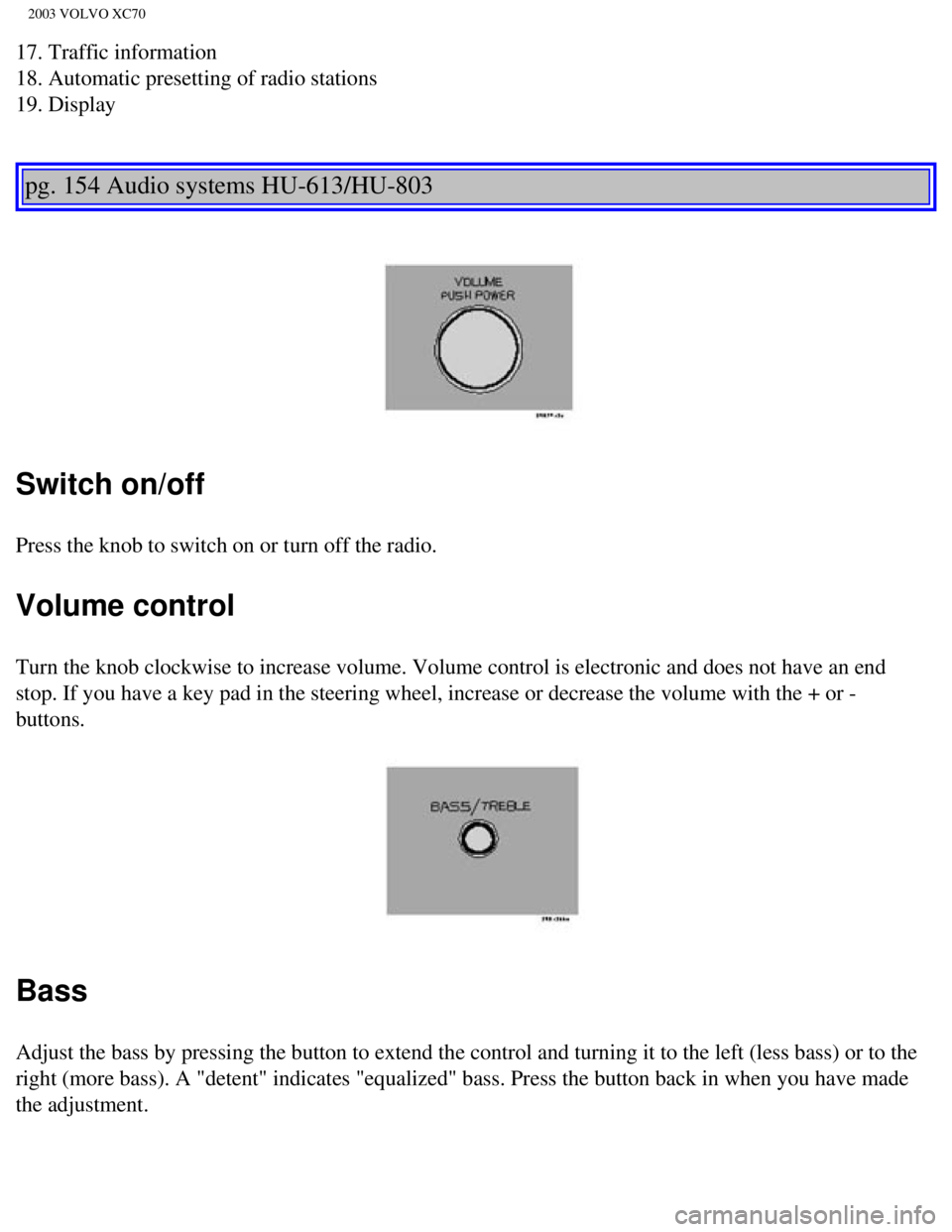
Switch on/off
Press the knob to switch on or turn off the radio.
Volume control
Turn the knob clockwise to increase volume. Volume control is electronic\
and does not have an end
stop. If you have a key pad in the steering wheel, increase or decrease \
the volume with the + or -
buttons.
Bass
Adjust the bass by pressing the button to extend the control and turning\
it to the left (less bass) or to the
right (more bass). A "detent" indicates "equalized" bass. Press the bu\
tton back in when you have made
the adjustment.
file:///K|/ownersdocs/2003/2003_XC70/03xc70_10a.htm (4 of 10)12/30/200\
6 4:18:06 PM
Page 219 of 257

2003 VOLVO XC70
indicates "equalized" balance. Press the button back in when you have ma\
de the adjustment.
Balance right/left
Adjust left/right speaker balance by pressing the button to extend the c\
ontrol, pulling it out as far as
possible and then turning it to the left (more sound from the left spea\
kers) or to the right (more sound
from the right speakers). A "detent" indicates "equalized" balance. Pre\
ss the button back in when you
have made the adjustment.
A - Setting station
Press the left side of the button to select lower frequencies and the ri\
ght side for higher frequencies. Set
frequencies are displayed.
B - Station seek up/down
Press the left side (lower frequency) or right side (higher frequency\
) of the button to start the seek
function. The radio seeks the next audible station and tunes it in. Repe\
at the procedure to continue the
seek function.
Audio system controls on the steering wheel
Station seek up/down
file:///K|/ownersdocs/2003/2003_XC70/03xc70_10a.htm (6 of 10)12/30/200\
6 4:18:06 PM