steering wheel VOLVO XC70 2003 Owners Manual
[x] Cancel search | Manufacturer: VOLVO, Model Year: 2003, Model line: XC70, Model: VOLVO XC70 2003Pages: 257, PDF Size: 5.33 MB
Page 11 of 257

2003 VOLVO XC70
WARNING!
l As its name implies, SRS is designed to be a SUPPLEMENT to - not a repla\
cement for - the three-
point belt system. For maximum protection, wear seat belts at all times.\
Be aware that no system can
prevent all possible injuries that may occur in an accident.
l When installing any accessory equipment, make sure that the SRS system i\
s not damaged. Do not
attempt to service any component of the SRS yourself. Attempting to do s\
o may result in serious
personal injury. If a problem arises, take your car to the nearest autho\
rized Volvo retailer for
inspection as soon as possible.
pg. 4 Front airbags - SRS
Driver's side airbag - in
steering wheel hub
Passenger's side airbag - above
glove compartment
As an enhancement to the three-point seat belt system, your Volvo is equ\
ipped with a Supplemental
Restraint System (SRS). The Volvo SRS consists of an airbag (2) on b\
oth the driver's and passenger's
sides and seat belt tensioners in both front door pillars (4). The sys\
tem is designed to supplement the
protection provided by the three-point seat belt system. All three rear \
seat belts are also equipped with
tensioners.
The SRS system is indicated by the "SRS" embossed on the steering wheel \
pad and above the glove
compartment, and by decals on both sun visors and on the front and far r\
ight side of the dash.
The airbags are folded and located in the steering wheel hub and above t\
he glove compartment. They are
designed to deploy during certain frontal or front-angular collisions, i\
mpacts, or decelerations,
depending on the crash severity, angle, speed and object impacted. The a\
irbags may also deploy in
certain non-frontal collisions where rapid deceleration occurs.
The airbag system includes gas generators (1) surrounded by the airbag\
s (2) and front seat belt
tensioners for both of the front seats (4). To deploy the system, the \
sensor (3) activates the gas
generators causing the airbags to be inflated with nitrogen gas. As the \
movement of the seats' occupants
compresses the airbags, some of the gas is expelled at a controlled rate\
to provide better cushioning.
file:///K|/ownersdocs/2003/2003_XC70/03xc70_01a.htm (5 of 17)12/30/200\
6 4:17:51 PM
Page 13 of 257
 airbags. If a fault i\
s detected, the warning light will
illuminate. The light is included in the warning/indicator light cluster\")
2003 VOLVO XC70
monitor the Side Impact Protection System (SIPS) airbags. If a fault i\
s detected, the warning light will
illuminate. The light is included in the warning/indicator light cluster\
in the instrument panel. Normally,
the SRS warning lamp should light up when the ignition key is turned to \
positions I, II or III and should
go out after 7 seconds or when the engine is started. Check that this li\
ght is functioning properly every
time the car is started.
The following items are monitored by the self-diagnostic system:
l Sensor unit
l Cable harness
l Gas generator igniters
WARNING!
l Never drive an SRS equipped car with your hands on the steering wheel pa\
d / airbag housing.
l No objects, accessory equipment or stickers may be placed on, attached t\
o or installed near the
SRS cover in the center of the steering wheel, the SRS cover above the g\
love compartment or the area
affected by airbag deployment.
l If the SRS warning light stays on after the engine has started or if it \
comes on while you are
driving, drive the car to the nearest authorized Volvo retailer for insp\
ection as soon as possible.
There is no maintenance to perform on the SRS yourself. The month and ye\
ar shown on the decal on the
door pillar indicate when you should contact your Volvo retailer for spe\
cific servicing or replacement of
airbags and seat belt tensioners. This service must be performed by an a\
uthorized Volvo retailer.
Should you have any questions about the SRS system, please contact your \
authorized Volvo retailer or
Volvo Customer Support:
file:///K|/ownersdocs/2003/2003_XC70/03xc70_01a.htm (7 of 17)12/30/200\
6 4:17:51 PM
Page 16 of 257
 shorter than 4 feet 7 inches (140 cm)\
be sea")
2003 VOLVO XC70
WARNING!
l Children must never be allowed in the front passenger seat. Volvo recomm\
ends that ALL
occupants (adults and children) shorter than 4 feet 7 inches (140 cm)\
be seated in the back seat of any
vehicle with a passenger-side front airbag. See
page 14 for guidelines.
l Occupants in the front passenger's seat must never sit on the edge of th\
e seat, sit leaning toward the
instrument panel or otherwise sit out of position. The occupant's back m\
ust be as upright as comfort
allows and be against the seat back with the seat belt properly fastened\
.
l Feet must be on the floor, e.g. not on the dash, seat or out of the wind\
ow.
l No objects or accessory equipment, e.g. dash covers, may be placed on, a\
ttached to or installed
near the SRS hatch (the area above the glove compartment) or the area \
affected by airbag deployment
(see illustration on
page 4 ).
l There should be no loose articles, e.g. coffee cups, on the floor, seat \
or dash area.
l Never try to open the SRS cover on the steering wheel or the passenger s\
ide dash. This should only
be done by an authorized Volvo service technician.
l Failure to follow these instructions can result in injury to the vehicle\
occupants.
pg. 7 Front airbags - SRS
NOTE: The information on this page does not pertain to the Side Impact Protect\
ion System airbags.
When are the airbags deployed?
The SRS system is designed to deploy during certain frontal or front-ang\
ular collisions, impacts, or
decelerations, depending on the crash severity, angle, speed and object \
impacted. The SRS sensor is
designed to react to both the impact of the collision and the inertial f\
orces generated by it and to
determine if the intensity of the collision is sufficient for the airbag\
s to be deployed.
WARNING!
The SRS is designed to help prevent serious injury. Deployment occurs ve\
ry quickly and with
considerable force. During normal deployment and depending on variables \
such as seating position,
one may experience abrasions, bruises, swellings, or other injuries as a\
result of airbag(s) deployment.
If the airbags have been deployed, we recommend the following:
file:///K|/ownersdocs/2003/2003_XC70/03xc70_01a.htm (10 of 17)12/30/20\
06 4:17:51 PM
Page 38 of 257
2003 VOLVO XC70
2 0 0 3
VOLVO XC70
Chapter 2 - Instruments, switches and controls
pg. 23 Instruments, switches and controls
Interior 24
Exterior 25
Instruments 26
Instrument panel 27
Indicator and warning lights 28
Text information window 30
Switches in the center console 31
Trip computer 32
Cruise control 33
Light switch panel 34
Steering wheel adjustment, Ignition switch/Steering wheel lock 35
Turn signals 36
Windshield wipers/washers 37
Warning flashers, heated mirrors/rear window, heated front
seats 38
Parking brake, auxiliary socket/ashtrays 39
Electrically operated windows 40
Rearview/sideview mirrors 41
file:///K|/ownersdocs/2003/2003_XC70/03xc70_02a.htm (1 of 13)12/30/200\
6 4:17:53 PM
Page 53 of 257
2003 VOLVO XC70
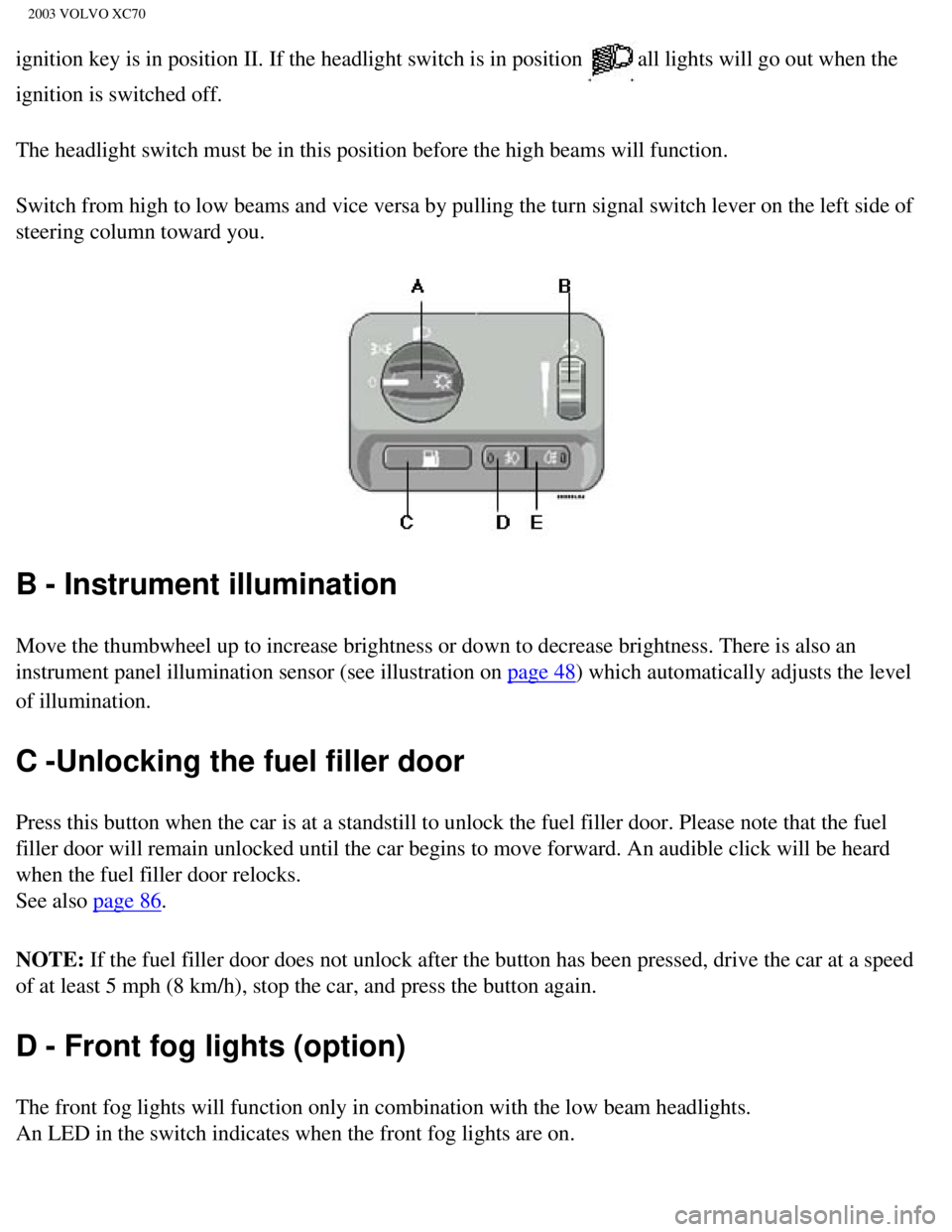
ignition key is in position II. If the headlight switch is in position all lights will go out when the
ignition is switched off.
The headlight switch must be in this position before the high beams will\
function.
Switch from high to low beams and vice versa by pulling the turn signal \
switch lever on the left side of
steering column toward you.
B - Instrument illumination
Move the thumbwheel up to increase brightness or down to decrease bright\
ness. There is also an
instrument panel illumination sensor (see illustration on
page 48) which automatically adjusts the level
of illumination.
C -Unlocking the fuel filler door
Press this button when the car is at a standstill to unlock the fuel fil\
ler door. Please note that the fuel
filler door will remain unlocked until the car begins to move forward. A\
n audible click will be heard
when the fuel filler door relocks.
See also
page 86.
NOTE: If the fuel filler door does not unlock after the button has been press\
ed, drive the car at a speed
of at least 5 mph (8 km/h), stop the car, and press the button again. \
D - Front fog lights (option)
The front fog lights will function only in combination with the low beam\
headlights.
An LED in the switch indicates when the front fog lights are on.
file:///K|/ownersdocs/2003/2003_XC70/03xc70_02b.htm (3 of 18)12/30/200\
6 4:17:54 PM
Page 54 of 257

2003 VOLVO XC70
E - Rear fog light
The rear fog light is considerably brighter than the normal tail lights \
and should be used only when
conditions such as fog, rain, snow, smoke or dust reduce visibility for \
other vehicles to less than 500 ft
(150 meters).
An LED in the switch indicates when the rear fog light is on.
The rear fog light will only function in combination with the high/low b\
eam head-lights.
By design, there is one rear fog light only, located in the driver's sid\
e tail light cluster.
Rear fog light in the instrument panel
This light indicates that the rear fog light is on.
pg. 35 Steering wheel adjustment, Ignition switch/steering wheel lock
Steering wheel adjustment
Both the height and the reach of the steering wheel can be adjusted to a\
comfortable position for the
driver. Pull down the lever on the left of the steering column. Adjust t\
he steering wheel to a suitable
position and press the lever back into place to lock the steering wheel \
in the new position. Check that the
steering wheel is locked in the new position.
WARNING!
Never adjust the steering wheel while
driving.
file:///K|/ownersdocs/2003/2003_XC70/03xc70_02b.htm (4 of 18)12/30/200\
6 4:17:54 PM
Page 55 of 257
ark position.
** Please be aware that leaving the key")
2003 VOLVO XC70
A chime will sound if the key is left in the ignition and the driver's d\
oor is opened.
* The gear selector must be in the (P)ark position.
** Please be aware that leaving the key in this position will increase b\
attery drain.
Steering wheel lock
The steering wheel lock might be under tension when the car is parked. T\
urn the steering wheel slightly
to free the ignition key.
In order to help reduce car theft, make sure the steering wheel lock is \
engaged before leaving the
car. WARNING!
Never switch off the ignition (turn the ignition key to position 0) or\
remove the key from the ignition
switch while the car is in motion. This could cause the steering wheel t\
o lock, which would make the
car impossible to steer.
pg. 36 Turn signals
file:///K|/ownersdocs/2003/2003_XC70/03xc70_02b.htm (5 of 18)12/30/200\
6 4:17:54 PM
Page 56 of 257

2003 VOLVO XC70
Turn signals
1 Lane change position. In maneuvers such as lane changing, the driver can flash the turn signal\
s by
moving the turn signal lever to the first stop and holding it there. The\
lever will return to the neutral
position when released.
2 Signal lever engaged for normal turns.
3 High beam/low beam switch (headlights on).
Move the lever towards the steering wheel and release it.
Headlight flasher (headlights off).
Move the lever towards the steering wheel. The headlight high beam will \
be on until the lever is
released.
NOTE: If the turn signal indicator flashes faster than normal, check for a bur\
ned-out turn signal bulb.
pg. 37Windshield/tailgate wipers/washers
file:///K|/ownersdocs/2003/2003_XC70/03xc70_02b.htm (6 of 18)12/30/200\
6 4:17:54 PM
Page 114 of 257

2003 VOLVO XC70
Two keys are provided with your car; a master key and a service key. The\
master key, the remote
control, and the central locking button may all be used to lock and unlo\
ck all of your car's locks.
The service key will operate only the driver's door and the ignition swi\
tch. It is intended to help deter
unwanted entry into the glove compartment and trunk.
Turn the key once to unlock the driver's door and the fuel filler door.
Turn the key again (within 10 seconds) to unlock all doors and the tailgate. One turn with the key
towards lock in the drivers door locks all doors and tailgate.
Use the switch on the front door armrests to lock/unlock the car from th\
e inside. WARNING!
If the doors are locked while driving, this may hinder rapid access to t\
he occupants of the car in the
event of an accident. (Also see information on "Child safety locks"). \
NOTE: To help prevent accidentally locking the keys in the car, the central lo\
cking system is designed
to unlock the doors immediately if the key is left in the ignition switc\
h, the car is locked using the lock
button on the door and the door is then closed. A sound from the lock will be audible at this time.
Please note that this function will not unlock the doors if the engine i\
s running.
Immobilizer (start inhibitor)
Each of the keys supplied with your car contains a coded transmitter. Th\
e code in the key is transmitted
to an antenna in the ignition switch where it is compared to the code st\
ored in the start inhibitor module.
The car will start only with a properly coded key. If you misplace a key\
, take the other keys to an
authorized Volvo retailer for reprogramming as an antitheft measure.
*This key operates only driver's door and ignition switch/steering wheel\
lock.
This device complies with part 15 of the FCC rules. Operation is subject\
to the following condition: (1)
This device may not cause harmful interference, and (2) this device mu\
st accept any interference
received, including interference that may cause undesired operation.
file:///K|/ownersdocs/2003/2003_XC70/03xc70_05.htm (2 of 11)12/30/2006\
4:17:58 PM
Page 115 of 257

2003 VOLVO XC70
Exterior courtesy lights
Home Safe System
When you leave your car at night, you can make use of the courtesy light\
ing function:
l Remove the key from the ignition switch.
l Pull the direction indicator lever towards the steering wheel (as when \
activating the high beams).
l Exit the car and lock the doors.
The headlights, parking lights, license plate lights and the lights in t\
he sideview mirrors will now come
on and remain on for 30, 60 or 90 seconds (the time interval is at your\
discretion and can be changed by
an authorized Volvo retailer).
Approach lighting
When approaching the car at night, press the yellow button in the centra\
l locking remote control (see
illustration on
page 77). This lights up the interior courtesy light, parking lights, license \
plate lights and
the lights in the sideview mirrors.
pg. 77 Remote keyless entry system
Remote keyless entry system
Your car is equipped with a remote control transmitter. This transmitter\
uses a radio frequency which
will allow "keyless" entry into the passenger compartment or the tailgat\
e. Your car is supplied with two
coded key ring transmitters, which will enable you to lock/ unlock all d\
oors and the tailgate from a
distance of 10-15 feet (3-5 meters). The remote transmitter will also \
activate or deactivate the your car's
file:///K|/ownersdocs/2003/2003_XC70/03xc70_05.htm (3 of 11)12/30/2006\
4:17:58 PM