brake VOLVO XC70 2003 Owner's Manual
[x] Cancel search | Manufacturer: VOLVO, Model Year: 2003, Model line: XC70, Model: VOLVO XC70 2003Pages: 257, PDF Size: 5.33 MB
Page 129 of 257
, depress the \
accelerator pedal halfway and turn
the key to the starting position. Release the pedal slowly when the engi\
n")
2003 VOLVO XC70
For cold starts at altitudes above 6000 ft (1800 meters), depress the \
accelerator pedal halfway and turn
the key to the starting position. Release the pedal slowly when the engi\
ne starts.
NOTE:
On certain models, when the car is started, idle speed may be noticeably\
higher than normal for a short
period, depending on the temperature of the engine.
This has been done to help bring components in the emission control syst\
em to their normal operating
temperature as quickly as possible, which enables them to function norma\
lly.
4. To release the gear selector from the (P)ark position, the engine m\
ust be running (or the ignition key
must be in position II) and the brake pedal must be depressed.
5. Select the desired gear. The gear engages after a very slight delay w\
hich is especially noticeable when
selecting R.
NOTE:
l Your car is equipped with a KEYLOCK system. When the engine is switched off, the gear selector
must be in the (P)ark position before the key can be removed from the \
ignition switch.
l When starting in cold weather, the transmission may shift up at slightly\
higher engine speeds than
normal until the automatic transmission fluid reaches normal operating t\
emperature.
* Your car is equipped with an electronic start inhibitor (immobilizer)\
. The keys you received with your
car are specially coded. The code in the key is transmitted to an antenn\
a in the ignition switch where it is
compared to the code stored in the start inhibitor module. The car can o\
nly be started if a properly coded
key is used.
If two of the keys to your car are close together, e.g., on the same key\
ring, when you try to start the car,
this could cause interference in the immobilizer system and result in th\
e car not starting. If this should
occur, remove one of the keys from the key ring before trying to start t\
he car again.
pg. 88 Starting the engine
CAUTION:
l The engine should be idling when you move the gear selector. Never accel\
erate until after you feel the
transmission engage! Accelerating immediately after selecting a gear wil\
l cause harsh engagement and
premature transmission wear.
l Selecting P or N when idling at a standstill for prolonged periods time \
will help prevent overheating
of the automatic transmission fluid.
l Do not race a cold engine immediately after starting. Oil flow may not r\
each some lubrication points
fast enough to prevent engine damage.
file:///K|/ownersdocs/2003/2003_XC70/03xc70_06a.htm (6 of 22)12/30/200\
6 4:17:59 PM
Page 130 of 257

2003 VOLVO XC70
WARNING!
l Always place the gear selector in Park and apply the parking brake befor\
e leaving the vehicle.
Never leave the car unattended with the engine running.
l Always open garage doors fully before starting the engine inside a garag\
e to ensure adequate
ventilation. The exhaust gases contain carbon monoxide, which is invisib\
le and odorless but very
poisonous.
l An extra mat on the driver's floor can cause the accelerator pedal and t\
he clutch to catch. Check
that the movement of the accelerator pedal and clutch is not impeded. No\
t more than one protective
floor covering may be used at one time.
pg. 89 Manual transmission
Shift positions
Depress the clutch pedal completely when changing gears*.
Remove your foot from the clutch pedal while driving. The shift pattern \
should be followed. Overdrive
(5th gear) should be used as often as possible to help improve fuel ec\
onomy. This gear should be
engaged at speeds above approx. 50 mph (80 km/h).
file:///K|/ownersdocs/2003/2003_XC70/03xc70_06a.htm (7 of 22)12/30/200\
6 4:17:59 PM
Page 132 of 257
2003 VOLVO XC70
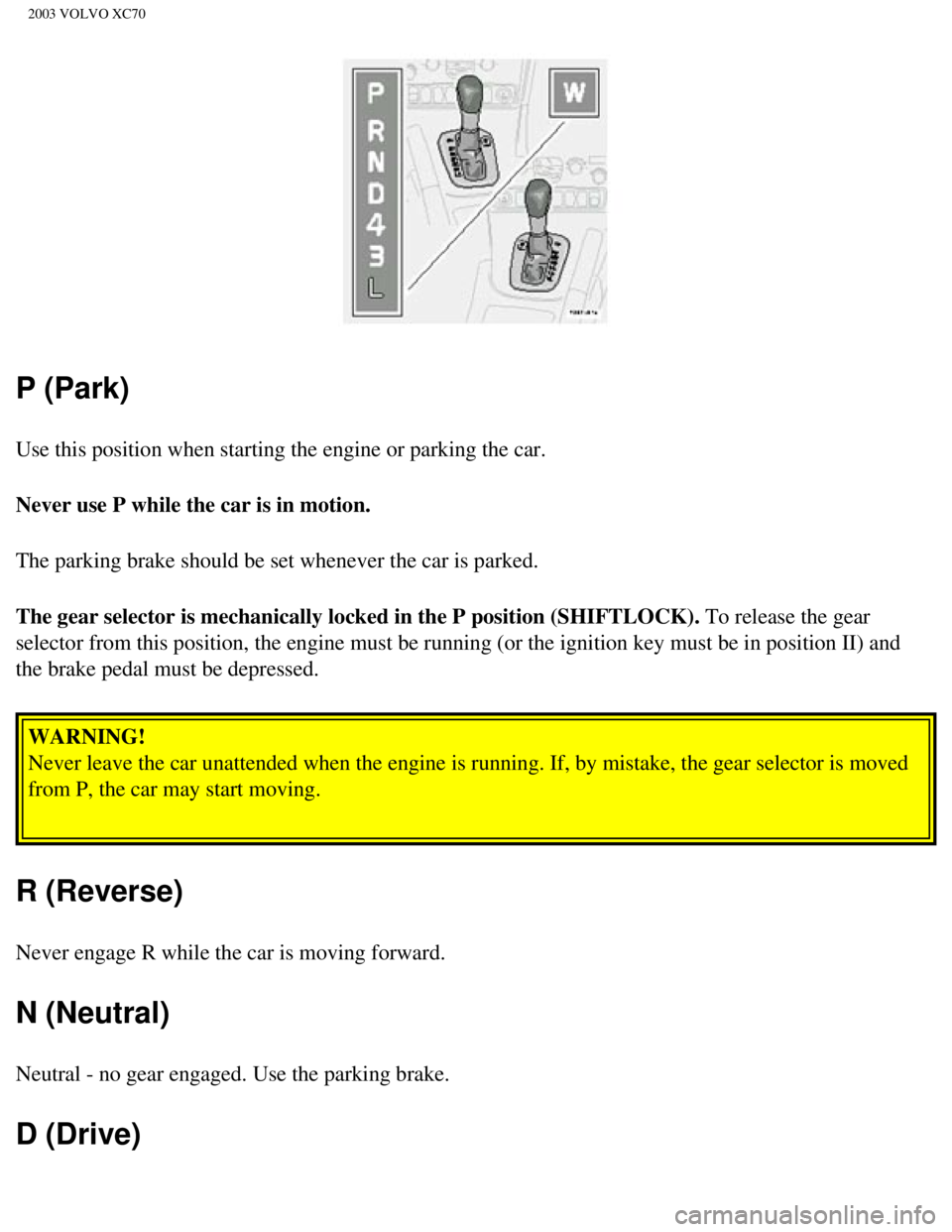
P (Park)
Use this position when starting the engine or parking the car.
Never use P while the car is in motion.
The parking brake should be set whenever the car is parked.
The gear selector is mechanically locked in the P position (SHIFTLOCK)\
. To release the gear
selector from this position, the engine must be running (or the ignitio\
n key must be in position II) and
the brake pedal must be depressed. WARNING!
Never leave the car unattended when the engine is running. If, by mistak\
e, the gear selector is moved
from P, the car may start moving.
R (Reverse)
Never engage R while the car is moving forward.
N (Neutral)
Neutral - no gear engaged. Use the parking brake.
D (Drive)
file:///K|/ownersdocs/2003/2003_XC70/03xc70_06a.htm (9 of 22)12/30/200\
6 4:17:59 PM
Page 135 of 257
 is achieved by depressing t\
he accelerator pedal fully and
briskly. An upshift will occur when approaching the top speed for a pa")
2003 VOLVO XC70
Kickdown
Automatic shift to a lower gear (kickdown) is achieved by depressing t\
he accelerator pedal fully and
briskly. An upshift will occur when approaching the top speed for a part\
icular gear or by releasing the
accelerator pedal slightly. Kickdown can be used for maximum acceleratio\
n or when passing at highway
speeds.
Cold starts
When driving before the engine has reached its normal operating temperat\
ure, the transmission will shift
up at slightly higher engine speeds to heat the three-way catalytic conv\
erter as quickly as possible.
pg. 92 Automatic transmission (Geartronic)
P (Park)
Use this position when starting the engine or parking the car.
Never use P while the car is in motion. The parking brake should be set whenever the car is parked.
The gear selector is mechanically locked in the P position (SHIFTLOCK)\
. To release the gear
selector from this position, the engine must be running (or the ignitio\
n key must be in position II) and
the brake pedal must be depressed.
file:///K|/ownersdocs/2003/2003_XC70/03xc70_06a.htm (12 of 22)12/30/20\
06 4:18:00 PM
Page 136 of 257

Never engage R while")
2003 VOLVO XC70
WARNING!
Never leave the car unattended when the engine is running. If, by mistak\
e, the gear selector is moved
from P, the car may start moving.
R (Reverse)
Never engage R while the car is moving forward.
N (Neutral)
Neutral - no gear engaged. Use the parking brake.
D (Drive)
D is the normal driving position and should be used as often as possible\
to help improve fuel economy.
The car should not be moving when shifting from R to the D position.
Kickdown
Automatic shift to a lower gear (kickdown) is achieved by depressing t\
he accelerator pedal fully and
briskly. An upshift will occur when approaching the top speed for a part\
icular gear or by releasing the
accelerator pedal slightly. Kickdown can be used for maximum acceleratio\
n or when passing at highway
speeds. Kickdown does not function when the transmission is in the manual shift\
(geartronic)
mode (see next page).
Automatic transmission - adaptive system
The automatic transmission is controlled by an adaptive control system t\
hat constantly monitors the way
in which the transmission functions. It senses and adapts each gear shif\
t for optimal performance. The
system also monitors your particular driving style and adapts gear shift\
ing accordingly.
file:///K|/ownersdocs/2003/2003_XC70/03xc70_06a.htm (13 of 22)12/30/20\
06 4:18:00 PM
Page 140 of 257

2003 VOLVO XC70
lower with the air conditioning on and the windows closed than with the \
air conditioning off and the
windows open.
l Using the onboard trip computer's fuel consumption modes can help you le\
arn how to drive more
economically.
Other factors that decrease gas mileage are:
l Dirty air cleaner
l Dirty engine oil and clogged oil filter
l Dragging brakes
l Incorrect front end alignment Some of the above mentioned items and othe\
rs are checked at the
standard Maintenance Service intervals.
NOTE: Vehicles equipped with automatic transmissions should use (D)rive as o\
ften as possible and
avoid using "kick-down" to help improve fuel economy. Vehicles equipped \
with manual transmissions
should use fifth gear at highway speeds. At other times, choose the high\
est gear that still allows smooth
acceleration.
Weight distribution affects handling
At the specified curb weight your car has a tendency to understeer, whic\
h means that the steering wheel
has to be turned more than might seem appropriate for the curvature of a\
bend. This ensures good
stability and reduces the risk of rear wheel skid. Remember that these p\
roperties can alter with the
vehicle load. The heavier the load on the rear of the vehicle (e.g., he\
avily loaded (max. 220 lbs, 100 kg)
cargo area or when towing a trailer, the less the tendency to understeer\
.
Handling, roadholding
Vehicle load, tire design and inflation pressure all affect vehicle hand\
ling. Therefore, check that the tires
are inflated to the recommended pressure according to the vehicle load. \
See "Tire pressure" section.
Loads should be distributed so that capacity weight or maximum permissib\
le axle loads are not
exceeded.
pg. 96 Points to remember
Cooling system
The risk for engine overheating is greatest, especially in hot weather, \
when:
l Towing a trailer up steep inclines for prolonged periods at wide open th\
rottle and low engine rpm.
l Stopping the engine suddenly after high speed driving (so-called "after\
-boiling" can occur).
l To avoid overheating, the following rules should be followed: Do not dri\
ve for prolonged periods at
file:///K|/ownersdocs/2003/2003_XC70/03xc70_06a.htm (17 of 22)12/30/20\
06 4:18:00 PM
Page 147 of 257

2003 VOLVO XC70
Rear towing eyelet
Precautions when the car is in tow
l The steering wheel must be unlocked. Turn the ignition key to position I\
or II.
l The gear selector must be in position N.
l Maximum speed: 50 mph (80 km/h)
l Maximum distance with front wheels on ground: 50 miles (80 km).
l While the car is being towed, try to keep the tow rope taut at all times\
.
l Cars with an automatic transmission should only be towed in forward dire\
ction.
CAUTION:
l Please check with state and local authorities before attempting this typ\
e of towing, as vehicles being
towed are subject to regulations regarding maximum towing speed, length \
and type of towing device,
lighting, etc.
l If the car's battery is dead, do not attempt to start the vehicle by pus\
hing or pulling it as this will
damage the three-way catalytic converter(s). The engine must be jump s\
tarted using an auxiliary battery
(see
page 103).
l If the car is being towed on a flat bed truck, the towing eyelets must n\
ot be used to secure the car on
the flat bed. Consult the tow truck operator.
WARNING!
l Remember that the power brakes and power steering will not function when\
engine is not running.
The braking and steering systems will function but the brake pedal press\
ure required is 3 - 4 times
above normal and greater steering effort must be exerted.
l The towing eyelets must not be used for pulling another vehicle out of a\
ditch or for any similar
purpose involving severe strain.
l Do not use the towing eyelets to pull the car up onto a flat bed tow tru\
ck.
pg. 100 Vehicle towing information
file:///K|/ownersdocs/2003/2003_XC70/03xc70_06b.htm (2 of 10)12/30/200\
6 4:18:00 PM
Page 149 of 257

2003 VOLVO XC70
pg. 101 Towing a trailer
When preparing for trailer towing, observe the following:
Volvo recommends the use of Volvo trailer hitches which are specially de\
signed for the car.
l Maximum trailer weight recommended by Volvo is:
Trailers without brakes: 1100 lbs (500 kg)
Trailers with brakes: 3300 lbs* (1,500 kg),
Observe the legal requirements of the state/province in which the vehicl\
es are registered.
l All Volvo models are equipped with energy-absorbing shock-mounted bumper\
s. Trailer hitch
installation should not interfere with the proper operation of this bump\
er system.
Trailer towing does not normally present any particular problems, but ta\
ke into consideration:
l Increase tire pressure to recommended full. See section "Wheels and tire\
s".
l When your car is new, avoid towing heavy trailers during the first 620 m\
iles (1000 km).
l Recommended hitch tongue load is:
Trailer weights below 2,650 lbs (1,200 kg) - 110 lbs (50 kg)
Trailer weights above 2,650 lbs (1,200 kg) - 165 lbs (75 kg)
l Maximum speed when towing a trailer: 50 mph (80 km/h).
l Engine and transmission are subject to increased loads. Therefore, engin\
e coolant temperature should
be closely watched when driving in hot climates or hilly terrain. Use a \
lower gear and turn off the air
conditioner if the temperature gauge needle enters the red range.
l If the automatic transmission begins to overheat, a message will be disp\
layed in the text window.
l Avoid overload and other abusive operation.
l Hauling a trailer affects handling, durability, and economy.
l It is necessary to balance trailer brakes with the towing vehicle brakes\
to provide a safe stop (check
and observe state/local regulations).
l Do not connect the trailer's brake system directly to the vehicle's brak\
e system.
l More frequent vehicle maintenance is required.
l Remove the ball and drawbar assembly when the hitch is not being used.
l Volvo recommends the use of synthetic engine oil when towing a trailer o\
ver long distances or in
mountainous areas.
file:///K|/ownersdocs/2003/2003_XC70/03xc70_06b.htm (4 of 10)12/30/200\
6 4:18:00 PM
Page 150 of 257

2003 VOLVO XC70
WARNING!
l Bumper-attached trailer hitches must not be used on Volvo's, nor should \
safety chains be attached
to the bumper.
l Trailer hitches attaching to the vehicle rear axle must not be used.
l Never connect a trailer's hydraulic brake system directly to the vehicle\
brake system, nor a trailer's
lighting system directly to the vehicle lighting system. Consult your ne\
arest authorized Volvo retailer
for correct installation.
l When towing a trailer, the trailer's safety wire must be correctly faste\
ned to the hole or hook
provided in the trailer hitch on the car. The safety wire should never b\
e fastened to or wound around
the drawbar ball.
NOTE:
l When parking the car with a trailer on a hill, apply the parking brake before putting the gear selector
in (P)ark. When starting on a hill, put the gear selector in (D)rive\
before releasing the parking brake.
l If you use the manual (Geartronic) shift positions while towing a trai\
ler, make sure the gear you select
does not put too much strain on the engine (using too high a gear).
l The drawbar assembly/trailer hitch may be certified for trailers that ar\
e heavier than the car is
designed to tow. Please adhere to Volvo's recommended trailer weights.
* When driving for prolonged periods at temperatures above 86° F (30\
° C), the maximum recommended
weight is 2000 lbs (900 kg).
pg. 102 Detachable trailer hitch (accessory) - installing/removing
A - ball holder, B - locking bolt, C - cotter pin, D - hitch assembly
Installing the ball holder
file:///K|/ownersdocs/2003/2003_XC70/03xc70_06b.htm (5 of 10)12/30/200\
6 4:18:00 PM
Page 154 of 257

2003 VOLVO XC70
pg. 105 Long distance trips
Before a long distance trip
It is always worthwhile to have your car checked at a Volvo retailer bef\
ore driving long distances. Your
retailer will also be able to supply you with bulbs, fuses, spark plugs \
and wiper blades for your use in the
event that problems occur.
As a minimum, the following items should be checked before any long trip\
:
l Check that engine runs smoothly and that fuel consumption is normal.
l Check for fuel, oil, and fluid leakage.
l Check condition of accessory drive belts.
l Check transmission oil level*.
l Check state of the battery's charge.
l Examine tires carefully (the spare tire as well), and replace those th\
at are worn. Check tire pressures.
l The brakes, front wheel alignment, and steering gear should be checked b\
y your Volvo retailer only.
l Check all lights, including high beams.
l Reflective warning triangles are legal requirement in some countries.
l Have a word with your Volvo retailer if you intend to drive in countries\
where it may be difficult to
obtain the correct fuel.
l Consider your destination. If you will be driving through an area where \
snow or ice are likely to
occur, consider snow tires.
* To prevent injury from contact with hot surfaces, do not inspect your \
car's transmission fluid yourself.
Have your car's transmission fluid level inspected by a qualified Volvo \
service technician.
pg. 106 Three-way catalytic converters
file:///K|/ownersdocs/2003/2003_XC70/03xc70_06b.htm (9 of 10)12/30/200\
6 4:18:00 PM