wheel VOLVO XC70 2003 Owner's Manual
[x] Cancel search | Manufacturer: VOLVO, Model Year: 2003, Model line: XC70, Model: VOLVO XC70 2003Pages: 257, PDF Size: 5.33 MB
Page 124 of 257
2003 VOLVO XC70
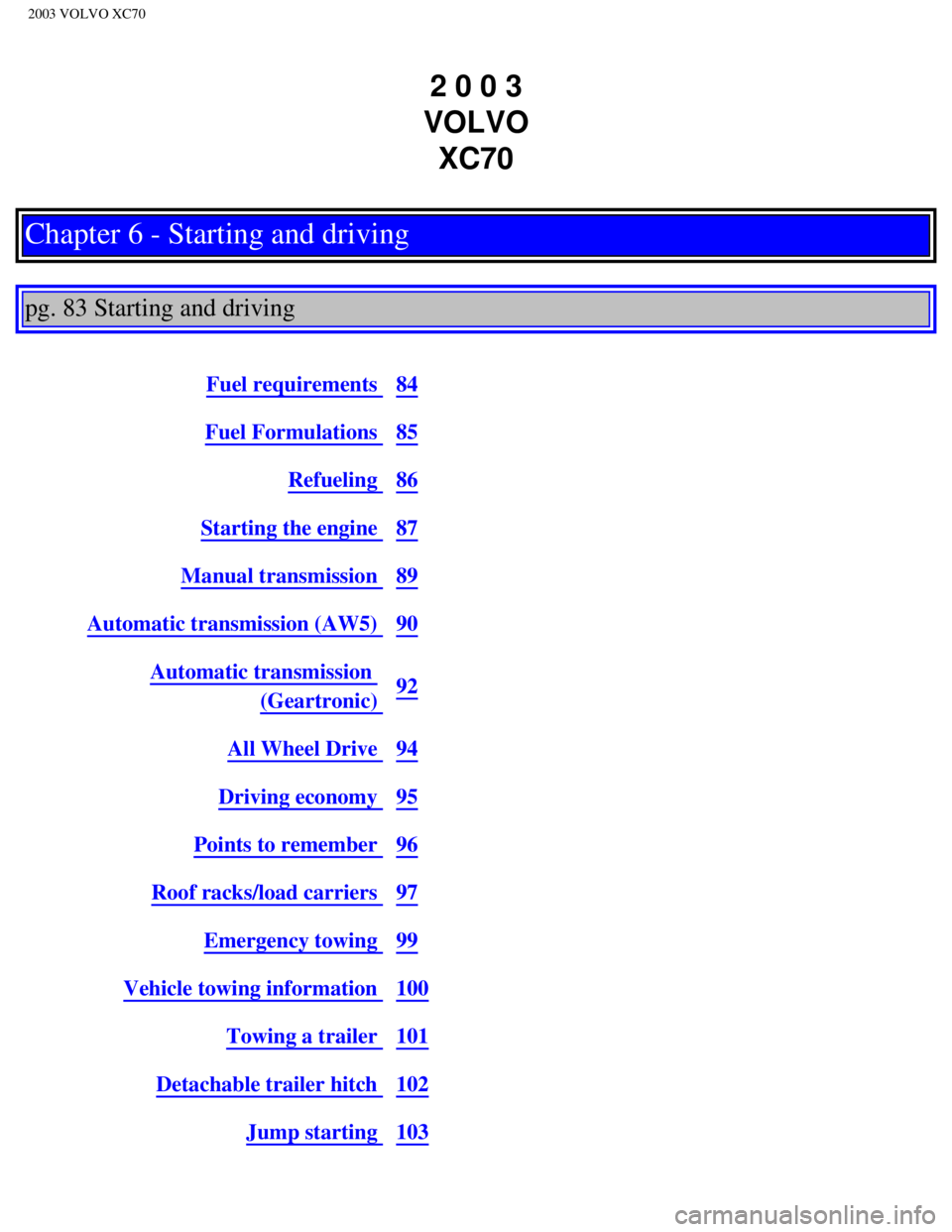
2 0 0 3
VOLVO XC70
Chapter 6 - Starting and driving
pg. 83 Starting and driving
Fuel requirements 84
Fuel Formulations 85
Refueling 86
Starting the engine 87
Manual transmission 89
Automatic transmission (AW5) 90
Automatic transmission
(Geartronic) 92
All Wheel Drive 94
Driving economy 95
Points to remember 96
Roof racks/load carriers 97
Emergency towing 99
Vehicle towing information 100
Towing a trailer 101
Detachable trailer hitch 102
Jump starting 103
file:///K|/ownersdocs/2003/2003_XC70/03xc70_06a.htm (1 of 22)12/30/200\
6 4:17:59 PM
Page 127 of 257

2003 VOLVO XC70
With the exception of gas line antifreeze during winter months, do not a\
dd solvents, thickeners, or other
store-bought additives to your car's fuel, cooling, or lubricating syste\
ms. Overuse may damage your
engine, and some of these additives contain organically volatile chemica\
ls. Do not needlessly expose
yourself to these chemicals.
pg. 86 Refueling
Refueling
The fuel tank holds approximately 18.5 US gals (70 liters) or 19 US ga\
ls (72 liters) on models equipped
with All Wheel Drive, with sufficient volume left over to accommodate po\
ssible expansion of the fuel in
hot weather. Be aware that the "usable" tank capacity will be somewhat l\
ess than the specified
maximum. When the fuel level is low, such factors as ambient temperature\
, the fuel's "Reid vapor
pressure" characteristics, and terrain can affect the fuel pump's abilit\
y to supply the engine with an
adequate supply of fuel. Therefore, it is advisable to refuel as soon as\
possible when the needle nears the
red zone, or when the fuel warning light comes on.
Fuel filler door
Press the button on the light switch panel (see illustration on page 34) when the car is at a standstill to
unlock the fuel filler door. Please note that the fuel filler door will \
remain unlocked until the car begins
to move forward. An audible click will be heard when the fuel filler doo\
r relocks.
If you intend to leave your car while it is being refueled, this feature\
s enables you to lock the door/
tailgate while leaving the fuel filler door unlocked.
You can also keep the car locked if you remain inside it during refuelin\
g. The central locking button
does not lock the fuel filler door.
Be sure the fuel filler door is not obstructed and is completely closed \
after refueling. Open the fuel
filler cap slowly during hot weather conditions.
file:///K|/ownersdocs/2003/2003_XC70/03xc70_06a.htm (4 of 22)12/30/200\
6 4:17:59 PM
Page 128 of 257

2003 VOLVO XC70
NOTE: During a transitional period, a small number of service stations may sti\
ll have fuel nozzles that
are not compatible with the fuel filler neck on cars equipped with the e\
vaporative control system. Please
refer to
page 130 for additional information.
CAUTION:
l Do not refuel with the engine running *. Turn the ignition off or to pos\
ition I. If the ignition is on, an
incorrect reading could occur in the fuel gauge.
l After refueling, close the fuel filler cap by turning it clockwise until\
it clicks into place *.
l Allow for fuel expansion by not overfilling the tank. Overfilling could \
also cause damage to the
emission control systems.
l Avoid spilling gasoline when refueling. In addition to causing damage to\
the environment, gasolines
containing alcohol can cause damage to painted surfaces, which may not b\
e covered under the New
Vehicle Limited Warranty.
l Do not use gasolines containing methanol (methyl alcohol, wood alcohol)\
. This practice can result in
vehicle performance deterioration and can damage critical parts in the f\
uel system. Such damage may
not be covered under the New Vehicle Limited Warranty.
* If the fuel filler cap is not closed tightly or if the engine is runni\
ng when the car is refueled, the Check
Engine light (malfunction indicator lamp) may indicate a fault. Howeve\
r, your vehicle's performance
will not be affected. Use only Volvo original or approved fuel filler ca\
ps.
pg. 87 Starting the engine
Starting the engine
1. Fasten the seat belt.
WARNING!
Before starting, check that the seat, steering wheel and mirrors adjuste\
d properly. Make sure the brake
pedal can be depressed completely. Adjust the seat if necessary. See
page 56.
2. Apply the parking brake, if not already set. The gear selector (automatic transmission) is locked in
the (P)ark position (SHIFT-LOCK). Manual transmission: the clutch must be fully depressed.
3. Without touching the accelerator pedal, turn the ignition key* to the starting position. Allow the
starter to operate for up to 10 seconds. Release the key as soon as the \
engine starts. If the engine fails to
start, repeat this step.
file:///K|/ownersdocs/2003/2003_XC70/03xc70_06a.htm (5 of 22)12/30/200\
6 4:17:59 PM
Page 138 of 257

2003 VOLVO XC70
downshift will not occur until the speed has decreased enough to allow t\
he lower gear to be used.
l If you slow down to a very low speed, the transmission will automaticall\
y shift down.
l When starting in the (MAN)ual position, 3rd gear is the highest gear t\
hat may be selected.
NOTE: Kickdown (see previous page) does not function when the transmission is in the manual shift
(geartronic) mode. The gear selector must be in the D (Drive) positi\
on.
W Winter/Wet driving mode - enhanced vehicle traction
l Mode W will function only if the gear selector is in the (D)rive posit\
ion.
l Press the button at the base of the gear selector to engage/disengage th\
is driving mode (see
illustration).
l An LED in the button will light up to indicate that W is engaged and this will also be displayed in the
instrument panel (see
page 27).
l This mode may be selected for starting/moving off on slippery roads.
pg. 94 All Wheel Drive - option
All Wheel Drive (AWD) - general information
Your Volvo can be equipped with permanent All Wheel Drive, which means t\
hat power is distributed
automatically between the front and rear wheels. Under normal driving co\
nditions, most of the engine's
power is directed to the front wheels. However, if there is any tendency\
for the front wheels to spin, an
electronically controlled coupling distributes power to the wheels that \
have the best traction.
Tire dimensions
Volvo recommends that you always drive on tires of the same brand, size,\
construction (radial), tread
file:///K|/ownersdocs/2003/2003_XC70/03xc70_06a.htm (15 of 22)12/30/20\
06 4:18:00 PM
Page 140 of 257

2003 VOLVO XC70
lower with the air conditioning on and the windows closed than with the \
air conditioning off and the
windows open.
l Using the onboard trip computer's fuel consumption modes can help you le\
arn how to drive more
economically.
Other factors that decrease gas mileage are:
l Dirty air cleaner
l Dirty engine oil and clogged oil filter
l Dragging brakes
l Incorrect front end alignment Some of the above mentioned items and othe\
rs are checked at the
standard Maintenance Service intervals.
NOTE: Vehicles equipped with automatic transmissions should use (D)rive as o\
ften as possible and
avoid using "kick-down" to help improve fuel economy. Vehicles equipped \
with manual transmissions
should use fifth gear at highway speeds. At other times, choose the high\
est gear that still allows smooth
acceleration.
Weight distribution affects handling
At the specified curb weight your car has a tendency to understeer, whic\
h means that the steering wheel
has to be turned more than might seem appropriate for the curvature of a\
bend. This ensures good
stability and reduces the risk of rear wheel skid. Remember that these p\
roperties can alter with the
vehicle load. The heavier the load on the rear of the vehicle (e.g., he\
avily loaded (max. 220 lbs, 100 kg)
cargo area or when towing a trailer, the less the tendency to understeer\
.
Handling, roadholding
Vehicle load, tire design and inflation pressure all affect vehicle hand\
ling. Therefore, check that the tires
are inflated to the recommended pressure according to the vehicle load. \
See "Tire pressure" section.
Loads should be distributed so that capacity weight or maximum permissib\
le axle loads are not
exceeded.
pg. 96 Points to remember
Cooling system
The risk for engine overheating is greatest, especially in hot weather, \
when:
l Towing a trailer up steep inclines for prolonged periods at wide open th\
rottle and low engine rpm.
l Stopping the engine suddenly after high speed driving (so-called "after\
-boiling" can occur).
l To avoid overheating, the following rules should be followed: Do not dri\
ve for prolonged periods at
file:///K|/ownersdocs/2003/2003_XC70/03xc70_06a.htm (17 of 22)12/30/20\
06 4:18:00 PM
Page 143 of 257

The attachment brackets for the load carriers are located under the roof\
molding.
1 Make sure that th")
2003 VOLVO XC70
Load carrier attachment points
Attaching load carriers (models without rails)
The attachment brackets for the load carriers are located under the roof\
molding.
1 Make sure that the load carriers are placed in the right direction. Se\
e the mark on the decal under the
cover.
2 Press the guide lugs into the holes (1).
3 Carefully lower the opposite side of the load carrier to the roof.
4 Loosen the tightening wheel slightly. Slide the hook on the load carri\
er attachment into the attachment
bracket under the roof molding.
5 Turn the tightening wheel to secure the load carrier in the attachment\
bracket.
6 Repeat this procedure for the other load carrier attachments.
7 Check that the hooks on all four load carrier attachments are securely\
tightened in the respective
attachment brackets on the roof of the car.
8 Press down the covers.
Check periodically that the load carriers and load are properly secured.\
Reducing wind noise and improving fuel economy
To maximize fuel efficiency and minimize wind noise, Volvo recommends th\
at load carriers be removed
when not in use.
pg. 98 Load carriers (models with rails)
file:///K|/ownersdocs/2003/2003_XC70/03xc70_06a.htm (20 of 22)12/30/20\
06 4:18:00 PM
Page 147 of 257

2003 VOLVO XC70
Rear towing eyelet
Precautions when the car is in tow
l The steering wheel must be unlocked. Turn the ignition key to position I\
or II.
l The gear selector must be in position N.
l Maximum speed: 50 mph (80 km/h)
l Maximum distance with front wheels on ground: 50 miles (80 km).
l While the car is being towed, try to keep the tow rope taut at all times\
.
l Cars with an automatic transmission should only be towed in forward dire\
ction.
CAUTION:
l Please check with state and local authorities before attempting this typ\
e of towing, as vehicles being
towed are subject to regulations regarding maximum towing speed, length \
and type of towing device,
lighting, etc.
l If the car's battery is dead, do not attempt to start the vehicle by pus\
hing or pulling it as this will
damage the three-way catalytic converter(s). The engine must be jump s\
tarted using an auxiliary battery
(see
page 103).
l If the car is being towed on a flat bed truck, the towing eyelets must n\
ot be used to secure the car on
the flat bed. Consult the tow truck operator.
WARNING!
l Remember that the power brakes and power steering will not function when\
engine is not running.
The braking and steering systems will function but the brake pedal press\
ure required is 3 - 4 times
above normal and greater steering effort must be exerted.
l The towing eyelets must not be used for pulling another vehicle out of a\
ditch or for any similar
purpose involving severe strain.
l Do not use the towing eyelets to pull the car up onto a flat bed tow tru\
ck.
pg. 100 Vehicle towing information
file:///K|/ownersdocs/2003/2003_XC70/03xc70_06b.htm (2 of 10)12/30/200\
6 4:18:00 PM
Page 148 of 257

2003 VOLVO XC70
Towing cars with all wheel drive/front wheel drive
Volvo recommends the use of flat bed equipment. If wheel lift equipment \
must be used, please use
extreme caution to help avoid damage to the car. In this case, the car should be towed with the rear
wheels on the ground if at all possible.
If it is absolutely necessary to tow the vehicle with the front wheels o\
n the ground, please refer to the
towing information on the previous page.
CAUTION:
l The car must not be driven with wheels of different dimensions/specifica\
tions or with a spare tire
other than the one that came with the car. The use of different size whe\
els can seriously damage your
car's transmission.
l Sling-type equipment applied at the front will damage radiator and air c\
onditioning lines.
l It is equally important not to use sling-type equipment at the rear or a\
pply lifting equipment inside the
rear wheels; serious damage to the rear axle may result.
l If the car is being towed on a flat bed truck, the towing eyelets must n\
ot be used to secure the car on
the flat bed. Consult the tow truck operator.
WARNING!
l Do not use the towing eyelets to pull the car up onto a flat bed tow
truck.
file:///K|/ownersdocs/2003/2003_XC70/03xc70_06b.htm (3 of 10)12/30/200\
6 4:18:00 PM
Page 149 of 257

2003 VOLVO XC70
pg. 101 Towing a trailer
When preparing for trailer towing, observe the following:
Volvo recommends the use of Volvo trailer hitches which are specially de\
signed for the car.
l Maximum trailer weight recommended by Volvo is:
Trailers without brakes: 1100 lbs (500 kg)
Trailers with brakes: 3300 lbs* (1,500 kg),
Observe the legal requirements of the state/province in which the vehicl\
es are registered.
l All Volvo models are equipped with energy-absorbing shock-mounted bumper\
s. Trailer hitch
installation should not interfere with the proper operation of this bump\
er system.
Trailer towing does not normally present any particular problems, but ta\
ke into consideration:
l Increase tire pressure to recommended full. See section "Wheels and tire\
s".
l When your car is new, avoid towing heavy trailers during the first 620 m\
iles (1000 km).
l Recommended hitch tongue load is:
Trailer weights below 2,650 lbs (1,200 kg) - 110 lbs (50 kg)
Trailer weights above 2,650 lbs (1,200 kg) - 165 lbs (75 kg)
l Maximum speed when towing a trailer: 50 mph (80 km/h).
l Engine and transmission are subject to increased loads. Therefore, engin\
e coolant temperature should
be closely watched when driving in hot climates or hilly terrain. Use a \
lower gear and turn off the air
conditioner if the temperature gauge needle enters the red range.
l If the automatic transmission begins to overheat, a message will be disp\
layed in the text window.
l Avoid overload and other abusive operation.
l Hauling a trailer affects handling, durability, and economy.
l It is necessary to balance trailer brakes with the towing vehicle brakes\
to provide a safe stop (check
and observe state/local regulations).
l Do not connect the trailer's brake system directly to the vehicle's brak\
e system.
l More frequent vehicle maintenance is required.
l Remove the ball and drawbar assembly when the hitch is not being used.
l Volvo recommends the use of synthetic engine oil when towing a trailer o\
ver long distances or in
mountainous areas.
file:///K|/ownersdocs/2003/2003_XC70/03xc70_06b.htm (4 of 10)12/30/200\
6 4:18:00 PM
Page 153 of 257

2003 VOLVO XC70
Cold weather precautions
If you wish to check your car before the approach of cold weather, the f\
ollowing advice is worth noting:
l Make sure that the engine coolant contains 50 percent antifreeze. Any ot\
her mixture will reduce
freeze protection. This gives protection against freezing down to -31°\
F (-35°C). See section "Coolant".
The use of "recycled" antifreeze is not approved by Volvo. Different typ\
es of antifreeze must not
be mixed.
l Volvo recommends using only genuine Volvo antifreeze in your car's radia\
tor. Your local Volvo
retailer stocks plenty of Volvo engine coolant to protect your car durin\
g cold weather.
l Try to keep the fuel tank well filled - this prevents the formation of condensation in the tank. \
In
addition, in extremely cold weather conditions it is worthwhile to add f\
uel line de-icer before refueling.
l The viscosity of the engine oil is important. Oil with low viscosity (thinner oil) improves cold-
weather starting as well as decreasing fuel consumption while the engine\
is warming up. For winter use,
5W-30 oil, particularly the synthetic type *, is recommended. Be sure to\
use good quality oil but do not
use this cold-weather oil for hard driving or in warm weather. See section "Engine oil" for more
information.
l The load placed on the battery is greater during the winter since the windshield wipers, lighting, etc\
.
are used more often. Moreover, the capacity of the battery decreases as \
the temperature drops. In very
cold weather, a poorly charged battery can freeze and be damaged. It is \
therefore advisable to check the
state of charge more frequently and spray an anti-rust oil on the batter\
y posts.
l Volvo recommends the use of snow tires on all four wheels for winter dri\
ving - see section "Wheels
and tires".
l To prevent the washer fluid reservoir from freezing, add washer solvents\
containing antifreeze (see
page 130 for the location of the washer fluid reservoir). This is important sin\
ce dirt is often splashed on
the windshield during winter driving, requiring the frequent use of the \
washers and wipers. The Volvo
Washer Solvent should be diluted as follows:
Down to 14° F (-10° C): 1 part washer solvent and 4 parts water \
Down to 5° F (-15° C): 1 part washer solvent and 3 parts water
Down to 0° F (-18° C): 1 part washer solvent and 2 parts water
Down to -18° F (-28° C): 1 part washer solvent and 1 part water \
l Use Volvo Teflon Lock Spray in the locks.
NOTE: Avoid the use of de-icing sprays as they can cause damage to the locks.
W Winter/Wet driving mode - enhanced vehicle traction
l Mode W will only function if the gear selector is in the (D)rive posit\
ion.
l Press the button at the base of the gear selector to engage/disengage th\
is driving mode (see
illustration).
l An LED in the button will light up to indicate that W is engaged and this will also be displayed in the
instrument panel (see
page 27).
l This mode may be selected for starting/moving off on slippery roads.
file:///K|/ownersdocs/2003/2003_XC70/03xc70_06b.htm (8 of 10)12/30/200\
6 4:18:00 PM