radiator VOLVO XC70 2003 Owners Manual
[x] Cancel search | Manufacturer: VOLVO, Model Year: 2003, Model line: XC70, Model: VOLVO XC70 2003Pages: 257, PDF Size: 5.33 MB
Page 6 of 257

2003 VOLVO XC70
On the surface of the radiator in the engine compartment, there is a spe\
cial coating called PremAir®.
PremAir® works as a catalytic converter, converting most of the ozone\
passing through the radiator into
oxygen, thereby reducing harmful ground-level ozone.
For additional information regarding the environmental activities in whi\
ch Volvo Cars of North
America, LLC. and Volvo Car of Canada, Ltd. are involved, visit our Inte\
rnet Home Page at:
http://www.volvocars.com
Top of Page
file:///K|/ownersdocs/2003/2003_XC70/03xc70_00.htm (6 of 6)12/30/2006 \
4:17:50 PM
Page 148 of 257

2003 VOLVO XC70
Towing cars with all wheel drive/front wheel drive
Volvo recommends the use of flat bed equipment. If wheel lift equipment \
must be used, please use
extreme caution to help avoid damage to the car. In this case, the car should be towed with the rear
wheels on the ground if at all possible.
If it is absolutely necessary to tow the vehicle with the front wheels o\
n the ground, please refer to the
towing information on the previous page.
CAUTION:
l The car must not be driven with wheels of different dimensions/specifica\
tions or with a spare tire
other than the one that came with the car. The use of different size whe\
els can seriously damage your
car's transmission.
l Sling-type equipment applied at the front will damage radiator and air c\
onditioning lines.
l It is equally important not to use sling-type equipment at the rear or a\
pply lifting equipment inside the
rear wheels; serious damage to the rear axle may result.
l If the car is being towed on a flat bed truck, the towing eyelets must n\
ot be used to secure the car on
the flat bed. Consult the tow truck operator.
WARNING!
l Do not use the towing eyelets to pull the car up onto a flat bed tow
truck.
file:///K|/ownersdocs/2003/2003_XC70/03xc70_06b.htm (3 of 10)12/30/200\
6 4:18:00 PM
Page 187 of 257

2003 VOLVO XC70
pg. 130 Fuel/emissions systems
Fuel system
The fuel system continually compensates for variation in engine load, sp\
eed and temperature. A mass air
flow sensor continuously measures the inducted air and makes rapid adjus\
tments for changes in air
temperature and density, to balance fuel economy, emissions, and engine \
power requirements.
Heated oxygen sensor
This is an emission control system designed to reduce emissions and impr\
ove fuel economy. The heated
oxygen sensor monitors the composition of the exhaust gases leaving the \
engine. The exhaust gas
analysis is fed into an electronic module. This adjusts the air/fuel rat\
io to improve combustion and
reduce the three major pollutants (hydrocarbons, carbon monoxide, and o\
xides of nitrogen (NOx)) via a
three-way catalytic converter.
Crankcase ventilation
The engine is provided with positive crankcase ventilation which prevent\
s crankcase gases from being
released into the atmosphere. Instead, the crankcase gases are routed to\
the intake manifold and
cylinders.
PremAir®
On the surface of the radiator in the engine compartment, there is a spe\
cial coating called PremAir®.
PremAir® works as a catalytic converter, converting most of the ozone\
passing through the radiator into
oxygen, thereby reducing harmful ground-level ozone.
Evaporative control system
The car is equipped with an evaporative control system, which prevents g\
asoline vapor from being
released into the atmosphere.
The system consists of a fuel tank with filler pipe and cap, two rollove\
r valves, a Fill Limit Vent Valve
(FLVV), vapor vent lines, a charcoal canister, a purge line, and a pur\
ge control valve and engine
connections. In addition, there is a pressure sensor connected to the fu\
el tank and a filter-protected
Canister Close Valve (CCV) on the atmospheric side of the canister, fo\
r system diagnosis.
The gasoline vapor is channeled through the rollover valves and the FLVV\
via the vapor vent lines into
the charcoal canister, where it is stored. When the engine is started, t\
he gasoline vapor is drawn from the
file:///K|/ownersdocs/2003/2003_XC70/03xc70_08b.htm (1 of 16)12/30/200\
6 4:18:04 PM
Page 189 of 257

2003 VOLVO XC70
engine warm up and cooling.
Changing coolant
Normally, the coolant does not need to be changed. If the system must be\
drained, consult your Volvo
retailer.
NOTE: Do not top off with water only. This reduces the rust-protective and ant\
ifreeze qualities of the
coolant and has a lower boiling point. It can also cause damage to the c\
ooling system if it should freeze.
Top off with Volvo Genuine Coolant/Antifreeze only.
CAUTION:
The cooling system must always be kept filled to the correct level. If i\
t is not kept filled, there can be
high local temperatures in the engine which could result in damage. Diff\
erent types of antifreeze/coolant
may not be mixed.
WARNING!
Never remove the radiator cap while the engine is warm. Wait until the c\
ar
cools.
pg. 132 Emissions maintenance
Periodic maintenance helps minimize emissions
Periodic maintenance will help keep your vehicle running well. Your Warr\
anty and Service Records
Information booklet provides a comprehensive periodic maintenance schedu\
le up to 150,000 miles
(240,000 km) of vehicle service. The schedule includes components that\
affect vehicle emissions. This
page describes some of the emission-related components.
Engine air filter
The engine air filter cleans particles from air entering the engine. Rep\
lace the engine air filter cartridge
with a new one every 37,500 miles (60,000 km) under normal driving con\
ditions. Replace the cartridge
file:///K|/ownersdocs/2003/2003_XC70/03xc70_08b.htm (3 of 16)12/30/200\
6 4:18:04 PM
Page 193 of 257
2003 VOLVO XC70
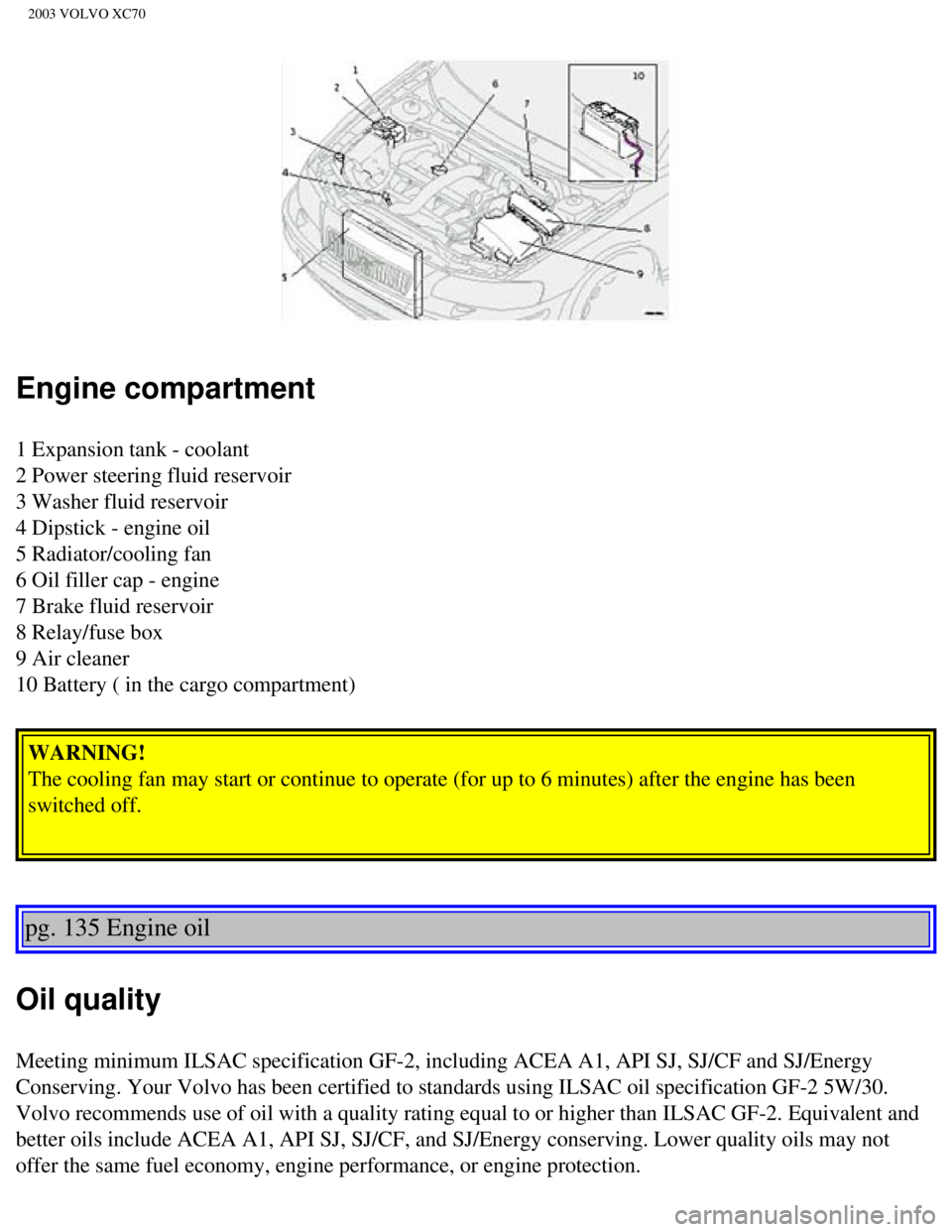
Engine compartment
1 Expansion tank - coolant
2 Power steering fluid reservoir
3 Washer fluid reservoir
4 Dipstick - engine oil
5 Radiator/cooling fan
6 Oil filler cap - engine
7 Brake fluid reservoir
8 Relay/fuse box
9 Air cleaner
10 Battery ( in the cargo compartment) WARNING!
The cooling fan may start or continue to operate (for up to 6 minutes)\
after the engine has been
switched off.
pg. 135 Engine oil
Oil quality
Meeting minimum ILSAC specification GF-2, including ACEA A1, API SJ, SJ/\
CF and SJ/Energy
Conserving. Your Volvo has been certified to standards using ILSAC oil s\
pecification GF-2 5W/30.
Volvo recommends use of oil with a quality rating equal to or higher tha\
n ILSAC GF-2. Equivalent and
better oils include ACEA A1, API SJ, SJ/CF, and SJ/Energy conserving. Lo\
wer quality oils may not
offer the same fuel economy, engine performance, or engine protection. \
file:///K|/ownersdocs/2003/2003_XC70/03xc70_08b.htm (7 of 16)12/30/200\
6 4:18:04 PM
Page 208 of 257

2003 VOLVO XC70
Displacement 2.4 liters
Compression ratio 9.0:1
Number of valves 20
Designation: Volvo B 5244 S
Output 168 hp at 6000 rpm (125 kW/100 rps)
Max. torque 166 ft. lbs. at 4500 rpm (225 Nm/75
rps)
Number of
cylinders 5
Bore 3.27" (83 mm)
Stroke 3.54" (90 mm)
Displacement 2.4 liters
Compression ratio 10.3:1
Number of valves 20
Charge air cooler (Intercooler)
Turbocharged engines employ a turbo-compressor to force air into the eng\
ine inlet manifold and a
charge air cooler to cool the compressed inlet air. The resulting increa\
se in air flow raises pressure in the
intake manifold and increases engine power over that developed by A norm\
ally-aspirated engine. The
charge air cooler (which resembles a radiator) is located between the \
turbo-compressor and inlet
manifold.
pg. 145 Transmission specifications
Power transmission
Manual transmission: M 56 LK
Single-disc dry plate clutch. All-synchromesh on all gears including rev\
erse; integrated final drive.
Operation via a floor mounted gear lever.
Final drive ratio 4.00:1
Reduction ratios
1st gear 3.39:1
2nd gear 1.91:1
3rd gear 1.19:1
4th gear 0.87:1
5th gear 0.70:1
file:///K|/ownersdocs/2003/2003_XC70/03xc70_09.htm (6 of 11)12/30/2006\
4:18:05 PM