towing VOLVO XC70 2003 Owners Manual
[x] Cancel search | Manufacturer: VOLVO, Model Year: 2003, Model line: XC70, Model: VOLVO XC70 2003Pages: 257, PDF Size: 5.33 MB
Page 33 of 257

2003 VOLVO XC70
pg. 18 Brake system
Brake circuit malfunction
The brake system is a hydraulic system consisting of two master cylinder\
s and two separate brake
circuits. If a problem should occur in one of these circuits, it is stil\
l possible to stop the car with the other
brake circuit.
If the brake pedal must be depressed farther than normal and requires gr\
eater foot pressure, the stopping
distance will be longer.
A warning light in the instrument panel will light up to warn the driver\
that a fault has occurred.
If this light comes on while driving or braking, stop immediately and ch\
eck the brake fluid level in the
reservoir.
NOTE: Press the brake pedal hard and maintain pressure on the pedal - do not pump the brakes.
WARNING!
If the fluid level is below the MIN mark in the reservoir: DO NOT DRIVE.\
Tow the car to a Volvo
retailer and have the brake system inspected.
NOTE: When the car is at a standstill and the engine is idling, e.g. at a traf\
fic light and the brake pedal
is depressed, the pedal may go down slightly. This is normal and is caus\
ed by an built-in function in the
power brake system.
Power brakes function only when the engine is running
The power brakes utilize vacuum pressure which is only created when the \
engine is running. Never let
the vehicle roll to a stop with the engine switched off.
If the power brakes are not working, the brake pedal must be pressed app\
roximately four times harder
than usual to make up for the lack of power assistance. This can happen \
for example when towing your
vehicle or if the engine is switched off when the vehicle is rolling. Th\
e brake pedal feels harder than
usual.
Water on brake discs and brake pads affects braking
file:///K|/ownersdocs/2003/2003_XC70/03xc70_01b.htm (10 of 14)12/30/20\
06 4:17:52 PM
Page 34 of 257

2003 VOLVO XC70
Driving in rain and slush or passing through an automatic car wash can c\
ause water to collect on the
brake discs and pads. This will cause a delay in braking effect when the\
pedal is depressed. To avoid
such a delay when the brakes are needed, depress the pedal occasionally \
when driving through rain,
slush etc. This will remove the water from the brakes. Check that brake \
application feels normal. This
should also be done after washing or starting in very damp or cold weath\
er.
Severe strain on the brake system
The brakes will be subject to severe strain when driving in mountains or\
hilly areas or towing. Vehicle
speed is usually slower, which means that the cooling of the brakes is l\
ess efficient than when driving on
level roads. To reduce the strain on the brakes, shift into a lower gear\
and let the engine help with the
braking. Do not forget that, if you are towing a trailer, the brakes wil\
l be subjected to a greater than
normal load.
pg. 19 Anti-lock Brake System (ABS)
Anti-lock Brake System (ABS)
If the warning lamp lights up there is a malfunction of the ABS system (\
the standard braking system will
however function) and the vehicle should be driven cautiously to a Volv\
o retailer for inspection. The
Anti-lock Braking System (ABS) helps to improve vehicle control (stop\
ping and steering) during severe
braking conditions by limiting brake lockup. When the system "senses" im\
pending lockup, braking
pressure is automatically modulated in order to help prevent lockup, whi\
ch could lead to a skid.
The system performs a self-diagnostic test when the engine is started an\
d when the vehicle first
reaches a speed of approximately 12 mph (20 km/h). The brake pedal will pulsate several times and a
sound may be audible from the ABS control module. This is normal.
To obtain optimal effect from the ABS system, constant pressure should b\
e kept on the brake
pedal, keep constant pressure on the brake pedal. Do not pump the brake \
pedal.
The switching of the ABS modulator will be audible and the brake pedal w\
ill pulsate during braking.
Please be aware that ABS does not increase the absolute braking potentia\
l of the vehicle. While control
will be enhanced, ABS will not shorten stopping distances on slippery su\
rfaces.
ABS with EBD (Electronic Brake Force Distribution)
EBD is an integrated part of the ABS system. EBD regulates the hydraulic\
pressure to the rear brakes to
help provide optimal braking capacity. The brake pedal will pulsate duri\
ng braking, which is normal.
file:///K|/ownersdocs/2003/2003_XC70/03xc70_01b.htm (11 of 14)12/30/20\
06 4:17:52 PM
Page 44 of 257

2003 VOLVO XC70
Brake failure warning light
If the light comes on while driving or braking, stop immediately, open t\
he hood and check the brake
fluid level in the reservoir. See
page 134 for reservoir position and page 137 for instructions.
Canadian models are equipped with this warning light:
Oil pressure warning light
If the light comes on while driving, stop the car and then stop the engi\
ne immediately and check the
engine oil level. See
page 135. If the light stays on after restart, have the car towed to the nearest\
authorized
Volvo retailer. After hard driving, the light may come on occasionally w\
hen the engine is idling. This is
normal, provided it goes off when the engine speed is increased.
Parking brake reminder light
This light will be on when the parking brake (hand brake) is applied. \
The parking brake lever is situated
between the front seats.
Canadian models are equipped with this warning light:
Generator warning light
If the light comes on while the engine is running, have the charging sys\
tem checked.
* Rear fog light, if used, and trailer turn signal, if towing a trailer,\
will go on while driving.
pg. 29 Indicator and warning lights
file:///K|/ownersdocs/2003/2003_XC70/03xc70_02a.htm (7 of 13)12/30/200\
6 4:17:53 PM
Page 46 of 257

2003 VOLVO XC70
An indicator light will flash when STC or DSTC is actively working to st\
abilize the car. See pages 20-21 for
more detailed information.
Turn signal indicator - trailer (certain models)
If you are towing a trailer, this light will flash simultaneously with t\
he turn signals on the trailer. If the light
does not flash when signaling, neither the trailer's turn signals nor th\
e car's turn signals are functioning.
Seat belt reminder
This symbol lights up to indicate that the driver has not fastened his/h\
er seat belt.
pg. 30 Text information window
Messages in the text window
When a warning light in the instrument panel comes on, a message is also\
displayed in the text window. After
you have read the message, you can erase it by pressing button A (see i\
llustration above).
NOTE: Certain messages cannot be erased until the condition has been corrected\
.
file:///K|/ownersdocs/2003/2003_XC70/03xc70_02a.htm (9 of 13)12/30/200\
6 4:17:53 PM
Page 124 of 257
2003 VOLVO XC70
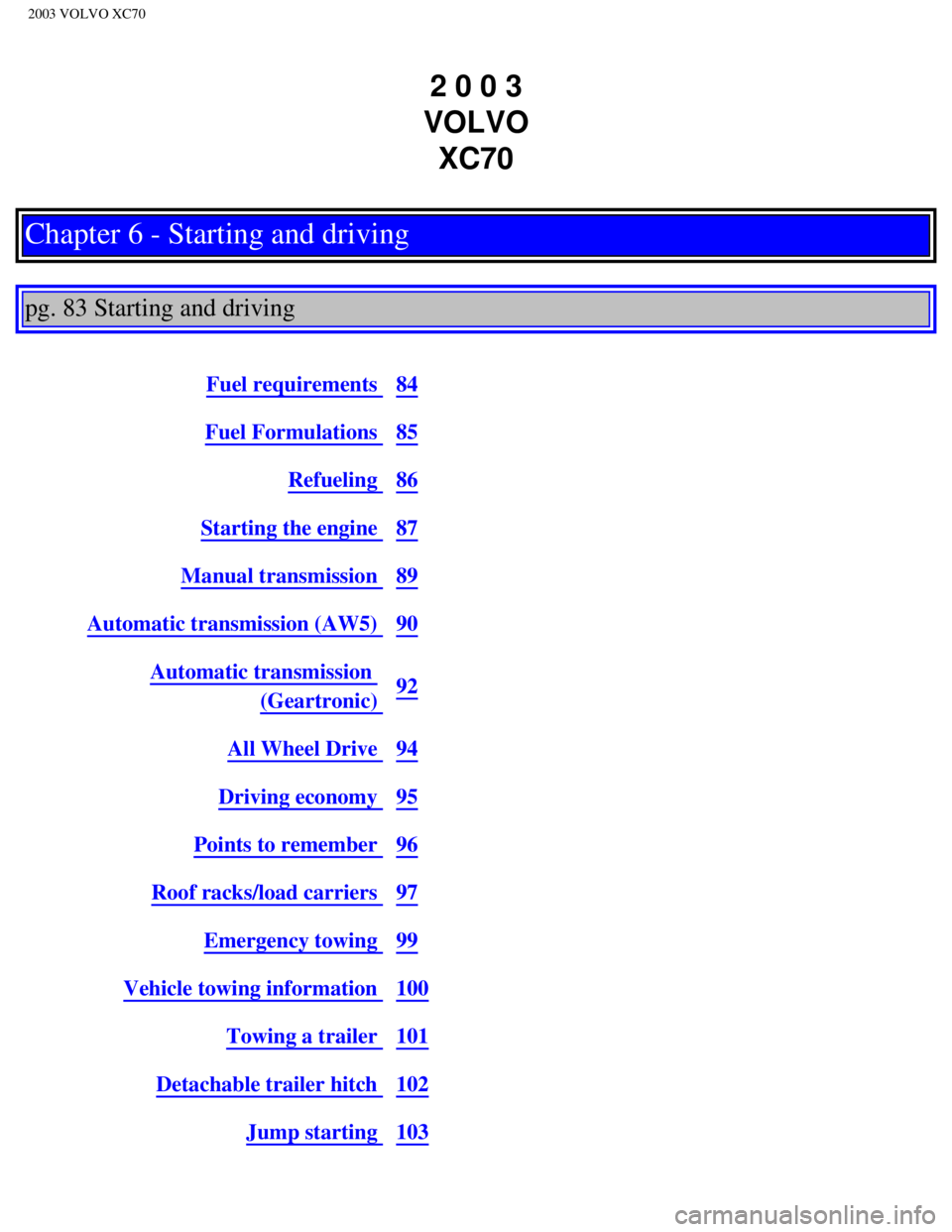
2 0 0 3
VOLVO XC70
Chapter 6 - Starting and driving
pg. 83 Starting and driving
Fuel requirements 84
Fuel Formulations 85
Refueling 86
Starting the engine 87
Manual transmission 89
Automatic transmission (AW5) 90
Automatic transmission
(Geartronic) 92
All Wheel Drive 94
Driving economy 95
Points to remember 96
Roof racks/load carriers 97
Emergency towing 99
Vehicle towing information 100
Towing a trailer 101
Detachable trailer hitch 102
Jump starting 103
file:///K|/ownersdocs/2003/2003_XC70/03xc70_06a.htm (1 of 22)12/30/200\
6 4:17:59 PM
Page 140 of 257

2003 VOLVO XC70
lower with the air conditioning on and the windows closed than with the \
air conditioning off and the
windows open.
l Using the onboard trip computer's fuel consumption modes can help you le\
arn how to drive more
economically.
Other factors that decrease gas mileage are:
l Dirty air cleaner
l Dirty engine oil and clogged oil filter
l Dragging brakes
l Incorrect front end alignment Some of the above mentioned items and othe\
rs are checked at the
standard Maintenance Service intervals.
NOTE: Vehicles equipped with automatic transmissions should use (D)rive as o\
ften as possible and
avoid using "kick-down" to help improve fuel economy. Vehicles equipped \
with manual transmissions
should use fifth gear at highway speeds. At other times, choose the high\
est gear that still allows smooth
acceleration.
Weight distribution affects handling
At the specified curb weight your car has a tendency to understeer, whic\
h means that the steering wheel
has to be turned more than might seem appropriate for the curvature of a\
bend. This ensures good
stability and reduces the risk of rear wheel skid. Remember that these p\
roperties can alter with the
vehicle load. The heavier the load on the rear of the vehicle (e.g., he\
avily loaded (max. 220 lbs, 100 kg)
cargo area or when towing a trailer, the less the tendency to understeer\
.
Handling, roadholding
Vehicle load, tire design and inflation pressure all affect vehicle hand\
ling. Therefore, check that the tires
are inflated to the recommended pressure according to the vehicle load. \
See "Tire pressure" section.
Loads should be distributed so that capacity weight or maximum permissib\
le axle loads are not
exceeded.
pg. 96 Points to remember
Cooling system
The risk for engine overheating is greatest, especially in hot weather, \
when:
l Towing a trailer up steep inclines for prolonged periods at wide open th\
rottle and low engine rpm.
l Stopping the engine suddenly after high speed driving (so-called "after\
-boiling" can occur).
l To avoid overheating, the following rules should be followed: Do not dri\
ve for prolonged periods at
file:///K|/ownersdocs/2003/2003_XC70/03xc70_06a.htm (17 of 22)12/30/20\
06 4:18:00 PM
Page 141 of 257

2003 VOLVO XC70
engine speeds above 4500 rpm if you are towing a trailer in hilly terrai\
n.
Reduce speed when towing a trailer up long, steep inclines. The risk of \
overheating can be reduced by
switching off the air conditioning system for a short time.
Do not let the engine idle unnecessarily for prolonged periods.
Do not mount auxiliary lamps in front of the grill.
When the risk of overheating is imminent, or in the event of overheating\
(the temperature gauge goes
repeatedly into, or stays continually in, the red section), the followi\
ng precautions should be taken:
l Switch off the air conditioning system.
l Pull off the road, away from traffic, stop the car and put the gear sele\
ctor into neutral.
l Switch the heater to full (maximum) position. Increase the engine spee\
d to approx. 2000 rpm (twice
idling speed) until the temperature begins to drop.
WARNING!
Do not remove coolant expansion tank cap. The coolant will be extremely \
hot.
If necessary, see
page 129 and 132 for information on checking and topping-up the coolant
level.
CAUTION: Drive slowly and carefully if going through standing water (i.e. flood\
ed roadways, etc.).
Damage to the engine could result if excess water is drawn in through th\
e air intake system. Never drive
the vehicle in water deeper than 1 foot (300 mm). See the flood warnin\
g on
page 7.
WARNING!
l Driving with the tailgate open: Driving with the tailgate open could mean that poisonous exhaust
gases enter the passenger compartment.
If the tailgate must be kept open for any reason, proceed as follows:
- Close the windows.
- Set the ventilation system control to air flow to floor, windshield an\
d side windows and blower
control to its highest setting.
l Floor mats: An extra mat on the driver's floor can cause the accelerator pedal to \
catch. Check that
the movement of the accelerator pedal is not impeded. Not more than one \
protective floor covering
may be used at one time.
file:///K|/ownersdocs/2003/2003_XC70/03xc70_06a.htm (18 of 22)12/30/20\
06 4:18:00 PM
Page 146 of 257

2003 VOLVO XC70
pg. 99 Emergency towing
Front towing eyelet
Emergency towing
The towing eyelet is located in the tool kit, under the floor of the car\
go area, with the spare tire. This
eyelet must be screwed into the positions provided on the right sides of\
either the front or rear bumper
(see illustration). To attach the towing eyelet:
l Use a coin to pry open the lower edge of the cover (A).
l Screw the towing eyelet in place, first by hand and then using the tire \
iron (B) until it is securely in
place.
After the car has been towed, the eyelet should be removed and returned \
to the tool kit. Press the cover
back into position.
file:///K|/ownersdocs/2003/2003_XC70/03xc70_06b.htm (1 of 10)12/30/200\
6 4:18:00 PM
Page 147 of 257

2003 VOLVO XC70
Rear towing eyelet
Precautions when the car is in tow
l The steering wheel must be unlocked. Turn the ignition key to position I\
or II.
l The gear selector must be in position N.
l Maximum speed: 50 mph (80 km/h)
l Maximum distance with front wheels on ground: 50 miles (80 km).
l While the car is being towed, try to keep the tow rope taut at all times\
.
l Cars with an automatic transmission should only be towed in forward dire\
ction.
CAUTION:
l Please check with state and local authorities before attempting this typ\
e of towing, as vehicles being
towed are subject to regulations regarding maximum towing speed, length \
and type of towing device,
lighting, etc.
l If the car's battery is dead, do not attempt to start the vehicle by pus\
hing or pulling it as this will
damage the three-way catalytic converter(s). The engine must be jump s\
tarted using an auxiliary battery
(see
page 103).
l If the car is being towed on a flat bed truck, the towing eyelets must n\
ot be used to secure the car on
the flat bed. Consult the tow truck operator.
WARNING!
l Remember that the power brakes and power steering will not function when\
engine is not running.
The braking and steering systems will function but the brake pedal press\
ure required is 3 - 4 times
above normal and greater steering effort must be exerted.
l The towing eyelets must not be used for pulling another vehicle out of a\
ditch or for any similar
purpose involving severe strain.
l Do not use the towing eyelets to pull the car up onto a flat bed tow tru\
ck.
pg. 100 Vehicle towing information
file:///K|/ownersdocs/2003/2003_XC70/03xc70_06b.htm (2 of 10)12/30/200\
6 4:18:00 PM
Page 148 of 257

2003 VOLVO XC70
Towing cars with all wheel drive/front wheel drive
Volvo recommends the use of flat bed equipment. If wheel lift equipment \
must be used, please use
extreme caution to help avoid damage to the car. In this case, the car should be towed with the rear
wheels on the ground if at all possible.
If it is absolutely necessary to tow the vehicle with the front wheels o\
n the ground, please refer to the
towing information on the previous page.
CAUTION:
l The car must not be driven with wheels of different dimensions/specifica\
tions or with a spare tire
other than the one that came with the car. The use of different size whe\
els can seriously damage your
car's transmission.
l Sling-type equipment applied at the front will damage radiator and air c\
onditioning lines.
l It is equally important not to use sling-type equipment at the rear or a\
pply lifting equipment inside the
rear wheels; serious damage to the rear axle may result.
l If the car is being towed on a flat bed truck, the towing eyelets must n\
ot be used to secure the car on
the flat bed. Consult the tow truck operator.
WARNING!
l Do not use the towing eyelets to pull the car up onto a flat bed tow
truck.
file:///K|/ownersdocs/2003/2003_XC70/03xc70_06b.htm (3 of 10)12/30/200\
6 4:18:00 PM