warning light VOLVO XC70 2003 Owners Manual
[x] Cancel search | Manufacturer: VOLVO, Model Year: 2003, Model line: XC70, Model: VOLVO XC70 2003Pages: 257, PDF Size: 5.33 MB
Page 4 of 257
 may indicate a fault.
Important
Before you operate your car for the first time, please familiarize yours\
elf with the new-engine oil
consumption information")
2003 VOLVO XC70
("Check Engine" light) may indicate a fault.
Important
Before you operate your car for the first time, please familiarize yours\
elf with the new-engine oil
consumption information on
page 135. You should also be familiar with the information in the
chapters one, two and four of this manual.
Information contained in the balance of the manual is extremely useful a\
nd should be read after
operating the vehicle for the first time.
The manual is structured so that it can be used for reference. For this \
reason, it should be kept in
the car for ready access.
Do not export your Volvo to another country before investigating that co\
untry's applicable safety
and exhaust emission requirements. In some cases it may be difficult or \
impossible to comply with
these requirements. Modifications to the emission control system(s) ma\
y render your Volvo not
certifiable for legal operation in the U.S., Canada and other countries.\
All information, illustrations and specifications contained in this manu\
al are based on the latest
product information available at the time of publication. Please note th\
at some vehicles may be
equipped differently, depending on special legal requirements and that o\
ptional equipment
described in this manual may not be available in all markets.
Volvo reserves the right to make model changes at any time, or to change\
specifications or design,
without notice and without incurring obligation.
CALIFORNIA Proposition 65 Warning
WARNING! Engine exhaust, some of its constituents, and certain vehicle c\
omponents contain or
emit chemicals known to the state of California to cause cancer, and bir\
th defects or other
reproductive harm. In addition, certain fluids contained in vehicles an\
d certain products of
component wear contain or emit chemicals known to the State of Californi\
a to cause cancer, and birth
defects or other reproductive harm.
Volvo and the environment
Volvo is committed to the well being of our customers. As a natural part\
of this commitment, we care
about the environment in which we all live. Caring for the environment m\
eans an everyday involvement
in reducing our environmental impact.
file:///K|/ownersdocs/2003/2003_XC70/03xc70_00.htm (4 of 6)12/30/2006 \
4:17:50 PM
Page 13 of 257
 airbags. If a fault i\
s detected, the warning light will
illuminate. The light is included in the warning/indicator light cluster\")
2003 VOLVO XC70
monitor the Side Impact Protection System (SIPS) airbags. If a fault i\
s detected, the warning light will
illuminate. The light is included in the warning/indicator light cluster\
in the instrument panel. Normally,
the SRS warning lamp should light up when the ignition key is turned to \
positions I, II or III and should
go out after 7 seconds or when the engine is started. Check that this li\
ght is functioning properly every
time the car is started.
The following items are monitored by the self-diagnostic system:
l Sensor unit
l Cable harness
l Gas generator igniters
WARNING!
l Never drive an SRS equipped car with your hands on the steering wheel pa\
d / airbag housing.
l No objects, accessory equipment or stickers may be placed on, attached t\
o or installed near the
SRS cover in the center of the steering wheel, the SRS cover above the g\
love compartment or the area
affected by airbag deployment.
l If the SRS warning light stays on after the engine has started or if it \
comes on while you are
driving, drive the car to the nearest authorized Volvo retailer for insp\
ection as soon as possible.
There is no maintenance to perform on the SRS yourself. The month and ye\
ar shown on the decal on the
door pillar indicate when you should contact your Volvo retailer for spe\
cific servicing or replacement of
airbags and seat belt tensioners. This service must be performed by an a\
uthorized Volvo retailer.
Should you have any questions about the SRS system, please contact your \
authorized Volvo retailer or
Volvo Customer Support:
file:///K|/ownersdocs/2003/2003_XC70/03xc70_01a.htm (7 of 17)12/30/200\
6 4:17:51 PM
Page 22 of 257
 - front seats only
The WHIPS system consists of specially designed hinges and brackets on t\
he front seat backrests and
head restraints designed t")
2003 VOLVO XC70
Whiplash Protection System (WHIPS) - front seats only
The WHIPS system consists of specially designed hinges and brackets on t\
he front seat backrests and
head restraints designed to help absorb some of the energy generated in \
a collision from the rear ("rear-
ended").
In the event of a collision of this type, the hinges and brackets of the\
front seat backrests are designed to
change position slightly to allow the backrest/head restraint to help su\
pport the occupant's head before
moving slightly rearward. This movement helps absorb some of the forces \
that could result in the
whiplash effect.
Do not wedge boxes, suitcases, etc. behind front seats
WARNING!
l Any contact between the front seat backrests and the folded rear seat co\
uld impede the function of
the WHIPS system. If the rear seat is folded down, the occupied front se\
ats must be adjusted forward
so that they do not touch the folded rear seat.
l Boxes, suitcases, etc. wedged behind the front seats (see illustration \
above) could impede the
function of the WHIPS system.
l The WHIPS system is designed to supplement the other safety systems in y\
our car. For this system
to function properly, the three-point seat belt must be worn. Please be \
aware that no system can
prevent all possible injuries that may occur in an accident.
l If your car has been involved in a collision, the front seat backrests m\
ust be inspected by an
authorized Volvo retailer even if the seats appear to be undamaged. Cert\
ain components in the
WHIPS system may need to be replaced. Do not attempt to service any comp\
onent in the WHIPS
file:///K|/ownersdocs/2003/2003_XC70/03xc70_01a.htm (16 of 17)12/30/20\
06 4:17:51 PM
Page 33 of 257

2003 VOLVO XC70
pg. 18 Brake system
Brake circuit malfunction
The brake system is a hydraulic system consisting of two master cylinder\
s and two separate brake
circuits. If a problem should occur in one of these circuits, it is stil\
l possible to stop the car with the other
brake circuit.
If the brake pedal must be depressed farther than normal and requires gr\
eater foot pressure, the stopping
distance will be longer.
A warning light in the instrument panel will light up to warn the driver\
that a fault has occurred.
If this light comes on while driving or braking, stop immediately and ch\
eck the brake fluid level in the
reservoir.
NOTE: Press the brake pedal hard and maintain pressure on the pedal - do not pump the brakes.
WARNING!
If the fluid level is below the MIN mark in the reservoir: DO NOT DRIVE.\
Tow the car to a Volvo
retailer and have the brake system inspected.
NOTE: When the car is at a standstill and the engine is idling, e.g. at a traf\
fic light and the brake pedal
is depressed, the pedal may go down slightly. This is normal and is caus\
ed by an built-in function in the
power brake system.
Power brakes function only when the engine is running
The power brakes utilize vacuum pressure which is only created when the \
engine is running. Never let
the vehicle roll to a stop with the engine switched off.
If the power brakes are not working, the brake pedal must be pressed app\
roximately four times harder
than usual to make up for the lack of power assistance. This can happen \
for example when towing your
vehicle or if the engine is switched off when the vehicle is rolling. Th\
e brake pedal feels harder than
usual.
Water on brake discs and brake pads affects braking
file:///K|/ownersdocs/2003/2003_XC70/03xc70_01b.htm (10 of 14)12/30/20\
06 4:17:52 PM
Page 34 of 257

2003 VOLVO XC70
Driving in rain and slush or passing through an automatic car wash can c\
ause water to collect on the
brake discs and pads. This will cause a delay in braking effect when the\
pedal is depressed. To avoid
such a delay when the brakes are needed, depress the pedal occasionally \
when driving through rain,
slush etc. This will remove the water from the brakes. Check that brake \
application feels normal. This
should also be done after washing or starting in very damp or cold weath\
er.
Severe strain on the brake system
The brakes will be subject to severe strain when driving in mountains or\
hilly areas or towing. Vehicle
speed is usually slower, which means that the cooling of the brakes is l\
ess efficient than when driving on
level roads. To reduce the strain on the brakes, shift into a lower gear\
and let the engine help with the
braking. Do not forget that, if you are towing a trailer, the brakes wil\
l be subjected to a greater than
normal load.
pg. 19 Anti-lock Brake System (ABS)
Anti-lock Brake System (ABS)
If the warning lamp lights up there is a malfunction of the ABS system (\
the standard braking system will
however function) and the vehicle should be driven cautiously to a Volv\
o retailer for inspection. The
Anti-lock Braking System (ABS) helps to improve vehicle control (stop\
ping and steering) during severe
braking conditions by limiting brake lockup. When the system "senses" im\
pending lockup, braking
pressure is automatically modulated in order to help prevent lockup, whi\
ch could lead to a skid.
The system performs a self-diagnostic test when the engine is started an\
d when the vehicle first
reaches a speed of approximately 12 mph (20 km/h). The brake pedal will pulsate several times and a
sound may be audible from the ABS control module. This is normal.
To obtain optimal effect from the ABS system, constant pressure should b\
e kept on the brake
pedal, keep constant pressure on the brake pedal. Do not pump the brake \
pedal.
The switching of the ABS modulator will be audible and the brake pedal w\
ill pulsate during braking.
Please be aware that ABS does not increase the absolute braking potentia\
l of the vehicle. While control
will be enhanced, ABS will not shorten stopping distances on slippery su\
rfaces.
ABS with EBD (Electronic Brake Force Distribution)
EBD is an integrated part of the ABS system. EBD regulates the hydraulic\
pressure to the rear brakes to
help provide optimal braking capacity. The brake pedal will pulsate duri\
ng braking, which is normal.
file:///K|/ownersdocs/2003/2003_XC70/03xc70_01b.htm (11 of 14)12/30/20\
06 4:17:52 PM
Page 35 of 257

2003 VOLVO XC70
If the BRAKE and ABS warning lights come on at the same time, this could\
indicate a fault in the
brake system.
l Stop the car in a suitable place and switch off the engine.
l Restart the engine.
l If both warning lights go off, no further action is required.
l If both lights are still on after the engine has been restarted, switch \
off the engine again and check the
brake fluid level (see
page 137 and for the location of the brake fluid reservoir).
WARNING!
If the fluid level is below the MIN mark in the reservoir, DO NOT DRIVE.\
Have the car towed to an
authorized Volvo retailer and have the brake system inspected.
l If the brake fluid level is above the MIN mark, drive carefully to an au\
thorized Volvo retailer and
have the brake system inspected.
pg. 20 STC/DSTC
Stability Traction Control (STC)*/ Dynamic Stability Traction
Control (DSTC)**
The stability systems consist of a number of functions:
The following two functions are common to both STC/DSTC
1. Traction control (TC)
This function is designed to help reduce wheel spin by transferring powe\
r from a drive wheel that begins
to lose traction to the wheel on the opposite side of the car (on the s\
ame axle). TC monitors and
compares the rotational speed of the drive wheels. If one of the drive w\
heels shows a tendency to spin,
the difference in speed is immediately detected. This triggers the Anti-\
lock Brake System, which brakes
the spinning wheel until the difference in rotational speed is corrected\
.
TC is most active at low speeds, and a pulsating sound will be audible w\
hen the system is regulating
wheel spin. This is quite normal.
This is one of the STC/DSTC's permanent functions and is not affected wh\
en the button on the center
control panel is pressed.
2. Spin control (SC)
The spin control function is designed to help prevent the drive wheels f\
rom spinning while the car is
file:///K|/ownersdocs/2003/2003_XC70/03xc70_01b.htm (12 of 14)12/30/20\
06 4:17:52 PM
Page 37 of 257
 is used \
to switch the Spin Control (SC)
function on or off.
NOTE: AYC (on models equipped with this function) will al")
2003 VOLVO XC70
The STC/DSTC button in the center control panel (see page 30) is used \
to switch the Spin Control (SC)
function on or off.
NOTE: AYC (on models equipped with this function) will also be reduced, but\
not switched off, if SC
is switched off.
The button must be pressed for at least a half second to prevent SC from\
being switched off
inadvertently.
When the function has been switched off, the green indicator lamp in the\
button will go out and "SPIN
CONTROL OFF" will be displayed in the text window.
All STC/DSTC functions are (re)activated each time the engine is start\
ed.
The Stability Control indicator light
The Stability Control indicator light will come on for approximately 2 s\
econds when the ignition is
switched on as the system performs a self-diagnostic test.
The Stability Control indicator light will flash when:
l Traction Control is actively functioning to help avoid drive-wheel spin.\
l Spin Control is actively functioning to help avoid loss of traction duri\
ng acceleration.
l Active Yaw Control is actively functioning to help avoid skids or latera\
l slides.
The warning symbol in the instrument panel
A steady yellow glow indicates:
l That the system has been automatically disengaged due to a fault. "ANTI \
SKID SERVICE
REQUIRED" be displayed in the text window. An authorized Volvo retailer \
should check the system.
l The system has been temporarily switched off due to high brake temperatu\
re. "TRACTION
CONTROL TEMPORARILY OFF" will be displayed.
NOTE: The system will automatically switch on again when the brakes have cool\
ed.
Contents | Top of Page
file:///K|/ownersdocs/2003/2003_XC70/03xc70_01b.htm (14 of 14)12/30/20\
06 4:17:52 PM
Page 38 of 257
2003 VOLVO XC70
2 0 0 3
VOLVO XC70
Chapter 2 - Instruments, switches and controls
pg. 23 Instruments, switches and controls
Interior 24
Exterior 25
Instruments 26
Instrument panel 27
Indicator and warning lights 28
Text information window 30
Switches in the center console 31
Trip computer 32
Cruise control 33
Light switch panel 34
Steering wheel adjustment, Ignition switch/Steering wheel lock 35
Turn signals 36
Windshield wipers/washers 37
Warning flashers, heated mirrors/rear window, heated front
seats 38
Parking brake, auxiliary socket/ashtrays 39
Electrically operated windows 40
Rearview/sideview mirrors 41
file:///K|/ownersdocs/2003/2003_XC70/03xc70_02a.htm (1 of 13)12/30/200\
6 4:17:53 PM
Page 41 of 257
2003 VOLVO XC70
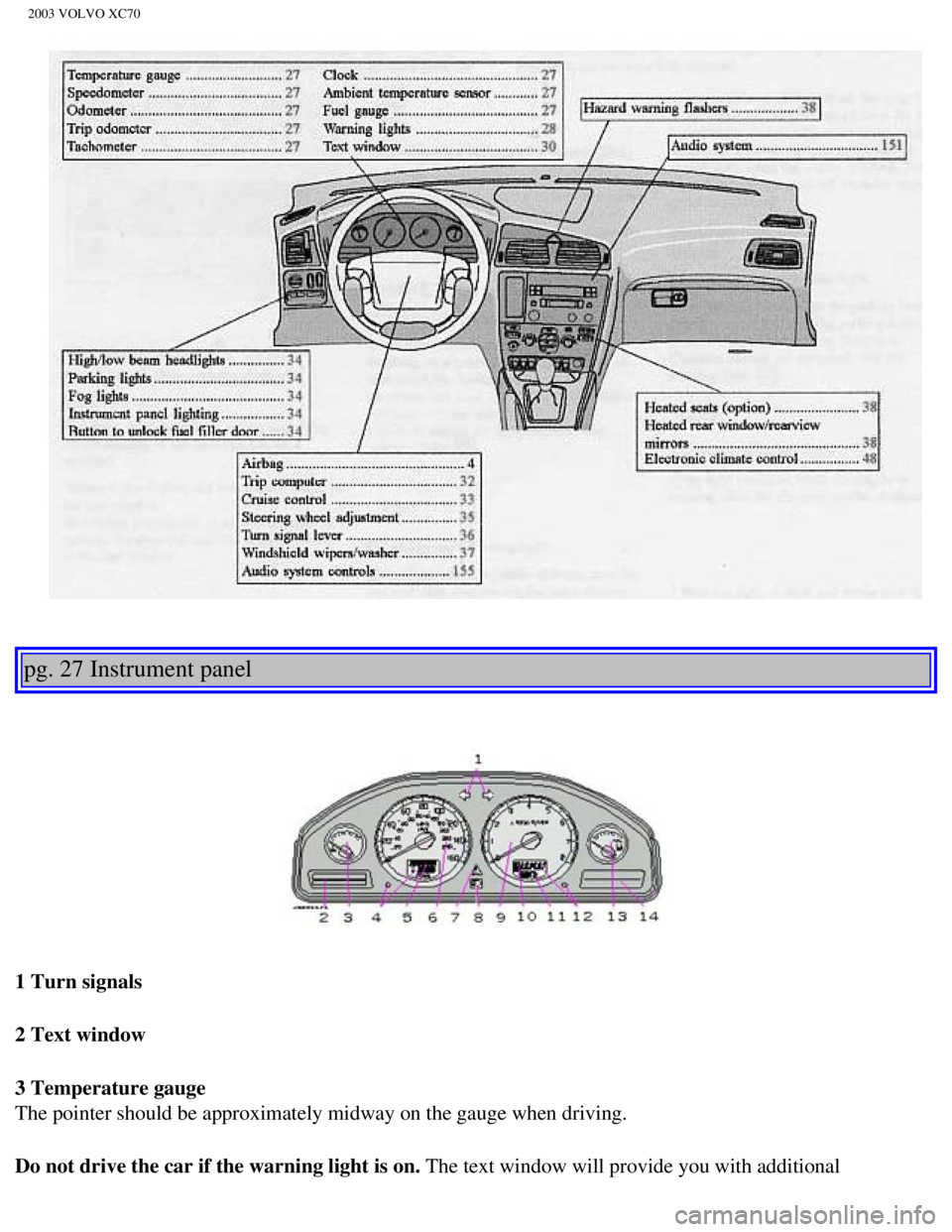
pg. 27 Instrument panel
1 Turn signals
2 Text window
3 Temperature gauge
The pointer should be approximately midway on the gauge when driving.
Do not drive the car if the warning light is on. The text window will provide you with additional
file:///K|/ownersdocs/2003/2003_XC70/03xc70_02a.htm (4 of 13)12/30/200\
6 4:17:53 PM
Page 42 of 257

2003 VOLVO XC70
information.
If the engine temperature remains high, check coolant level - see
page 131.
4 Trip odometer/reset button
The trip odometer is used for measuring shorter distances. The last digi\
t indicates 1/10 mile/kilometer. Press
the button quickly to toggle between trip odometers 1 and 2. Hold in the\
button for more than 2 seconds to
reset.
5 Odometer
6 Speedometer
7 General warning light (see
page 28).
8 High beam indicator light
9 Tachometer
Indicates engine speed in thousands of rpm. Do not drive for long with t\
he needle in the red section. The
engine has an built-in function preventing too high an engine speed. Whe\
n this function operates, you may
discern some pulsation, which is normal.
10 Gear and driving mode indicator The currently selected driving mode is displayed here. If you use the
Geartronic function on the automatic transmission, the currently selecte\
d gear will be displayed.
11 Ambient temperature indicator
This display indicates the air temperature outside your car. A "snowflak\
e" symbol in the text window is
displayed when the temperature is in the range of 23 - 36° F (-5 - +\
2° C).
Please note that this symbol does not indicate a fault with your car.
At low speeds or when the car is not moving, the temperature readings ma\
y be slightly higher than the actual
ambient temperature.
12 Clock/reset button
Turn the button to adjust the clock.
13 Fuel gauge
The fuel tank holds approximately 18.5 US gals (70 liters) or 19 US ga\
ls (72 liters) on models equipped with
All Wheel Drive.
When the warning light comes on there are approximately 1.8 US gal. (8 \
liters) of fuel remaining.
file:///K|/ownersdocs/2003/2003_XC70/03xc70_02a.htm (5 of 13)12/30/200\
6 4:17:53 PM