oil VOLVO XC70 2004 User Guide
[x] Cancel search | Manufacturer: VOLVO, Model Year: 2004, Model line: XC70, Model: VOLVO XC70 2004Pages: 241, PDF Size: 5.78 MB
Page 155 of 241

2004 VOLVO XC70
Replacing high/low beam headlight bulbs
The headlight bulbs must be replaced from the engine compartment.
CAUTION:
l Do not touch the glass on halogen bulbs with your fingers. Grease, oil o\
r any other impurities can be
carbonized onto the bulb and cause damage to the reflector.
l Be sure to use bulbs of the correct type and voltage.
Removing a defective bulb
To remove a defective low beam bulb:
l Switch off all lights and turn the ignition switch to position 0.
file:///K|/ownersdocs/2004/2004_XC70/04xc70_08a.htm (8 of 22)12/30/200\
6 4:33:05 PM
Page 165 of 241

2004 VOLVO XC70
Deep scratches
1. Place a strip of masking tape over the damaged surface. Pull the tape\
off so that any loose flakes of
paint adhere to it.
2. Thoroughly mix the primer and apply it with a small brush.
When the primer surface is dry, the paint can be applied using a brush. \
Mix the paint thoroughly; apply
several thin paint coats and let dry after each application.
3. If there is a longer scratch, you may want to protect surrounding pai\
nt by masking it off.
pg. 129 Washing the car
Washing the car
l The car should be washed at regular intervals since dirt, dust, insects \
and tar spots adhere to the paint
and may cause damage. It is particularly important to wash the car frequ\
ently in the wintertime to
prevent corrosion, when salt has been used on the roads.
l When washing the car, do not expose it to direct sunlight. Use lukewarm \
water to soften the dirt
before you wash with a sponge and plenty of water, to avoid scratching. \
l Bird droppings: Remove from paintwork as soon as possible. Otherwise the finish may be\
permanently damaged.
l A detergent can be used to facilitate the softening of dirt and oil.
l A water-soluble grease solvent may be used in cases of sticky dirt. Howe\
ver, use a wash place
equipped with a drainage separator.
l Remove dirt from the drain holes in the doors and rocker panels.
l Dry the car with a clean chamois.
l Tar spots can be removed with kerosene or tar remover after the car has \
been washed.
file:///K|/ownersdocs/2004/2004_XC70/04xc70_08a.htm (18 of 22)12/30/20\
06 4:33:05 PM
Page 167 of 241
.
l An automatic wash is a simple and quick way to clean your car, but it is\
worth remembering that it
may not be as tho")
2004 VOLVO XC70
(because the paint will not have hardened sufficiently).
l An automatic wash is a simple and quick way to clean your car, but it is\
worth remembering that it
may not be as thorough as when you yourself go over the car with sponge \
and water. Keeping the
underbody clean is most important, especially in the winter. Some automa\
tic washers do not have
facilities for washing the underbody.
l Before driving into an automatic wash, make sure that side view mirrors,\
auxiliary lamps, etc, are
secure, otherwise there is risk of the machine dislodging them.
Polishing and waxing
l Normally, polishing is not required during the first year after delivery\
. However, waxing may be
beneficial.
l Before applying polish or wax the car must be washed and dried. Tar spot\
s can be removed with
kerosene or tar remover. Difficult spots may require a fine rubbing comp\
ound.
l After polishing, use liquid or paste wax.
l Several commercially available products contain both polish and wax.
l Waxing alone does not substitute for polishing of a dull surface.
l A wide range of polymer-based car waxes can be purchased today. These wa\
xes are easy to use and
produce a long-lasting, high-gloss finish that protects the bodywork aga\
inst oxidation, road dirt and
fading.
l Do not polish or wax your car in direct sunlight (the surface of the ca\
r should not be warmer than
113° F (45° C).
Cleaning the upholstery
l The fabric can be cleaned with soapy water or a detergent. For more difficult spot\
s caused by oil, ice
cream, shoe polish, grease, etc., use a clothing/fabric stain remover.
l The plastic in the upholstery can be cleaned with a soft cloth and mild soap soluti\
on.
l Leather upholstery/suede-like upholstery (alcanteraTM) can be cleaned with a soft cloth and mild
soap solution. For more difficult spots, Volvo offers a leather care kit\
.
l Under no circumstances should gasoline, naphtha or similar cleaning agen\
ts be used on the
plastic or the leather since these can cause damage.
Cleaning the seat belts
Clean only with lukewarm water and mild soap solution.
Cleaning floor mats
The floor mats should be vacuumed or brushed clean regularly, especially\
during winter, when they
file:///K|/ownersdocs/2004/2004_XC70/04xc70_08a.htm (20 of 22)12/30/20\
06 4:33:05 PM
Page 172 of 241

2004 VOLVO XC70
coolant circulation between the engine and the expansion tank during eng\
ine warm up and cooling.
Changing coolant
Normally, the coolant does not need to be changed. If the system must be\
drained, consult your Volvo
retailer.
NOTE: Do not top off with water only. This reduces the rust-protective and ant\
ifreeze qualities of the
coolant and has a lower boiling point. It can also cause damage to the c\
ooling system if it should freeze.
Top off with Volvo Genuine Coolant/Antifreeze only.
CAUTION:
The cooling system must always be kept filled to the correct level. If i\
t is not kept filled, there can be
high local temperatures in the engine which could result in damage. Diff\
erent types of antifreeze/coolant
may not be mixed.
WARNING!
Never remove the radiator cap while the engine is warm. Wait until the c\
ar
cools.
pg. 134 Emissions maintenance
Periodic maintenance helps minimize emissions
Periodic maintenance will help keep your vehicle running well. Your Warr\
anty and Service Records
Information booklet provides a comprehensive periodic maintenance schedu\
le up to 150,000 miles
(240,000 km) of vehicle service. The schedule includes components that\
affect vehicle emissions. This
page describes some of the emission-related components.
Engine air filter
The engine air filter cleans particles from air entering the engine. Rep\
lace the engine air filter cartridge
with a new one every 37,500 miles (60,000 km) under normal driving con\
ditions. Replace the cartridge
more often when the vehicle is driven under dirty and dusty conditions. \
The cartridge cannot be cleaned,
and should always be replaced with a new one.
file:///K|/ownersdocs/2004/2004_XC70/04xc70_08b.htm (3 of 16)12/30/200\
6 4:33:06 PM
Page 176 of 241

2004 VOLVO XC70
Engine compartment
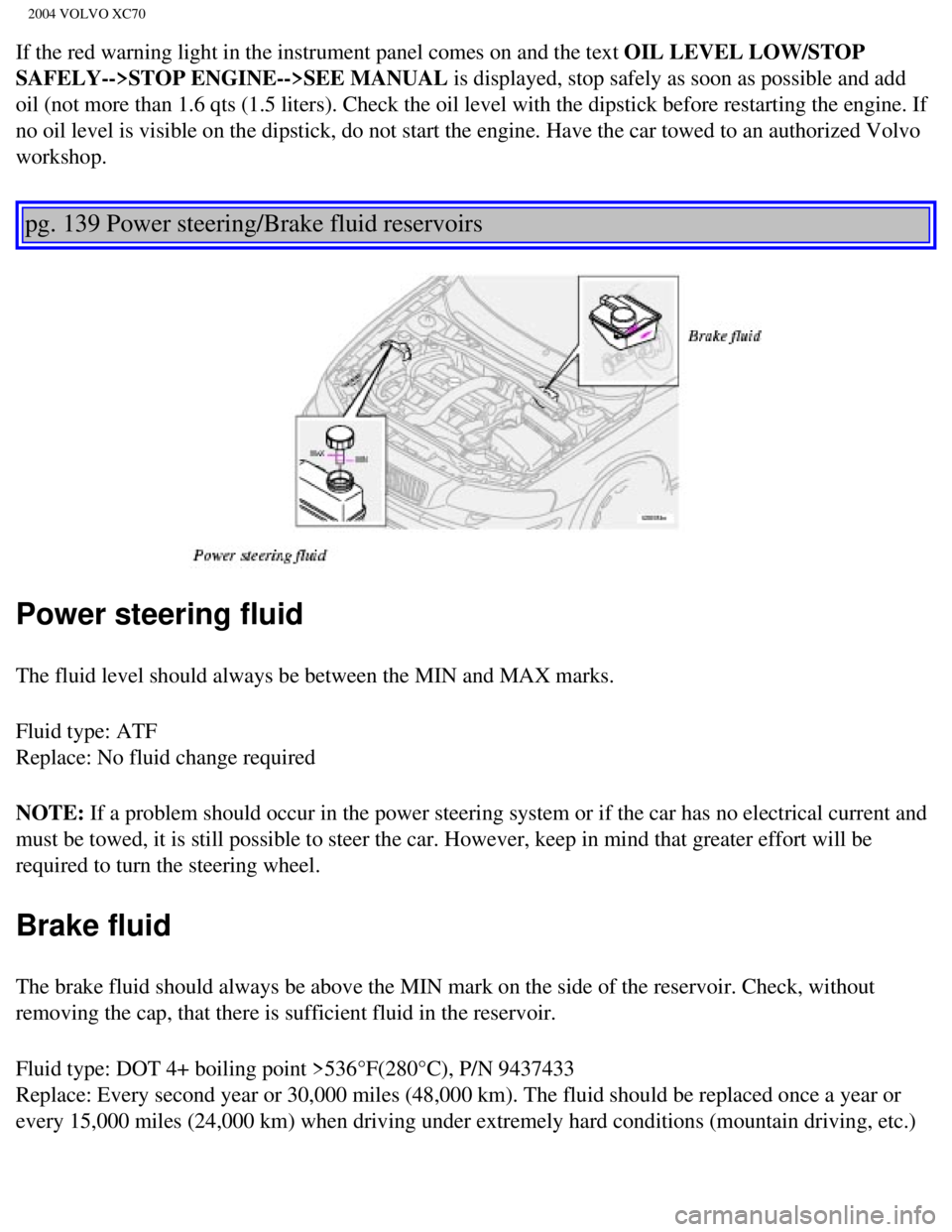
1 Expansion tank - coolant
2 Power steering fluid reservoir
3 Washer fluid reservoir
4 Dipstick - engine oil
5 Radiator/cooling fan
6 Oil filler cap - engine
7 Brake fluid reservoir
8 Relay/fuse box
9 Air cleaner
10 Battery (in the cargo compartment) WARNING!
The cooling fan may start or continue to operate (for up to 6 minutes)\
after the engine has been
switched off.
pg. 137 Engine oil
Oil quality
Engine oil must meet the minimum ILSAC specification GF-2, including ACE\
A A1, API SJ, SJ/CF and
SJ/Energy Conserving.
Your Volvo has been certified to standards using ILSAC oil specification\
GF-2 5W-30. Volvo
file:///K|/ownersdocs/2004/2004_XC70/04xc70_08b.htm (7 of 16)12/30/200\
6 4:33:06 PM
Page 177 of 241

2004 VOLVO XC70
recommends use of oil with a quality rating equal to or higher than ILSA\
C GF-2. Equivalent and better
oils include ACEA A1, API SJ, SJ/CF, and SJ/Energy conserving. Lower qua\
lity oils may not offer the
same fuel economy, engine performance, or engine protection.
Volvo Cars recommends Castrol.
Depending on your driving habits, premium or synthetic oils may provide \
superior fuel economy and
engine protection. Consult your Volvo retailer for recommendations on pr\
emium or synthetic oils.
Oil additives must not be used.
NOTE: Synthetic oil is not used when the oil is changed at the normal mainten\
ance services. This oil is
only used at customer request, at additional charge. Please consult your\
Volvo retailer.
Oil viscosity (stable ambient temperatures)
Oil viscosity (stable ambient temperatures)
Operation in temperate climates
Incorrect viscosity oil can shorten engine life. Under normal use when t\
emperatures do not exceed 86 °F
(30°C), SAE 5W/30 will provide good fuel economy and engine protect\
ion. See the viscosity chart
below.
Operation in hot climates
When temperatures exceed 86 °F (30°C) in your area, Volvo recomm\
ends, for the protection of your
engine, that you use a heavier weight oil, such as SAE 10W/30. See the v\
iscosity chart below.
Extreme engine operation
Synthetic oils meeting SAE 10W/30 and complying with oil quality require\
ments are recommended for
driving in areas of sustained temperature extremes (hot or cold), when\
towing a trailer over long
distances, and for prolonged driving in mountainous areas.
Changing oil and oil filter
Oil and oil filter changes should be made at 7,500 mile (12,000 km) in\
tervals.
The API Service Symbol
file:///K|/ownersdocs/2004/2004_XC70/04xc70_08b.htm (8 of 16)12/30/200\
6 4:33:06 PM
Page 178 of 241
2004 VOLVO XC70
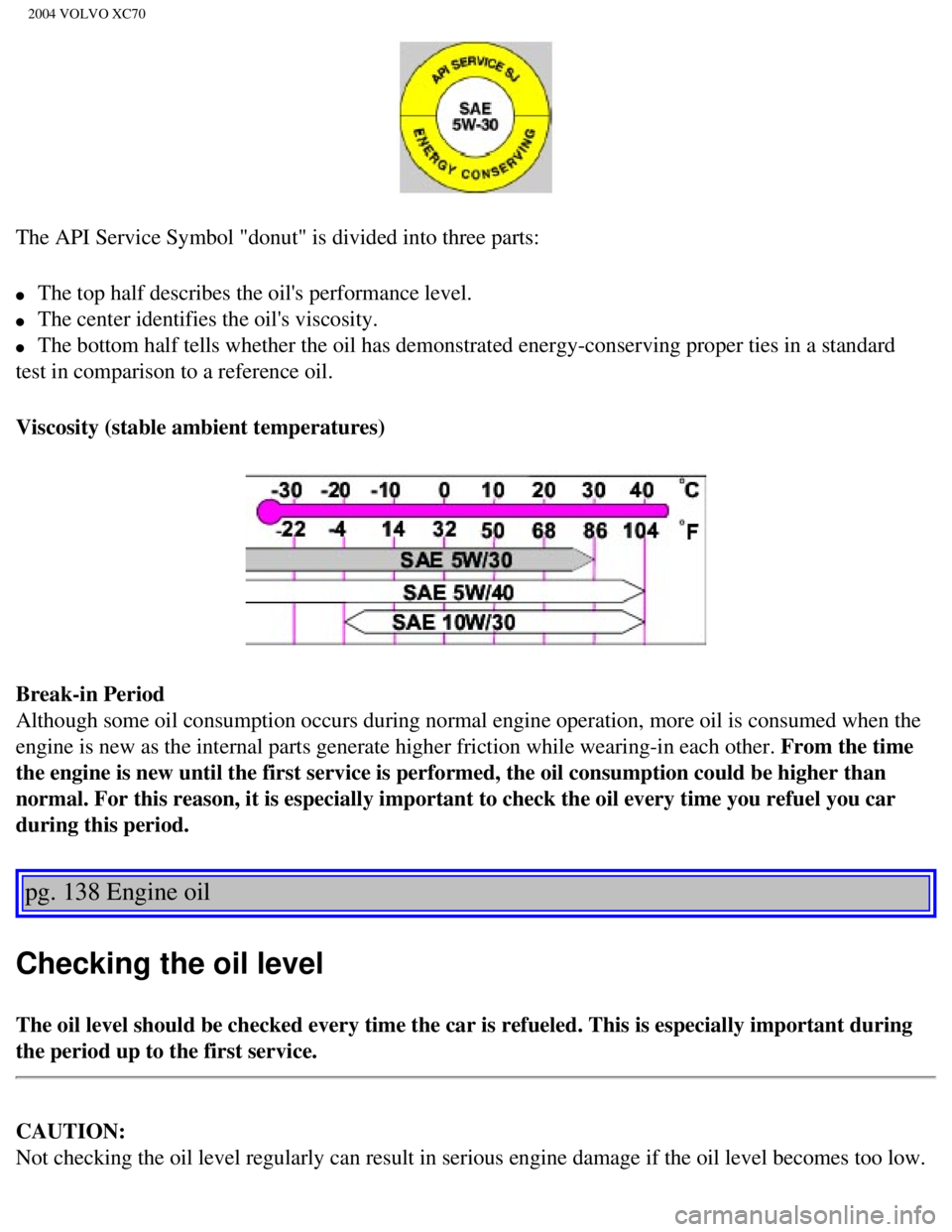
The API Service Symbol "donut" is divided into three parts:
l The top half describes the oil's performance level.
l The center identifies the oil's viscosity.
l The bottom half tells whether the oil has demonstrated energy-conserving\
proper ties in a standard
test in comparison to a reference oil.
Viscosity (stable ambient temperatures)
Break-in Period
Although some oil consumption occurs during normal engine operation, mor\
e oil is consumed when the
engine is new as the internal parts generate higher friction while weari\
ng-in each other. From the time
the engine is new until the first service is performed, the oil consumpt\
ion could be higher than
normal. For this reason, it is especially important to check the oil eve\
ry time you refuel you car
during this period.
pg. 138 Engine oil
Checking the oil level
The oil level should be checked every time the car is refueled. This is \
especially important during
the period up to the first service.
CAUTION:
Not checking the oil level regularly can result in serious engine damage\
if the oil level becomes too low.
file:///K|/ownersdocs/2004/2004_XC70/04xc70_08b.htm (9 of 16)12/30/200\
6 4:33:06 PM
Page 179 of 241

2004 VOLVO XC70
Park the car on a level surface and wait for at least 5 minutes after th\
e engine has been switched off. Be
sure the oil level is maintained between the upper and lower marks on th\
e dipstick. Low oil level can
damage the engine. Overfilling can result in high oil consumption and da\
mage the emissions system.
The distance between the dipstick marks represents approx. 1.6 US qt (1\
.5 liter). The oil should
preferably be checked when cold, before the engine has been started.
NOTE: The engine must be stopped when checking the oil. Do not fill to the max\
when the engine is
hot
WARNING!
Do not allow oil to spill onto or come into contact with hot exhaust pip\
e
surfaces.
Adding oil
l Add oil of the same kind as already used.
l Capacity (including oil filter): 6.1 US qts. (5.8 liters)
l Capacity (including oil filter and oil cooler): 7.1 US qts. (6.7 lite\
rs)
l The oil filter should be replaced at every oil change.
R-models
R-models are equipped with an oil level warning system. If the engine oi\
l level becomes too low, the
warning light in the instrument panel will come on and a warning will be\
displayed in the text window.
If the yellow warning light in the instrument panel comes on and the tex\
t OIL LEVEL LOW/FILL
OIL is displayed, stop safely as soon as possible and add 1 qt (1 liter) o\
f oil. Check the oil level with the
dipstick before restarting the engine.
file:///K|/ownersdocs/2004/2004_XC70/04xc70_08b.htm (10 of 16)12/30/20\
06 4:33:06 PM
Page 180 of 241
2004 VOLVO XC70
If the red warning light in the instrument panel comes on and the text OIL LEVEL LOW/STOP
SAFELY-->STOP ENGINE-->SEE MANUAL is displayed, stop safely as soon as possible and add
oil (not more than 1.6 qts (1.5 liters). Check the oil level with the\
dipstick before restarting the engine. If
no oil level is visible on the dipstick, do not start the engine. Have t\
he car towed to an authorized Volvo
workshop.
pg. 139 Power steering/Brake fluid reservoirs
Power steering fluid
The fluid level should always be between the MIN and MAX marks.
Fluid type: ATF
Replace: No fluid change required
NOTE: If a problem should occur in the power steering system or if the car ha\
s no electrical current and
must be towed, it is still possible to steer the car. However, keep in m\
ind that greater effort will be
required to turn the steering wheel.
Brake fluid
The brake fluid should always be above the MIN mark on the side of the r\
eservoir. Check, without
removing the cap, that there is sufficient fluid in the reservoir.
Fluid type: DOT 4+ boiling point >536°F(280°C), P/N 9437433
Replace: Every second year or 30,000 miles (48,000 km). The fluid shou\
ld be replaced once a year or
every 15,000 miles (24,000 km) when driving under extremely hard condi\
tions (mountain driving, etc.)
file:///K|/ownersdocs/2004/2004_XC70/04xc70_08b.htm (11 of 16)12/30/20\
06 4:33:06 PM
Page 186 of 241
2004 VOLVO XC70
2 0 0 4
VOLVO XC70
Chapter 9 - Specifications
pg. 143 Specifications
Label information 144
Dimensions and weights 145
Engine specifications 147
Oil/fluid specifications and volumes 148
Fuel system, Distributor ignition system,
Suspension 149
Electrical system 150
Volvo On Call Roadside Assistance 151
pg. 144 Label information
1 Vehicle Emission Control Information
Your Volvo is designed to meet all applicable emission standards, as evi\
denced by the certification label
on the underside of the hood. For further information regarding these re\
gulations, please consult your
Volvo retailer.
2 Vacuum hose routing
(underside of hood)
3 Loads and Tire Pressures
(on inside of fuel filler door)
4 Model plate
file:///K|/ownersdocs/2004/2004_XC70/04xc70_09.htm (1 of 12)12/30/2006\
4:33:07 PM