EGR VOLVO XC70 2007 Owners Manual
[x] Cancel search | Manufacturer: VOLVO, Model Year: 2007, Model line: XC70, Model: VOLVO XC70 2007Pages: 283, PDF Size: 9.63 MB
Page 7 of 283

2007 Volvo XC70
2 0 0 7
VOLVO XC70
Safety
pg. 9 Safety
Occupant safety, Reporting safety
defects
10
Seat belts
12
Supplemental Restraint System (SRS)
15
Front airbags
16
Occupant Weight Sensor (OWS)
20
Side impact (SIPS) airbag
24
Volvo Inflatable Curtain (VIC)
25
Whiplash Protection System (WHIPS)
26
Child safety
28
Infant seats
33
Convertible seats
35
Booster cushions
37
ISOFIX lower anchors
38
Top tether anchors
39
Integrated booster cushion
40
pg. 10 Safety
Occupant safety, Reporting safety defects
Volvo concern for safety
Safety is the Volvo cornerstone. Our concern dates back to 1927 when the\
first Volvo rolled off the
production line. Three-point seat belts (a Volvo invention), safety ca\
ges, and energy-absorbing impact
file:///K|/ownersdocs/2007/2007_XC70/07xc70_01.htm (1 of 38)12/30/2006\
5:51:26 PM
Page 42 of 283

2007 Volvo XC70
WARNING!
l Never route a top tether strap over the top or around the head restraint\
. It should always be routed
under the head restraint.
l Child restraint anchorages are designed to withstand only those loads im\
posed by correctly fitted
child restraints. Under no circumstances are they to be used for adult s\
eat belts or harnesses. The
anchorages are not able to withstand excessive forces on them in the eve\
nt of collision if full harness
seat belts or adult seat belts are installed to them. An adult who uses \
a belt anchored in a child
restraint anchorage runs a great risk of suffering severe injuries shoul\
d a collision occur.
l Do not install rear speakers that require the removal of the top tether \
anchors or interfere with the
proper use of the top tether strap.
pg. 40 Safety
Integrated booster cushion
Integrated booster cushion (option)
Volvo's own integrated booster cushion has been specially designed to he\
lp safeguard a child seated in
the center position of the rear seat. When using the integrated booster \
cushion, the child must be secured
with the vehicle's three-point seat belt.
Use this booster cushion only with children who weigh between 33 and 80 \
lbs (15 and 36 kg) and whose
height is between 38 and 54 in (97 and 137 cm). In Canada, Transport C\
anada's weight recommendation
is 40-80 lbs (18-36 kg).
The booster cushion is designed to raise the child higher, so that the s\
houlder strap crosses over the
child's collarbone, not over the child's neck. If using a booster cushio\
n does not result in proper
positioning of the shoulder strap, then the child should be placed in a \
properly secured child restraint
(see the information beginning on
page 31). The shoulder belt must never be placed behind the child's
file:///K|/ownersdocs/2007/2007_XC70/07xc70_01.htm (36 of 38)12/30/200\
6 5:51:26 PM
Page 43 of 283

2007 Volvo XC70
back or under the arm.
WARNING!
l DEATH or SERIOUS INJURY can occur.
l Follow all instructions on the booster cushion and in the vehicle's owne\
r's manual.
l MAKE SURE THE BOOSTER CUSHION IS SECURELY LOCKED BEFORE THE CHILD IS
SEATED.
l Use this booster cushion only with children who weigh between 33 and 80 \
lbs (15 and 36 kg) and
whose height is between 38 and 54 in (97 and 137 cm). In Canada, Trans\
port Canada's weight
recommendation is 40-80 lbs (18-36 kg).
WARNING!
In the event of a collision while the integrated booster cushion was occ\
upied, the entire booster
cushion and seat belt must be replaced. The booster cushion should also \
be replaced if it is badly
worn or damaged in any way. This work should be performed by an authoriz\
ed Volvo retailer only.
Canada only: This cushion may be referred to as a built-in booster cushi\
on.
pg. 41 Safety
Integrated booster cushion
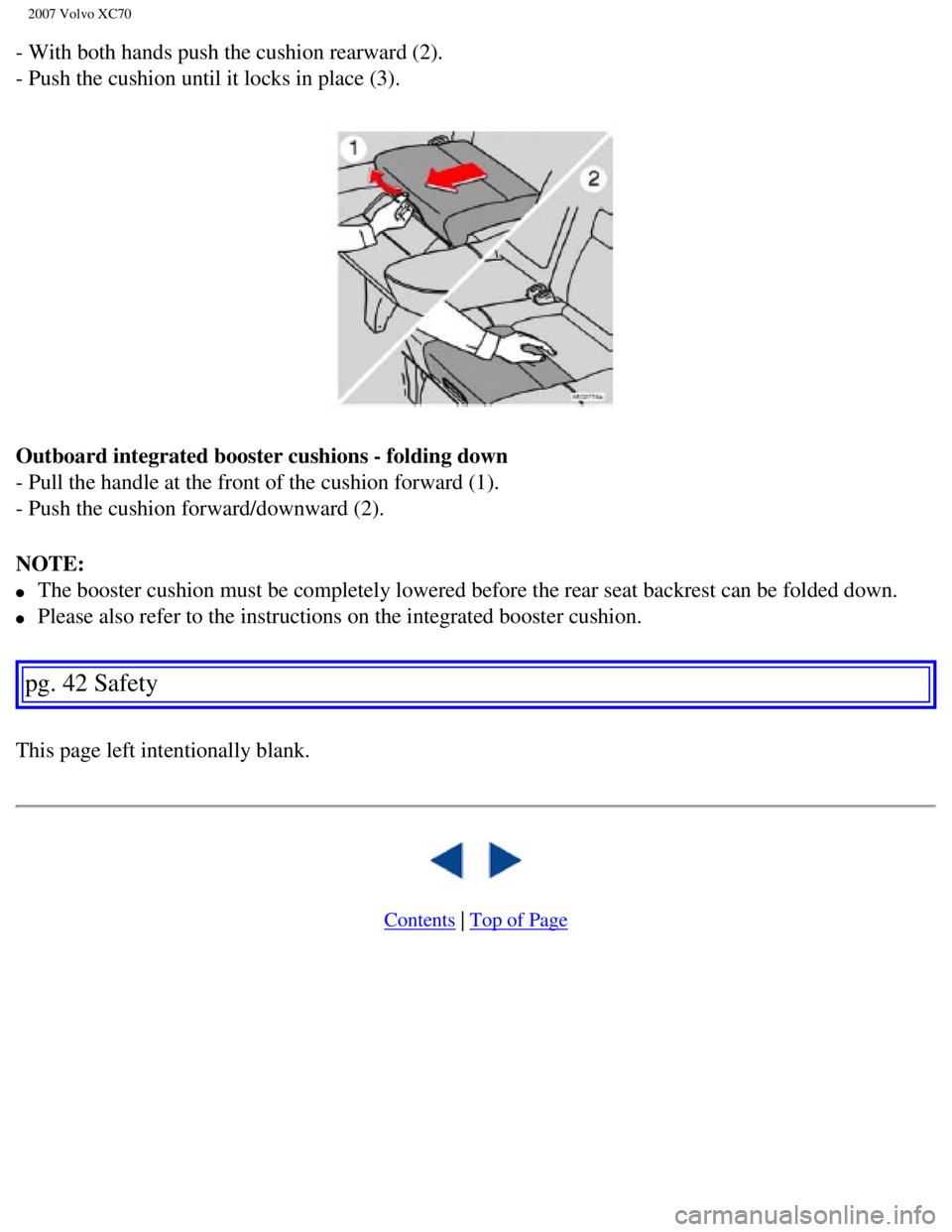
Outboard integrated booster cushions - folding up
- Pull the handle at the front of the cushion forward (1).
file:///K|/ownersdocs/2007/2007_XC70/07xc70_01.htm (37 of 38)12/30/200\
6 5:51:26 PM
Page 44 of 283
2007 Volvo XC70
- With both hands push the cushion rearward (2).
- Push the cushion until it locks in place (3).
Outboard integrated booster cushions - folding down
- Pull the handle at the front of the cushion forward (1).
- Push the cushion forward/downward (2).
NOTE:
l The booster cushion must be completely lowered before the rear seat back\
rest can be folded down.
l Please also refer to the instructions on the integrated booster cushion.\
pg. 42 Safety
This page left intentionally blank.
Contents | Top of Page
file:///K|/ownersdocs/2007/2007_XC70/07xc70_01.htm (38 of 38)12/30/200\
6 5:51:26 PM
Page 73 of 283

2007 Volvo XC70
Rearview mirror
To reduce glare from the headlights of following vehicles, use the contr\
ol to switch between the normal
and night-driving positions.
A. Normal position
B. Night position, reduces glare from following headlights
Autodim function (option)
The autodim function reacts to headlights from following traffic and aut\
omatically reduces glare.
NOTE: This function is automatically switched off when the gear selector is p\
laced in the Reverse
position.
Rearview mirror with compass (option)
The upper left-hand corner of the rearview mirror has an integrated disp\
lay that shows the compass
direction toward which the car is pointing. Eight different directions c\
an be displayed: N, NE, E, SE, S,
SW, W and NW. The display shows your car's orientation with respect to t\
rue north.
If the compass is activated, it will be displayed automatically when the\
ignition is in postilion II or when
the engine is running. The compass can be switched off or on by pressing\
the inset button on the rear
file:///K|/ownersdocs/2007/2007_XC70/07xc70_02.htm (29 of 35)12/30/200\
6 5:51:30 PM
Page 122 of 283

2007 Volvo XC70
using the lock button on the door and the door is then closed. A sound f\
rom the lock will be audible at
this time.
Please note that this function will not unlock the doors if the engine i\
s running.
Immobilizer (start inhibitor)
Each of the keys supplied with your vehicle contains a coded transmitter\
. The code in the key is
transmitted to an antenna in the ignition switch where it is compared to\
the code stored in the start
inhibitor module. The vehicle will start only with a properly coded key.\
Each key has a unique code, which your Volvo retailer uses if new keys a\
re required. A maximum of six
remote controls/keys can be programmed and used for one vehicle.
If you misplace a key, take the other keys to an authorized Volvo retail\
er for reprogramming as an
antitheft measure.
NOTE: This device complies with part 15 of the FCC rules. Operation is subjec\
t to the following
condition: (1) This device may not cause harmful interference, and (2\
) this device must accept any
interference received, including interference that may cause undesired o\
peration.
pg. 111 Locks and alarm
Remote control
Your vehicle is equipped with two coded remote control transmitters with\
integrated ignition keys called
Key Integrated Remote (KIR). These transmitters use a radio frequency \
that will enable you to lock/
unlock all doors and the tailgate from a distance of 10-15 feet (3-5 me\
ters).
The transmitters will also activate or allow "keyless" entry into the pa\
ssenger compartment or the
tailgate. They will also activate or deactivate your vehicle's alarm sys\
tem(s). The vehicle can also be
locked/ unlocked with the key.
If one of the transmitters is misplaced, contact your nearest authorized\
Volvo retailer for replacement.
file:///K|/ownersdocs/2007/2007_XC70/07xc70_05.htm (3 of 12)12/30/2006\
5:51:34 PM
Page 154 of 283

If the warning lamp lights up there is a malfunction of the ABS system (\
the standard braking system will
however function) and the vehicle should be drive")
2007 Volvo XC70
Anti-lock brakes (ABS)
If the warning lamp lights up there is a malfunction of the ABS system (\
the standard braking system will
however function) and the vehicle should be driven cautiously to a Volv\
o retailer for inspection. The
Anti-lock Braking System (ABS) helps to improve vehicle control (stop\
ping and steering) during severe
braking conditions by limiting brake lockup. When the system "senses" im\
pending lockup, braking
pressure is automatically modulated in order to help prevent lockup, whi\
ch could lead to a skid.
The system performs a self-diagnostic test when the engine is started an\
d when the vehicle first
reaches a speed of approximately 12 mph (20 km/h). The brake pedal will pulsate several times and a
sound may be audible from the ABS control module. This is normal.
To obtain optimal effect from the ABS system, constant pressure should b\
e kept on the brake pedal. Do
not pump the brake pedal.
The switching of the ABS modulator will be audible and the brake pedal w\
ill pulsate during braking.
Please be aware that ABS does not increase the absolute braking potentia\
l of the vehicle. While control
will be enhanced, ABS will not shorten stopping distances on slippery su\
rfaces.
ABS with EBD (Electronic Brake Force Distribution)
EBD is an integrated part of the ABS system. EBD regulates the hydraulic\
pressure to the rear brakes to
help provide optimal braking capacity. The brake pedal will pulsate duri\
ng braking, which is normal.
If the BRAKE and ABS warning lights come on at the same time, this could\
indicate a fault in the brake
system.
- Stop the vehicle in a suitable place and switch off the engine.
- Restart the engine.
- If both warning lights go off, no further action is required.
- If both lights are still on after the engine has been restarted, switc\
h off the engine again and check the
brake fluid level (see
page 193 for the location of the brake fluid reservoir).
WARNING!
If the fluid level is below the MIN mark in the reservoir or if a "Brake\
failure - Service urgent"
message is displayed in the text window: DO NOT DRIVE. Have the vehicle \
towed to a Volvo
retailer and have the brake system inspected.
- If the brake fluid level is above the MIN mark, drive carefully to an \
authorized Volvo retailer and have
the brake system inspected.
Emergency Brake Assistance (EBA)
The EBA function is designed to provide full brake effect immediately in\
the event of sudden, hard
braking. The system is activated by the speed with which you depress the\
brake pedal.
file:///K|/ownersdocs/2007/2007_XC70/07xc70_06.htm (23 of 41)12/30/200\
6 5:51:38 PM
Page 155 of 283

2007 Volvo XC70
NOTE:
l When the EBA system is activated, the brake pedal will go down and press\
ure in the brake system
immediately increases to the maximum level. You must maintain full press\
ure on the brake pedal in
order to utilize the system completely. There will be no braking effect \
if the pedal is
pg. 138 Starting and driving
Brake system
released. EBA is automatically deactivated when the brake pedal is relea\
sed.
l When the vehicle has been parked for some time, the brake pedal may sink\
more than usual when the
engine is started. This is normal and the pedal will return to its usual\
position when it is released.
pg. 139 Starting and driving
Stability system
Stability Traction Control (STC)/ Dynamic Stability Traction Control (\
DSTC)
The stability system consists of a number of functions designed help red\
uce wheel spin, counteract
skidding, and to generally help improve directional stability.
NOTE: A pulsating sound will be audible when the system is actively operating\
and is normal.
1. Standard on all models except the T5 turbo and R-models. Models equip\
ped with All Wheel Drive (AWD)
have an integrated traction control function, and are not equipped with \
an STC button. DSTC is optional on
AWD models.
2. Standard on the T5 turbo and R-models, option on all other models.
Traction control (TC)
This function is designed to help reduce wheel spin by transferring powe\
r from a drive wheel that begins
to lose traction to the wheel on the opposite side of the vehicle (on t\
he same axle).
TC is most active at low speeds.
This is one of the STC/DSTC's permanent functions and cannot be switched\
off.
file:///K|/ownersdocs/2007/2007_XC70/07xc70_06.htm (24 of 41)12/30/200\
6 5:51:38 PM
Page 168 of 283
. Se")
2007 Volvo XC70
Load carrier cover
The vehicle's ignition key or the stud on the edge of the supplied torqu\
e wrench can be used to undo or
tighten the cover. Turn a quarter turn (90 degrees). See illustration.\
pg. 151 Starting and driving
Cold weather precautions
If you wish to check your vehicle before the approach of cold weather, t\
he following advice is worth
noting:
l Make sure that the engine coolant contains 50 percent antifreeze. Any ot\
her mixture will reduce
freeze protection. This gives protection against freezing down to -31°\
F (-35°C). See section "Coolant".
The use of "recycled" antifreeze is not approved by Volvo. Different typ\
es of antifreeze must not
be mixed.
l Volvo recommends using only genuine Volvo antifreeze in your vehicle's r\
adiator. Your Volvo
retailer stocks plenty of Volvo engine coolant to protect your vehicle d\
uring cold weather.
l Try to keep the fuel tank well filled - this prevents the formation of condensation in the tank. \
In
addition, in extremely cold weather conditions it is worthwhile to add f\
uel line de-icer before refueling.
l The viscosity of the engine oil is important. Oil with low viscosity (thinner oil) improves cold-
weather starting as well as decreasing fuel consumption while the engine\
is warming up. For winter use,
5W-30 oil, particularly the synthetic type
1, is recommended. Be sure to use good quality oil but do not
use cold-weather oil for hard driving or in warm weather. See section "E\
ngine oil" for more information.
l The load placed on the battery is greater during the winter since the windshield wipers, lighting, etc\
.
are used more often. Moreover, the capacity of the battery decreases as \
the temperature drops. In very
cold weather, a poorly charged battery can freeze and be damaged. It is \
therefore advisable to check the
state of charge more frequently and spray an antirust oil on the battery\
posts.
l Volvo recommends the use of snow tires on all four wheels for winter driving - see section "Wheels
and tires."
l To prevent the washer fluid reservoir from freezing, add washer solvents containing antifreeze (see
file:///K|/ownersdocs/2007/2007_XC70/07xc70_06.htm (37 of 41)12/30/200\
6 5:51:38 PM
Page 174 of 283

2007 Volvo XC70
surfaces.
Certain models are equipped with "all-season" tires, which provide a som\
ewhat higher degree of road
holding on slippery surfaces than tires without the "all-season" rating.\
However, for optimum road
holding on icy or snow-covered roads, we recommend suitable winter tires\
on all four wheels.
When replacing tires, be sure that the new tires are the same size desig\
nation, type (radial) and
preferably from the same manufacturer, on all four wheels. Otherwise the\
re is a risk of altering the
vehicle's roadholding and handling characteristics.
Storing wheels and tires
When storing complete wheels (tires mounted on rims), they should be s\
uspended off the floor or placed
on their sides on the floor.
Tires not mounted on rims should be stored on their sides or standing up\
right, but should not be
suspended. CAUTION!
Tires should preferably be stored in a cool, dry, dark place, and should\
never be stored in close
proximity to solvents, gasoline, oils, etc.
Tread wear indicator
The tires have wear indicator strips running across or parallel to the t\
read. The letters TWI are printed on
the side of the tire. When approximately 1/16" (1.6 mm) is left on the\
tread, these strips become visible
and indicate that the tire should be replaced. Tires with less than 1/16\
" (1.6 mm) tread offer very poor
traction.
When replacing worn tires, it is recommended that the tire be identical \
in type (radial) and size as the
one being replaced. Using a tire of the same make (manufacturer) will \
prevent alteration of the driving
characteristics of the vehicle.
file:///K|/ownersdocs/2007/2007_XC70/07xc70_07.htm (2 of 24)12/30/2006\
5:51:40 PM