ECU VOLVO XC70 2013 Owner´s Manual
[x] Cancel search | Manufacturer: VOLVO, Model Year: 2013, Model line: XC70, Model: VOLVO XC70 2013Pages: 382, PDF Size: 6.78 MB
Page 227 of 382
06 Infotainment
Radio
06
* Option/accessory, for more information, see Introduction.225 General functions
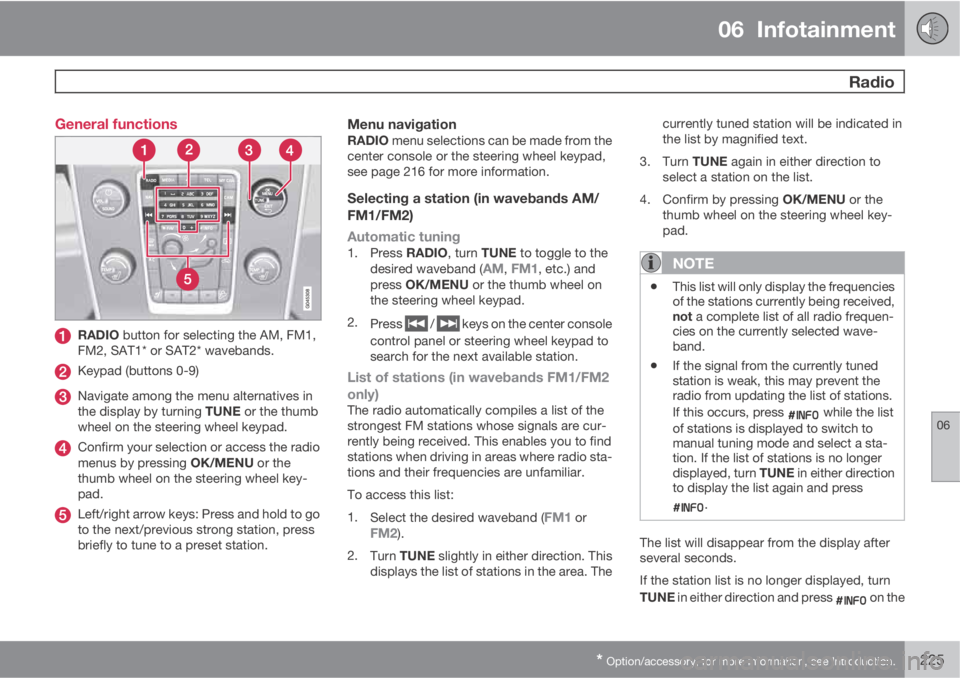
RADIO button for selecting the AM, FM1,
FM2, SAT1* or SAT2* wavebands.
Keypad (buttons 0-9)
Navigate among the menu alternatives in
the display by turning TUNE or the thumb
wheel on the steering wheel keypad.
Confirm your selection or access the radio
menus by pressing OK/MENU or the
thumb wheel on the steering wheel key-
pad.
Left/right arrow keys: Press and hold to go
to the next/previous strong station, press
briefly to tune to a preset station.
Menu navigationRADIO menu selections can be made from the
center console or the steering wheel keypad,
see page 216 for more information.
Selecting a station (in wavebands AM/
FM1/FM2)
Automatic tuning
1.
Press RADIO, turn TUNE to toggle to the
desired waveband (AM, FM1, etc.) and
press OK/MENU or the thumb wheel on
the steering wheel keypad.
2.
Press
/ keys on the center console
control panel or steering wheel keypad to
search for the next available station.
List of stations (in wavebands FM1/FM2
only)
The radio automatically compiles a list of the
strongest FM stations whose signals are cur-
rently being received. This enables you to find
stations when driving in areas where radio sta-
tions and their frequencies are unfamiliar.
To access this list:
1.
Select the desired waveband (
FM1 orFM2).
2.
Turn TUNE slightly in either direction. This
displays the list of stations in the area. Thecurrently tuned station will be indicated in
the list by magnified text.
3.
Turn TUNE again in either direction to
select a station on the list.
4.
Confirm by pressing OK/MENU or the
thumb wheel on the steering wheel key-
pad.
NOTE
•This list will only display the frequencies
of the stations currently being received,
not a complete list of all radio frequen-
cies on the currently selected wave-
band.
•If the signal from the currently tuned
station is weak, this may prevent the
radio from updating the list of stations.
If this occurs, press
while the list
of stations is displayed to switch to
manual tuning mode and select a sta-
tion. If the list of stations is no longer
displayed, turn TUNE in either direction
to display the list again and press
.
The list will disappear from the display after
several seconds.
If the station list is no longer displayed, turn
TUNE in either direction and press
on the
Page 278 of 382
07 During your trip
Loading
07
276* Option/accessory, for more information, see Introduction.
Introduction
The load carrying capacity of your vehicle is
determined by factors such as the number of
passengers, the amount of cargo, the weight
of any accessories that may be installed, etc.
To increase loading space, the rear seat back-
rests can be folded down, see page 87.
When loading the cargo area, keep the follow-
ing in mind:
•Load objects in the cargo area against the
backrest whenever possible.
•Unstable loads can be secured to the load
anchoring eyelets with straps or web lash-
ings to help keep them from shifting.
•Stop the engine and apply the parking
brake when loading or unloading long
objects. The gear selector can be knocked
out of position by long loads, which could
set the vehicle in motion.
WARNING
•Stop the engine, put the gear selector in
P, and apply the parking brake when
loading or unloading long objects.
•The vehicle's driving characteristics
may change depending on the weight
and distribution of the load.
•A 44-pound (20 kg) object produces a
force of 2,200 pounds (1,000 kg) in a
head-on collision at 30 mph (50 km/h).
•The cargo area and rear seat should not
be loaded to a level higher than 2 in.
(5 cm) below the upper edge of the rear
side windows. Objects placed higher
than this level could impede the func-
tion of the Inflatable Curtain.
Power tailgate*
G017876
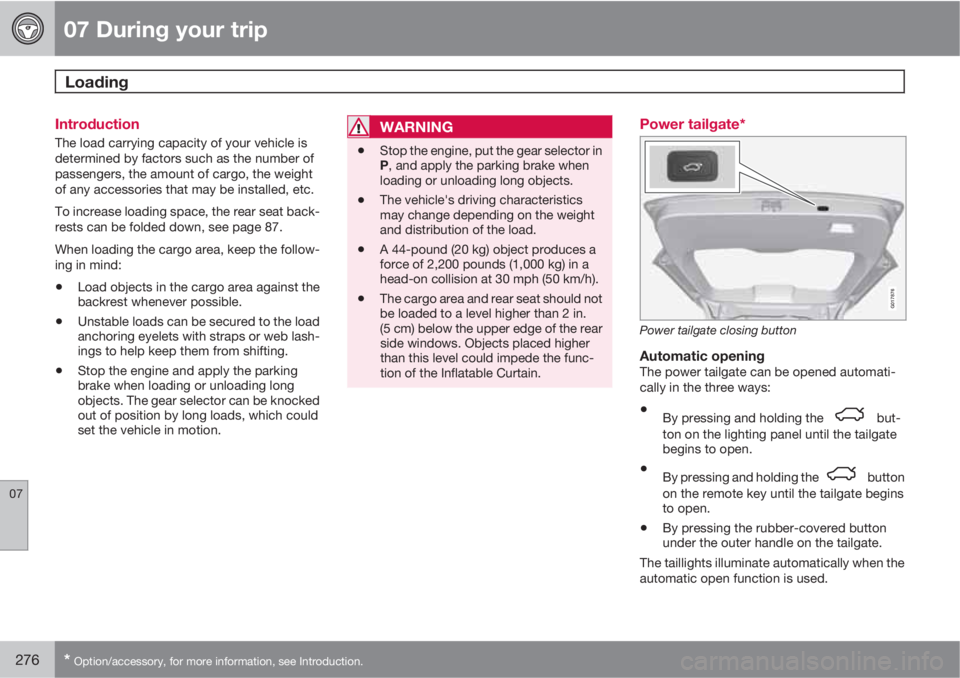
Power tailgate closing button
Automatic openingThe power tailgate can be opened automati-
cally in the three ways:
•By pressing and holding the but-
ton on the lighting panel until the tailgate
begins to open.
•By pressing and holding the button
on the remote key until the tailgate begins
to open.
•By pressing the rubber-covered button
under the outer handle on the tailgate.
The taillights illuminate automatically when the
automatic open function is used.
Page 280 of 382
07 During your trip
Loading
07
278
ing the outer handle twice. The tailgate can
then be opened/closed manually.
Folding down the rear seat backrests
The rear seat backrests can be folded down for
additional loading space, see page 89.
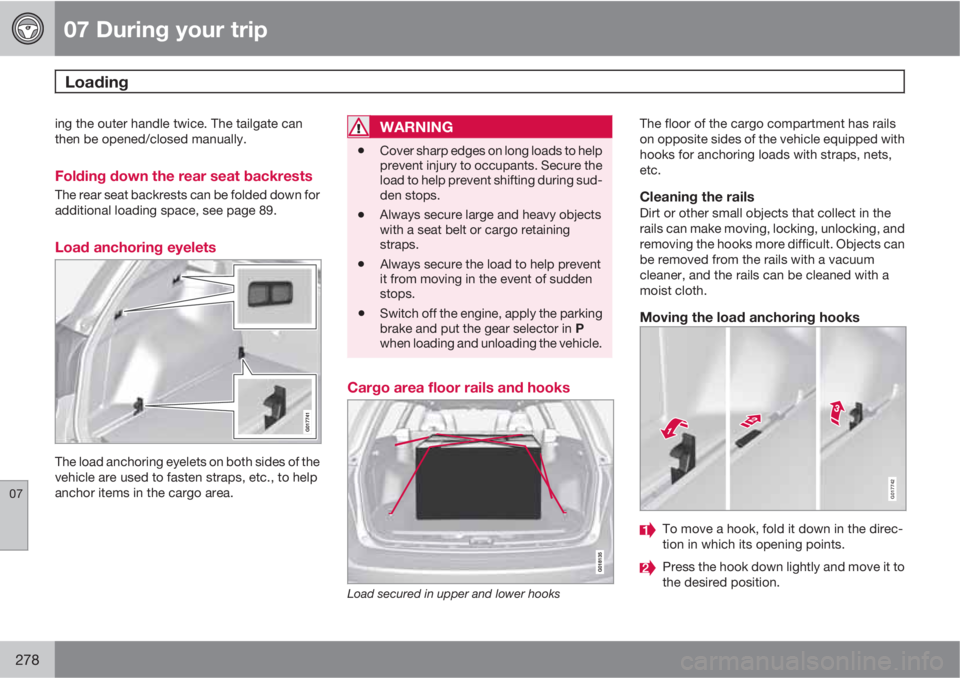
Load anchoring eyelets
The load anchoring eyelets on both sides of the
vehicle are used to fasten straps, etc., to help
anchor items in the cargo area.
WARNING
•Cover sharp edges on long loads to help
prevent injury to occupants. Secure the
load to help prevent shifting during sud-
den stops.
•Always secure large and heavy objects
with a seat belt or cargo retaining
straps.
•Always secure the load to help prevent
it from moving in the event of sudden
stops.
•Switch off the engine, apply the parking
brake and put the gear selector in P
when loading and unloading the vehicle.
Cargo area floor rails and hooks
Load secured in upper and lower hooks
The floor of the cargo compartment has rails
on opposite sides of the vehicle equipped with
hooks for anchoring loads with straps, nets,
etc.
Cleaning the railsDirt or other small objects that collect in the
rails can make moving, locking, unlocking, and
removing the hooks more difficult. Objects can
be removed from the rails with a vacuum
cleaner, and the rails can be cleaned with a
moist cloth.
Moving the load anchoring hooks
G017742
To move a hook, fold it down in the direc-
tion in which its opening points.
Press the hook down lightly and move it to
the desired position.
Page 281 of 382
07 During your trip
Loading
07
279
Fold up the hook. It will lock in place.
NOTE
There should be at least 2 in. (50 cm)
between the hooks in the rail.
WARNING
Switch off the engine, apply the parking
brake and put the gear selector in P when
loading and unloading the vehicle.
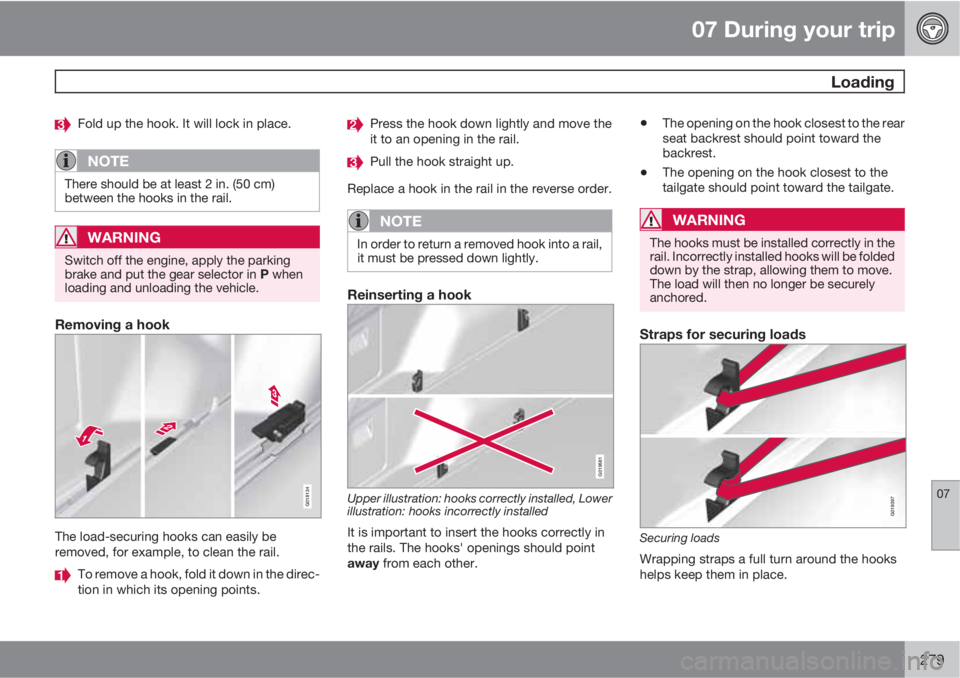
Removing a hook
G018134
The load-securing hooks can easily be
removed, for example, to clean the rail.
To remove a hook, fold it down in the direc-
tion in which its opening points.
Press the hook down lightly and move the
it to an opening in the rail.
Pull the hook straight up.
Replace a hook in the rail in the reverse order.
NOTE
In order to return a removed hook into a rail,
it must be pressed down lightly.
Reinserting a hook
G019581
Upper illustration: hooks correctly installed, Lower
illustration: hooks incorrectly installed
It is important to insert the hooks correctly in
the rails. The hooks' openings should point
away from each other.
•The opening on the hook closest to the rear
seat backrest should point toward the
backrest.
•The opening on the hook closest to the
tailgate should point toward the tailgate.
WARNING
The hooks must be installed correctly in the
rail. Incorrectly installed hooks will be folded
down by the strap, allowing them to move.
The load will then no longer be securely
anchored.
Straps for securing loads
G019397
Securing loads
Wrapping straps a full turn around the hooks
helps keep them in place.
Page 282 of 382
07 During your trip
Loading
07
280* Option/accessory, for more information, see Introduction.
NOTE
The straps should preferably be approxi-
mately 1 in. (25 mm) in width.
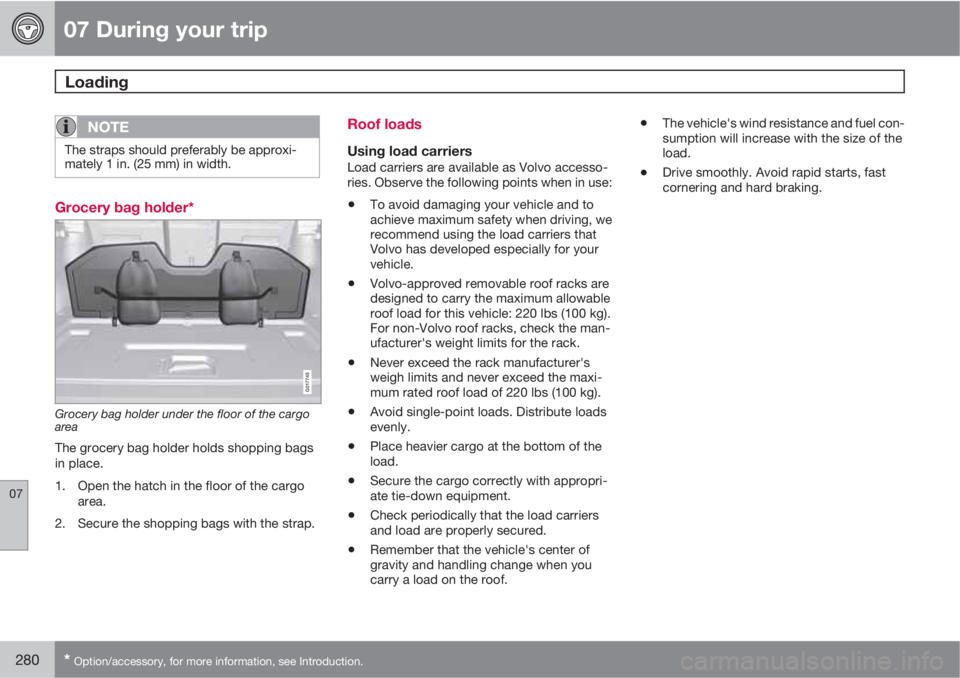
Grocery bag holder*
G017745
Grocery bag holder under the floor of the cargo
area
The grocery bag holder holds shopping bags
in place.
1. Open the hatch in the floor of the cargo
area.
2. Secure the shopping bags with the strap.
Roof loads
Using load carriersLoad carriers are available as Volvo accesso-
ries. Observe the following points when in use:
•To avoid damaging your vehicle and to
achieve maximum safety when driving, we
recommend using the load carriers that
Volvo has developed especially for your
vehicle.
•Volvo-approved removable roof racks are
designed to carry the maximum allowable
roof load for this vehicle: 220 lbs (100 kg).
For non-Volvo roof racks, check the man-
ufacturer's weight limits for the rack.
•Never exceed the rack manufacturer's
weigh limits and never exceed the maxi-
mum rated roof load of 220 lbs (100 kg).
•Avoid single-point loads. Distribute loads
evenly.
•Place heavier cargo at the bottom of the
load.
•Secure the cargo correctly with appropri-
ate tie-down equipment.
•Check periodically that the load carriers
and load are properly secured.
•Remember that the vehicle's center of
gravity and handling change when you
carry a load on the roof.
•The vehicle's wind resistance and fuel con-
sumption will increase with the size of the
load.
•Drive smoothly. Avoid rapid starts, fast
cornering and hard braking.
Page 284 of 382
07 During your trip
Cargo area
07
282* Option/accessory, for more information, see Introduction.
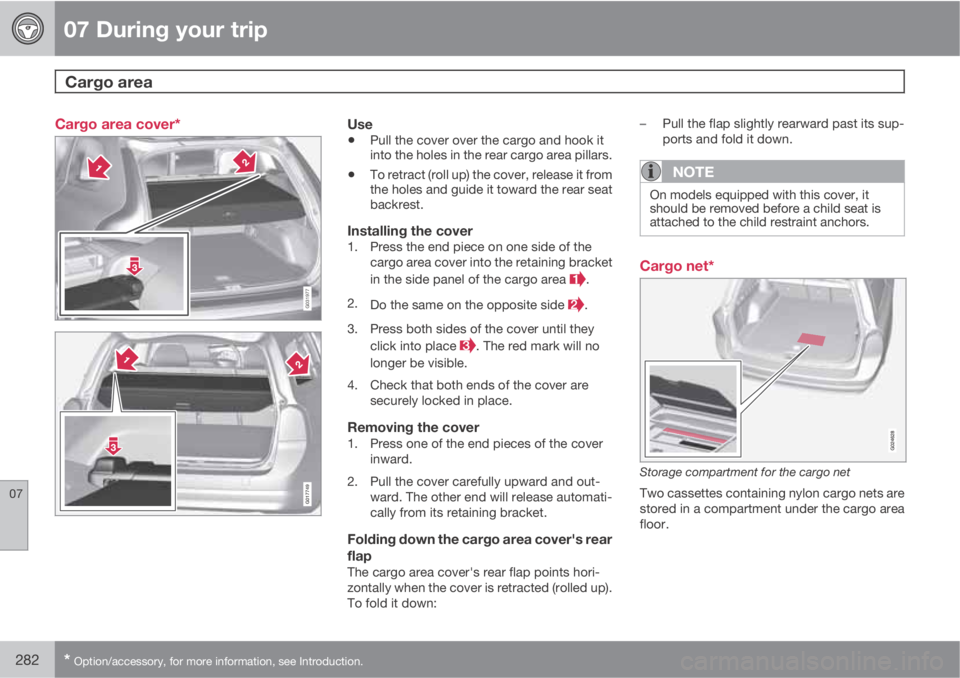
Cargo area cover*
G031977
G017749
Use
•Pull the cover over the cargo and hook it
into the holes in the rear cargo area pillars.
•To retract (roll up) the cover, release it from
the holes and guide it toward the rear seat
backrest.
Installing the cover1. Press the end piece on one side of the
cargo area cover into the retaining bracket
in the side panel of the cargo area
.
2.
Do the same on the opposite side
.
3. Press both sides of the cover until they
click into place
. The red mark will no
longer be visible.
4. Check that both ends of the cover are
securely locked in place.
Removing the cover1. Press one of the end pieces of the cover
inward.
2. Pull the cover carefully upward and out-
ward. The other end will release automati-
cally from its retaining bracket.
Folding down the cargo area cover's rear
flap
The cargo area cover's rear flap points hori-
zontally when the cover is retracted (rolled up).
To fold it down:–Pull the flap slightly rearward past its sup-
ports and fold it down.
NOTE
On models equipped with this cover, it
should be removed before a child seat is
attached to the child restraint anchors.
Cargo net*
Storage compartment for the cargo net
Two cassettes containing nylon cargo nets are
stored in a compartment under the cargo area
floor.
Page 285 of 382
07 During your trip
Cargo area
07
283
Attaching the cassette(s)
The two-sections of the net are attached to the
rear side of the rear seat backrest. The cas-
settes have different widths, and the widest
section should be mounted on the right side
(seen from the rear of the vehicle).
1. Fold down the rear seat backrests.
2. Align the cassette’s mounting rail above
the mounting brackets on the backrest
.
3. Slide the cassette onto the mounting
brackets
.
4. Return the backrest to the upright position.
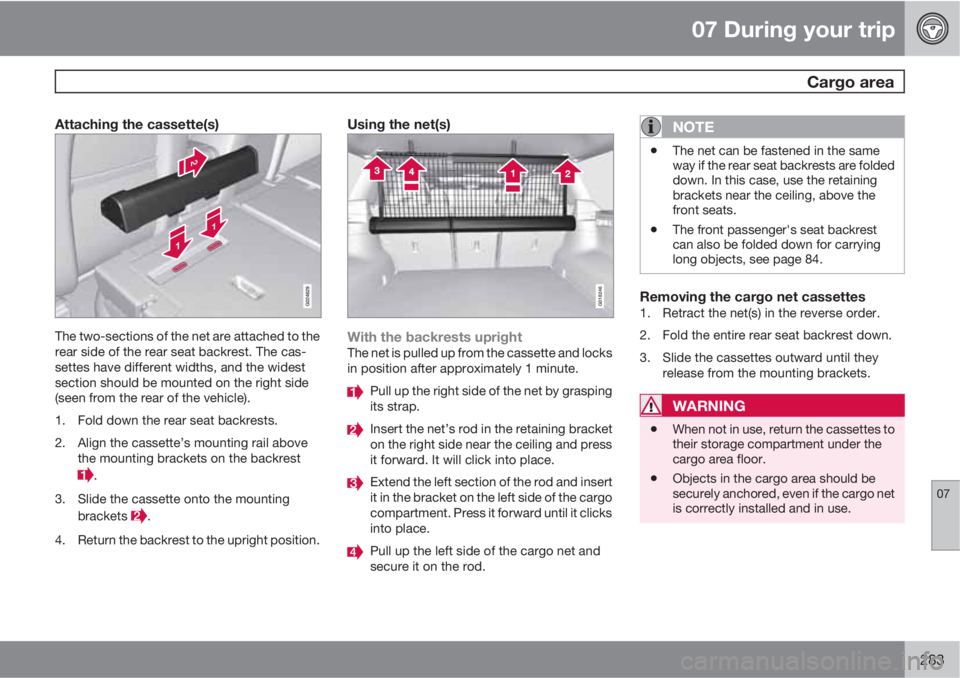
Using the net(s)
G018246
With the backrests uprightThe net is pulled up from the cassette and locks
in position after approximately 1 minute.
Pull up the right side of the net by grasping
its strap.
Insert the net’s rod in the retaining bracket
on the right side near the ceiling and press
it forward. It will click into place.
Extend the left section of the rod and insert
it in the bracket on the left side of the cargo
compartment. Press it forward until it clicks
into place.
Pull up the left side of the cargo net and
secure it on the rod.
NOTE
•The net can be fastened in the same
way if the rear seat backrests are folded
down. In this case, use the retaining
brackets near the ceiling, above the
front seats.
•The front passenger's seat backrest
can also be folded down for carrying
long objects, see page 84.
Removing the cargo net cassettes1. Retract the net(s) in the reverse order.
2. Fold the entire rear seat backrest down.
3. Slide the cassettes outward until they
release from the mounting brackets.
WARNING
•When not in use, return the cassettes to
their storage compartment under the
cargo area floor.
•Objects in the cargo area should be
securely anchored, even if the cargo net
is correctly installed and in use.
Page 290 of 382
07 During your trip
Emergency towing
07
288
Towing eyelet
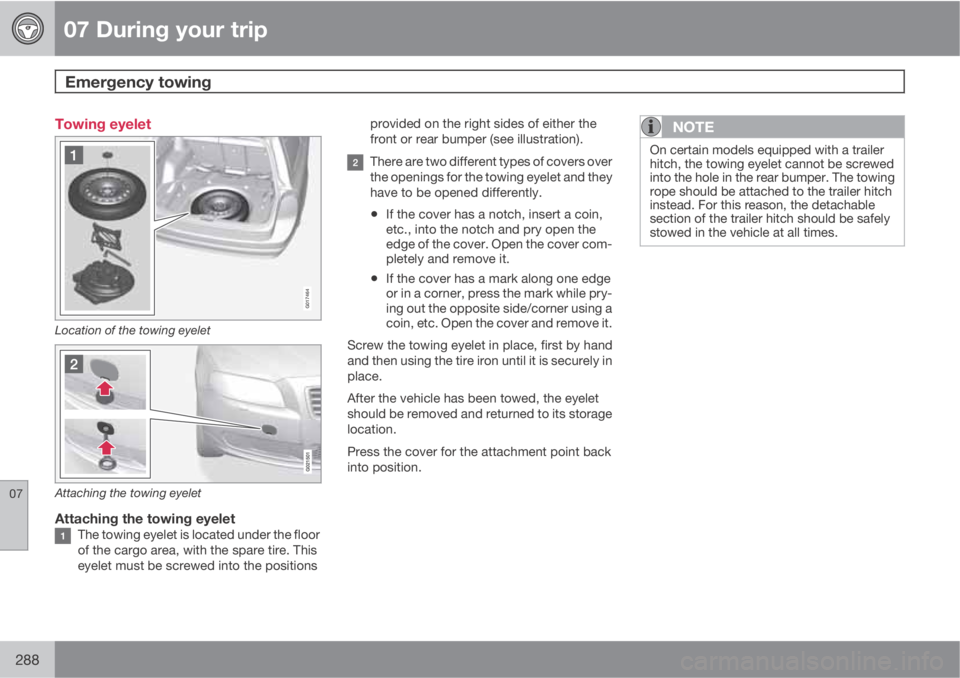
G017464
Location of the towing eyelet
Attaching the towing eyelet
Attaching the towing eyeletThe towing eyelet is located under the floor
of the cargo area, with the spare tire. This
eyelet must be screwed into the positionsprovided on the right sides of either the
front or rear bumper (see illustration).
There are two different types of covers over
the openings for the towing eyelet and they
have to be opened differently.
•If the cover has a notch, insert a coin,
etc., into the notch and pry open the
edge of the cover. Open the cover com-
pletely and remove it.
•If the cover has a mark along one edge
or in a corner, press the mark while pry-
ing out the opposite side/corner using a
coin, etc. Open the cover and remove it.
Screw the towing eyelet in place, first by hand
and then using the tire iron until it is securely in
place.
After the vehicle has been towed, the eyelet
should be removed and returned to its storage
location.
Press the cover for the attachment point back
into position.
NOTE
On certain models equipped with a trailer
hitch, the towing eyelet cannot be screwed
into the hole in the rear bumper. The towing
rope should be attached to the trailer hitch
instead. For this reason, the detachable
section of the trailer hitch should be safely
stowed in the vehicle at all times.
Page 292 of 382
07 During your trip
Emergency towing
07
290* Option/accessory, for more information, see Introduction.
Having the vehicle towed by a tow
truck
Call for professional help from an authorized
towing company.Volvo recommends the use of
flat bed equipment.
CAUTION
•The vehicle should always be towed in
the forward direction.
•Vehicles with All Wheel Drive (AWD)*
that are being towed with the front
wheels off the ground should not be
towed at a speed above approx. 45 mph
(70 km/h) and should not be towed far-
ther than 30 miles (50 km).
•If the vehicle is being towed on a flat bed
truck, the towing eyelet must not be
used to pull the vehicle up onto the flat
bed or to secure the vehicle on the flat
bed. Consult the tow truck operator.
Page 312 of 382
08 Wheels and tires
Tire Sealing System
08
310
Tire sealing system–temporarily
repairing a flat tire
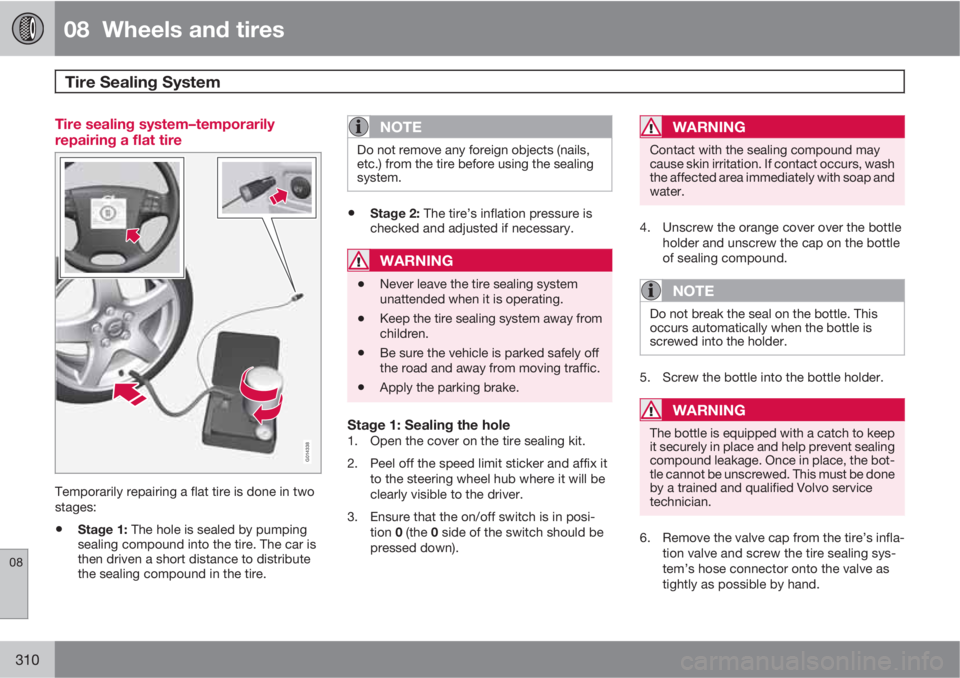
G014338
Temporarily repairing a flat tire is done in two
stages:
•Stage 1: The hole is sealed by pumping
sealing compound into the tire. The car is
then driven a short distance to distribute
the sealing compound in the tire.
NOTE
Do not remove any foreign objects (nails,
etc.) from the tire before using the sealing
system.
•Stage 2: The tire’s inflation pressure is
checked and adjusted if necessary.
WARNING
•Never leave the tire sealing system
unattended when it is operating.
•Keep the tire sealing system away from
children.
•Be sure the vehicle is parked safely off
the road and away from moving traffic.
•Apply the parking brake.
Stage 1: Sealing the hole1. Open the cover on the tire sealing kit.
2. Peel off the speed limit sticker and affix it
to the steering wheel hub where it will be
clearly visible to the driver.
3. Ensure that the on/off switch is in posi-
tion 0 (the 0 side of the switch should be
pressed down).
WARNING
Contact with the sealing compound may
cause skin irritation. If contact occurs, wash
the affected area immediately with soap and
water.
4. Unscrew the orange cover over the bottle
holder and unscrew the cap on the bottle
of sealing compound.
NOTE
Do not break the seal on the bottle. This
occurs automatically when the bottle is
screwed into the holder.
5. Screw the bottle into the bottle holder.
WARNING
The bottle is equipped with a catch to keep
it securely in place and help prevent sealing
compound leakage. Once in place, the bot-
tle cannot be unscrewed. This must be done
by a trained and qualified Volvo service
technician.
6. Remove the valve cap from the tire’s infla-
tion valve and screw the tire sealing sys-
tem’s hose connector onto the valve as
tightly as possible by hand.