ignition VOLVO XC70 2014 Owner´s Manual
[x] Cancel search | Manufacturer: VOLVO, Model Year: 2014, Model line: XC70, Model: VOLVO XC70 2014Pages: 394, PDF Size: 11.55 MB
Page 337 of 394
09 Maintenance and specifications
Hood and engine compartment09
335
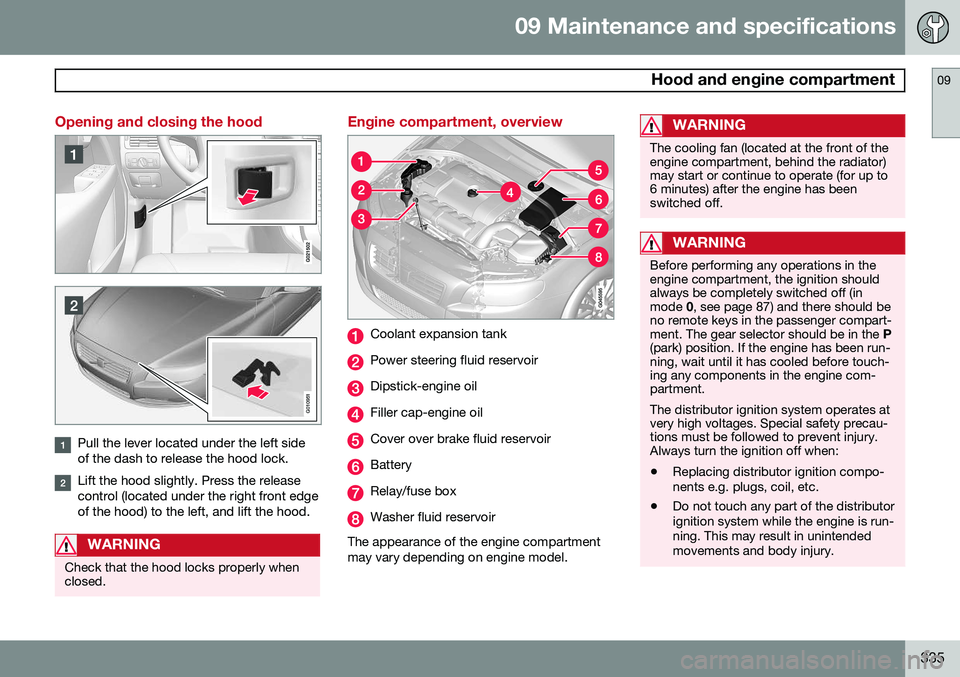
Opening and closing the hood
G010951
Pull the lever located under the left side of the dash to release the hood lock.
Lift the hood slightly. Press the release control (located under the right front edgeof the hood) to the left, and lift the hood.
WARNING
Check that the hood locks properly when closed.
Engine compartment, overview
Coolant expansion tank
Power steering fluid reservoir
Dipstick-engine oil
Filler cap-engine oil
Cover over brake fluid reservoir
Battery
Relay/fuse box
Washer fluid reservoir
The appearance of the engine compartment may vary depending on engine model.
WARNING
The cooling fan (located at the front of the engine compartment, behind the radiator)may start or continue to operate (for up to6 minutes) after the engine has beenswitched off.
WARNING
Before performing any operations in the engine compartment, the ignition shouldalways be completely switched off (inmode 0, see page 87) and there should be
no remote keys in the passenger compart-ment. The gear selector should be in the P
(park) position. If the engine has been run-ning, wait until it has cooled before touch-ing any components in the engine com-partment. The distributor ignition system operates at very high voltages. Special safety precau-tions must be followed to prevent injury.Always turn the ignition off when:
• Replacing distributor ignition compo- nents e.g. plugs, coil, etc.
• Do not touch any part of the distributorignition system while the engine is run-ning. This may result in unintendedmovements and body injury.
Page 342 of 394
09 Maintenance and specifications
Replacing bulbs 09
340* Option/accessory, for more information, see Introduction.
Introduction
All bulb specifications are listed on page 345. The following bulbs should only be replacedby a trained and qualified Volvo service tech-nician:
• Active Bending Lights
• Front parking lights
• Daytime running lights
• Turn signals in the door mirrors
• Approach lighting in the door mirrors
• Interior lighting
• Glove compartment lighting
• Brake lights
• Rear parking lights
• Rear side marker lights
• Back-up lights
• Rear fog light
• LED bulbsNOTE
•For information regarding any bulbs not mentioned in this section, pleasecontact your Volvo retailer or a trainedand authorized Volvo service techni-cian.
• Always switch off the ignition beforestarting to replace a bulb.
• If an error message remains in the dis-play after a faulty bulb has beenreplaced, contact an authorized Volvoworkshop.
• Condensation may form temporarily onthe inside of the lenses of exteriorlights such as headlights, fog lights, ortaillights. This is normal and the lightsare designed to withstand moisture.Normally, condensation will dissipateafter the lights have been on for ashort time.
• The optional Active Bending Lightbulbs contain trace amounts of mer-cury. These bulbs should always bedisposed of by a trained and qualifiedVolvo service technician.
CAUTION
Never touch the glass of bulbs with your fingers. Grease and oils from your fingersvaporize in the heat and will leave adeposit on the reflector, which will damageit.
WARNING
•The engine should not be running when changing bulbs.
• If the engine has been running justprior to replacing bulbs in the head-light housing, please keep in mind thatcomponents in the engine compart-ment will be hot.
WARNING
•Active Bending Lights* – due to the high voltage used by these headlights,these bulbs should only be replacedby a trained and qualified Volvo serv-ice technician.
• Turn off the lights and remove theremote key from the ignition beforechanging any bulbs.
Page 343 of 394
09 Maintenance and specifications
Replacing bulbs09
341
Headlight housing
The entire headlight housing must be lifted out when replacing all front bulbs.
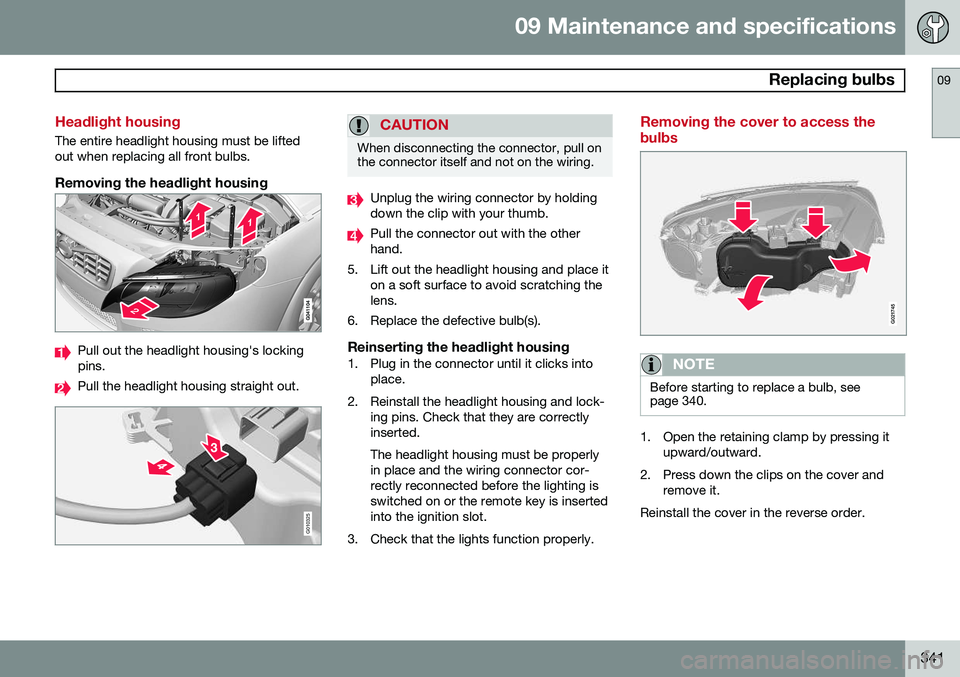
Removing the headlight housing
Pull out the headlight housing's locking pins.
Pull the headlight housing straight out.
G010325
CAUTION
When disconnecting the connector, pull on the connector itself and not on the wiring.
Unplug the wiring connector by holding down the clip with your thumb.
Pull the connector out with the other hand.
5. Lift out the headlight housing and place it on a soft surface to avoid scratching thelens.
6. Replace the defective bulb(s).
Reinserting the headlight housing1. Plug in the connector until it clicks into place.
2. Reinstall the headlight housing and lock- ing pins. Check that they are correctlyinserted. The headlight housing must be properly in place and the wiring connector cor-rectly reconnected before the lighting isswitched on or the remote key is insertedinto the ignition slot.
3. Check that the lights function properly.
Removing the cover to access the bulbs
G021745
NOTE
Before starting to replace a bulb, see page 340.
1. Open the retaining clamp by pressing it upward/outward.
2. Press down the clips on the cover and remove it.
Reinstall the cover in the reverse order.
Page 349 of 394
09 Maintenance and specifications
Wiper blades and washer fluid09
347
Wiper blades
Service position
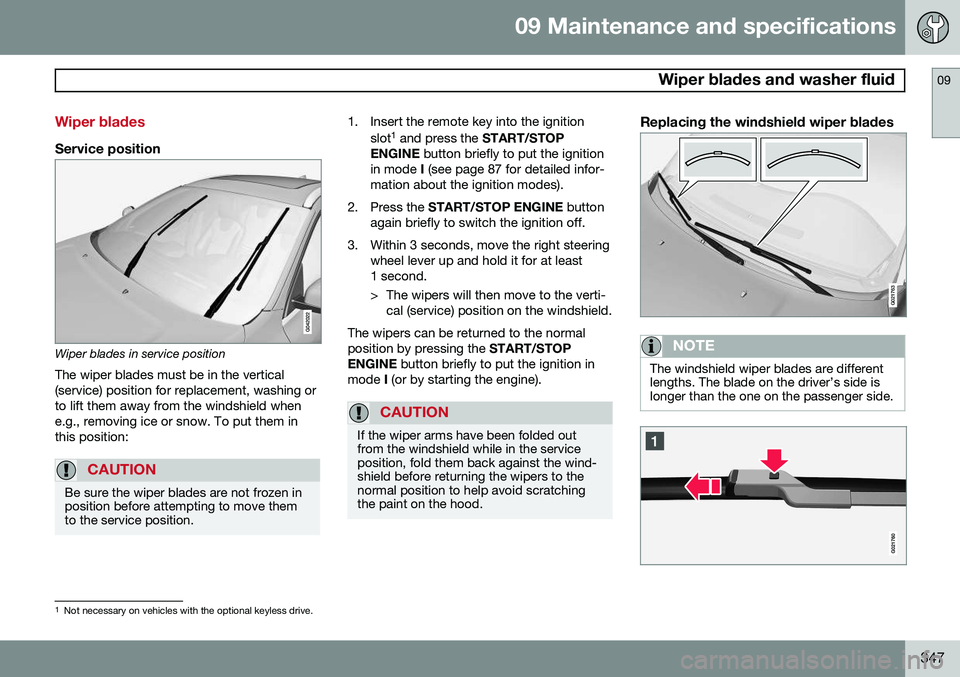
Wiper blades in service positionThe wiper blades must be in the vertical (service) position for replacement, washing orto lift them away from the windshield whene.g., removing ice or snow. To put them inthis position:
CAUTION
Be sure the wiper blades are not frozen in position before attempting to move themto the service position.
1. Insert the remote key into the ignition slot1
and press the START/STOP
ENGINE button briefly to put the ignition
in mode I (see page 87 for detailed infor-
mation about the ignition modes).
2. Press the START/STOP ENGINE button
again briefly to switch the ignition off.
3. Within 3 seconds, move the right steering wheel lever up and hold it for at least 1 second.
> The wipers will then move to the verti-cal (service) position on the windshield.
The wipers can be returned to the normal position by pressing the START/STOP
ENGINE button briefly to put the ignition in
mode I (or by starting the engine).
CAUTION
If the wiper arms have been folded out from the windshield while in the serviceposition, fold them back against the wind-shield before returning the wipers to thenormal position to help avoid scratchingthe paint on the hood.
Replacing the windshield wiper blades
G021763
NOTE
The windshield wiper blades are different lengths. The blade on the driver’s side islonger than the one on the passenger side.
1
Not necessary on vehicles with the optional keyless drive.
Page 353 of 394
09 Maintenance and specifications
Battery09
351
WARNING
•Never expose the battery to open flame or electric spark.
• Do not smoke near the battery.
• Battery fluid contains sulfuric acid. Donot allow battery fluid to contact eyes,skin, fabrics or painted surfaces. Ifcontact occurs, flush the affected areaimmediately with water. Obtain medi-cal help immediately if eyes are affec-ted.
NOTE
The life of the battery is shortened if it becomes discharged repeatedly.
Maintenance
•
Use a screw driver to open the caps or cover and a flashlight to inspect the level.
• If necessary, add distilled water. The levelshould never be above the indicator.
• The fluid level should be checked if thebattery has been recharged.
• After inspection, be sure the cap overeach battery cell or the cover is securelyin place.
• Check that the battery cables are cor-rectly connected and properly tightened. •
Never disconnect the battery when theengine is running, or when the key is inthe ignition. This could damage the vehi-cle's electrical system.
• The battery should be disconnected fromthe vehicle when a battery charger isused directly on the battery.
• To help keep the battery in good condi-tion, the vehicle should be driven for atleast 15 minutes a week or connected toa charger with an automatic chargingfunction.
• If the battery is fully discharged a numberof times, this may shorten its service life.Keeping the battery fully charged helpsprolong its service life.
• The service life of a battery is affected byfactors such as driving conditions and cli-mate. Extreme cold may also furtherdecrease the battery’s starting capacity.
• Because the battery’s starting capacitydecreases with time, it may be necessaryto recharge it if the vehicle is not drivenfor an extended period of time or if thevehicle is usually only driven short dis-tances.
CAUTION
•Always use distilled or deionized water (battery water).
• Never fill above the level mark in thecell.
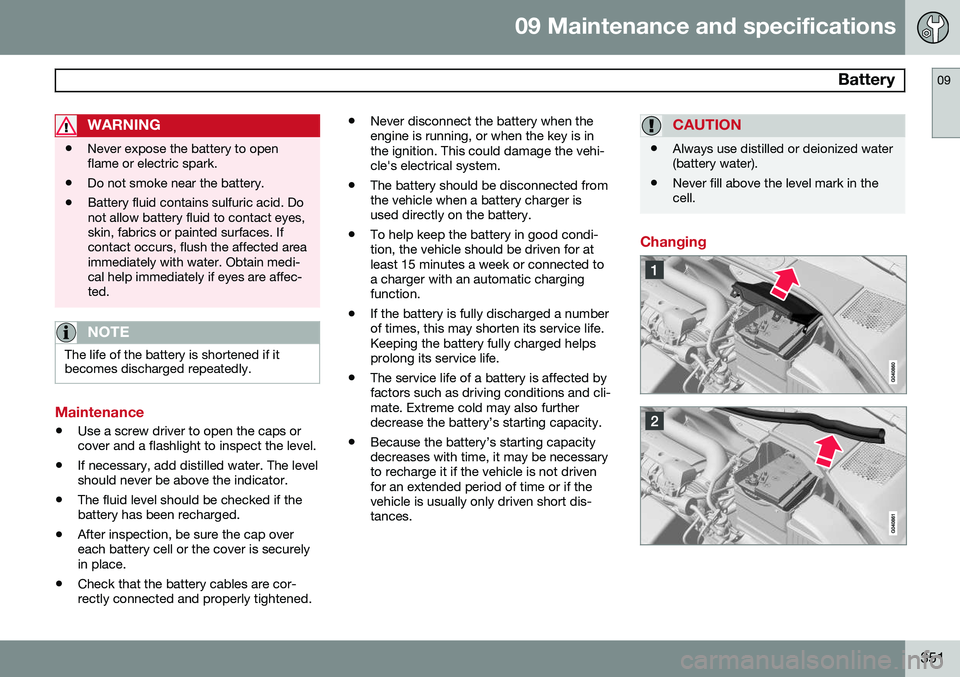
Changing
Page 354 of 394
09 Maintenance and specifications
Battery 09
352
WARNING
Connect and disconnect the positive and negative cables in the correct sequence.
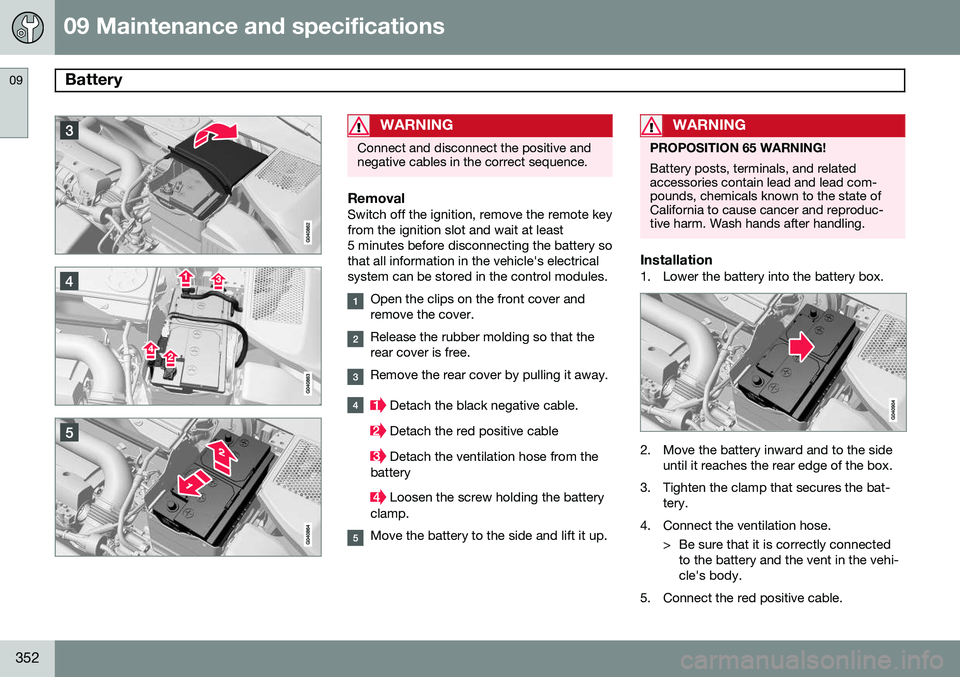
RemovalSwitch off the ignition, remove the remote key from the ignition slot and wait at least5 minutes before disconnecting the battery sothat all information in the vehicle's electricalsystem can be stored in the control modules.
Open the clips on the front cover and remove the cover.
Release the rubber molding so that the rear cover is free.
Remove the rear cover by pulling it away.
Detach the black negative cable.
Detach the red positive cable
Detach the ventilation hose from the
battery
Loosen the screw holding the battery
clamp.
Move the battery to the side and lift it up.
WARNING
PROPOSITION 65 WARNING! Battery posts, terminals, and related accessories contain lead and lead com-pounds, chemicals known to the state ofCalifornia to cause cancer and reproduc-tive harm. Wash hands after handling.
Installation1. Lower the battery into the battery box.
2. Move the battery inward and to the side until it reaches the rear edge of the box.
3. Tighten the clamp that secures the bat- tery.
4. Connect the ventilation hose. > Be sure that it is correctly connectedto the battery and the vent in the vehi- cle's body.
5. Connect the red positive cable.
Page 359 of 394

09 Maintenance and specifications
Fuses09
}}
357
PosFunctionA
Coils-A/C compressor5
Starter motor relay30
Ignition coils, condenser20
Engine Control Module10
Injection system, mass air meter, engine control module15
A/C compressor, engine valves, engine control mod-ule (6-cyl.), solenoids (6-cyl.non-turbo only)10
EVAP valve, heated oxygen sensor15
-
Fuel leakage detection5
–
Cooling fan80
Electro-hydraulic power steering100
Page 387 of 394

11 Index
11
385
G
Garage door openerHomeLink ®
Wireless Control System. 117
Gasoline requirements............................. 279
Gas tank volume...................................... 376
Gauges...................................................... 77
Geartronic................................................ 126
Geartronic automatic transmission.......... 126
Generator warning light............................. 82
Glossary of tire terminology..................... 310
Grocery bag holder.................................. 287
Gross vehicle weight............................... 311
H
Hazard warning flashers.......................... 102
HD digital radio........................................ 242Headlights Active Bending Lights......................... 100
active high beams................................. 98
changing bulbs........................... 341, 342
daytime running lights.......................... 97
high/low beams.................................... 98 high beam flash.................................... 98
tunnel detection.................................. 100
Headlight washers................................... 106
Head restraints, rear seat.................... 91, 92
Heated front seats................................... 208
Heated oxygen sensors........................... 282
Heated rear seats.................................... 209
Heated steering wheel............................... 96
Heated windshield........................... 111, 211
High beams................................................ 98 active.................................................... 98
Hill Descent Control................................. 137
Hill Start Assist (HSA).............................. 125
Hoisting the vehicle................................. 333 HomeLink ®
Wireless Control System...... 117
Home safe lighting................................... 103
Hood, opening/closing............................ 335
Horn........................................................... 95
I
Ignition modes........................................... 86
Immobilizer................................................ 58 Important information.................................. 6
Indicator lights............................... 77, 79, 81
Infant seats................................................ 42
Inflatable Curtain........................................ 32
Inflation pressure..................................... 305
Inflation pressure table............................ 307Information and warning symbols, table
of.............................................................. 378
Information lights........................... 77, 79, 81Infotainment
Menu navigation................................. 233
Infotainment system................................ 230 AUX/USB sockets............................... 254 Bluetooth ®
devices............................. 257
Bluetooth ®
hands-free system........... 259
getting started.................................... 231
media player....................................... 249
menus......................................... 231, 233
radio functions.................................... 240
sound settings.................................... 235
voice control....................................... 268
Inspection readiness................................ 333
Instrument lighting................................... 100 "theater" lighting................................. 100
Instrument overview............................ 76, 77