transmission VOLVO XC90 2003 User Guide
[x] Cancel search | Manufacturer: VOLVO, Model Year: 2003, Model line: XC90, Model: VOLVO XC90 2003Pages: 242, PDF Size: 6.5 MB
Page 116 of 242

2003 VOLVO XC90
l Models equipped with a 5-cylinder turbo engine have five forward speeds.\
Models equipped with a 6-
cylinder turbo engine have four forward speeds
l A "lock-up" feature on gears 3 and 4 (and 5, if equipped) reduces engi\
ne speed and help saves fuel.
The currently selected gear will be displayed in the instrument panel (\
see
page 24).
l To access the (MAN)ual shifting position from (D)rive, move the gear selector to the left to MAN.
l To return to the (D)rive position from MAN, move the gear selector to the right.
While driving
If you select the (MAN)ual position while driving, the gear that was being used in the (D)rive position
will also initially be selected in (MAN)ual position.
l Move the gear selector forward (toward "+") to shift to a higher gear \
or rearward (toward "-") to shift
to a lower gear.
l If you hold the gear selector toward "-", the transmission will downshif\
t one gear and will utilize the
braking power of the engine. If the current speed is too high for using \
a lower gear, the downshift will
not occur until the speed has decreased enough to allow the lower gear t\
o be used.
l If you slow down to a very low speed, the transmission will automaticall\
y shift down.
l When starting in the (MAN)ual position, 3rd gear is the highest gear that may be selected.
Kickdown
Automatic shift to a lower gear (kickdown) is achieved by depressing t\
he accelerator pedal fully and
briskly. An upshift will occur when approaching the top speed for a part\
icular gear or by releasing the
accelerator pedal slightly. Kickdown can be used for maximum acceleratio\
n or when passing at highway
speeds.
NOTE: The gear selector must be in the D (Drive) position for kickdown to fu\
nction.
Automatic transmission - adaptive system
The automatic transmission is controlled by an adaptive control system t\
hat constantly monitors the way
in which the transmission functions. It senses and adapts each gear shif\
t for optimal performance. The
system also monitors your particular driving style and adapts gear shift\
ing accordingly.
pg. 93 Starting and driving
file:///K|/ownersdocs/2003/2003_XC90/03xc90_06a.htm (13 of 15)12/30/20\
06 4:18:58 PM
Page 129 of 242

2003 VOLVO XC90
pg. 103 Starting and driving
Towing a trailer
Volvo recommends the use of Volvo trailer hitches that are specially des\
igned for the vehicle.
l Maximum trailer weights recommended by Volvo are:
All models - trailers without brakes: 1,650 lbs (750 kg)
Models with all wheel drive - trailers with brakes: 4,960 lbs (2250 kg)\
Models with front wheel drive - trailers with brakes: 3,970 lbs (1800 k\
g)
Observe the legal requirements of the state/province in which the vehicl\
es are registered.
l All Volvo models are equipped with energy-absorbing shock-mounted bumper\
s. Trailer hitch
installation should not interfere with the proper operation of this bump\
er system.
Trailer towing does not normally present any particular problems, but ta\
ke into consideration:
l Increase tire pressure to recommended full. See section "Wheels and tire\
s."
l When your vehicle is new, avoid towing heavy trailers during the first 6\
20 miles (1,000 km).
l Recommended hitch tongue load is: Trailer weights below 2,650 lbs (1,200 kg) - 110 lbs (50 kg)
Trailer weights above 2,650 lbs (1,200 kg) - 198 lbs (90 kg)
l Maximum speed when towing a trailer: 50 mph (80 km/h).
l Engine and transmission are subject to increased loads. Therefore, engin\
e coolant temperature should
be closely watched when driving in hot climates or hilly terrain. Use a \
lower gear and turn off the air
conditioner if the temperature gauge needle enters the red range.
l If the automatic transmission begins to overheat, a message will be disp\
layed in the text window.
l Avoid overload and other abusive operation.
l Hauling a trailer affects handling, durability, and economy.
l It is necessary to balance trailer brakes with the towing vehicle brakes\
to provide a safe stop (check
and observe state/local regulations).
l Do not connect the trailer's brake system directly to the vehicle's brak\
e system.
l More frequent vehicle maintenance is required.
l Remove the ball and drawbar assembly when the hitch is not being used.
l Volvo recommends the use of synthetic engine oil when towing a trailer o\
ver long distances or in
mountainous areas.
file:///K|/ownersdocs/2003/2003_XC90/03xc90_06b.htm (11 of 17)12/30/20\
06 4:18:59 PM
Page 134 of 242
.
This is important since dirt is often splashed on the windshield during \
winter driving, requiring the
frequent use of the")
2003 VOLVO XC90
page 128 for the location of the washer fluid reservoir).
This is important since dirt is often splashed on the windshield during \
winter driving, requiring the
frequent use of the washers and wipers. Volvo Washer Solvent should be d\
iluted as follows:
Down to 14° F (-10° C): 1 part washer solvent and 4 parts water \
Down to 5° F (-15° C): 1 part washer solvent and 3 parts water
Down to 0° F (-18° C): 1 part washer solvent and 2 parts water
Down to -18° F (-28° C): 1 part washer solvent and 1 part water \
l Use Volvo Teflon Lock Spray in the locks.
NOTE: Avoid the use of de-icing sprays as they can cause damage to the locks.
W Winter/Wet driving modeÐenhanced vehicle traction
l Mode W will only function if the gear selector is in the (D)rive position.
l Press the button at the base of the gear selector to engage/disengage th\
is driving mode.
l An LED in the button will light up to indicate that W is engaged and thi\
s will also be displayed in the
instrument panel (see
page 24).
l This mode may be selected for starting/moving off on slippery roads.
* Synthetic oil is not used when the oil is changed at the normal mainte\
nance intervals except at owner
request and at additional charge. Please consult your Volvo retailer.
pg. 108 Starting and driving
Before a long distance trip
It is always worthwhile to have your vehicle checked at a Volvo retailer\
before driving long distances.
Your retailer will also be able to supply you with bulbs, fuses, spark p\
lugs and wiper blades for your use
in the event that problems occur.
As a minimum, the following items should be checked before any long trip\
:
l Check that engine runs smoothly and that fuel consumption is normal.
l Check for fuel, oil, and fluid leakage
l Check transmission oil level*.
l Check condition of drive belts.
l Check state of the battery's charge.
l Examine tires carefully (the spare tire as well), and replace those th\
at are worn. Check tire pressures.
l The brakes, front wheel alignment, and steering gear should be checked b\
y your Volvo retailer only.
l Check all lights, including high beams.
l Reflective warning triangles are legally required in some states/provinc\
es.
l Have a word with your Volvo retailer if you intend to drive in countries\
where it may be difficult to
obtain the correct fuel.
file:///K|/ownersdocs/2003/2003_XC90/03xc90_06b.htm (16 of 17)12/30/20\
06 4:18:59 PM
Page 135 of 242

2003 VOLVO XC90
l Consider your destination. If you will be driving through an area where \
snow or ice are likely to
occur, consider snow tires.
* To prevent injury from contact with hot surfaces, do not inspect your \
vehicle's transmission fluid
yourself. Have your vehicle's transmission fluid level inspected by a qu\
alified Volvo service technician.
Contents | Top of Page
file:///K|/ownersdocs/2003/2003_XC90/03xc90_06b.htm (17 of 17)12/30/20\
06 4:18:59 PM
Page 143 of 242

2003 VOLVO XC90
CAUTION
The vehicle must not be driven with wheels of different dimensions or wi\
th a spare tire other than the
one that came with the vehicle. The use of different size wheels can ser\
iously damage your vehicle's
transmission.
pg. 115 Wheels and tires
Snow chains
Snow chains can be used on your Volvo with the following restrictions:
l Snow chains should be installed on front wheels only. Use only Volvo app\
roved snow chains.
l If accessory, aftermarket or "custom" tires and wheels are installed and\
are of a size different than the
original tires and wheels, chains in some cases CANNOT be used. Sufficie\
nt clearances between chains
and brakes, suspension and body components must be maintained.
l Some strap-on type chains will interfere with brake components and there\
fore CANNOT be used.
l All Wheel Drive models: Snow chains should only be installed on the front wheels. Only chains
adapted for AWD models should be used.
NOTE: Consult your Volvo retailer for additional snow chain information.
CAUTION
- Check local regulations regarding the use of snow chains before instal\
ling.
- Always follow the chain manufacturer's installation instructions caref\
ully. Install chains as tightly as
possible and retighten periodically.
- Never exceed the chain manufacturer's specified maximum speed limit. (\
Under no circumstances
should you exceed 31 mph 50 km/h)
- Avoid bumps, holes or sharp turns when driving with snow chains.
- The handling of the vehicle can be adversely affected when driving wit\
h chains. Avoid fast or sharp
turns as well as locked wheel braking.
Snow tires, studded tires*
Tires for winter use:
Owners who live in or regularly commute through areas with sustained per\
iods of snow or icy driving
conditions are strongly advised to fit suitable winter tires to help ret\
ain the highest degree of traction.
It is important to install winter tires on all four wheels to help retai\
n traction during cornering, braking,
and accelerating. Failure to do so could reduce traction to an unsafe le\
vel or adversely affect handling.
Do not mix tires of different design as this could also negatively affec\
t overall tire road grip.
file:///K|/ownersdocs/2003/2003_XC90/03xc90_08.htm (3 of 12)12/30/2006\
4:19:01 PM
Page 145 of 242

2003 VOLVO XC90
l With warm tires, correct only when the pressure is too low. The tire tem\
perature rises after driving
just a few miles.
Vehicle loading
The tires on your Volvo will perform to specifications at all normal loa\
ds when inflated as
recommended on the tire information label located on the inside of the f\
uel filler door. This label lists
both tire and vehicle design limits. Do not load your vehicle beyond the\
load limits indicated.
WARNING!
Improperly inflated tires will reduce tire life, adversely affect vehicl\
e handling and can possibly lead
to failure resulting in loss of vehicle control without prior warning.
Temporary Spare
The spare tire in your vehicle is called a "Temporary Spare".
Recommended tire pressure (see decal on Fuel filler door) should be ma\
intained irrespective which
position on the vehicle the Temporary Spare tire is used on. In the even\
t of damage this tire, a new one
can be purchased from your Volvo retailer.
WARNING!
Current legislation prohibits the use of the Temporary Spare" tire other\
than as a temporary
replacement for a punctured tire. It must be replaced as soon as possibl\
e by a standard tire. Road
holding and handling may be affected with the "Temporary Spare" in use. \
Do not exceed 50 mph (80
km/h). Do not drive farther than 50 miles (80 km) on a temporary spar\
e tire.
CAUTION
The vehicle must not be driven with wheels of different dimensions or wi\
th a spare tire other than the
one that came with the vehicle. The use of different size wheels can ser\
iously damage your vehicle's
transmission.
The temporary spare tire is for temporary, low-speed, short-distance use\
only. Replace it with a full-
sized tire as soon as possible, in accordance with "Tire Rotation" in th\
e previous paragraph. Do not drive
on the temporary spare at speeds above 50 m.p.h. (80km/h) or for dista\
nces greater than 50 miles (80
km). Never install snow chains on a temporary spare.
NOTE: Certain models may be equipped with a full-size spare tire. When used, i\
t should be inflated to
the same pressure as the tire it is replacing.
file:///K|/ownersdocs/2003/2003_XC90/03xc90_08.htm (5 of 12)12/30/2006\
4:19:01 PM
Page 151 of 242

2003 VOLVO XC90
CAUTION
- The vehicle must not be driven with wheels of different dimensions or \
with a spare tire other than
the one that came with the vehicle. The use of different size wheels can\
seriously damage your
vehicle's transmission.
- Correct tightening torque on wheel bolts must be observed.
- The wheel bolts should never be greased or lubricated.
- Extended, chromed wheel bolts must not be used with steel rims, as the\
y make it impossible to fit
the hub caps.
pg. 121 Wheels and tires
Attaching the jack
l Position the jack correctly on the bar in the attachment (see illustrat\
ion above) and crank while
simultaneously guiding the base of the jack to the ground. The base of t\
he jack must be flat on a level,
firm, non-slippery surface. Before raising the vehicle, check that the j\
ack is still correctly positioned in
the attachment.
l Raise the vehicle until the wheel to be changed is lifted off the ground\
.
l Unscrew the wheel bolts completely and carefully remove the wheel so as \
not to damage the threads
on the studs.
NOTE: To avoid excessive wear and the necessity of rebalancing, mark and reins\
tall wheels in the same
location and position as before removal. To lessen the chance of imbalan\
ce, each wheel hub is equipped
with a guide stud to ensure that a removed wheel can be reinstalled in i\
ts original position (as when
changing over to winter tires/wheels).
Installing the wheel
l Clean the contact surfaces on the wheel and hub.
file:///K|/ownersdocs/2003/2003_XC90/03xc90_08.htm (11 of 12)12/30/200\
6 4:19:01 PM
Page 152 of 242

2003 VOLVO XC90
l Lift the wheel and place it on the hub.
l Install the wheel bolts and tighten handtight. Using the lug wrench, tig\
hten crosswise until all bolts
are snug.
l Lower the vehicle to the ground and alternately tighten the bolts crossw\
ise to 102 ft. lbs. (140 Nm).
l Install the wheel cap (where applicable).
WARNING!
- The jack must correctly engage the bar in the jack attachment. The veh\
icle's weight must not rest on
the jack attachment. See illustration "Attaching the jack" above. Be sure the jack is on a firm, level,
non-slippery surface.
- Never allow any part of your body to be extended under a vehicle suppo\
rted by a jack.
- Use the jack intended for the vehicle when replacing a wheel. For any \
other job, use stands to
support the side of the vehicle being worked on.
- Apply the parking brake and put the gear selector in the (P)ark position (or reverse on manual
transmissions).
- Block the wheels standing on the ground, use rigid wooden blocks or la\
rge stones. The jack should
be kept well-greased.
pg. 122 Wheels and tires
This page intentionally left blank
Contents | Top of Page
file:///K|/ownersdocs/2003/2003_XC90/03xc90_08.htm (12 of 12)12/30/200\
6 4:19:01 PM
Page 188 of 242
15
20. Infotainment system 10
21. Relay extended D1 feed: climate control system, power drivers seat,\
instrument panel 10
22. Headlight s")
2003 VOLVO XC90
19. Heated front passenger's seat (option)15
20. Infotainment system 10
21. Relay extended D1 feed: climate control system, power driver's seat,\
instrument panel 10
22. Headlight switch module, climate control system, onboard diagnostic \
connector,
steering wheel lever modules 5
23. Turn signals 20
24. Automatic transmission - shift inhibitor, extended D2 feed 10
25. Fuel pump 15
26. Moonroof (option) 15
27. Central electronic module, vanity mirror lighting, courtesy lighting\
, glove compartment
lighting, alarm siren* 10
28. Alarm siren* 5
29. -
30. Daytime running lights 10
31. Daytime running lights 10
32. Left front/rear parking lights 7.5
33. Right front/rear parking lights, license plate lights 7.5
34. Front fog lights 15
35. -
36. High beam headlights 20
37. Navigation system (option), DVD player 10
38. Low beam headlights, Bi-Xenon headlights (option) 15
Please be aware that if these fuese are not intact, or have been removed\
, the alarm will not sound.
pg. 148 Maintenance
Fuses (contd)
file:///K|/ownersdocs/2003/2003_XC90/03xc90_09b.htm (21 of 23)12/30/20\
06 4:19:04 PM
Page 191 of 242
2003 VOLVO XC90
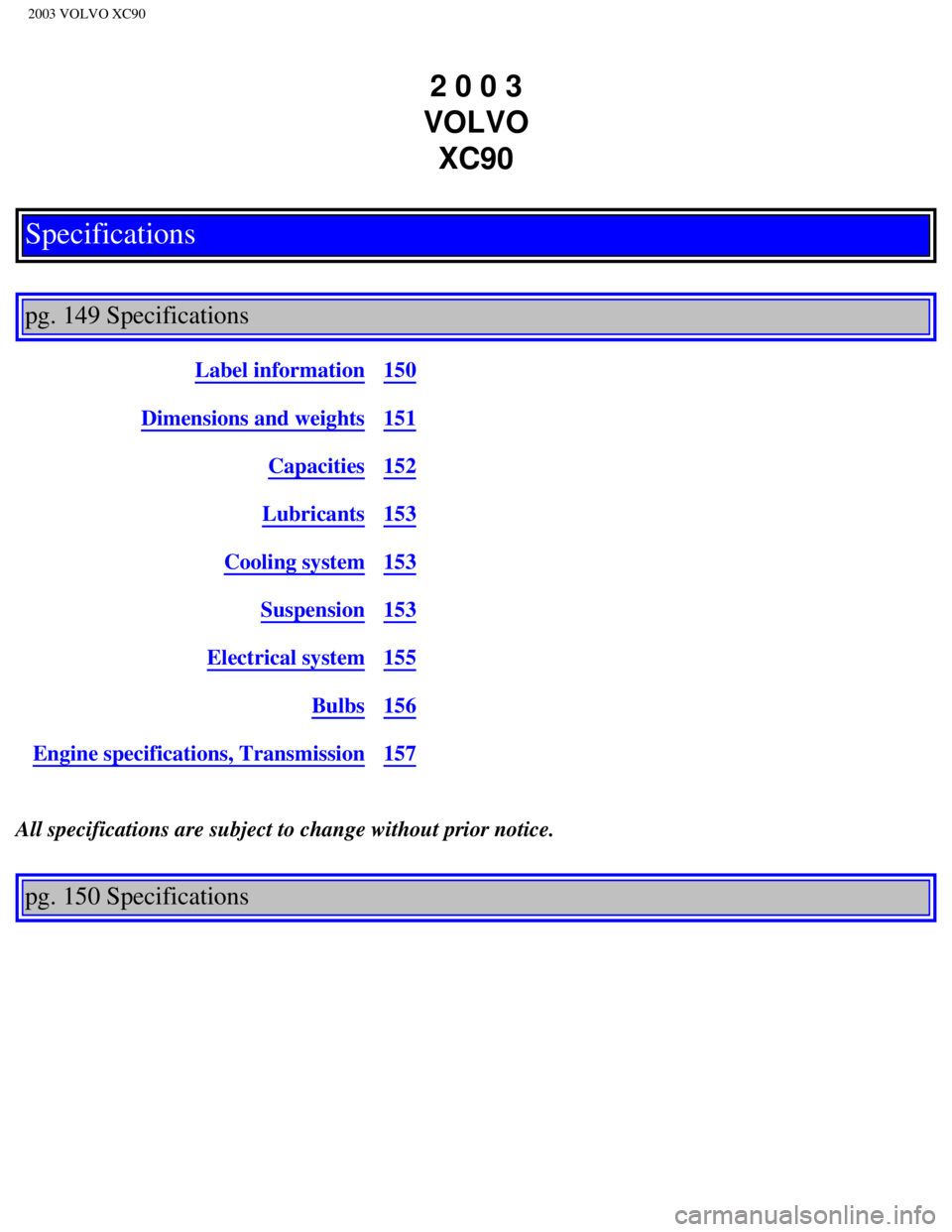
2 0 0 3
VOLVO XC90
Specifications
pg. 149 Specifications
Label information150
Dimensions and weights151
Capacities152
Lubricants153
Cooling system153
Suspension153
Electrical system155
Bulbs156
Engine specifications, Transmission157
All specifications are subject to change without prior notice.
pg. 150 Specifications
file:///K|/ownersdocs/2003/2003_XC90/03xc90_10.htm (1 of 10)12/30/2006\
4:19:05 PM