steering wheel VOLVO XC90 2003 Owners Manual
[x] Cancel search | Manufacturer: VOLVO, Model Year: 2003, Model line: XC90, Model: VOLVO XC90 2003Pages: 242, PDF Size: 6.5 MB
Page 6 of 242
2003 VOLVO XC90
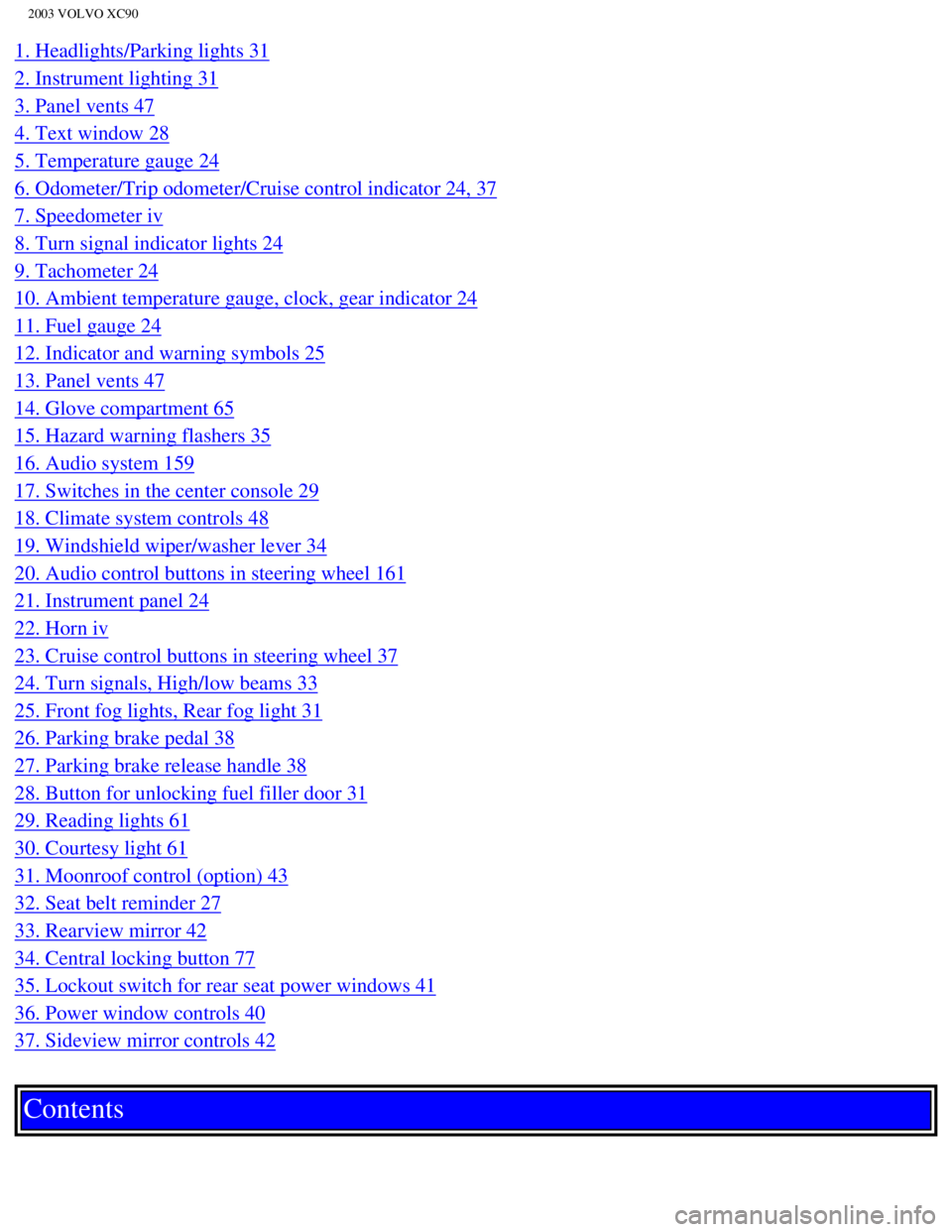
1. Headlights/Parking lights 31
2. Instrument lighting 31
3. Panel vents 47
4. Text window 28
5. Temperature gauge 24
6. Odometer/Trip odometer/Cruise control indicator 24, 37
7. Speedometer iv
8. Turn signal indicator lights 24
9. Tachometer 24
10. Ambient temperature gauge, clock, gear indicator 24
11. Fuel gauge 24
12. Indicator and warning symbols 25
13. Panel vents 47
14. Glove compartment 65
15. Hazard warning flashers 35
16. Audio system 159
17. Switches in the center console 29
18. Climate system controls 48
19. Windshield wiper/washer lever 34
20. Audio control buttons in steering wheel 161
21. Instrument panel 24
22. Horn iv
23. Cruise control buttons in steering wheel 37
24. Turn signals, High/low beams 33
25. Front fog lights, Rear fog light 31
26. Parking brake pedal 38
27. Parking brake release handle 38
28. Button for unlocking fuel filler door 31
29. Reading lights 61
30. Courtesy light 61
31. Moonroof control (option) 43
32. Seat belt reminder 27
33. Rearview mirror 42
34. Central locking button 77
35. Lockout switch for rear seat power windows 41
36. Power window controls 40
37. Sideview mirror controls 42
Contents
file:///K|/ownersdocs/2003/2003_XC90/03xc90_00.htm (6 of 7)12/30/2006 \
4:18:48 PM
Page 11 of 242
2003 VOLVO XC90
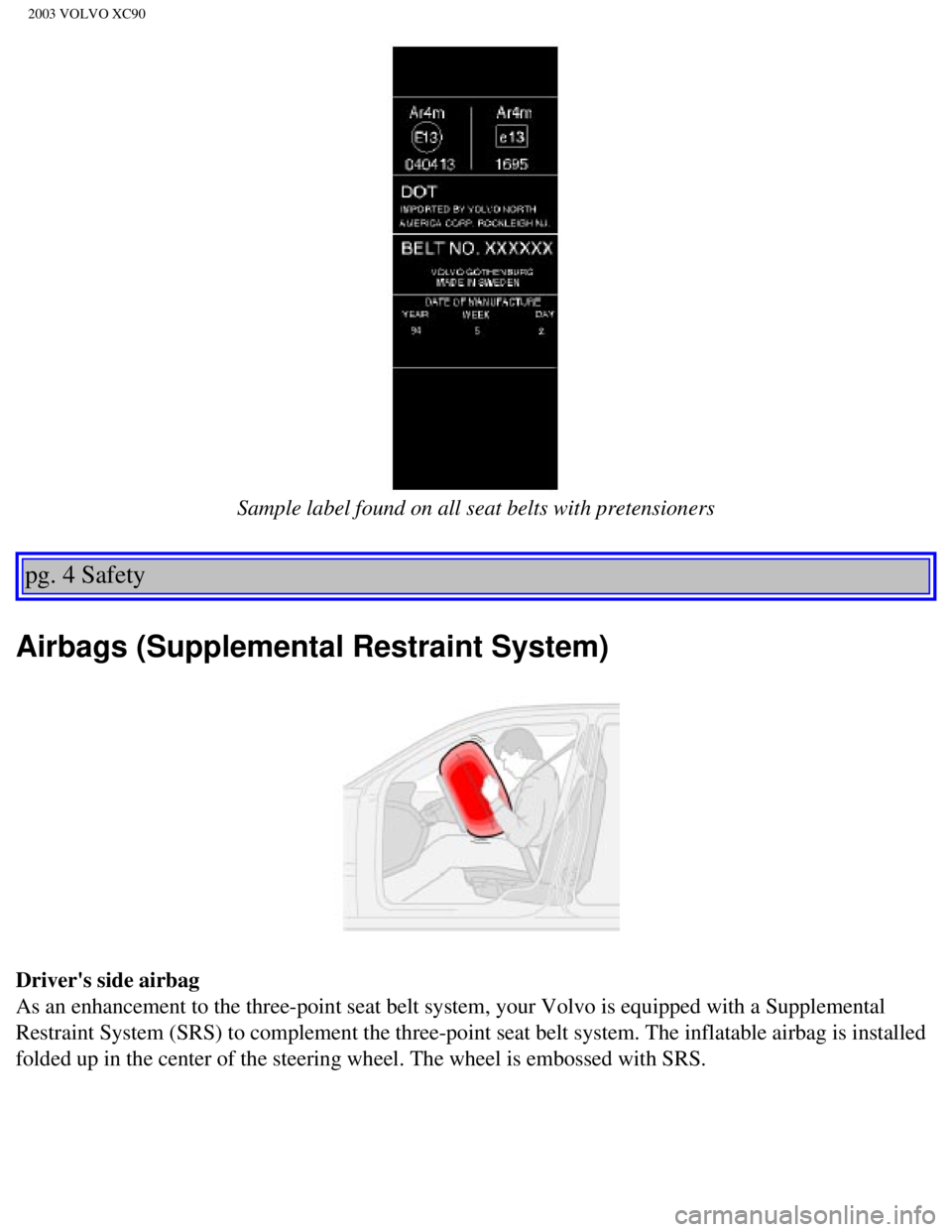
Sample label found on all seat belts with pretensioners
pg. 4 Safety
Airbags (Supplemental Restraint System)
Driver's side airbag
As an enhancement to the three-point seat belt system, your Volvo is equ\
ipped with a Supplemental
Restraint System (SRS) to complement the three-point seat belt system.\
The inflatable airbag is installed
folded up in the center of the steering wheel. The wheel is embossed wit\
h SRS.
file:///K|/ownersdocs/2003/2003_XC90/03xc90_01a.htm (4 of 12)12/30/200\
6 4:18:49 PM
Page 12 of 242

2003 VOLVO XC90
WARNING!
Never drive an SRS equipped vehicle with your hands on the steering whee\
l pad/airbag
housing.
Passenger side airbag
The airbag on the front passenger side is folded up in a compartment abo\
ve the glove compartment. The
panel is embossed SRS.
WARNING!
No objects, accessory equipment or stickers may be placed on, attached t\
o, or installed near the SRS
cover in the center of the steering wheel, the SRS cover above the glove\
compartment or the area
affected by airbag deployment.
Passenger side airbag - location
file:///K|/ownersdocs/2003/2003_XC90/03xc90_01a.htm (5 of 12)12/30/200\
6 4:18:49 PM
Page 15 of 242
 shorter than 4 feet 7 inches (140 cm) be seate\
d")
2003 VOLVO XC90
WARNING!
Children must never be allowed in the front passenger's seat. Volvo reco\
mmends that ALL occupants
(adults and children) shorter than 4 feet 7 inches (140 cm) be seate\
d in the back seat of any vehicle
with a front passenger-side airbag. See
page 20 for guidelines.
Occupants in the front passenger's seat must never sit on the edge of th\
e seat, sit leaning toward the
instrument panel or otherwise sit out of position. The occupant's back m\
ust be as upright as comfort
allows and be against the seat back with the seat belt properly fastened\
.
Feet must be on the floor, e.g. not on the dash, seat or out of the wind\
ow. No objects or accessory
equipment, e.g. dashboard covers, may be placed on, attached to, or inst\
alled near the SRS hatch (the
area above the glove compartment) or the area affected by airbag deploy\
ment (see illustration on
page
4).
There should be no loose articles, e.g. coffee cups, on the floor, seat \
or dashboard area. Never try to
open the SRS cover on the steering wheel or the passenger side dash. Thi\
s should only be done by an
authorized Volvo service technician.
Failure to follow these instructions can result in injury to the vehicle\
occupants.
Warning light in the instrument panel
A self-diagnostic system incorporated in the sensor monitors the SRS. Th\
is system does not, however,
monitor the Side Impact Protection System (SIPS) airbags. If a fault i\
s detected, the warning light will
illuminate. The light is included in the warning/indicator light cluster\
in the instrument panel. Normally,
the SRS warning lamp should light up when the ignition key is turned to \
positions I, II or III and should
go out after 7 seconds or when the engine is started. Check that this li\
ght is functioning properly every
time the vehicle is started.
The following items are monitored by the self-diagnostic system:
l Sensor unit
l Cable harness
l Gas generator
file:///K|/ownersdocs/2003/2003_XC90/03xc90_01a.htm (8 of 12)12/30/200\
6 4:18:49 PM
Page 18 of 242
 system
As an enhancement to the three-point seat belt system, your Volvo is equ\
ipped with a Supplemental
Restraint System (SRS). The Volvo SRS consists of an ai")
2003 VOLVO XC90
Front airbag (SRS) system
As an enhancement to the three-point seat belt system, your Volvo is equ\
ipped with a Supplemental
Restraint System (SRS). The Volvo SRS consists of an airbag (2) on b\
oth the driver's and passenger's
sides and seat belt pretensioners in both front door pillars. The system\
is designed to supplement the
protection provided by the three-point seat belt system. All rear seat b\
elts are also equipped with
pretensioners. The SRS system is indicated by the "SRS" embossed on the \
steering wheel pad and above
the glove compartment, and by decals on both sun visors and on the front\
and far right side of the dash.
The airbags are folded and located in the steering wheel hub and above t\
he glove compartment.
Deployment:
The SRS airbags are designed to deploy during certain frontal or front-a\
ngular collisions, impacts, or
decelerations, depending on the crash severity, angle, speed and object \
impacted. The airbags may also
deploy in certain non-frontal collisions where rapid deceleration occurs\
.
The airbag system includes gas generators (1) surrounded by the airbag\
s (2) and front seat belt
pretensioners for both of the front seats. To deploy the system, the sen\
sor (3) activates the gas generators
causing the airbags to be inflated with nitrogen gas.
As the movement of the seats' occupants compresses the airbags, some of \
the gas is expelled at a
controlled rate to provide better cushioning. Both seat belt pretensione\
rs also deploy, minimizing any
seat belt slack.The entire process, including inflation and deflation of\
the airbags, takes approximately
two-tenths of a second.
WARNING!
The SRS is designed to help prevent serious injury. Deployment occurs ve\
ry quickly and with
considerable force. During normal deployment and depending on variables \
such as seating position,
one may experience abrasions, bruises, swellings, or other injuries as a\
result of airbag(s) deployment.
Never try to repair any part of the SRS or SIPS bag systems yourself. Any int\
erference in the system
could cause malfunction and serious injury. All work on these systems sh\
ould be performed by an
authorized Volvo retailer.
file:///K|/ownersdocs/2003/2003_XC90/03xc90_01a.htm (11 of 12)12/30/20\
06 4:18:49 PM
Page 35 of 242
2003 VOLVO XC90
2 0 0 3
VOLVO XC90
Safety
pg. 23 Instruments and controls
Instrument panel24
Indicator and warning symbols25
Switches in center console29
Steering wheel adjustment30
Lighting panel31
Manually unlocking the fuel filler door32
Turn signals33
Hazard warning flashers, rear window/sideview mirror defroster, heated f\
ront seats35
Trip computer (option)36
Cruise control37
Parking brake, Opening/closing the hood38
Opening the tailgate, Auxiliary 12-volt sockets39
Electrically operated windows40
Rearview mirror/power folding sideview mirrors42
Electrically operated moonroof (option)43
pg. 24 Instruments and controls
file:///K|/ownersdocs/2003/2003_XC90/03xc90_02a.htm (1 of 16)12/30/200\
6 4:18:52 PM
Page 44 of 242
")
2003 VOLVO XC90
This button controls the optional rear seat air conditioning system on s\
even-seat models. See page 48 for
more information.
6. Temporarily disconnecting the alarm sensors (option)
See
page 81 for more details.
7. Not in use
8. 12 volt socket
This 12 volt socket can be used to plug in certain accessories such as c\
ellular telephones, etc. The
ignition key must be in position 1 (or higher) for the auxiliary socke\
t to function.
NOTE: The auxiliary sockets can also be used for cigarette lighters, which are\
available as accessories
at your Volvo retailer.
pg. 30 Instruments and controls
Steering wheel adjustment
Steering wheel adjustment
Both the height and the reach of the steering wheel can be adjusted to a\
comfortable position for the
driver. Pull down the lever on the left of the steering column. Adjust t\
he steering wheel to a suitable
position and press the lever back into place to lock the steering wheel \
in the new position. Check that the
steering wheel is locked in the new position.
file:///K|/ownersdocs/2003/2003_XC90/03xc90_02a.htm (10 of 16)12/30/20\
06 4:18:52 PM
Page 45 of 242
2003 VOLVO XC90
WARNING!
The Never adjust the steering wheel while
driving.
pg. 31 Instruments and controls
Lighting panel
A - Headlights and parking lights
All lighting off.
Models with daytime running lights:
Low beam headlights will automatically come on if the ignition key is in\
position II. Front and rear
parking lights, tail lights, side marker lights, and license plate light\
s will also be on. Volvo recommends
the use of daytime running lights. If, however, you would prefer to have\
these lights turned off (USA
only), please consult your Volvo retailer. Please note that the use of \
daytime running lights is mandatory
in Canada.
Parking lights on. The parking lights should be switched off when you leave the vehicle to \
help avoid battery drain.
Headlights, parking lights, license plate lights and instrument panel il\
lumination are on if the
ignition key is in position II.
If the headlight switch is in this position, all lights will go out when\
the ignition is switched off.
The headlight switch must be in this position before the high beams will\
function.
Switch from high to low beams and vice versa by pulling the turn signal \
switch lever on the left side of
steering column toward you.
file:///K|/ownersdocs/2003/2003_XC90/03xc90_02a.htm (11 of 16)12/30/20\
06 4:18:52 PM
Page 48 of 242
 to access the fuel filler doo\
r motor (5).
6. Move the catch (6) rearward to unlock the fuel filler door lock, or\
move it forward to lock t")
2003 VOLVO XC90
5. Pull down the insulating material (4) to access the fuel filler doo\
r motor (5).
6. Move the catch (6) rearward to unlock the fuel filler door lock, or\
move it forward to lock the filler
door.
pg. 33 Instruments and controls
Turn signals
1. Lane change
In maneuvers such as lane changing, the driver can flash the turn signal\
s by moving the turn signal lever
to the first stop and holding it there. The lever will return to the neu\
tral position when released.
2. Signal lever engaged for normal turns
3. High/low beam switch (headlights on).
Move the lever towards the steering wheel and release it.
Headlight flasher (headligts off).
Move the lever towards the steering wheel. The headlight high beam will \
be on until the lever is
released.
NOTE: If the turn signal indicator flashes faster than normal, check for a bur\
ned-out turn signal bulb.
Exterior courtesy lights
Home safe lighting
When you leave your vehicle at night, you can make use of the courtesy l\
ighting function:
l Remove the key from the ignition switch.
l Pull the turn signal lever towards the steering wheel (as when using th\
e headlight flasher function).
l Exit the vehicle and lock the doors.
file:///K|/ownersdocs/2003/2003_XC90/03xc90_02a.htm (14 of 16)12/30/20\
06 4:18:52 PM
Page 108 of 242

2003 VOLVO XC90
CAUTION
- Do not refuel with the engine running *. Turn the ignition off or to p\
osition I. If the ignition is on,
an incorrect reading could occur in the fuel gauge
- After refueling, close the fuel filler cap by turning it clockwise unt\
il it clicks into place*.
- Allow for fuel expansion by not overfilling the tank. Overfilling coul\
d also cause damage to the
emission control systems.
- Avoid spilling gasoline during refueling. In addition to causing damag\
e to the environment,
gasolines containing alcohol can cause damage to painted surfaces, which\
may not be covered under
the New Vehicle Limited Warranty.
- Do not use gasolines containing methanol (methyl alcohol, wood alcoho\
l). This practice can result
in vehicle performance deterioration and can damage critical parts in th\
e fuel system. Such damage
may not be covered under the New Vehicle Limited Warranty.
* If the fuel filler cap is not closed tightly or if the engine is runni\
ng when the vehicle is refueled, the
Check Engine Light (malfunction indicator lamp) may indicate a fault. \
However, your vehicle's
performance will not be affected. Use only Volvo original or approved fu\
el filler caps.
pg. 87 Starting and driving
Starting the engine
1. Fasten the seat belt.
WARNING!
Before starting, check that the seat, steering wheel and mirrors are adj\
usted properly. Make sure the
brake pedal can be depressed completely. Adjust the seat if necessary. S\
ee
pages 54, 56.
2. Apply the parking brake if not already set. The gear selector is lock\
ed in the (P)ark position
(Shiftlock).
Manual transmission: the clutch must be fully depressed.
3. Without touching the accelerator pedal, turn the ignition key* to the\
starting position. Allow the
starter to operate for up to 10 seconds. Release the key as soon as the \
engine starts. If the engine fails to
start, repeat this step.
NOTE:
- On certain models, when the vehicle is started, idle speed may be noti\
ceably higher than normal for a
short period, depending on the temperature of the engine.
This has been done to help bring components in the emission control syst\
em to their normal operating
temperature as quickly as possible, which enables them to function norma\
lly.
file:///K|/ownersdocs/2003/2003_XC90/03xc90_06a.htm (5 of 15)12/30/200\
6 4:18:58 PM