warning VOLVO XC90 2003 User Guide
[x] Cancel search | Manufacturer: VOLVO, Model Year: 2003, Model line: XC90, Model: VOLVO XC90 2003Pages: 242, PDF Size: 6.5 MB
Page 21 of 242
 occurs only on the side of the ve\
hicle affected by the
impact.The airbags are not designed to deploy in all side impact situati\
ons.
*A S")
2003 VOLVO XC90
NOTE: SIPS airbag deployment (one airbag) occurs only on the side of the ve\
hicle affected by the
impact.The airbags are not designed to deploy in all side impact situati\
ons.
*A SIPS airbag ' decal is also located at the end of the instrument pane\
l on the driver's side of the
vehicle.
WARNING!
l The SIPS airbag system is a supplement to the Side Impact Protection Sys\
tem and the three-point
seat belt system. It is not designed to deploy during collisions from th\
e front or rear of the vehicle,
and will only deploy in certain rollover situations.
l The use of seat covers on the front seats may impede SIPS airbag deploym\
ent.
l No objects, accessory equipment or stickers may be placed on, attached t\
o or installed near, the
SIPS airbag system or in the area affected by SIPS airbag deployment (s\
ee illustration in the center
column above).
l Never try to open or repair any components of the SIPS airbag system. Th\
is should be done only
by an authorized Volvo service technician.
l In order for the SIPS airbag to provide its best protection, both front \
seat occupants should sit in an
upright position with the seat belt properly fastened.
l Failure to follow these instructions can result in injury to the occupan\
ts of the vehicle in the event
of an accident.
pg. 11 Safety
The SIPS airbag system
This system consists of a gas generator (1), the side airbags (2), a\
nd electronic sensors/cables (3).
file:///K|/ownersdocs/2003/2003_XC90/03xc90_01b.htm (2 of 15)12/30/200\
6 4:18:50 PM
Page 23 of 242

2003 VOLVO XC90
WARNING!
The IC system is a supplement to the Side Impact Protection System. It i\
s not designed to deploy
during collisions from the front or rear of the vehicle. The Inflatable \
Curtains are designed to deploy
only during certain side-impact collisions, depending on the crash sever\
ity, angle, speed and impact.
The Inflatable Curtains are not designed to deploy in all side impact si\
tuations. Never try to open or
repair any components of the IC system. This should be done only by an a\
uthorized Volvo service
technician. In order for the IC to provide its best protection, both fro\
nt seat occupants and all
outboard rear seat occupants should sit in an upright position with the \
seat belt properly fastened;
adults using the seat belt and children using the proper child restraint\
system. Only adults should sit in
the front seats. Children must never be allowed in the front passenger s\
eat. See
page 20 for
guidelines. Failure to follow these instructions can result in injury to\
the vehicle occupants in an
accident.
When the backrest(s) in the rear seat(s) are folded down, the vehicl\
e should not be loaded to a level
higher than 2 inches (5 cm) below the upper edge of the side windows. \
Objects placed higher than
this level could impede the function of the Inflatable Curtain.
pg. 13 Safety
Roll-over Protection System
Volvo's Roll-over Protection System has been developed to help prevent t\
he vehicle from rolling over in
the event of sudden evasive maneuvers, skids, etc and to offer enhanced \
protection if a roll-over occurs.
The system works in two ways:
l The stabilizing system Roll Stability Control (RSC) acts to minimize b\
ody roll.
l The system provides additional protection with a reinforced body, Inflat\
able Curtains for all outboard
seating positions, and seat belt pretensioners for all seating positions\
.
RSC uses a gyro-sensor that registers the vehicle's angle of inclination\
and the speed at which this angle
changes. Using this information, the control module calculates the risk \
of a roll-over. If there is an
imminent roll-over risk, the Dynamic Stability and Traction Control (DS\
TC) system is activated, engine
speed is reduced, and the brakes are applied to one or more of the wheel\
s until the vehicle has regained
stability.
If a roll-over occurs, RSC triggers the seat belt pretensioners and then\
deploys the Inflatable Curtains
(which remain inflated for approximately 5 seconds). These curtains ar\
e designed to follow the contours
of the side windows so that they position themselves between the occupan\
ts' heads and the sides of the
vehicle.
pg. 14 Safety
file:///K|/ownersdocs/2003/2003_XC90/03xc90_01b.htm (4 of 15)12/30/200\
6 4:18:50 PM
Page 25 of 242
 - front seats only
WHIPS consists of specially designed hinges and brackets on the front se\
at backrests and head restraints
designed to help abs")
2003 VOLVO XC90
Whiplash Protection System (WHIPS) - front seats only
WHIPS consists of specially designed hinges and brackets on the front se\
at backrests and head restraints
designed to help absorb some of the energy generated in a rear-end colli\
sion.
In the event of a collision of this type, the hinges and brackets of the\
front seat backrests are designed to
change position slightly to allow the backrest/head restraint to help su\
pport the occupant's head before
moving slightly rearward. This movement helps absorb some of the forces \
that could result in the
whiplash effect.
WARNING!
WHIPS is designed to supplement the other safety systems in your vehicle\
. For this system to
function properly, the three-point seat belt must be worn. Please be awa\
re that no system can prevent
all possible injuries that may occur in an accident.
If your vehicle has been involved in a collision, the front seat backres\
ts must be inspected by an
authorized Volvo retailer even, if the seats appear to be undamaged. Cer\
tain components in the
WHIPS system may need to be replaced. Do not attempt to service any comp\
onent in the WHIPS
system yourself.
file:///K|/ownersdocs/2003/2003_XC90/03xc90_01b.htm (6 of 15)12/30/200\
6 4:18:50 PM
Page 26 of 242

2003 VOLVO XC90
WARNING!
If the rear seat backrests are folded down, cargo must be secured to pre\
vent it from sliding forward
against the front seat backrests in the event of a collision from the re\
ar. This could interfere with the
action of the WHIPS system.
The WHIPS system is designed to function in certain collisions from the \
rear, depending on the crash
severity, angle and speed.
Occupants in the front seats must never sit out of position. The occupan\
t's back must be as upright as
comfort allows and be against the seat back with the seat belt properly \
fastened.
pg. 16 Safety
WARNING!
Any contact between the front seat backrests and the folded rear seat co\
uld impede the function of the
WHIPS system. If the rear seat is folded down, the occupied front seats \
must be adjusted forward so
that they do not touch the folded rear seat.
Boxes, suitcases, etc. wedged behind the front seats (see illustration \
above) could impede the function
of the WHIPS system.
pg. 17 Safety
Child safety
Volvo recommends the proper use of restraint systems for all occupants i\
ncluding children. Remember
file:///K|/ownersdocs/2003/2003_XC90/03xc90_01b.htm (7 of 15)12/30/200\
6 4:18:50 PM
Page 28 of 242
 in h")
2003 VOLVO XC90
WARNING!
l Do not use child safety seats or child booster cushions/backrests in the\
front passenger's seat. We
also recommend that children under 4 feet 7 inches (140 cm) in height \
who have outgrown these
devices sit in the rear seat with the seat belt fastened.
l Keep vehicle doors and the tailgate locked and keep keys out of a child'\
s reach. Unsupervised
children could lock themselves in an open tailgate and risk injury. Chil\
dren should be taught not to
play in vehicles.
l On hot days, the temperature in the vehicle interior can rise very quick\
ly. Exposure to these high
temperatures for even a short period of time can cause heat-related inju\
ry or death. Small children are
particularly at risk.
pg. 18 Safety
Child safety (contd)
Isofix attachments
ISOFIX fasteners and seat guides
ISOFIX fasteners are installed in the second row of seats in the outboar\
d positions. One set of ISOFIX
guides is also provided. Consult your Volvo retailer for more informatio\
n on child safety accessories.
When installing child seats in the second row of seats (in seven-seat m\
odels), we recommend that the
seats in this row be moved to their rearmost position.
file:///K|/ownersdocs/2003/2003_XC90/03xc90_01b.htm (9 of 15)12/30/200\
6 4:18:50 PM
Page 29 of 242

Volvos own integrated booster cushion has been specially designed to he\
lp safeguard a child seated in
the rear seat. When using an integ")
2003 VOLVO XC90
Integrated child booster cushion (option)
Volvo's own integrated booster cushion has been specially designed to he\
lp safeguard a child seated in
the rear seat. When using an integrated booster cushion, the child must \
be secured with the vehicle's
three-point seat belt. This child seat is designed for use only by child\
ren who weigh between 33 and 80
lb (15 and 36 kg) and whose height is between 38 and 54 in (97 and 13\
7 cm).
The child should be properly seated on the booster cushion. The hip sect\
ion of the three-point seat belt
must fit snugly across the child's hips, not across the stomach. The sho\
ulder section of the three-point
seat belt should be positioned across the chest and shoulder (see illus\
tration). The shoulder belt must
never be placed behind the child's back or under the arm.
WARNING!
Failure to follow the manufacturer's instructions on the use of this chi\
ld restraint system can result in
your child striking the vehicle's interior during a sudden stop or crash\
. In the event of a collision
while the integrated booster cushion was occupied, the entire booster cu\
shion and seat belt must be
replaced. The booster cushion should also be replaced if it is badly wor\
n or damaged in any way. This
work should be performed by an authorized Volvo retailer only. The boost\
er cushion should be
cleaned while in place in the vehicle if possible. If not, please consul\
t your Volvo retailer.
pg. 19 Safety
file:///K|/ownersdocs/2003/2003_XC90/03xc90_01b.htm (10 of 15)12/30/20\
06 4:18:50 PM
Page 31 of 242

2003 VOLVO XC90
securing the child seat.
WARNING!
Child Restraint Anchorages are designed to withstand only those loads im\
posed by correctly fitted
Child Restraints. Under no circumstances are they to be used for adult s\
eat belts or harnesses. The
anchorages are not able to withstand excessive forces on them in the eve\
nt of collision if full harness
seat belts or adult seat belts are installed to them. An adult who uses \
a belt anchored in a Child
Restraint Anchorage runs a great risk of suffering severe injuries shoul\
d a collision occur. Do not
install rear speakers which would require the removal of the top tether \
anchors or interfere with the
proper use of the top tether strap.
pg. 20 Safety
Child safety (contd)
Keeping child seats in place (ALR/ ELR*)
To make child seat installation easier, each seat belt (except for the \
driver's belt) is equipped with a
locking mechanism to help keep the seat belt taut.
When attaching the seat belt to a child seat:
l Attach the seat belt to the child seat according to the child seat manuf\
acturer's instructions.
l Pull the seat belt out as far as possible.
l Insert the seat belt latch plate into the buckle (lock) in the usual w\
ay.
l Release the seat belt and pull it taut around the child seat.
A sound from the seat belt retractor will be audible at this time and is\
normal.
The belt will now be locked in place.
This function is automatically disabled when the seat belt is unlocked a\
nd the belt is fully retracted.
WARNING!
Do not use child safety seats or child booster cushions/backrests in the\
front passenger's seat. We also
recommend that children who have outgrown these devices sit in the rear \
seat with the seat belt
properly fastened.
Important!
file:///K|/ownersdocs/2003/2003_XC90/03xc90_01b.htm (12 of 15)12/30/20\
06 4:18:50 PM
Page 35 of 242
2003 VOLVO XC90
2 0 0 3
VOLVO XC90
Safety
pg. 23 Instruments and controls
Instrument panel24
Indicator and warning symbols25
Switches in center console29
Steering wheel adjustment30
Lighting panel31
Manually unlocking the fuel filler door32
Turn signals33
Hazard warning flashers, rear window/sideview mirror defroster, heated f\
ront seats35
Trip computer (option)36
Cruise control37
Parking brake, Opening/closing the hood38
Opening the tailgate, Auxiliary 12-volt sockets39
Electrically operated windows40
Rearview mirror/power folding sideview mirrors42
Electrically operated moonroof (option)43
pg. 24 Instruments and controls
file:///K|/ownersdocs/2003/2003_XC90/03xc90_02a.htm (1 of 16)12/30/200\
6 4:18:52 PM
Page 36 of 242
2003 VOLVO XC90
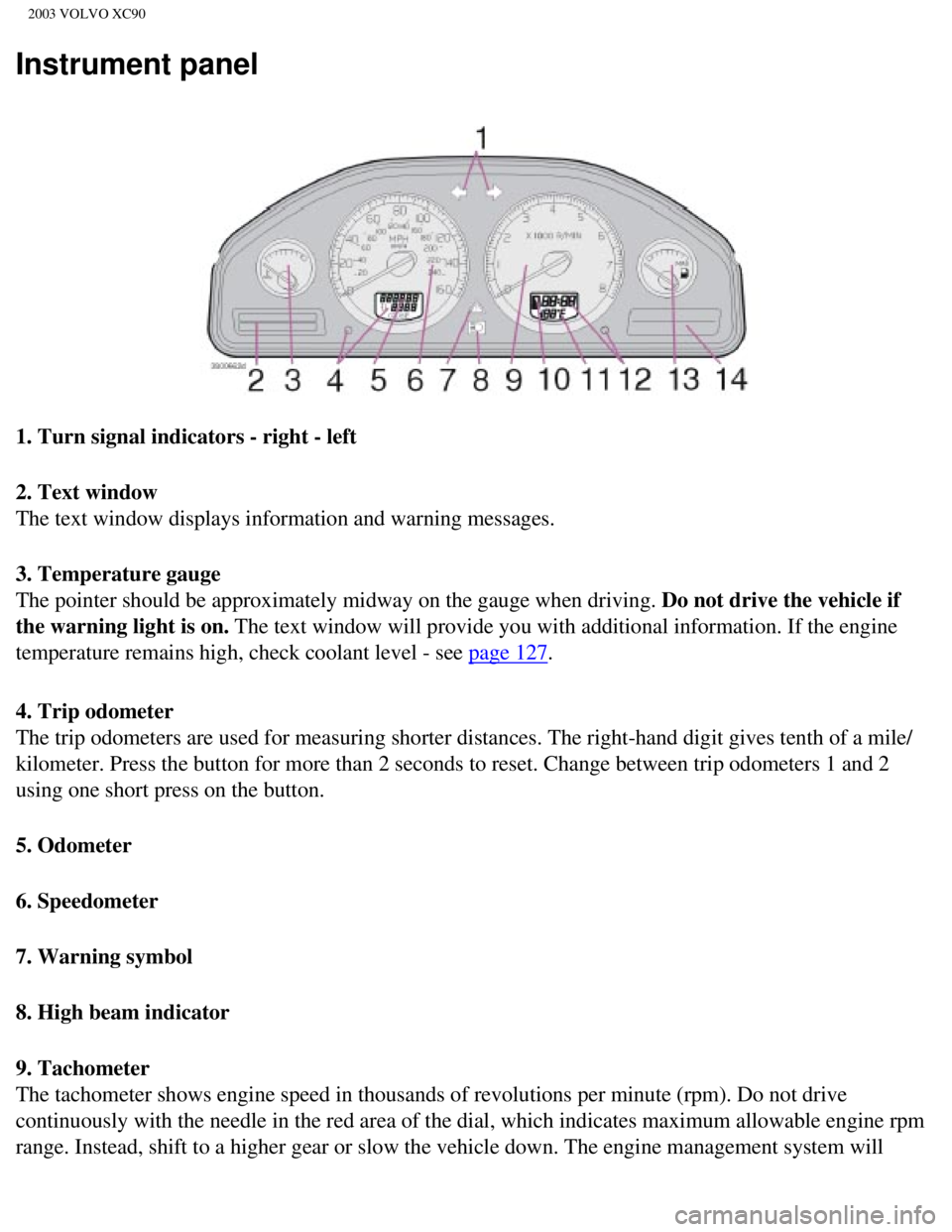
Instrument panel
1. Turn signal indicators - right - left
2. Text window
The text window displays information and warning messages.
3. Temperature gauge
The pointer should be approximately midway on the gauge when driving. Do not drive the vehicle if
the warning light is on. The text window will provide you with additional information. If the en\
gine
temperature remains high, check coolant level - see
page 127.
4. Trip odometer
The trip odometers are used for measuring shorter distances. The right-h\
and digit gives tenth of a mile/
kilometer. Press the button for more than 2 seconds to reset. Change bet\
ween trip odometers 1 and 2
using one short press on the button.
5. Odometer
6. Speedometer
7. Warning symbol
8. High beam indicator
9. Tachometer
The tachometer shows engine speed in thousands of revolutions per minute\
(rpm). Do not drive
continuously with the needle in the red area of the dial, which indicate\
s maximum allowable engine rpm
range. Instead, shift to a higher gear or slow the vehicle down. The eng\
ine management system will
file:///K|/ownersdocs/2003/2003_XC90/03xc90_02a.htm (2 of 16)12/30/200\
6 4:18:52 PM
Page 37 of 242

2003 VOLVO XC90
automatically prevent excessively high engines speeds. This will be noti\
ceable as a pronounced
unevenness in engine speed.
10. Gear and driving mode indicator
The currently selected driving mode is displayed here. If you use the op\
tional Geartronic function on the
automatic transmission, the currently selected gear will be displayed.
11. Ambient temperature gauge
This display indicates the air temperature outside your vehicle. A "snow\
flake" symbol in the text
window is displayed when the temperature is in the range of 23 -36° F\
(-5 -+2° C). Please note that this
symbol does not indicate a fault with your vehicle. At low speeds or whe\
n the vehicle is not moving, the
temperature readings may be slightly higher than the actual ambient temp\
erature.
12. Clock/set button
Turn the button to set the clock.
13. Fuel gauge
The fuel tank holds approximately 19 US gals (72 liters). When a warni\
ng light in the gauge comes on,
there are approximately 1.8 US gal. (8 liters) of fuel remaining in th\
e tank.
14. Indicator and warning symbols
pg. 25 Instruments and controls
Indicator and warning symbols
The indicator and warning symbols light up when you turn the ignition ke\
y to the driving position
(position II) before starting. This shows that the symbols are functio\
ning. When the engine starts, all
symbols go out. If the engine is not started within 5 seconds, all symbo\
ls except CHECK ENGINE and
go out. The symbol for the parking brake goes out when the parking brak\
e is released.
Warning symbol
in center of instrument panel
This symbol shines as a red or yellow light depending on the severity of\
the fault that has been detected.
Red symbol -Stop the vehicle as soon as possible in a suitable location and read th\
e message shown in
the text window.
Yellow symbol -Follow the instructions shown in the text window.
file:///K|/ownersdocs/2003/2003_XC90/03xc90_02a.htm (3 of 16)12/30/200\
6 4:18:52 PM