oil VOLVO XC90 2006 User Guide
[x] Cancel search | Manufacturer: VOLVO, Model Year: 2006, Model line: XC90, Model: VOLVO XC90 2006Pages: 256, PDF Size: 6.87 MB
Page 142 of 256
\
, including the weight of the
load carriers and any other load carrying equipment (ski boxes, bicycl")
2006 VOLVO XC90
WARNING!
Loads carried on the vehicle's roof should not exceed 220 lbs (100 kg)\
, including the weight of the
load carriers and any other load carrying equipment (ski boxes, bicycle\
racks, etc.). Excessive loads
on the roof can adversely affect the handling and roadholding characteri\
stics of the vehicle.
Load carrier cover
The vehicle's ignition key or the stud on the edge of the supplied torqu\
e wrench can be used to undo or
tighten the cover. Turn a quarter turn (90 degrees). See illustration.\
pg. 108 Starting and driving
Cold weather precautions
If you wish to check your vehicle before the approach of cold weather, t\
he following advice is worth
noting:
l Make sure that the engine coolant contains 50 percent antifreeze. Any ot\
her mixture will reduce
freeze protection. This gives protection against freezing down to -31°\
F (-35°C). See section "Coolant".
The use of "recycled" antifreeze is not approved by Volvo. Different typ\
es of antifreeze must not
be mixed.
l Volvo recommends using only genuine Volvo antifreeze in your vehicle's r\
adiator. Your Volvo
retailer stocks plenty of Volvo engine coolant to help protect your vehi\
cle during cold weather.
l Try to keep the fuel tank well filled - this prevents the formation of condensation in the tank. \
In
addition, in extremely cold weather conditions it is worthwhile to add f\
uel line de-icer before refueling.
l The viscosity of the engine oil is important. Oil with low viscosity (thinner oil) improves cold-
weather starting as well as decreasing fuel consumption while the engine\
is warming up. For winter use,
5W-30 oil, particularly the synthetic type*, is recommended. Be sure to \
use good quality oil but do not
use cold-weather oil for hard driving or in warm weather. See section "E\
ngine oil" for more information.
l The load placed on the battery is greater during the winter since the windshield wipers, lighting, etc\
.
file:///K|/ownersdocs/2006/2006_XC90/06xc90_06b.htm (16 of 18)12/30/20\
06 5:32:46 PM
Page 143 of 256

2006 VOLVO XC90
are used more often. Moreover, the capacity of the battery decreases as \
the temperature drops. In very
cold weather, a poorly charged battery can freeze and be damaged. It is \
therefore advisable to check the
state of charge more frequently and spray an antirust oil on the battery\
posts.
l Volvo recommends the use of snow tires on all four wheels for winter driving - see section "Wheels
and tires."
l To prevent the washer fluid reservoir from freezing, add washer solvents containing antifreeze (see
page 147 for the location of the washer fluid reservoir).
This is important since dirt is often splashed on the windshield during \
winter driving, requiring the
frequent use of the washers and wipers. Volvo Washer Solvent should be d\
iluted as follows:
Down to 14° F (-10° C): 1 part washer solvent and 4 parts water \
Down to 5° F (-15° C): 1 part washer solvent and 3 parts water
Down to 0° F (-18° C): 1 part washer solvent and 2 parts water
Down to -18° F (-28° C): 1 part washer solvent and 1 part water \
l Use Volvo Teflon Lock Spray in the locks.
NOTE: Avoid the use of de-icing sprays as they can cause damage to the locks.
W Winter/Wet driving mode-enhanced vehicle traction
l Mode W will only function if the gear selector is in the (D)rive position.
l Press the button at the base of the gear selector to engage/disengage th\
is driving mode.
l An LED in the button will light up to indicate that W is engaged and thi\
s will also be displayed in the
instrument panel (see
page 22).
l This mode may be selected for starting/moving off on slippery roads.
* Synthetic oil is not used when the oil is changed at the normal mainte\
nance intervals except at owner request and at additional
charge. Please consult your Volvo retailer.
pg. 109 Starting and driving
Before a long distance trip
It is always worthwhile to have your vehicle checked at a Volvo retailer\
before driving long distances.
Your retailer will also be able to supply you with bulbs, fuses, spark p\
lugs and wiper blades for your use
in the event that problems occur.
As a minimum, the following items should be checked before any long trip\
:
l Check that engine runs smoothly and that fuel consumption is normal.
l Check for fuel, oil, and fluid leakage
l Check transmission oil level*.
l Check condition of drive belts.
l Check state of the battery's charge.
file:///K|/ownersdocs/2006/2006_XC90/06xc90_06b.htm (17 of 18)12/30/20\
06 5:32:46 PM
Page 145 of 256
2006 VOLVO XC90
2 0 0 6
VOLVO XC90
Vehicle care
pg. 135 Vehicle care
Washing and cleaning the vehicle136
Paint touch up139
pg. 136 Vehicle care
Washing and cleaning the vehicle
l The vehicle should be washed at regular intervals since dirt, dust, inse\
cts and tar spots adhere to the
paint and may cause damage. It is particularly important to wash the veh\
icle frequently in the wintertime
to prevent corrosion, when salt has been used on the roads.
l When washing the vehicle, do not expose it to direct sunlight. Use lukew\
arm water to soften the dirt
before you wash with a sponge, and plenty of water, to avoid scratching.\
l Bird droppings: Remove from paintwork as soon as possible. Otherwise the\
finish may be
permanently damaged.
l A detergent can be used to facilitate the softening of dirt and oil.
l A water-soluble grease solvent may be used in cases of sticky dirt. Howe\
ver, use a wash place
equipped with a drainage separator.
CAUTION
If the vehicle is equipped with chromeplated aluminum wheels, use only s\
pecial car washing
detergents to clean the wheels. Wheel cleaning agents can permanently st\
ain chrome-plated wheels
l Dry the vehicle with a clean chamois and remember to clean the drain hol\
es in the doors and rocker
panels.
l Tar spots can be removed with kerosene or tar remover after the vehicle \
has been washed.
l A stiff-bristle brush and lukewarm soapy water can be used to clean the \
wiper blades. Frequent
cleaning improves visibility considerably.
l Wash off the dirt from the underside (wheel housings, fenders, etc.). \
file:///K|/ownersdocs/2006/2006_XC90/06xc90_07.htm (1 of 7)12/30/2006 \
5:32:47 PM
Page 148 of 256

2006 VOLVO XC90
Fabric
Clean with soapy water or a detergent. For more difficult spots caused b\
y oil, ice cream, shoe polish,
grease, etc., use a clothing/fabric stain remover. Consult your Volvo re\
tailer.
Interior plastic components
Cleaning interior plastic components should be done with a cleaning agen\
t specially designed for this
purpose. Consult your Volvo retailer.
Alcantera
TM suede-like material
Suede-like upholstery can be cleaned with a soft cloth and mild soap sol\
ution.
Leather care
Volvo's leather upholstery is manufactured with a protectant to repel so\
iling. Over time, sunlight, grease
and dirt can break down the protection. Staining, cracking, scuffing, an\
d fading can result.
Volvo offers an easy-to-use, non-greasy leather care kit formulated to c\
lean and beautify your vehicle's
leather, and to renew the protective qualities of its finish. The cleane\
r removes dirt and oil buildup. The
light cream protectant restores a barrier against soil and sunlight.
Volvo also offers a special leather softener that should be applied afte\
r the cleaner and protectant. It
leaves leather soft and smooth, and reduces friction between leather and\
other finishes in the vehicle.
Volvo recommends cleaning, protecting and conditioning your vehicle's le\
ather two to four times a year.
Ask your Volvo retailer about Leather Care Kit 951 0251 and Leather Soft\
ener 943 7429.
CAUTION:
- Under no circumstances should gasoline, naphtha or similar cleaning ag\
ents be used on the plastic or
the leather since these can cause damage.
- Take extra care when removing stains such as ink or lipstick since the\
coloring can spread.
- Use solvents sparingly. Too much solvent can damage the seat padding. \
- Start from the outside of the stain and work toward the center.
- Sharp objects (e.g. pencils or pens in a pocket) or velcro fasteners\
on clothing may damage the textile
upholstery.
Cleaning the seat belts
Clean only with lukewarm water and a mild soap solution.
Cleaning floor mats
file:///K|/ownersdocs/2006/2006_XC90/06xc90_07.htm (4 of 7)12/30/2006 \
5:32:47 PM
Page 153 of 256

2006 VOLVO XC90
The tires have good road holding characteristics and offer good handling\
on dry and wet surfaces. It
should be noted however that the tires have been developed to give these\
features on snow/ice-free
surfaces.
Certain models are equipped with "all-season" tires, which provide a som\
ewhat higher degree of road
holding on slippery surfaces than tires without the "all-season" rating.\
However, for optimum road
holding on icy or snow-covered roads, we recommend suitable winter tires\
on all four wheels.
When replacing tires, be sure that the new tires are the same size desig\
nation, type (radial) and
preferably from the same manufacturer, on all four wheels. Otherwise the\
re is a risk of altering the car's
roadholding and handling characteristics.
Storing wheels and tires
When storing complete wheels (tires mounted on rims), they should be s\
uspended off the floor or placed
on their sides on the floor.
Tires not mounted on rims should be stored on their sides or standing up\
right, but should not be
suspended.
Tread wear indicator
CAUTION
Tires should preferably be stored in a cool, dry, dark place, and should\
never be stored in close
proximity to solvents, gasoline, oils, etc.
Tread wear indicator
The tires have wear indicator strips running across or parallel to the t\
read. The letters TWI are printed on
the side of the tire. When approximately 1/16" (1.6 mm) is left on the\
tread, these strips become visible
and indicate that the tire should be replaced. Tires with less than 1/16\
" (1.6 mm) tread offer very poor
traction.
When replacing worn tires, it is recommended that the tire be identical \
in type (radial) and size as the
one being replaced. Using a tire of the same make (manufacturer) will \
prevent alteration of the driving
characteristics of the vehicle.
file:///K|/ownersdocs/2006/2006_XC90/06xc90_08.htm (2 of 22)12/30/2006\
5:32:49 PM
Page 174 of 256
2006 VOLVO XC90
2 0 0 6
VOLVO XC90
Maintenance
pg. 141 Maintenance
Volvo maintenance142
Owner maintenance143
Emission inspection readiness144
Working on your vehicle145
Engine compartment147
Oils and fluids148
Wiper Blades152
Battery maintenance153
Bulbs156
Fuses164
pg. 142 Maintenance
Volvo Maintenance
Maintenance Service
Periodic maintenance will help keep your vehicle running well. Your Warr\
anty and Service Records
Information booklet provides a comprehensive maintenance schedule up to \
150,000 miles (240,000 km)
of vehicle service. This maintenance program contains inspections and se\
rvices necessary for the proper
function of your car, and includes components that affect vehicle emissi\
ons. The maintenance services
contain several checks that require special instruments and tools and th\
erefore must be performed by a
file:///K|/ownersdocs/2006/2006_XC90/06xc90_09a.htm (1 of 15)12/30/200\
6 5:32:50 PM
Page 176 of 256

2006 VOLVO XC90
pg. 143 Maintenance
Owner maintenance
Periodic maintenance requirements and intervals are described in your ve\
hicle's Warranty and Service
Records Information booklet.
The following points can be carried out between the normally scheduled m\
aintenance services.
Each time the car is refueled:
l Check the engine oil level
l Clean the windshield, windshield wipers, headlights, and tail lights
Monthly:
l Check cold tire pressure in all tires. Inspect the tires for wear.
l Check that engine coolant and other fluid levels are between the indicat\
ed "min" and "max" markings.
l Clean interior glass surfaces with a glass cleaner and soft paper towels\
.
l Wipe driver information displays with a soft cloth.
l Visually inspect battery terminals for corrosion. Corrosion may indicate\
a loose terminal connector, or
a battery near the end of its useful service life. Consult your Volvo re\
tailer for additional information.
As needed:
l Wash the car, including the undercarriage, to reduce wear that can be ca\
used by a buildup of dirt, and
corrosion that can be caused by salt residues.
l Clean leaves and twigs from air intake vents at the base of the windshie\
ld, and from other places
where they may collect.
NOTE: Complete service information for qualified technicians is available onli\
ne for purchase or
subscription at
www.volvotechinfo.com.
pg. 144 Maintenance
Emission inspection readiness
What is an Onboard Diagnostic System (OBD II)?
OBD II is part of your vehicle's computerized engine management system. \
It stores diagnostic
information about your vehicle's emission controls. It can light the Che\
ck Engine light (MIL) if it detects
an emission control "fault." A "fault" is a component or system that is \
not performing within an expected
range. A fault may be permanent or temporary. OBD II will store a messag\
e about any fault.
How do states use OBD II for emission inspections?
file:///K|/ownersdocs/2006/2006_XC90/06xc90_09a.htm (3 of 15)12/30/200\
6 5:32:50 PM
Page 178 of 256

2006 VOLVO XC90
the engine. Ensure that the jack is positioned so that the vehicle canno\
t slide off it. Always use axle
stands or similar structures. The car's gross vehicle weight is between \
5770 lb (2630 kg) and 6080 lb
(2760 kg). Use a jack and stands rated for this weight.
If a two-post hoist is used to lift the vehicle, the front and rear lift\
arm pads should be centered under the
reinforced lift plates on the inboard edge of the sill rail (see illust\
ration).
Please note the following before you begin working on your vehicle:
Battery (see also
page 155 for more information on handling the battery)
l Ensure that the battery cables are correctly connected and tightened.
l Never disconnect the battery when the engine is running (e.g. when repl\
acing the battery).
l The battery contains acid that is both corrosive and poisonous. It is im\
portant that the battery is
handled in an environmentally friendly way. Let your Volvo retailer assi\
st you.
l Never use a fast charger to charge the battery. The battery cables shoul\
d be disconnected when
recharging.
WARNING!
The ignition system has very high voltage! The voltage in the ignition s\
ystem is dangerous!
Do not touch spark plugs, ignition cables or the ignition coil when the \
engine is running or the
ignition is switched on!
The ignition should be switched off when:
- Conducting engine tests.
- Replacing parts in the ignition system, such as spark plugs, ignition \
coil, distributor, ignition cables,
etc.
- Never try to repair any part of the SRS/SIPS/WHIPS/IC systems yourself\
. Any interference in the
system could cause malfunction and serious injury. Any work should only \
be performed by an
authorized Volvo workshop.
pg. 146 Maintenance
Belt check
Check the belt regularly to make sure it is in good condition and is cle\
an. A worn or dirty belt can cause
poor cooling and low alternator output as well as impair the operation o\
f the power steering and the air
conditioning unit.
NOTE: The drive belt is equipped with a self-tensioning mechanism and requires\
no adjustment
between changes.
file:///K|/ownersdocs/2006/2006_XC90/06xc90_09a.htm (5 of 15)12/30/200\
6 5:32:50 PM
Page 179 of 256

2006 VOLVO XC90
WARNING!
The engine must not be running when this check is
performed.
Check coolant level
The cooling system must be filled with coolant and not leak to operate a\
t maximum efficiency. Check
the coolant level regularly. The level should be between the "MAX" and "\
MIN" marks on the expansion
tank. The check should be made with particular thoroughness when the eng\
ine is new or when the
cooling system has been drained.
Do not remove the filler cap other than for topping up with coolant. Fre\
quent removal may prevent
coolant circulation between the engine and the expansion tank during eng\
ine warm up and cooling.
Changing coolant
Normally, the coolant does not need to be changed. If the system must be\
drained, consult your Volvo
retailer.
NOTE: Do not top off with water only. This reduces the rust-protective and ant\
ifreeze qualities of the
coolant and has a lower boiling point. It can also cause damage to the c\
ooling system if it should freeze.
Top off with Volvo Genuine Coolant/Antifreeze only (a 50/50 mix of wate\
r and antifreeze). CAUTION
The cooling system must always be kept filled to the correct level. If i\
t is not kept filled, there can be
high local temperatures in the engine which could result in damage. Diff\
erent types of antifreeze/
coolant may not be mixed.
WARNING!
Never remove the radiator cap while the engine is warm. Wait until the v\
ehicle
cools.
pg. 147 Maintenance
Engine compartment
file:///K|/ownersdocs/2006/2006_XC90/06xc90_09a.htm (6 of 15)12/30/200\
6 5:32:50 PM
Page 180 of 256
2006 VOLVO XC90
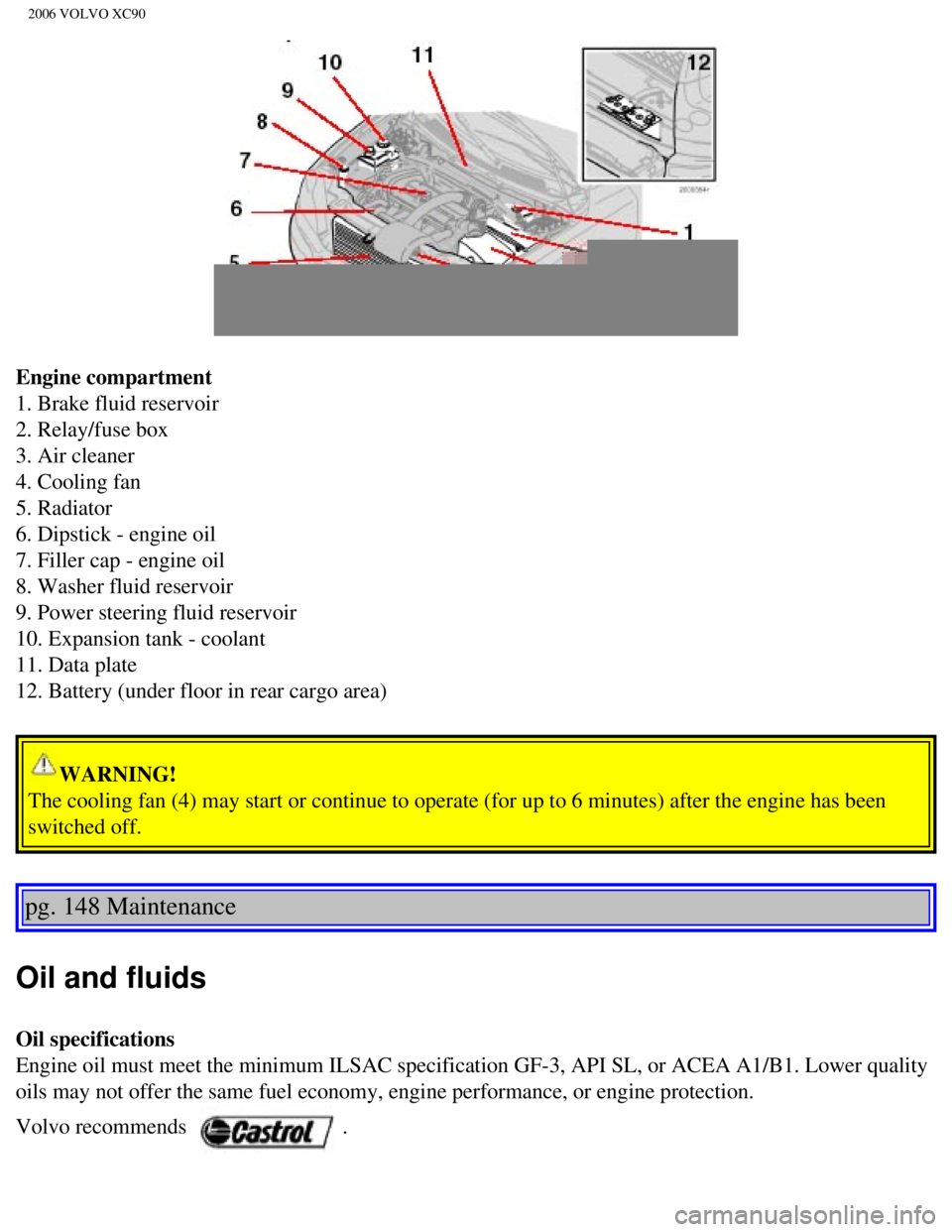
Engine compartment
1. Brake fluid reservoir
2. Relay/fuse box
3. Air cleaner
4. Cooling fan
5. Radiator
6. Dipstick - engine oil
7. Filler cap - engine oil
8. Washer fluid reservoir
9. Power steering fluid reservoir
10. Expansion tank - coolant
11. Data plate
12. Battery (under floor in rear cargo area)
WARNING!
The cooling fan (4) may start or continue to operate (for up to 6 min\
utes) after the engine has been
switched off.
pg. 148 Maintenance
Oil and fluids
Oil specifications
Engine oil must meet the minimum ILSAC specification GF-3, API SL, or AC\
EA A1/B1. Lower quality
oils may not offer the same fuel economy, engine performance, or engine \
protection.
Volvo recommends
.
file:///K|/ownersdocs/2006/2006_XC90/06xc90_09a.htm (7 of 15)12/30/200\
6 5:32:50 PM