towing VOLVO XC90 2006 User Guide
[x] Cancel search | Manufacturer: VOLVO, Model Year: 2006, Model line: XC90, Model: VOLVO XC90 2006Pages: 256, PDF Size: 6.87 MB
Page 139 of 256

2006 VOLVO XC90
l Do not connect the trailer's brake system directly to the vehicle's brak\
e system.
l Remove the ball and drawbar assembly when the hitch is not being used.
l Volvo recommends the use of synthetic engine oil when towing a trailer o\
ver long distances or in
mountainous areas.
WARNING!
- Bumper-attached trailer hitches must not be used on Volvos, nor should\
safety chains be attached to
the bumper.
Trailer hitches attaching to the vehicle rear axle must not be used.
- Never connect a trailer's hydraulic brake system directly to the vehic\
le brake system, nor a trailer's
lighting system directly to the vehicle lighting system. Consult your ne\
arest authorized Volvo retailer
for correct installation.
- When towing a trailer, the trailer's safety wire must be correctly fas\
tened to the hole or hook
provided in the trailer hitch on the vehicle. The safety wire should nev\
er be fastened to or wound
around the drawbar ball.
NOTE!
- When parking the vehicle with a trailer on a hill, apply the parking b\
rake before putting the gear
selector in (P)ark. When starting on a hill, put the gear selector in \
(D)rive before releasing the parking
brake. Always follow the trailer manufacturer's recommendations for whee\
l chocking.
- If you use the manual (Geartronic) shift positions while towing a tr\
ailer, make sure the gear you select
does not put too much strain on the engine (using too high a gear).
pg. 106 Starting and driving
Smoother starts with a trailer Models equipped with the V8-engine and the 6-speed automatic
transmission have a built-in function that reduces acceleration slightly\
in first gear when the vehicle is
towing a trailer. This is done to help avoid wheel spin and to make star\
ting off smoother.
l This function is activated when the trailer's electrical connector is pl\
ugged into the electrical socket
mounted near the trailer hitch.
l The function is automatically deactivated when the trailer's wiring is d\
isconnected from the socket.
The vehicle will then accelerate normally.
NOTE: Since this function is activated when a connector is plugged into the e\
lectrical socket near the
trailer hitch, it will be activated by any electrical equipment (e.g. b\
icycle racks with lighting, etc) that is
plugged in, and will remain active until the equipment is unplugged from\
the socket.
Leveling
If your vehicle is equipped with automatic levelling, the rear suspensio\
n always retains the correct ride
height regardless of the load.
file:///K|/ownersdocs/2006/2006_XC90/06xc90_06b.htm (13 of 18)12/30/20\
06 5:32:46 PM
Page 163 of 256

2006 VOLVO XC90
l PSI: Pounds per square inch, a standard unit of air pressure.
l B-pillar: The structural member at the side of the vehicle behind the front door\
.
l Bead area of the tire: Area of the tire next to the rim.
l Sidewall of the tire: Area between the bead area and the tread.
l Tread area of the tire: Area of the perimeter of the tire that contacts the road when mounted \
on the
vehicle.
l Rim: The metal support (wheel) for a tire or a tire and tube assembly upo\
n which the tire beads are
seated.
l Maximum load rating: a figure indicating the maximum load in pounds and kilograms that can \
be
carried by the tire. This rating is established by the tire manufacturer\
.
l Maximum permissible inflation pressure: the greatest amount of air pressure that should ever be
put in the tire. This limit is set by the tire manufacturer.
l Recommended tire inflation pressure: inflation pressure, established by Volvo, which is based on
the type of tires that are mounted on a vehicle at the factory. This inf\
lation pressure is affected by the
number of occupants in the car, the amount of cargo, and the speed at wh\
ich the vehicle will be driven
for a prolonged period. This information can be found on the tire inflat\
ion placard(s) located on the
driver's side B-pillar or on the inside of the fuel filler door on Canad\
ian models, and in the tire inflation
table in this chapter.
l Cold tires: The tires are considered to be cold when they have the same temperatur\
e as the
surrounding (ambient) air. This temperature is normally reached after \
the car has been parked for at least
3 hours.
pg. 121 Wheels and tires
Vehicle loading
Properly loading your vehicle will provide maximum return of vehicle des\
ign performance. Before
loading your vehicle, familiarize yourself with the following terms for \
determining your vehicle's weight
ratings, with or without a trailer, from the vehicle's Federal/Canadian \
Motor Vehicle Safety Standards
(FMVSS/CMVSS) label, and the vehicle's tire information placard:
Curb weight
The weight of the vehicle including a full tank of fuel and all standard\
equipment. It does not include
passengers, cargo, or optional equipment.
Capacity weight
All weight added to the curb weight, including cargo and optional equipm\
ent. When towing, trailer hitch
tongue load is also part of cargo weight.
NOTE: For trailer towing information, please refer to the section "Towin\
g a trailer" on
page 104.
Permissible axle weight
file:///K|/ownersdocs/2006/2006_XC90/06xc90_08.htm (12 of 22)12/30/200\
6 5:32:49 PM
Page 164 of 256
. These numbers are
shown on the Federal/Canadian Motor Vehicle Safety Standards (FMVSS/CMV\
SS) la")
2006 VOLVO XC90
The maximum allowable weight that can be carried by a single axle (fron\
t or rear). These numbers are
shown on the Federal/Canadian Motor Vehicle Safety Standards (FMVSS/CMV\
SS) label. The total load
on each axle must never exceed its maximum permissible weight.
Gross vehicle weight (GVW)
The vehicle's curb weight + cargo + passengers.
NOTE:
l The location of the various labels in your vehicle can be found on page 172.
l A table listing important weight limits for your vehicle can be found on\
page 173.
Steps for Determining Correct Load Limit
(1) Locate the statement "the combined weight of occupants and cargo s\
hould never exceed XXX
pounds" on your vehicle's placard.
(2) Determine the combined weight of the driver and passengers that wi\
ll be riding in your vehicle.
(3) Subtract the combined weight of the driver and passengers from XXX\
kilograms or XXX pounds.
(4) The resulting figure equals the available amount of cargo and lugg\
age load capacity. For example, if
the "XXX" amount equals 1400 lbs. and there will be five 150 lb. passeng\
ers in your vehicle, the amount
of available cargo and luggage load capacity is 650 lbs. (1400-750 (5 \
x 150) = 650 lbs.)
(5) Determine the combined weight of luggage and cargo being loaded on\
the vehicle. That weight may
not safely exceed the available cargo and luggage load capacity calculat\
ed in Step 4.
(6) If your vehicle will be towing a trailer, load from your trailer w\
ill be transferred to your vehicle.
Consult this manual
1 to determine how this reduces the available cargo and luggage load capa\
city of
your vehicle.
WARNING!
- Exceeding the permissible axle weight, gross vehicle weight, or any ot\
her weight rating limits can
cause tire overheating resulting in permanent deformation or catastrophi\
c failure.
- Do not use replacement tires with lower load carrying capacities than \
the tires that were original
equipment on the vehicle because this will lower the vehicle's GVW ratin\
g. Replacement tires with a
higher limit than the originals do not increase the vehicle's GVW rating\
limitations.
1. See "Towing a trailer" on
page 104
pg. 122 Wheels and tires
file:///K|/ownersdocs/2006/2006_XC90/06xc90_08.htm (13 of 22)12/30/200\
6 5:32:49 PM
Page 181 of 256

2006 VOLVO XC90
Depending on your driving habits, premium or synthetic oils may provide \
superior fuel economy and
engine protection. Consult your Volvo retailer for recommendations on pr\
emium or synthetic oils.
Oil additives must not be used.
NOTE: Synthetic oil is not used when the oil is changed when the normal mainte\
nance is carried out.
This oil is only used at customer request, at additional charge. Please \
consult your Volvo retailer.
Oil Viscosity
Operation in hot climates.
For the protection of your engine when temperatures in your area exceed \
86° F (30° C), Volvo
recommends that you use an oil with suitable viscosity, as shown in the \
chart below.
Operation in temperate climates
Incorrect viscosity oil can shorten engine life. Under normal use when t\
emperatures do not exceed 86° F
(30° C), SAE 5W-30 will provide good fuel economy and engine protec\
tion. See the viscosity chart
above.
Extreme engine operation
Synthetic oils meeting ACEA A5/B5 requirements are recommended for drivi\
ng in areas of sustained
temperature extremes (hot or cold), when towing a trailer over long di\
stances, and for prolonged driving
in mountainous areas.
American Petroleum Institute (API) symbol
American Petroleum Institute (API) symbol
file:///K|/ownersdocs/2006/2006_XC90/06xc90_09a.htm (8 of 15)12/30/200\
6 5:32:50 PM
Page 252 of 256
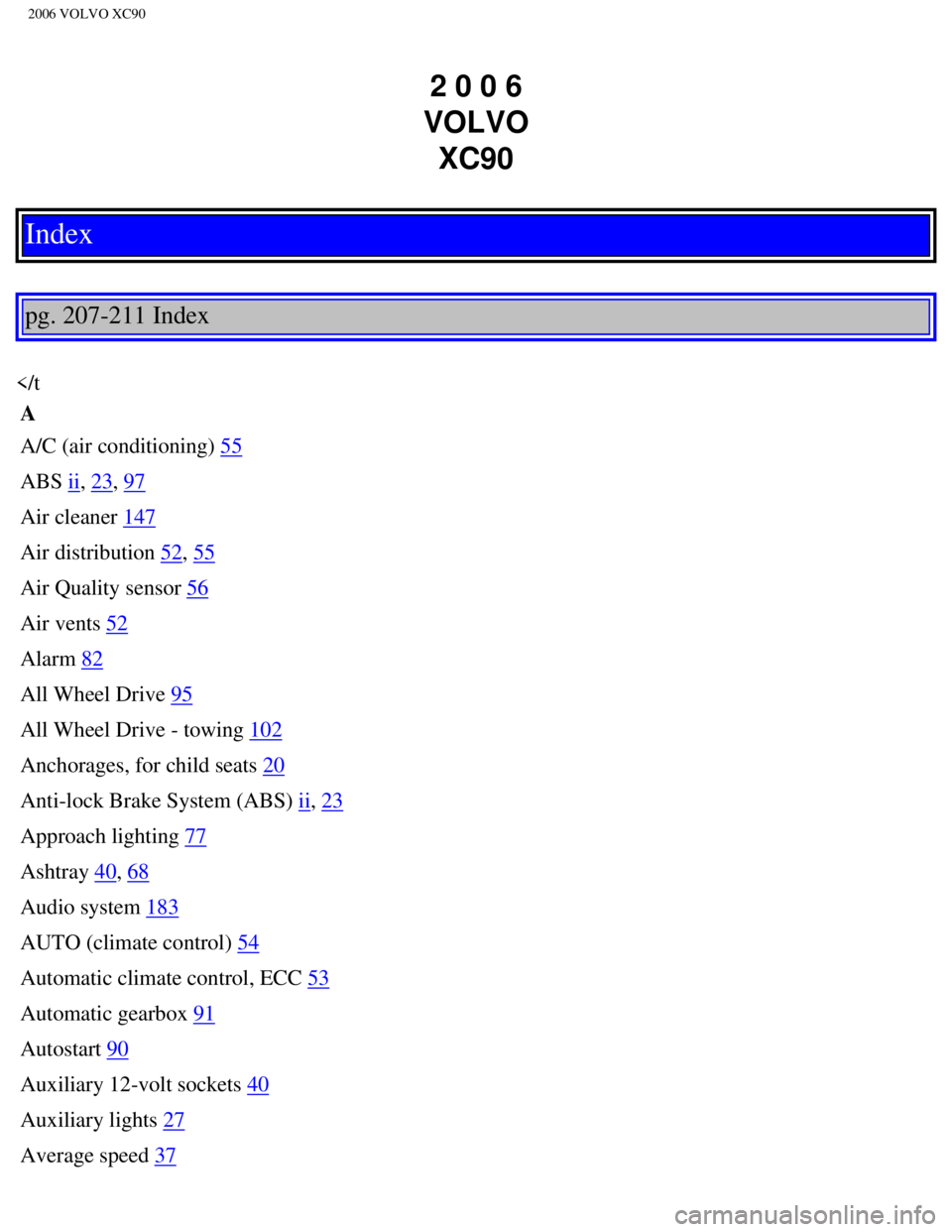
2006 VOLVO XC90
2 0 0 6
VOLVO XC90
Index
pg. 207-211 Index
A/C (air conditioning)
55
ABS
ii, 23, 97
Air cleaner
147
Air distribution
52, 55
Air Quality sensor
56
Air vents
52
Alarm
82
All Wheel Drive
95
All Wheel Drive - towing
102
Anchorages, for child seats
20
Anti-lock Brake System (ABS)
ii, 23
Approach lighting
77
Ashtray
40, 68
Audio system
183
AUTO (climate control)
54
Automatic climate control, ECC
53
Automatic gearbox
91
Autostart
90
Auxiliary 12-volt sockets
40
Auxiliary lights
27
Average speed
37
file:///K|/ownersdocs/2006/2006_XC90/06xc90_12.htm (1 of 5)12/30/2006 \
5:32:56 PM