light VOLVO XC90 2006 Manual PDF
[x] Cancel search | Manufacturer: VOLVO, Model Year: 2006, Model line: XC90, Model: VOLVO XC90 2006Pages: 256, PDF Size: 6.87 MB
Page 147 of 256
 are retracted or removed. Otherwise th\
ere is risk of the machine
dislodging them.
Polishing and Waxing
l Normally, polishing is not required du")
2006 VOLVO XC90
secure, and that any antenna(s) are retracted or removed. Otherwise th\
ere is risk of the machine
dislodging them.
Polishing and Waxing
l Normally, polishing is not required during the first year after delivery\
, however, waxing may be
beneficial.
l Before applying polish or wax the vehicle must be washed and dried. Tar \
spots can be removed with
kerosene or tar remover. Difficult spots may require a fine rubbing comp\
ound.
l After polishing use liquid or paste wax.
l Several commercially available products contain both polish and wax.
l Waxing alone does not substitute for polishing a dull surface.
l A wide range of polymer-based waxes can be purchased today. These waxes \
are easy to use and
produce a long-lasting, high-gloss finish that protects the bodywork aga\
inst oxidation, road dirt and
fading.
l Do not polish or wax your vehicle in direct sunlight (the surface of th\
e vehicle should not be warmer
than 113° F (45° C).
CAUTION:
Volvo does not recommend the use of long-life or durable paint protectio\
n coatings, some of which may
claim to prevent pitting, fading, oxidation, etc. These coatings have no\
t been tested by Volvo for
compatibility with your vehicle's clear coat. Some of them may cause the\
clear coat to soften, crack, or
cloud. Damage caused by application of paint protection coatings may not\
be covered under your
vehicle's paint warranty.
Mirrors/side windows with the water repellent glass coating-option
l Do not apply wax, degreasing agents, etc to this glass. This could damag\
e the coating.
l Clean the glass surface with care to avoid scratching.
l Use only suitable plastic scrapers to remove ice or snow from the window\
s.
NOTE: The water repellent coating is subject to natural wear.
l In order to maintain the coating's water repellent characteristics, it s\
hould be treated with a special
compound that is available at your Volvo retailer.
l This treatment should be carried out for the first time after three year\
s, and thereafter once a year.
pg. 138 Vehicle care
Cleaning the upholstery
file:///K|/ownersdocs/2006/2006_XC90/06xc90_07.htm (3 of 7)12/30/2006 \
5:32:47 PM
Page 148 of 256

2006 VOLVO XC90
Fabric
Clean with soapy water or a detergent. For more difficult spots caused b\
y oil, ice cream, shoe polish,
grease, etc., use a clothing/fabric stain remover. Consult your Volvo re\
tailer.
Interior plastic components
Cleaning interior plastic components should be done with a cleaning agen\
t specially designed for this
purpose. Consult your Volvo retailer.
Alcantera
TM suede-like material
Suede-like upholstery can be cleaned with a soft cloth and mild soap sol\
ution.
Leather care
Volvo's leather upholstery is manufactured with a protectant to repel so\
iling. Over time, sunlight, grease
and dirt can break down the protection. Staining, cracking, scuffing, an\
d fading can result.
Volvo offers an easy-to-use, non-greasy leather care kit formulated to c\
lean and beautify your vehicle's
leather, and to renew the protective qualities of its finish. The cleane\
r removes dirt and oil buildup. The
light cream protectant restores a barrier against soil and sunlight.
Volvo also offers a special leather softener that should be applied afte\
r the cleaner and protectant. It
leaves leather soft and smooth, and reduces friction between leather and\
other finishes in the vehicle.
Volvo recommends cleaning, protecting and conditioning your vehicle's le\
ather two to four times a year.
Ask your Volvo retailer about Leather Care Kit 951 0251 and Leather Soft\
ener 943 7429.
CAUTION:
- Under no circumstances should gasoline, naphtha or similar cleaning ag\
ents be used on the plastic or
the leather since these can cause damage.
- Take extra care when removing stains such as ink or lipstick since the\
coloring can spread.
- Use solvents sparingly. Too much solvent can damage the seat padding. \
- Start from the outside of the stain and work toward the center.
- Sharp objects (e.g. pencils or pens in a pocket) or velcro fasteners\
on clothing may damage the textile
upholstery.
Cleaning the seat belts
Clean only with lukewarm water and a mild soap solution.
Cleaning floor mats
file:///K|/ownersdocs/2006/2006_XC90/06xc90_07.htm (4 of 7)12/30/2006 \
5:32:47 PM
Page 159 of 256

2006 VOLVO XC90
WARNING!
The TPMS system uses a radio frequency of 315 MHz. Accessory electrical \
equipment using the
same frequency could interfere with TPMS and should not be installed in \
the vehicle. Please consult
your Volvo retailer, a qualified Volvo service technician, or the access\
ory equipment's supplier for
further information.
When low inflation pressure is detected, TPMS will light up the tire pre\
ssure warning light (
) (also
referred to as a telltale) in the instrument panel, and will display a \
message in the text window. The
wording of this message is determined by the degree of inflation pressur\
e loss.
NOTE: If a fault occurs in TPMS, the tire pressure warning light will flash fo\
r approximately 1 minute
and TIRE PRESS SYST SERVICE REQUIRED will be displayed.
Each tire, including the spare (if provided), should be checked monthl\
y when cold and inflated to the
inflation pressure recommended by the vehicle manufacturer on the vehicl\
e placard or tire inflation
pressure label. (If your vehicle has tires of a different size than the\
size indicated on the vehicle placard
or tire inflation pressure label, you should consult the appropriate sec\
tion of this owner's manual to
determine the proper tire inflation pressure.) When the low tire pressu\
re telltale is illuminated, one or
more of your tires is significantly underinflated. You should stop and c\
heck your tires as soon as
possible, and inflate them to the proper pressure. Driving on a signific\
antly underinflated tire causes the
tire to overheat and can lead to tire failure. Under-inflation also redu\
ces fuel efficiency and tire tread
life, and may affect the vehicle's handling and stopping ability. Your v\
ehicle has also been equipped
with a TPMS malfunction telltale to indicate when the system is not oper\
ating properly. When the
malfunction telltale is illuminated, the system may not be able to detec\
t or signal low tire pressure as
intended. TPMS malfunctions may occur for a variety of reasons, includin\
g the installation of
incompatible replacement tires on the vehicle. Always check the TPMS mal\
function telltale after
replacing one or more tires on your vehicle to ensure that the replaceme\
nt tires are compatible with the
TPMS.
NOTE: TPMS indicates low tire pressure but does not replace normal tire maint\
enance. For information
on correct tire pressure, please refer to the table on
page 116, or consult your Volvo retailer.
Erasing warning messages
When a low tire pressure warning message has been displayed, and the tir\
e pressure warning light has
come on:
1. Use a tire pressure gauge to check the inflation pressure of all four\
tires.
2. Re-inflate the tire(s) to the correct pressure (consult the tire p\
ressure placard or the table on
page 116).
3. Drive the car for at least one minute at a speed of 20 mph (30 km/h)\
or faster.
This will erase the warning text and the warning light will go out.
file:///K|/ownersdocs/2006/2006_XC90/06xc90_08.htm (8 of 22)12/30/2006\
5:32:49 PM
Page 170 of 256
.
5. Lower the spare wheel under the vehicle by turning the crank counterc")
2006 VOLVO XC90
4. Insert the hooked end of the crank in the spare wheel retaining attac\
hment (see the illustration above).
5. Lower the spare wheel under the vehicle by turning the crank counterc\
lockwise until it is not possible
to turn it further.
6. Pivot the toggle at the end of the cable 90 degrees to release it fro\
m the spare wheel.
7. Crank up the cable again by turning the crank clockwise.CAUTION
When the spare wheel is mounted on the vehicle, the retaining cable coul\
d damage the underside of
the vehicle if it is not retracted.
8. Place the wheel with the flat tire in the vehicle's cargo compartment\
.
NOTE: The space under the vehicle is designed to hold the special spare wheel \
only. Other full-size
wheels will not fit in this compartment.
pg. 127 Wheels and tires
Returning the spare wheel to its storage compartment
1. Use the crank (turn it counterclockwise) to lower the spare wheel's\
retaining cable.
2. Pass the toggle at the end of the cable through the center hole in th\
e spare wheel. Pivot the toggle 90
degrees so that when raised, the wheel will rest on the toggle.
3. Retract the retaining cable slightly by slowly turning the crank cloc\
kwise several times.
4. Position the wheel so that it is not obstructed by components in the \
exhaust system.
5. Continue to raise the wheel by turning the crank clockwise.Raise the \
wheel a little bit at a time and
guide it around the rear axle until it is securely seated in the storage\
area.
6. When it is no longer possible to turn the crank any further, check th\
at the spare wheel is securely in
position in the storage compartment.
file:///K|/ownersdocs/2006/2006_XC90/06xc90_08.htm (19 of 22)12/30/200\
6 5:32:49 PM
Page 176 of 256

2006 VOLVO XC90
pg. 143 Maintenance
Owner maintenance
Periodic maintenance requirements and intervals are described in your ve\
hicle's Warranty and Service
Records Information booklet.
The following points can be carried out between the normally scheduled m\
aintenance services.
Each time the car is refueled:
l Check the engine oil level
l Clean the windshield, windshield wipers, headlights, and tail lights
Monthly:
l Check cold tire pressure in all tires. Inspect the tires for wear.
l Check that engine coolant and other fluid levels are between the indicat\
ed "min" and "max" markings.
l Clean interior glass surfaces with a glass cleaner and soft paper towels\
.
l Wipe driver information displays with a soft cloth.
l Visually inspect battery terminals for corrosion. Corrosion may indicate\
a loose terminal connector, or
a battery near the end of its useful service life. Consult your Volvo re\
tailer for additional information.
As needed:
l Wash the car, including the undercarriage, to reduce wear that can be ca\
used by a buildup of dirt, and
corrosion that can be caused by salt residues.
l Clean leaves and twigs from air intake vents at the base of the windshie\
ld, and from other places
where they may collect.
NOTE: Complete service information for qualified technicians is available onli\
ne for purchase or
subscription at
www.volvotechinfo.com.
pg. 144 Maintenance
Emission inspection readiness
What is an Onboard Diagnostic System (OBD II)?
OBD II is part of your vehicle's computerized engine management system. \
It stores diagnostic
information about your vehicle's emission controls. It can light the Che\
ck Engine light (MIL) if it detects
an emission control "fault." A "fault" is a component or system that is \
not performing within an expected
range. A fault may be permanent or temporary. OBD II will store a messag\
e about any fault.
How do states use OBD II for emission inspections?
file:///K|/ownersdocs/2006/2006_XC90/06xc90_09a.htm (3 of 15)12/30/200\
6 5:32:50 PM
Page 177 of 256

2006 VOLVO XC90
Many states connect a computer directly to a vehicle's OBD II system. Th\
e inspector can then read
"faults." In some states, this type of inspection has replaced the tailp\
ipe emission test.
How can my vehicle fail OBD II emission inspection?
Your vehicle can fail OBD II emission inspection for any of the followin\
g reasons.
l If your Check Engine (MIL) light is lit, your vehicle may fail inspect\
ion.
l If your vehicle's Check Engine light was lit, but went out without any a\
ction on your part, OBD II will
still have a recorded fault. Your vehicle may pass or fail, depending on\
the inspection practices in your
area.
l If you had recent service that required disconnecting the battery, OBD I\
I diagnostic information may
be incomplete and "not ready" for inspection. A vehicle that is not read\
y may fail inspection.
How can I prepare for my next OBD II emission inspection?
l If your Check Engine (MIL) light is lit - or was lit but went out with\
out service, have your vehicle
diagnosed and, if necessary, serviced by a qualified Volvo technician.
l If you recently had service for a lit Check Engine light, or if you had \
service that required
disconnecting the battery, a period of driving is necessary to bring the\
OBD II system to "ready" for
inspection. A half-hour trip of mixed stop-and-go/ highway driving is ty\
pically needed to allow OBD II
to reach readiness. Your Volvo retailer can provide you with more inform\
ation on planning a trip.
l Maintain your vehicle in accordance with your vehicle's maintenance sche\
dule.
pg. 145 Maintenance
Working you your vehicle
Reinforced lifting points
Hoisting the vehicle
If a garage jack is used to lift the vehicle, the two jack attachments p\
oints should be used. They are
specially reinforced to bear the weight of the vehicle (see the illustr\
ation above). A garage jack can also
be placed under the front of the engine support frame. Take care not to \
damage the splash guard under
file:///K|/ownersdocs/2006/2006_XC90/06xc90_09a.htm (4 of 15)12/30/200\
6 5:32:50 PM
Page 189 of 256

2006 VOLVO XC90
pg. 153 Maintenance
Battery Maintenance
The battery in your vehicle is located under the floor of the cargo comp\
artment.
Driving habits and conditions, climate, the number of starts, etc. all a\
ffect the service life and function of
the battery. In order for your battery to perform satisfactorily, keep t\
he following in mind:
l Check the fluid level in each cell in the battery every 24 months or eve\
ry 15,000* miles (24,000 km),
whichever is sooner. The fluid should be at the level shown in the illus\
tration above (A)**.
l Use a screw driver to open the caps and a flashlight to inspect the leve\
l.
l If necessary, add distilled water. The level should never be above the i\
ndicator (A**).
l The fluid level should be checked if the battery has been recharged.
l After inspection, be sure the cap over each battery cell is securely in \
place.
l Check that the battery cables are correctly connected and properly tight\
ened. Route ventilation hose
through opening in floor (see
page 151)
l Never disconnect the battery when the engine is running, for example whe\
n changing the battery.
l The battery should be disconnected from the vehicle when a battery charg\
er is used directly on the
battery.
l However, if the battery is being charged via the connecting points in th\
e engine compartment (see
page 103), the battery must be connected.
* More frequently in warm climates.
** The level indicator inside the battery could be designed in various w\
ays. See illustration.
file:///K|/ownersdocs/2006/2006_XC90/06xc90_09b.htm (1 of 24)12/30/200\
6 5:32:52 PM
Page 193 of 256

2006 VOLVO XC90
locking system's remote control to reactivate such features as the power\
windows, moonroof, courtesy
lighting, etc.
WARNING!
PROPOSITION 65 WARNING!
Battery posts, terminals, and related accessories contain lead and lead \
compounds, chemicals known
to the state of California to cause cancer and reproductive harm. Wash h\
ands after handling.
pg. 156 Maintenance
Bulbs
The following bulbs are used in the vehicle:
Bulb Type Socket
1. High beam H7 65W-
1. Low beam H11 55W-
2. Bi-Xenon headlight (option) D2R 35W
3. Front fog lights H1 55W
4. Front parking lights, front/rear side marker lights, license plate li\
ght, rear
footwell lighting W5W
W2,1x9,5d
5. Front turn signals H21W BAY9s
5. Rear fog light P21/4W BAY9s
file:///K|/ownersdocs/2006/2006_XC90/06xc90_09b.htm (5 of 24)12/30/200\
6 5:32:52 PM
Page 194 of 256
2006 VOLVO XC90
6. Side turn signals WY5W W2,1x9,5d
7. Brake lights, backup lights P21W BAY15d
8. Rear turn signals PY21W BA15s
9. Rear parking lights P21/4W BAZ15s
10. Vanity mirror lighting 1.2W SV5.5
11. Front footwell lighting, cargo area lighting C5W SV8.5
WARNING!
Bi-Xenon headlights (option) - due to the high voltage used by these h\
eadlights, these bulbs should
only be replaced by an authorized Volvo service technician.
pg. 157 Maintenance
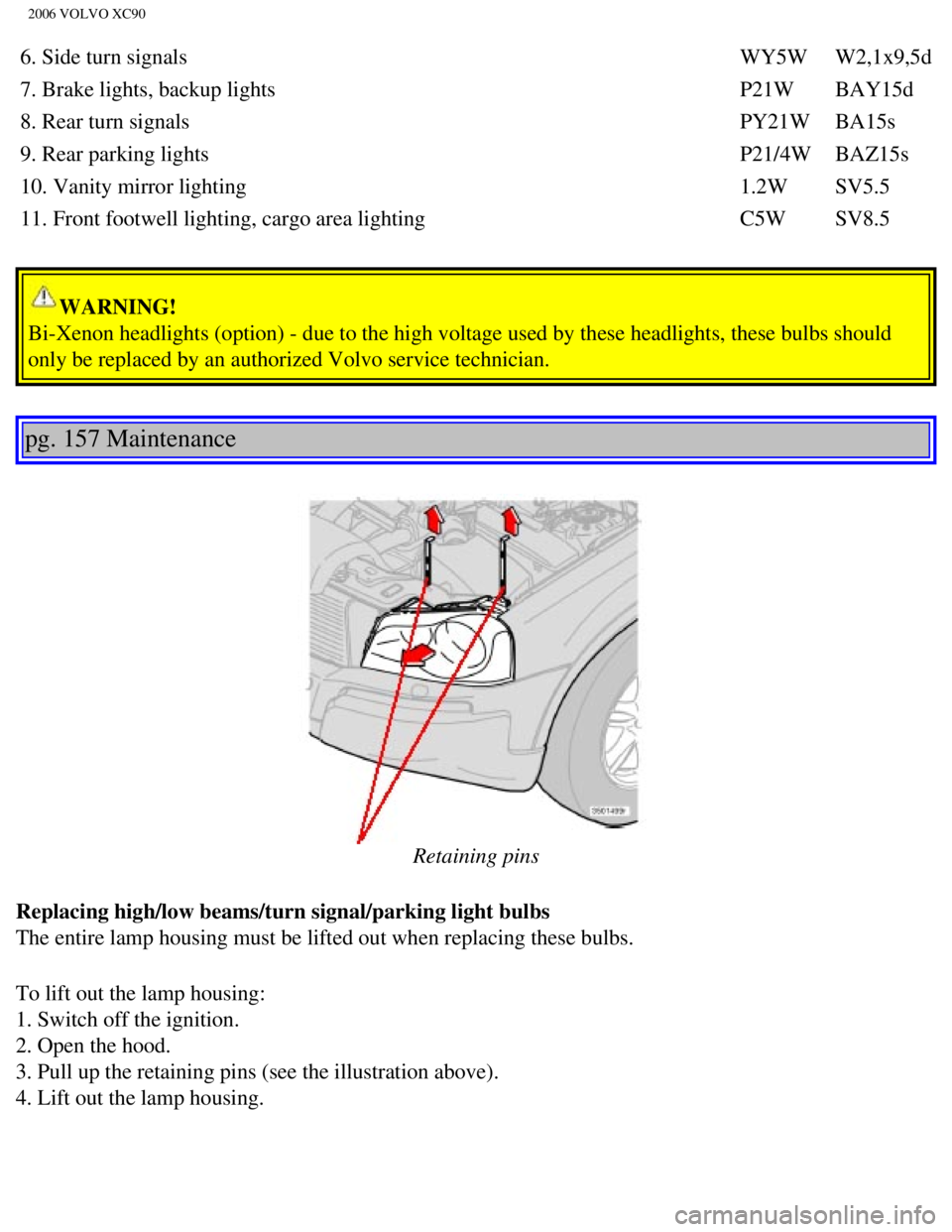
Retaining pins
Replacing high/low beams/turn signal/parking light bulbs
The entire lamp housing must be lifted out when replacing these bulbs.
To lift out the lamp housing:
1. Switch off the ignition.
2. Open the hood.
3. Pull up the retaining pins (see the illustration above).
4. Lift out the lamp housing.
file:///K|/ownersdocs/2006/2006_XC90/06xc90_09b.htm (6 of 24)12/30/200\
6 5:32:52 PM
Page 195 of 256

2006 VOLVO XC90
CAUTION
- Do not touch the glass on the halogen bulbs with your fingers. Grease,\
oil, or any other impurities
can be carbonized onto the bulb and cause damage to the reflector.
- Be sure to use bulbs of the correct type and voltage.
Location of the bulbs in the headlight housing
1. Low beam headlight/Bi-Xenon headlight (option)
2. High beam headlight
3. Turn signal
4. Parking light
5. Side marker light
pg. 158 Maintenance
file:///K|/ownersdocs/2006/2006_XC90/06xc90_09b.htm (7 of 24)12/30/200\
6 5:32:52 PM