fuel pressure VOLVO XC90 2006 Owners Manual
[x] Cancel search | Manufacturer: VOLVO, Model Year: 2006, Model line: XC90, Model: VOLVO XC90 2006Pages: 256, PDF Size: 6.87 MB
Page 4 of 256
 from the exhaust pipe by approxima\
tely 95% and the search to eliminate
the remaining emissions continues. Volvo is the only automobile manufact\")
2006 VOLVO XC90
of harmful substances (CO, HC, NOx) from the exhaust pipe by approxima\
tely 95% and the search to eliminate
the remaining emissions continues. Volvo is the only automobile manufact\
urer to offer CFC-free retrofit kits
for the air conditioning system of all models as far back as the 1975 Vo\
lvo 240. Advanced electronic engine
controls, refined purification systems and cleaner fuels are bringing us\
closer to our goal.
After Volvo vehicles and parts have fulfilled their use, recycling is th\
e next critical step in completing the life
cycle. The metal content is about 75% of the total weight of a vehicle, \
which makes the vehicle among the most
recycled industrial products. In order to have efficient and well contro\
lled recycling, many Volvo variants have
printed dismantling manuals, indicating the weight and material of indiv\
idual components. For Volvo, all
homogeneous plastic parts weighing more than 1.7 oz. (50 grams) are ma\
rked with international symbols that
indicate how the component is to be sorted for recycling.
In addition to continuous environmental refinement of conventional gasol\
ine-powered internal combustion
engines, Volvo is actively looking at advanced technology alternative-fu\
el vehicles.
When you drive a Volvo, you become our partner in the work to lessen the\
vehicle's impact on the environment.
To reduce your vehicle's environmental impact, you can:
l Maintain proper air pressure in your tires. Tests have shown decreased f\
uel economy with improperly
inflated tires.
l Follow the recommended maintenance schedule in your Warranty and Service\
Records Information booklet.
l Drive at a constant speed.
l See an authorized Volvo retailer as soon as possible for inspection if t\
he check engine (malfunction
indicator) lamp illuminates, or stays on after the vehicle has started.\
l Properly dispose of any vehicle-related waste such as used motor oil, us\
ed batteries, brake pads, etc.
l When cleaning your vehicle, use Volvo's own vehicle care products, all o\
f which have systematically been
adapted to the environment.
For additional information regarding the environmental activities in whi\
ch Volvo Cars of North America, LLC
and Volvo Car Corporation are involved, visit our Internet home page at:\
http://www.volvocars.us
PremAir®
On the surface of the radiator in the engine compartment, there is a spe\
cial coating called PremAir®. PremAir®
works as a catalytic converter, converting most of the ground-level ozon\
e passing through the radiator into
oxygen, thereby reducing harmful ground-level ozone.
PremAir is a registered trademark of Engelhard Corporation.
Instruments, switches and controls
file:///K|/ownersdocs/2006/2006_XC90/06xc90_00.htm (4 of 7)12/30/2006 \
5:32:34 PM
Page 41 of 256

2006 VOLVO XC90
Seat belt reminder
This symbol lights up to indicate that the driver has not fastened his/h\
er seat belt.
Tire pressure monitoring light
See
page 117 for more information on this function.
PARKING BRAKE
This light will be on when the parking brake is applied. The parking bra\
ke pedal is located on the left
side of the driver's footwell.
Canadian models are equipped with this symbol.
Rear fog light
This light indicates that the fog light is on.
Turn signal indicator - trailer (certain models)
If you are towing a trailer, this light will flash simultaneously with t\
he turn signals on the trailer. If the
light does not flash when signaling, neither the trailer's turn signals \
nor the vehicle's turn signals are
functioning.
Oil pressure warning light
If the light comes on while driving, stop the vehicle and then stop the \
engine immediately and
check the engine oil level See
page 149. If the light stays on after restart, have the vehicle towed to the
nearest authorized Volvo retailer. After hard driving, the light may com\
e on occasionally when the
engine is idling. This is normal, provided it goes off when the engine s\
peed is increased.
CHECK ENGINE Malfunction indicator light
On-Board Diagnostics II (OBDII): As you drive, a computer called "OBDI\
I" monitors your vehicle's
engine, transmission, electrical and emission systems. The CHECK ENGINE \
light will light up if the
computer senses a condition that potentially may need correcting. When t\
his happens, please have your
vehicle checked by a Volvo retailer as soon as possible.
A CHECK ENGINE light may have many causes. Sometimes, you may not notice\
a change in your
vehicle's behavior. Even so, an uncorrected condition could hurt fuel ec\
onomy, emission cleanliness, and
driveability. Extended driving without correcting the cause could even d\
amage other components in
file:///K|/ownersdocs/2006/2006_XC90/06xc90_02a.htm (6 of 18)12/30/200\
6 5:32:38 PM
Page 116 of 256

2006 VOLVO XC90
engine, and some of these additives contain organically volatile chemica\
ls. Do not needlessly expose
yourself to these chemicals.
pg. 88 Starting and driving
Fuel filler door
Press the button on the light switch panel (see illustration on
page 29) when the vehicle is at a standstill
to unlock the fuel filler door. Please note that the fuel filler door wi\
ll remain unlocked until the vehicle
begins to move forward. An audible click will be heard when the fuel fil\
ler door relocks.
If you intend to leave your vehicle while it is being refueled, this fea\
ture enables you to lock the doors/
tailgate while leaving the fuel filler door unlocked.
You can also keep the vehicle locked if you remain inside it during refu\
eling. The central locking button
does not lock the fuel filler door.
Be sure the fuel filler door is not obstructed and is completely closed \
after refueling.
Open the fuel filler cap slowly during hot weather.
NOTE: During a transitional period, a small number of service stations may st\
ill have fuel nozzles that
are not compatible with the fuel filler neck on vehicles equipped with t\
he evaporative control system.
Refueling
Fuel tank capacity:
The fuel tank's capacity is 21.1 US gals. (80 liters) with sufficient \
volume left over to accommodate
possible expansion of the fuel in hot weather. Be aware that the "usable\
" tank capacity will be somewhat
less than the specified maximum. When the fuel level is low, such factor\
s as ambient temperature, the
fuel's "Reid vapor pressure" characteristics, and terrain can affect the\
fuel pump's ability to supply the
file:///K|/ownersdocs/2006/2006_XC90/06xc90_06a.htm (4 of 14)12/30/200\
6 5:32:45 PM
Page 120 of 256

This function makes it possible to start the vehicle without holding the\
key in the start position (position
III) until the engine starts. Turn the key to")
2006 VOLVO XC90
Autostart (V8 AWD only)
This function makes it possible to start the vehicle without holding the\
key in the start position (position
III) until the engine starts. Turn the key to position III and release \
it. The starter motor will then operate
automatically (for up to ten seconds) until the engine starts.
Steering wheel lock
The steering wheel lock might be under tension when the vehicle is parke\
d.
Turn the steering wheel slightly to free the ignition key.
In order to help reduce vehicle theft, make sure the steering wheel lock\
is engaged before leaving
the vehicle.
WARNING!
Never switch off the ignition (turn the ignition key to position 0) or\
remove the key from the ignition
switch while the vehicle is in motion. This could cause the steering whe\
el to lock, which would make
the vehicle impossible to steer.
* The gear selector must be in the (P)ark position (automatic transmission).
** Please be aware that leaving the key in this position will increase b\
attery drain.
pg. 91 Starting and driving
General information
Economical driving conserves natural resources
Better driving economy may be obtained by thinking ahead, avoiding rapid\
starts and stops and
adjusting the speed of your vehicle to immediate traffic conditions. Obs\
erve the following rules:
l Bring the engine to normal operating temperature as soon as possible by \
driving with a light foot on
the accelerator pedal for the first few minutes of operation. A cold eng\
ine uses more fuel and is subject
to increased wear.
l Whenever possible, avoid using the vehicle for driving short distances. \
This does not allow the engine
to reach normal operating temperature.
l Drive carefully and avoid rapid acceleration and hard braking.
l Use the transmission's (D)rive position as often as possible and avoid using "kickdown" to help
improve fuel economy.
l Do not exceed posted speed limits.
l Avoid carrying unnecessary items (extra load) in the vehicle.
l Maintain correct tire pressure. Check tire pressure regularly (when tir\
es are cold).
file:///K|/ownersdocs/2006/2006_XC90/06xc90_06a.htm (8 of 14)12/30/200\
6 5:32:45 PM
Page 122 of 256

2006 VOLVO XC90
Vehicle load, tire design and inflation pressure all affect vehicle hand\
ling. Therefore, check that the tires
are inflated to the recommended pressure according to the vehicle load. \
See "Tire pressure" section.
Loads should be distributed so that capacity weight or maximum permissib\
le axle loads are not exceeded.
Driving on rough/unpaved surfaces
The Volvo XC90 is designed primarily for onroad driving, and it has exce\
llent handling characteristics
on very rough or unpaved roads.
When driving on poorly maintained or unpaved roads, please keep the foll\
owing in mind:
l Reduce speed on rough surfaces to minimize possible damage to the vehicl\
e's underbody.
l When driving on soft surfaces such as dry sand or snow, try to avoid sto\
pping if at all possible.
WARNING!
Avoid driving diagonally across steep inclines as this could increase th\
e risk of a roll-over. Try to
drive straight up or down the slope.
If the road is very steep, avoid turning the vehicle around to help avoi\
d the risk of rolling over. Back
the vehicle up or down the incline instead.
NOTE: Avoid driving on steep inclines if the fuel tank is nearly empty. If the\
flow of fuel to the engine
is interrupted due to the vehicle's angle of inclination, this could res\
ult in damage to the three-way
catalytic converter. We recommend keeping the fuel tank at least half fu\
ll when driving on steep inclines.
Driving through water
l The vehicle should not be driven through water that is deeper than 18 in\
ches (48 cm). Driving through
deeper water could result in damage to transmission components or the di\
fferential, or to the engine if
excess water is drawn in through the air intake system.
l Drive slowly and avoid stopping when driving through water.
l After having driven through water, apply the brakes lightly several time\
s to remove water, mud, etc
from the brake discs.
l Never allow the vehicle to stand in water above the door sills. This cou\
ld result in damage to the
electrical system.
Conserving electrical current
Keep the following in mind to help minimize battery drain:
l When the engine is not running, avoid turning the ignition key to positi\
on II (see page 90). Many
electrical systems (the audio system, the optional infotainment/navigat\
ion systems, power windows, etc)
will function with the ignition key in position I. This position reduces\
drain on the battery.
l Please keep in mind that using systems, accessories, etc that consume a \
great deal of current when the
engine is not running could result in the battery being completely drain\
ed.
file:///K|/ownersdocs/2006/2006_XC90/06xc90_06a.htm (10 of 14)12/30/20\
06 5:32:45 PM
Page 126 of 256
 - general information
Your Volvo can be equipped with permanent All Wheel Drive (option), wh\
ich means that power")
2006 VOLVO XC90
pg. 95 Starting and driving
All Wheel Drive
All Wheel Drive (AWD) - general information
Your Volvo can be equipped with permanent All Wheel Drive (option), wh\
ich means that power is
distributed automatically between the front and rear wheels. Under norma\
l driving conditions, most of
the engine's power is directed to the front wheels. However, if there is\
any tendency for the front wheels
to spin, an electronically controlled coupling distributes power to the \
wheels that have the best traction.
Tire dimensions
Volvo recommends that you always drive on tires of the same brand, size,\
construction (radial), tread
pattern, load-, speed-, traction-, temperature-, and treadwear rating. N\
ever drive on mixed tires, except
for brief periods when the temporary spare tire is in use.
Always use properly inflated tires of correct dimensions. Tire size and \
inflation pressures are shown on
the tire inflation pressure placards, located on the driver's side B-pil\
lar (the structural member at the side
of the vehicle, at the rear of the driver's door opening), or on the in\
side of the fuel filler door on
Canadian models.
Temporary Spare
The temporary spare tire is for temporary, lowspeed, short-distance use \
only. Replace it with a full-sized
tire as soon as possible. Do not drive on the temporary spare at speeds \
above 50 m.p.h. (80km/h) or for
distances greater than 50 miles (80 km).
Never install snow chains on a temporary spare.
Contents | Top of Page
file:///K|/ownersdocs/2006/2006_XC90/06xc90_06a.htm (14 of 14)12/30/20\
06 5:32:45 PM
Page 144 of 256
, and replace those th\
at are worn. Check tire pressures.
l The brakes, front wheel alignment, and steering gear should be")
2006 VOLVO XC90
l Examine tires carefully (the spare tire as well), and replace those th\
at are worn. Check tire pressures.
l The brakes, front wheel alignment, and steering gear should be checked b\
y your Volvo retailer only.
l Check all lights, including high beams.
l Reflective warning triangles are legally required in some states/provinc\
es.
l Have a word with your Volvo retailer if you intend to drive in countries\
where it may be difficult to
obtain the correct fuel.
l Consider your destination. If you will be driving through an area where \
snow or ice are likely to
occur, consider snow tires.
* To prevent injury from contact with hot surfaces, do not inspect your \
vehicle's transmission fluid
yourself. Have your vehicle's transmission fluid level inspected by a qu\
alified Volvo service technician.
pg. 110 Starting and driving
Contents | Top of Page
file:///K|/ownersdocs/2006/2006_XC90/06xc90_06b.htm (18 of 18)12/30/20\
06 5:32:46 PM
Page 152 of 256
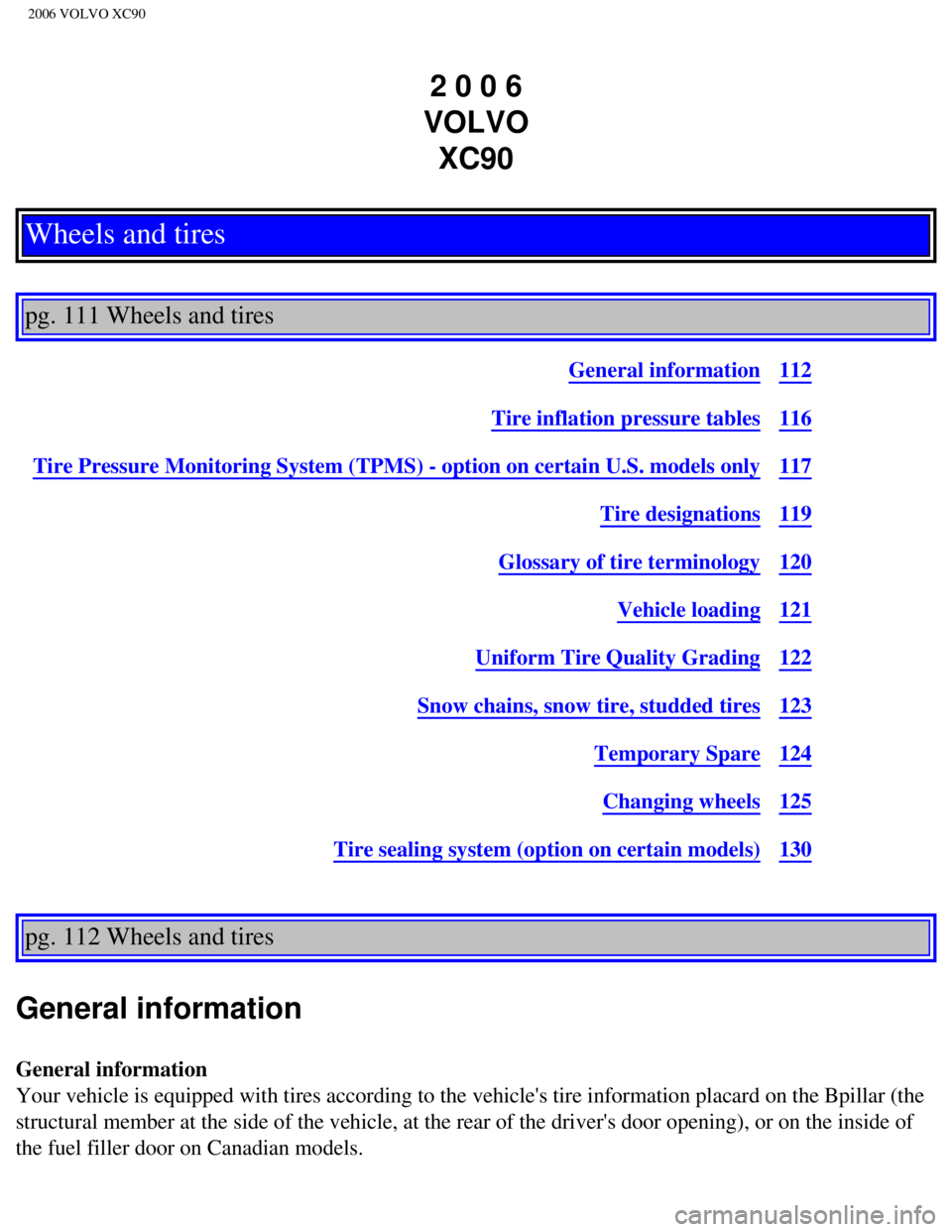
2006 VOLVO XC90
2 0 0 6
VOLVO XC90
Wheels and tires
pg. 111 Wheels and tires
General information112
Tire inflation pressure tables116
Tire Pressure Monitoring System (TPMS) - option on certain U.S. models\
only117
Tire designations119
Glossary of tire terminology120
Vehicle loading121
Uniform Tire Quality Grading122
Snow chains, snow tire, studded tires123
Temporary Spare124
Changing wheels125
Tire sealing system (option on certain models)130
pg. 112 Wheels and tires
General information
General information
Your vehicle is equipped with tires according to the vehicle's tire info\
rmation placard on the Bpillar (the
structural member at the side of the vehicle, at the rear of the driver'\
s door opening), or on the inside of
the fuel filler door on Canadian models.
file:///K|/ownersdocs/2006/2006_XC90/06xc90_08.htm (1 of 22)12/30/2006\
5:32:49 PM
Page 155 of 256

2006 VOLVO XC90
l Unbalanced wheels impair tire economy and driving comfort.
l Tires must maintain the same direction of rotation throughout their life\
time.
l When replacing tires, the tires with the most tread should be mounted on\
the rear wheels to reduce the
chance of oversteer during hard braking. Hitting curbs or potholes can d\
amage the tires and/or wheels
permanently.
pg. 114 Wheels and tires
Tire inflation placards on U.S. models
Tire inflation
Check tire inflation pressure regularly. A table listing the recommended\
inflation pressure for your
vehicle can be found on
page 116. Tire inflation pressure placards are also located on the driver's side\
B-
pillar (the structural member at the side of the vehicle, at the rear o\
f the driver's door opening), or on the
inside of the fuel filler door on Canadian models. These placards indica\
te the designation of the factory-
mounted tires on your vehicle, as well as load limits and inflation pres\
sure.
file:///K|/ownersdocs/2006/2006_XC90/06xc90_08.htm (4 of 22)12/30/2006\
5:32:49 PM
Page 159 of 256

2006 VOLVO XC90
WARNING!
The TPMS system uses a radio frequency of 315 MHz. Accessory electrical \
equipment using the
same frequency could interfere with TPMS and should not be installed in \
the vehicle. Please consult
your Volvo retailer, a qualified Volvo service technician, or the access\
ory equipment's supplier for
further information.
When low inflation pressure is detected, TPMS will light up the tire pre\
ssure warning light (
) (also
referred to as a telltale) in the instrument panel, and will display a \
message in the text window. The
wording of this message is determined by the degree of inflation pressur\
e loss.
NOTE: If a fault occurs in TPMS, the tire pressure warning light will flash fo\
r approximately 1 minute
and TIRE PRESS SYST SERVICE REQUIRED will be displayed.
Each tire, including the spare (if provided), should be checked monthl\
y when cold and inflated to the
inflation pressure recommended by the vehicle manufacturer on the vehicl\
e placard or tire inflation
pressure label. (If your vehicle has tires of a different size than the\
size indicated on the vehicle placard
or tire inflation pressure label, you should consult the appropriate sec\
tion of this owner's manual to
determine the proper tire inflation pressure.) When the low tire pressu\
re telltale is illuminated, one or
more of your tires is significantly underinflated. You should stop and c\
heck your tires as soon as
possible, and inflate them to the proper pressure. Driving on a signific\
antly underinflated tire causes the
tire to overheat and can lead to tire failure. Under-inflation also redu\
ces fuel efficiency and tire tread
life, and may affect the vehicle's handling and stopping ability. Your v\
ehicle has also been equipped
with a TPMS malfunction telltale to indicate when the system is not oper\
ating properly. When the
malfunction telltale is illuminated, the system may not be able to detec\
t or signal low tire pressure as
intended. TPMS malfunctions may occur for a variety of reasons, includin\
g the installation of
incompatible replacement tires on the vehicle. Always check the TPMS mal\
function telltale after
replacing one or more tires on your vehicle to ensure that the replaceme\
nt tires are compatible with the
TPMS.
NOTE: TPMS indicates low tire pressure but does not replace normal tire maint\
enance. For information
on correct tire pressure, please refer to the table on
page 116, or consult your Volvo retailer.
Erasing warning messages
When a low tire pressure warning message has been displayed, and the tir\
e pressure warning light has
come on:
1. Use a tire pressure gauge to check the inflation pressure of all four\
tires.
2. Re-inflate the tire(s) to the correct pressure (consult the tire p\
ressure placard or the table on
page 116).
3. Drive the car for at least one minute at a speed of 20 mph (30 km/h)\
or faster.
This will erase the warning text and the warning light will go out.
file:///K|/ownersdocs/2006/2006_XC90/06xc90_08.htm (8 of 22)12/30/2006\
5:32:49 PM