maintenance VOLVO XC90 2006 Owners Manual
[x] Cancel search | Manufacturer: VOLVO, Model Year: 2006, Model line: XC90, Model: VOLVO XC90 2006Pages: 256, PDF Size: 6.87 MB
Page 1 of 256

2006 VOLVO XC90
2 0 0 6
VOLVO XC90
Introduction
Welcome to the world-wide family of Volvo owners. We trust that you will\
enjoy many years of safe driving in
your Volvo, an automobile designed with your safety and comfort in mind.\
To help ensure your satisfaction
with this vehicle, we encourage you to familiarize yourself with the equ\
ipment descriptions, operating
instructions and maintenance requirements/recommendations in this manual\
. We also urge you and your
passengers to wear seat belts at all times in this (or any other) auto\
mobile. And, of course, please do not operate
a vehicle if you may be affected by alcohol, medication or any impairmen\
t that could hinder your ability to
drive.
Your Volvo is designed to meet all applicable safety and emission standa\
rds, as evidenced by the certification
labels attached to the driver's door opening and on the left wheel housi\
ng in the engine compartment.
For further information please contact your retailer, or:
In the USA:
Volvo Cars of North America
Customer Care Center
P.O. Box 914
Rockleigh, New Jersey 07647-0914
file:///K|/ownersdocs/2006/2006_XC90/06xc90_00.htm (1 of 7)12/30/2006 \
5:32:34 PM
Page 4 of 256
 from the exhaust pipe by approxima\
tely 95% and the search to eliminate
the remaining emissions continues. Volvo is the only automobile manufact\")
2006 VOLVO XC90
of harmful substances (CO, HC, NOx) from the exhaust pipe by approxima\
tely 95% and the search to eliminate
the remaining emissions continues. Volvo is the only automobile manufact\
urer to offer CFC-free retrofit kits
for the air conditioning system of all models as far back as the 1975 Vo\
lvo 240. Advanced electronic engine
controls, refined purification systems and cleaner fuels are bringing us\
closer to our goal.
After Volvo vehicles and parts have fulfilled their use, recycling is th\
e next critical step in completing the life
cycle. The metal content is about 75% of the total weight of a vehicle, \
which makes the vehicle among the most
recycled industrial products. In order to have efficient and well contro\
lled recycling, many Volvo variants have
printed dismantling manuals, indicating the weight and material of indiv\
idual components. For Volvo, all
homogeneous plastic parts weighing more than 1.7 oz. (50 grams) are ma\
rked with international symbols that
indicate how the component is to be sorted for recycling.
In addition to continuous environmental refinement of conventional gasol\
ine-powered internal combustion
engines, Volvo is actively looking at advanced technology alternative-fu\
el vehicles.
When you drive a Volvo, you become our partner in the work to lessen the\
vehicle's impact on the environment.
To reduce your vehicle's environmental impact, you can:
l Maintain proper air pressure in your tires. Tests have shown decreased f\
uel economy with improperly
inflated tires.
l Follow the recommended maintenance schedule in your Warranty and Service\
Records Information booklet.
l Drive at a constant speed.
l See an authorized Volvo retailer as soon as possible for inspection if t\
he check engine (malfunction
indicator) lamp illuminates, or stays on after the vehicle has started.\
l Properly dispose of any vehicle-related waste such as used motor oil, us\
ed batteries, brake pads, etc.
l When cleaning your vehicle, use Volvo's own vehicle care products, all o\
f which have systematically been
adapted to the environment.
For additional information regarding the environmental activities in whi\
ch Volvo Cars of North America, LLC
and Volvo Car Corporation are involved, visit our Internet home page at:\
http://www.volvocars.us
PremAir®
On the surface of the radiator in the engine compartment, there is a spe\
cial coating called PremAir®. PremAir®
works as a catalytic converter, converting most of the ground-level ozon\
e passing through the radiator into
oxygen, thereby reducing harmful ground-level ozone.
PremAir is a registered trademark of Engelhard Corporation.
Instruments, switches and controls
file:///K|/ownersdocs/2006/2006_XC90/06xc90_00.htm (4 of 7)12/30/2006 \
5:32:34 PM
Page 7 of 256

2006 VOLVO XC90
Safety
Instruments and controls
Climate control
Interior
Locks and alarm
Starting and driving
Wheels and tires
Vehicle care
Maintenance
Specifications
Audio
Index
Back Cover
Top of Page
file:///K|/ownersdocs/2006/2006_XC90/06xc90_00.htm (7 of 7)12/30/2006 \
5:32:34 PM
Page 11 of 256
2006 VOLVO XC90
l if the vehicle is leaning excessively
l when driving in turns
When wearing the seat belt remember:
l The belt should not be twisted or turned.
l The lap section of the belt must be positioned low on the hips (not pre\
ssing against the abdomen).
l Make sure that the shoulder belt is rolled up into its retractor and tha\
t the shoulder and lap belts are
taut.
Unbuckling the seat belt
To remove the seat belt, press the red section on the seat belt receptac\
le. Before exiting the vehicle,
check that the seat belt retracts fully after being unbuckled. If necess\
ary, guide the belt back into the
retractor slot.
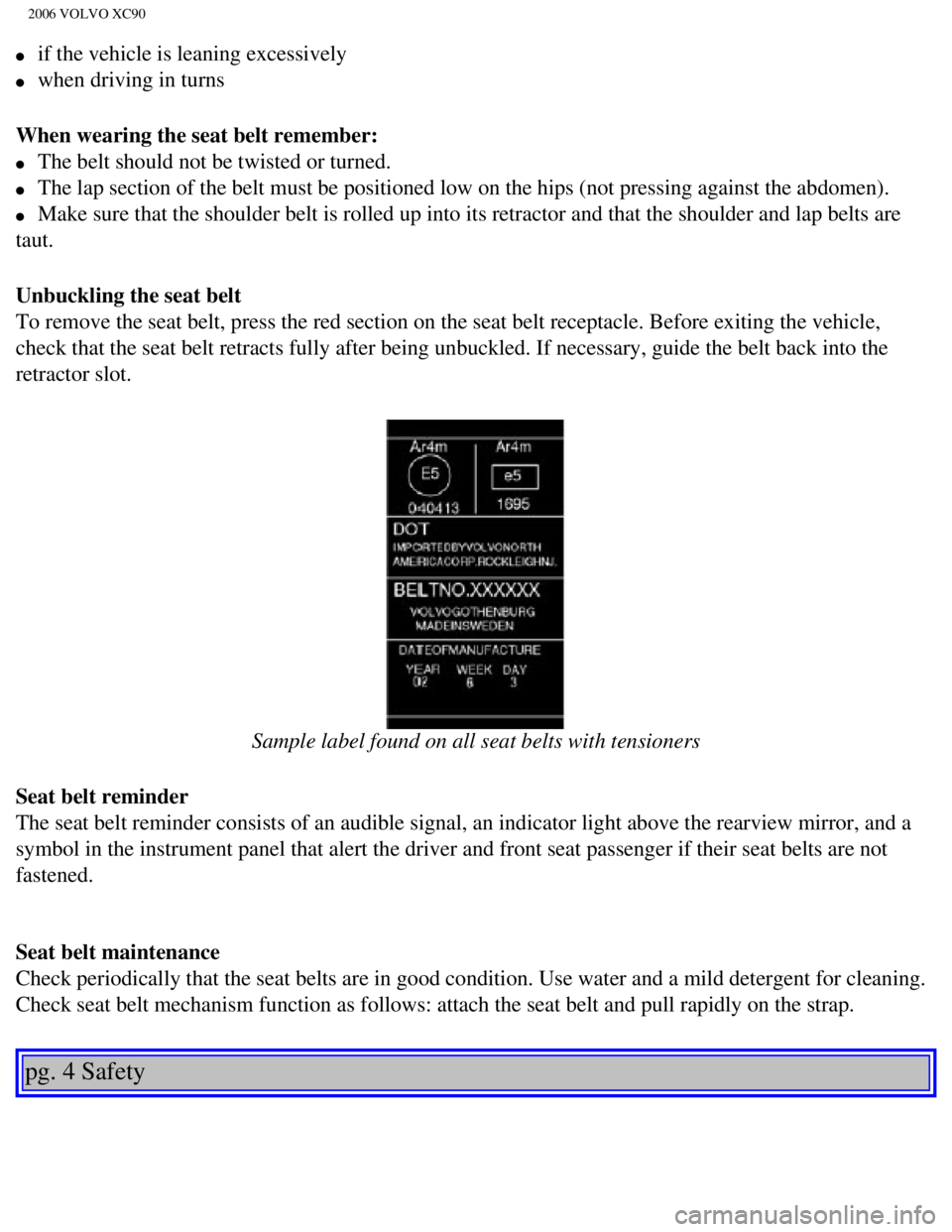
Sample label found on all seat belts with tensioners
Seat belt reminder
The seat belt reminder consists of an audible signal, an indicator light\
above the rearview mirror, and a
symbol in the instrument panel that alert the driver and front seat pass\
enger if their seat belts are not
fastened.
Seat belt maintenance
Check periodically that the seat belts are in good condition. Use water \
and a mild detergent for cleaning.
Check seat belt mechanism function as follows: attach the seat belt and \
pull rapidly on the strap.
pg. 4 Safety
file:///K|/ownersdocs/2006/2006_XC90/06xc90_01a.htm (4 of 17)12/30/200\
6 5:32:36 PM
Page 22 of 256

2006 VOLVO XC90
WARNING!
l Never try to open, remove, or repair any components in the OWS system. T\
his could result in
system malfunction. Maintenance or repairs should only be carried out by\
an authorized Volvo
service technician.
l The front passenger's seat should not be modified in any way. This could\
reduce pressure on the
seat cushion, which might interfere with the OWS system's function.
pg. 11 Safety
Occupant Weight Sensor (OWS) (contd)
WARNING!
Keep the following points in mind with respect to the OWS system. Failur\
e to follow these
instructions could adversely affect the system's function and result in \
serious injury to the occupant of
the front passenger's seat:
l The full weight of the front seat passenger should always be on the seat\
cushion. The passenger
should never lift him/herself off the seat cushion using the armrest in \
the door or the center console,
by pressing the feet on the floor, by sitting on the edge of the seat cu\
shion, or by pressing against the
backrest in a way that reduces pressure on the seat cushion. This could \
cause OWS to disable the
front passenger's side airbag.
l Do not place any type of object on the front passenger's seat in such a \
way that jamming, pressing,
or squeezing occurs between the object and the front seat, other than as\
a direct result of the correct
use of the ALR/ ELR seat belt (see
page 19).
l No objects should be placed under the front passenger's seat. This could\
interfere with the OWS
system's function.
pg. 12 Safety
Side impact (SIPS) airbag
file:///K|/ownersdocs/2006/2006_XC90/06xc90_01a.htm (15 of 17)12/30/20\
06 5:32:36 PM
Page 26 of 256

2006 VOLVO XC90
simultaneously.
NOTE: If the Inflatable Curtain deploys, it remains inflated for approximately\
5 seconds.
WARNING!
l The VIC system is a supplement to the Side Impact Protection System. It \
is not designed to deploy
during collisions from the front or rear of the car or in rollover situa\
tions.
l Never try to open or repair any components of the VIC system. This shoul\
d be done only by a
trained and qualified Volvo service technician.
l In order for the VIC to provide its best protection, both front seat occ\
upants and both outboard rear
seat occupants should sit in an upright position with the seat belt prop\
erly fastened; adults using the
seat belt and children using the proper child restraint system. Only adu\
lts should sit in the front seats.
Children must never be allowed in the front passenger seat. See
page 19 for guidelines. Failure to
follow these instructions can result in injury to the vehicle occupants \
in an accident.
pg. 14 Safety
Inspecting SRS system components
Inspection date
1. Driver's side airbag
2. Passenger's side airbag
3. Side airbag on the driver's side
4. Side airbag on the passenger's side
5. Driver's side inflatable curtain
6. Passenger's side inflatable curtain
WARNING!
There is no owner maintenance that can be performed on the SRS system. T\
he month and year shown
on the decal to the right (located on door pillar) indicate when you s\
hould contact your Volvo retailer
for specific servicing or replacement of SRS system components. This ser\
vice must be performed by
a trained and qualified Volvo service technician.
file:///K|/ownersdocs/2006/2006_XC90/06xc90_01b.htm (2 of 11)12/30/200\
6 5:32:37 PM
Page 43 of 256
2006 VOLVO XC90
SERVICE URGENT: Take your car to a trained and qualified Volvo service technician
for inspection immediately.
SEE MANUAL: Refer to your owner's manual. For additional information, please
contact your Volvo retailer.
SERVICE REQUIRED: Take your car to an authorized Volvo retailer for inspection at
your convenience (but preferably before the next scheduled
maintenance service).
FIX NEXT SERVICE: Have the system affected inspected at the next scheduled
maintenance.
TIME FOR REGULAR SERVICE This message will be displayed at 7,500 mile (12,000 km)
intervals, after 750 hours of driving or after 12 months,
whichever occurs first, to remind the driver that the service
interval has been exceeded. The message will be displayed for 2
minutes each time the vehicle is started until reset by the
servicing retailer.
OIL LEVEL LOW - FILL OIL
a Check the oil level and top up if necessary. See page 149.
OIL LEVEL LOW - STOP
SAFELY
b Stop as soon as possible and switch off the engine, check the oil
level and top up if necessary. See page 149.
OIL LEVEL LOW - STOP
ENGINE
b Stop as soon as possible and switch off the engine, check the oil
level and top up if necessary. See page 149.
OIL LEVEL LOW - SEE
MANUAL
b Stop as soon as possible and switch off the engine, check the oil
level and top up if necessary.See page 149.
a. The yellow warning symbol also lights up (see
page 23)
b. The red warning symbol also lights up (see
page 23)
pg. 27 Instruments and controls
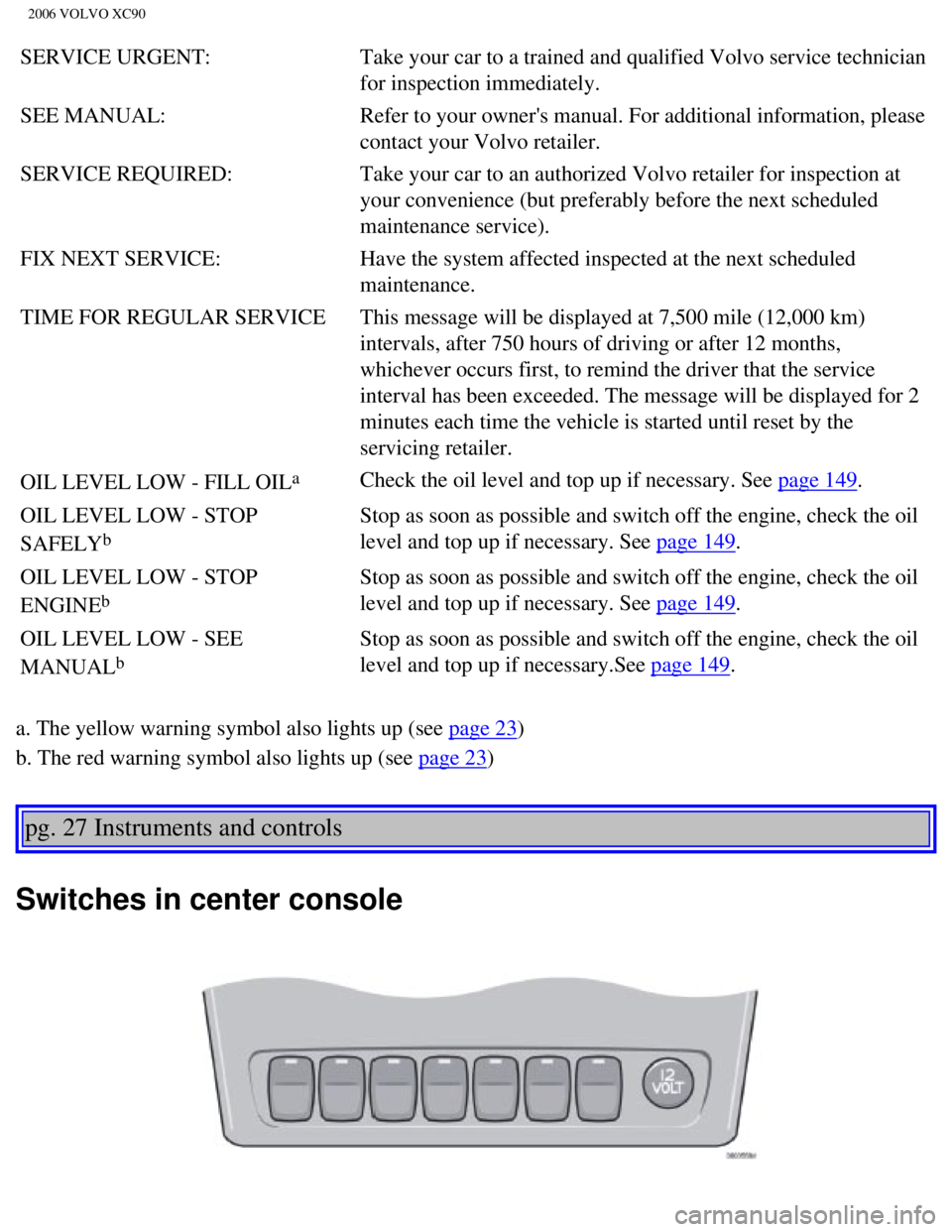
Switches in center console
file:///K|/ownersdocs/2006/2006_XC90/06xc90_02a.htm (8 of 18)12/30/200\
6 5:32:38 PM
Page 72 of 256

2006 VOLVO XC90
several minutes before driving will help release the warm air from the p\
assenger compartment. When the
engine is running, close the windows and moonroof and use the recirculat\
ion function for several minutes to
enable the air conditioning to cool the compartment as quickly as possib\
le.
Windows and optional moonroof
The ECC system will function best if the windows and optional moonroof a\
re closed. If you drive with the
moonroof open, we recommend that you manually adjust the temperature and\
blower control (the LED in
the AUTO switch should be off).
Acceleration
The air conditioning is momentarily disengaged during full-throttle acce\
leration.
Climate system maintenance
Special tools and equipment are required to maintain and carry out repai\
rs on the climate system. Work of
this type should only be done by a trained and qualified Volvo service t\
echnician.
Refrigerant
Volvo cares about the environment. The air conditioning system in your v\
ehicle contains a CFC-free
refrigerant - R134a (HFC134a). This substance will not deplete the ozo\
ne layer. The system contains 2.2 lbs
(1000 g) R134a and uses PAG oil.
Climate system blower
The climate system blower will be automatically switched off when the en\
gine is not running (even if the
ignition key is in position I or II) to avoid unnecessary battery drain\
. To activate the blower, turn the control
to the desired setting.
Passenger compartment blower
Approximately 50 minutes after the ignition is turned off, the blower ma\
y come on automatically, and run
for seven minutes, to remove condensation in the A/C evaporator.
Blower function to reduce battery drain
The climate system's blower functions normally while the engine is runni\
ng.
However, when the engine is switched off (even if the ignition is switc\
hed to positions I or II), the blower
control will be automatically switched off to avoid unnecessary battery \
drain.
The following points pertain if the ignition key is on but the engine is not running:
l To restart the blower, turn the control knob to the setting of your choi\
ce.
l After approximately 2 minutes, the blower speed will be reduced to avoid\
battery drain.
You can reset the blower speed at any time. Please be aware that the sys\
tem has been
file:///K|/ownersdocs/2006/2006_XC90/06xc90_03.htm (2 of 9)12/30/2006 \
5:32:40 PM
Page 114 of 256

2006 VOLVO XC90
pg. 86 Starting and driving
Refueling
ENGINE OIL
Although some oil consumption occurs during normal engine operation, mor\
e oil is consumed when the
engine is new as the internal parts generate higher friction while weari\
ng-in to each other. From the time
the engine is new until the first maintenance is performed, the oil cons\
umption could be higher than
normal. For this reason, it is especially important to check the oil eve\
ry time you refuel your vehicle
during this period. See
page 149.
Fuel requirements
Octane rating
Volvo engines are designed for optimum performance on unleaded premium g\
asoline with an AKI
octane rating of 91 or above. AKI (ANTI KNOCK INDEX) is an average of \
the Research Octane
Number, RON, and the Motor Octane Number, MON. ((RON + MON)/2). The \
minimum octane
requirement is AKI 87 (RON 91).
Deposit control gasoline (detergent additives)
Volvo recommends the use of detergent gasoline to control engine deposit\
s. Detergent gasoline is
effective in keeping injectors and intake valves clean. Consistent use o\
f deposit control gasolines will
help ensure good driveability and fuel economy. If you are not sure whet\
her the gasoline contains
deposit control additives, check with the service station operator.
NOTE: Volvo does not recommend the use of external fuel injector cleaning syst\
ems.
Unleaded fuel
Each Volvo has a three-way catalytic converter and must use only unleade\
d gasoline. U.S. and Canadian
regulations require that pumps delivering unleaded gasoline be labelled \
"UNLEADED". Only these
pumps have nozzles which fit your vehicle's filler inlet. It is unlawful\
to dispense leaded fuel into a
vehicle labelled "unleaded gasoline only". Leaded gasoline damages the t\
hree-way catalytic converter
and the heated oxygen sensor system. Repeated use of leaded gasoline wil\
l lessen the effectiveness of
the emission control system and could result in loss of emission warrant\
y coverage. State and local
vehicle inspection programs will make detection of misfueling easier, po\
ssibly resulting in emission test
failure for misfueled vehicles.
NOTE: Some U.S. and Canadian gasolines contain an octane enhancing additive ca\
lled methyl-
cyclopentadienyl manganese tricarbonyl (MMT). If such fuels are used, \
your Emission Control System
performance may be affected, and the Check Engine Light (malfunction in\
dicator lamp) located on your
instrument panel may light. If this occurs, please return your vehicle t\
o an authorized Volvo retailer for
maintenance.
file:///K|/ownersdocs/2006/2006_XC90/06xc90_06a.htm (2 of 14)12/30/200\
6 5:32:44 PM
Page 121 of 256

2006 VOLVO XC90
l Remove snow tires when threat of snow or ice has ended.
l Note that roof racks, ski racks, etc, increase air resistance and also f\
uel consumption.
l At highway driving speeds, fuel consumption will be lower with the air c\
onditioning on and the
windows closed than with the air conditioning off and the windows open. \
l Using the onboard trip computer's fuel consumption modes can help you le\
arn how to drive more
economically.
Other factors that decrease gas mileage are:
l Dirty air cleaner
l Dirty engine oil and clogged oil filter
l Dragging brakes
l Incorrect front end alignment
Some of the above mentioned items and others are checked at the standard\
Maintenance intervals.
Weight distribution affects handling
At the specified curb weight your vehicle has a tendency to understeer, \
which means that the steering
wheel has to be turned more than might seem appropriate for the curvatur\
e of a bend. This ensures good
stability and reduces the risk of rear wheel skid. Remember that these p\
roperties can alter with the
vehicle load. The heavier the load in the cargo area, the less the tende\
ncy to understeer.
WARNING!
Driving with the tailgate open: Driving with the tailgate open could lead to poisonous exhaust gases
entering the passenger compartment. If the tailgate must be kept open fo\
r any reason, proceed as
follows
- Close the windows
- Set the ventilation system control to air flow to floor, windshield an\
d side windows and blower
control to its highest setting.
CAUTION
Drive slowly and carefully if going through standing water (i.e. floode\
d roadways, etc.). Damage to
the engine could result if excess water is drawn in through the air inta\
ke system. Never drive the
vehicle in water deeper than 18 inches (48 cm).
pg. 92 Starting and driving
General information (contd)
Handling, roadholding
file:///K|/ownersdocs/2006/2006_XC90/06xc90_06a.htm (9 of 14)12/30/200\
6 5:32:45 PM