door lock VOLVO XC90 2007 Owner's Manual
[x] Cancel search | Manufacturer: VOLVO, Model Year: 2007, Model line: XC90, Model: VOLVO XC90 2007Pages: 268, PDF Size: 8.57 MB
Page 124 of 268

2007 Volvo XC90
moisture.
NOTE: The old battery should be disposed of properly at a recycling center or\
at your Volvo retailer.
pg. 108 Locks and alarm
Locking and unlocking
Locking and unlocking the vehicle from the inside
The switch on the driver's door armrest can be used to lock or unlock al\
l doors and the tailgate, and to
set the alarm.
Each door can also be locked with the lock button on the respective door\
and opened by pulling the door
handle on the door.
Automatic locking
The function locks the doors automatically when the vehicle's speed exce\
eds approximately 5 mph (7
km/h). The doors will then remain locked until a door
file:///K|/ownersdocs/2007/2007_XC90/07xc90_05.htm (7 of 7)12/30/2006 \
5:53:41 PM
Page 129 of 268
2007 Volvo XC90
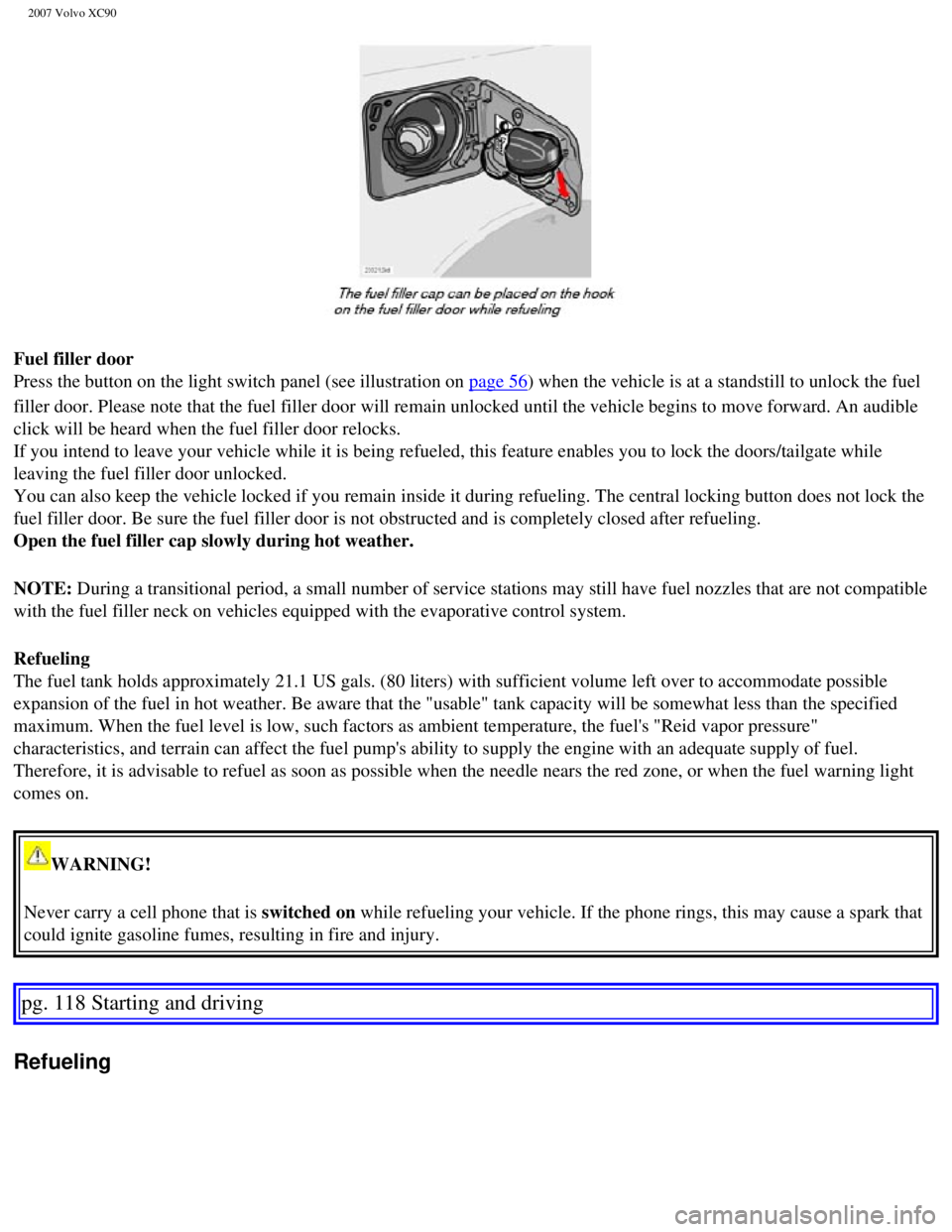
Fuel filler door
Press the button on the light switch panel (see illustration on
page 56) when the vehicle is at a standstill to unlock the fuel
filler door. Please note that the fuel filler door will remain unlocked \
until the vehicle begins to move forward. An audible
click will be heard when the fuel filler door relocks.
If you intend to leave your vehicle while it is being refueled, this fea\
ture enables you to lock the doors/tailgate while
leaving the fuel filler door unlocked.
You can also keep the vehicle locked if you remain inside it during refu\
eling. The central locking button does not lock the
fuel filler door. Be sure the fuel filler door is not obstructed and is \
completely closed after refueling.
Open the fuel filler cap slowly during hot weather.
NOTE: During a transitional period, a small number of service stations may st\
ill have fuel nozzles that are not compatible
with the fuel filler neck on vehicles equipped with the evaporative cont\
rol system.
Refueling
The fuel tank holds approximately 21.1 US gals. (80 liters) with suffi\
cient volume left over to accommodate possible
expansion of the fuel in hot weather. Be aware that the "usable" tank ca\
pacity will be somewhat less than the specified
maximum. When the fuel level is low, such factors as ambient temperature\
, the fuel's "Reid vapor pressure"
characteristics, and terrain can affect the fuel pump's ability to suppl\
y the engine with an adequate supply of fuel.
Therefore, it is advisable to refuel as soon as possible when the needle\
nears the red zone, or when the fuel warning light
comes on.
WARNING!
Never carry a cell phone that is switched on while refueling your vehicle. If the phone rings, this may cause a spar\
k that
could ignite gasoline fumes, resulting in fire and injury.
pg. 118 Starting and driving
Refueling
file:///K|/ownersdocs/2007/2007_XC90/07xc90_06.htm (5 of 32)12/30/2006\
5:53:44 PM
Page 131 of 268

2007 Volvo XC90
- Select the desired gear. The gear engages after a very slight delay wh\
ich is especially noticeable when selecting R.
NOTE: Your vehicle is equipped with a KEYLOCK system. When the engine is switched off, the gear selector must be
in the (P)ark position before the key can be removed from the ignition switch. W\
hen starting in cold weather, the
transmission may shift up at slightly higher engine speeds than normal u\
ntil the automatic transmission fluid reaches
normal operating temperature.
NOTE: Do not race a cold engine immediately after starting. Oil flow may not \
reach some lubrication points fast enough
to prevent engine damage.
WARNING!
An extra mat on the driver's floor can cause the accelerator pedal to ca\
tch. Check that the movement of the accelerator
pedal is not impeded. No more than one protective floor covering may be \
used at one time.
1. If two of the keys to your vehicle are close together, e.g. on the sa\
me key ring when you try to start the vehicle, this could cause
interference in the immobilizer system and result in the vehicle not sta\
rting. If this should occur, remove one of the keys from the key
ring before trying to start the vehicle again.
2. On vehicles equipped with the autostart feature, release the key imme\
diately. See also
page 121.
pg. 120 Starting and driving
Starting the vehicle
WARNING!
Always place the gear selector in Park and apply the parking brake befor\
e leaving the vehicle. Never leave the vehicle
unattended with the engine running. Always open garage doors fully befor\
e starting the engine inside a garage to ensure
adequate ventilation. The exhaust gases contain carbon monoxide, which i\
s invisible and odorless but very poisonous.
CAUTION!
Automatic transmission
The engine should be idling when you move the gear selector. Never accel\
erate until after you feel the transmission
engage! Accelerating immediately after selecting a gear will cause harsh\
engagement and premature transmission wear.
Selecting P or N when idling at a standstill for prolonged periods of ti\
me will help prevent overheating of the automatic
transmission fluid.
pg. 121 Starting and driving
Economical driving
Ignition switch and steering wheel lock
file:///K|/ownersdocs/2007/2007_XC90/07xc90_06.htm (7 of 32)12/30/2006\
5:53:44 PM
Page 172 of 268

2007 Volvo XC90
CAUTION!
- Check local regulations regarding the use of snow chains before instal\
ling.
- Always follow the chain manufacturer's installation instructions caref\
ully. Install chains as tightly as
possible and retighten periodically.
- Never exceed the chain manufacturer's specified maximum speed limit. (\
Under no circumstances
should you exceed 31 mph (50 km/h)).
- Avoid bumps, holes or sharp turns when driving with snow chains.
- The handling of the vehicle can be adversely affected when driving wit\
h chains. Avoid fast or sharp
turns as well as locked wheel braking.
Snow tires, studded tires
1
Tires for winter use:
l Owners who live in or regularly commute through areas with sustained per\
iods of snow or icy driving
conditions are strongly advised to fit suitable winter tires to help ret\
ain the highest degree of traction.
l It is important to install winter tires on all four wheels to help retai\
n traction during cornering,
braking, and accelerating. Failure to do so could reduce traction to an \
unsafe level or adversely affect
handling.
l Do not mix tires of different design as this could also negatively affec\
t overall tire road grip.
l Winter tires wear more quickly on dry roads in warm weather. They should\
be removed when the
winter driving season has ended.
l Studded tires should be run-in 300-600 miles (500-1000 km) during whic\
h the vehicle should be
driven as smoothly as possible to give the studs the opportunity to seat\
properly in the tires. The tires
should have the same rotational direction throughout their entire lifeti\
me.
NOTE: Please consult state or provincial regulations restricting the use of s\
tudded winter tires before
installing such tires.
1. Where permitted
pg. 165 Wheels and tires
Temporary spare
The spare tire in your vehicle is called a "Temporary Spare".
Recommended tire pressure (see the placard on the B-pillar or on the fu\
el filler door) should be
maintained irrespective of which position on the vehicle the temporary s\
pare tire is used.
In the event of damage to this tire, a new one can be purchased from you\
r Volvo retailer.
file:///K|/ownersdocs/2007/2007_XC90/07xc90_07.htm (16 of 23)12/30/200\
6 5:53:47 PM
Page 181 of 268

2007 Volvo XC90
l Tar spots can be removed with kerosene or tar remover after the vehicle \
has been washed.
l A stiff-bristle brush and lukewarm soapy water can be used to clean the \
wiper blades. Frequent
cleaning improves visibility considerably.
l Wash off the dirt from the underside (wheel housings, fenders, etc.). \
l In areas of high industrial fallout, more frequent washing is recommende\
d.
l After cleaning the engine, the spark plug wells should be inspected for \
water and blown dry if
necessary.
Suitable detergents
Special vehicle washing detergents should be used. A suitable mixture is\
about 2.5 fl. oz. (8.5 cl) of
detergent to 2.6 US gal. (10 liters) of warm water. After washing with\
a detergent the vehicle should be
well rinsed with clean water.
Exterior plastic components
Cleaning exterior plastic components should be done with a cleaning agen\
t specially designed for this
purpose. Solvents or stain removers should not be used. Consult your Vol\
vo retailer.
NOTE: When washing the vehicle, remember to remove dirt from the drain holes \
in the doors and sills.
CAUTION!
During high pressure washing, the spray mouthpiece must never be closer \
to the vehicle than 13" (30
cm). Do not spray into the locks.
When washing or steam cleaning the engine, avoid spraying water or steam\
directly on the electrical
components or toward the rear side of the engine.
Special moonroof cautions:
l Always close the moonroof and sun shade before washing your vehicle.
l Never use abrasive cleaning agents on the moonroof.
l Never use wax on the rubber seals around the moonroof.
pg. 175 Vehicle care
Washing and cleaning the vehicle
file:///K|/ownersdocs/2007/2007_XC90/07xc90_08.htm (2 of 7)12/30/2006 \
5:53:48 PM
Page 205 of 268

2007 Volvo XC90
NOTE: After the battery has been disconnected or replaced, lock and unlock th\
e vehicle with the central
locking system's remote control to reactivate such features as the power\
windows, moonroof, courtesy
lighting, etc.
WARNING!
Ventilation hose:
l The battery generates hydrogen gas, which is flammable and explosive. Th\
e battery is fitted with a
ventilation hose which vents hydrogen gas out of the battery compartment\
through a ventilation
opening in the bottom of this compartment. If the battery must be replac\
ed, it is essential that the
ventilation hose is properly connected to the battery and that it is rou\
ted through the ventilation
opening provided (see illustration).
l Be sure the ventilation hose is free of debris.
l Only use replacement batteries equipped with a ventilation hose. Consult\
your Volvo retailer.
pg. 194 Maintenance
Replacing bulbs
When replacing bulbs, keep the following points in mind:
l Never touch the glass of bulbs with your fingers. Grease and oils from y\
our fingers vaporize in the
heat and will leave a deposit on the reflector, which will damage it.
l The optional Active Bi-Xenon headlight bulbs contain trace amounts of me\
rcury. These bulbs should
always be disposed of by an authorized Volvo retailer.
l The following bulbs should only be replaced by a trained and qualified V\
olvo service technician:
- Active Bi-Xenon headlights,
- Courtesy (dome) lighting,
- Reading lights,
- Glove compartment lights
- Turn signals and courtesy lights in the side door mirrors
- High-mounted brake lights
file:///K|/ownersdocs/2007/2007_XC90/07xc90_09.htm (19 of 37)12/30/200\
6 5:53:50 PM
Page 217 of 268
2007 Volvo XC90
18. -
19. Engine control module feed, engine relay 5
20. Parking lights 15
21. -
pg. 203 Maintenance
Fuses
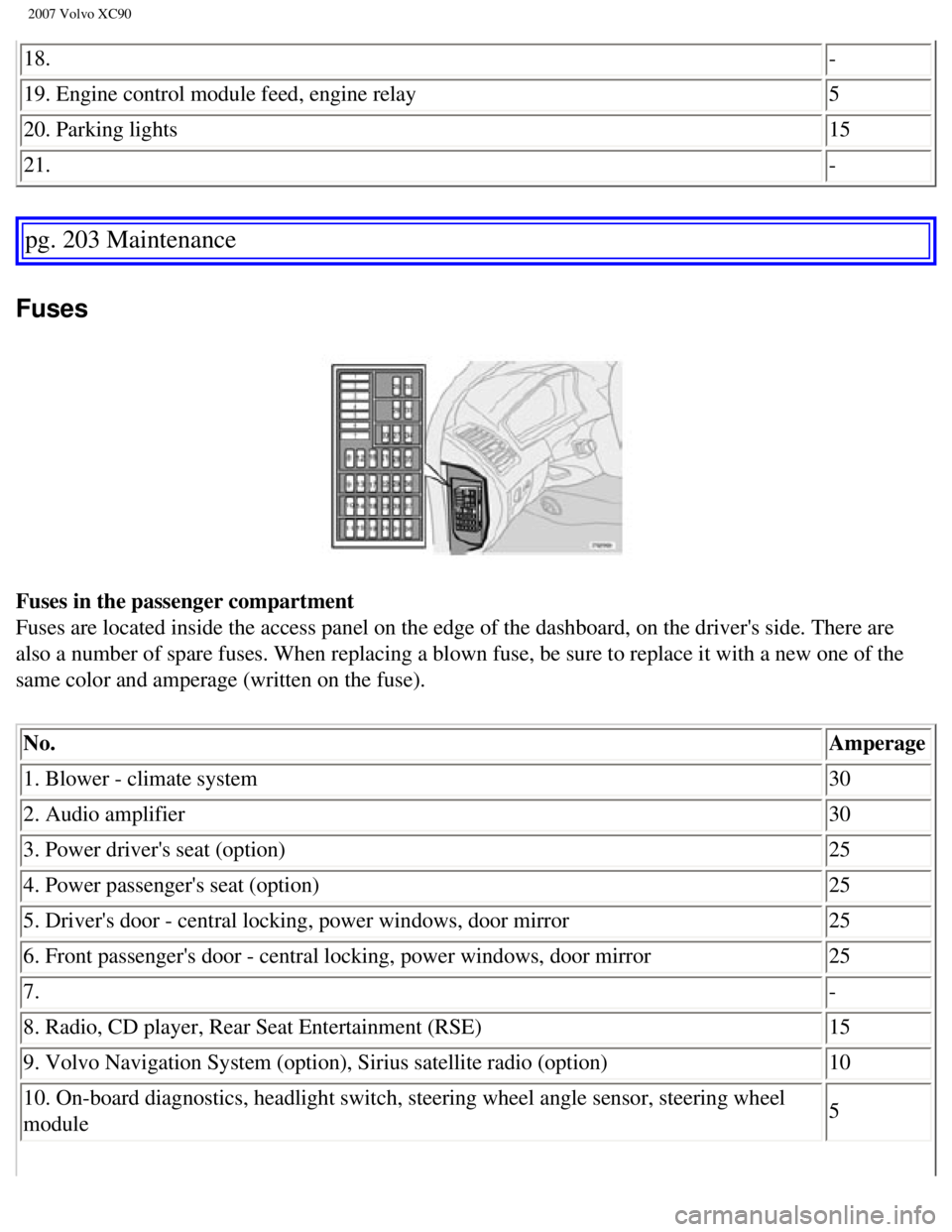
Fuses in the passenger compartment
Fuses are located inside the access panel on the edge of the dashboard, \
on the driver's side. There are
also a number of spare fuses. When replacing a blown fuse, be sure to re\
place it with a new one of the
same color and amperage (written on the fuse).
No. Amperage
1. Blower - climate system 30
2. Audio amplifier 30
3. Power driver's seat (option) 25
4. Power passenger's seat (option) 25
5. Driver's door - central locking, power windows, door mirror 25
6. Front passenger's door - central locking, power windows, door mirror \
25
7. -
8. Radio, CD player, Rear Seat Entertainment (RSE) 15
9. Volvo Navigation System (option), Sirius satellite radio (option)\
10
10. On-board diagnostics, headlight switch, steering wheel angle sensor,\
steering wheel
module 5
file:///K|/ownersdocs/2007/2007_XC90/07xc90_09.htm (31 of 37)12/30/200\
6 5:53:51 PM
Page 225 of 268
. Codes for color and upholstery, e\
tc.
2. Child safety lock labels
1
3. Federal Motor Vehicle Safety Standards (FMVSS) specifica")
2007 Volvo XC90
1. Model plate
Vehicle Identification Number (VIN). Codes for color and upholstery, e\
tc.
2. Child safety lock labels
1
3. Federal Motor Vehicle Safety Standards (FMVSS) specifications (USA\
) and Ministry of
Transport (CMVSS) standards (Canada)
Your Volvo is designed to meet all applicable safety standards, as evide\
nced by the certification label on
the facing side of the driver's door. For further information regarding \
these regulations, please consult
your Volvo retailer.
4. Loads and Tire Pressures
The appearance of the decal will vary, depending on the market for which\
the vehicle is intended.
l Canadian models: upper decal
l U.S. models: lower decal
5. Vehicle Identification Number (VIN)
The VIN plate is located on the top left surface of the dashboard. The V\
IN is also stamped on the right
hand door pillar. The Vehicle Identification Number (VIN) should alway\
s be quoted in all
correspondence concerning your vehicle with the retailer and when orderi\
ng parts.
6. Vehicle Emission Control Information/ Vacuum hose routing
Your Volvo is designed to meet all applicable emission standards, as evi\
denced by the certification label
on the underside of the hood. For further information regarding these re\
gulations, please consult your
Volvo retailer.
file:///K|/ownersdocs/2007/2007_XC90/07xc90_10.htm (2 of 10)12/30/2006\
5:53:52 PM
Page 256 of 268
2007 Volvo XC90
See Audio Settings in the FM Menu.
AUX Menu (option)
1. AUX input vol
2. Audio Settings
1
See Audio Settings in the FM Menu
1. Certain audio systems
pg. 237 Audio
HomeLink® Universal Transceiver
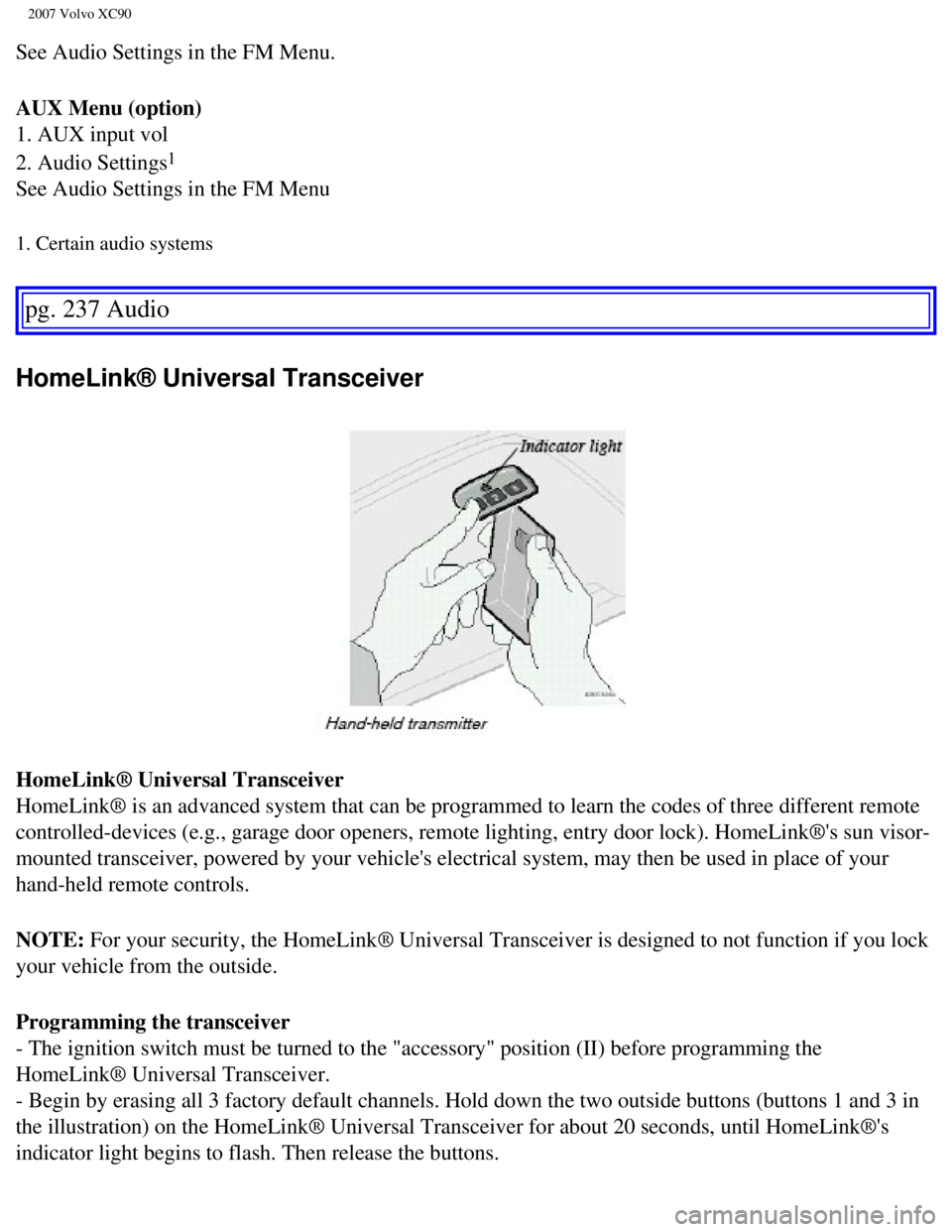
HomeLink® Universal Transceiver
HomeLink® is an advanced system that can be programmed to learn the c\
odes of three different remote
controlled-devices (e.g., garage door openers, remote lighting, entry d\
oor lock). HomeLink®'s sun visor-
mounted transceiver, powered by your vehicle's electrical system, may th\
en be used in place of your
hand-held remote controls.
NOTE: For your security, the HomeLink® Universal Transceiver is designed t\
o not function if you lock
your vehicle from the outside.
Programming the transceiver
- The ignition switch must be turned to the "accessory" position (II) \
before programming the
HomeLink® Universal Transceiver.
- Begin by erasing all 3 factory default channels. Hold down the two out\
side buttons (buttons 1 and 3 in
the illustration) on the HomeLink® Universal Transceiver for about 2\
0 seconds, until HomeLink®'s
indicator light begins to flash. Then release the buttons.
file:///K|/ownersdocs/2007/2007_XC90/07xc90_11.htm (23 of 26)12/30/200\
6 5:53:54 PM
Page 257 of 268
 2 \
to 5 in. (5 to 12 cm) away from
the HomeLink® surface, keeping the indicator light in view. For place\
ment")
2007 Volvo XC90
- Hold your hand-held transmitter (garage door opener, for example) 2 \
to 5 in. (5 to 12 cm) away from
the HomeLink® surface, keeping the indicator light in view. For place\
ment questions, contact
HomeLink® toll-free 1-800-355-3515 (Internet:
www.HomeLink.com).
- Using two hands, push and hold both your hand-held transmitter's butto\
n and the transceiver button
you wish to program. The indicator light will flash first slowly, then r\
apidly. Rapid flashing tells you the
HomeLink® button has been successfully programmed. Release both butto\
ns.
- If you are programming a rolling code-equipped device (e.g., garage d\
oor opener or entry door lock),
refer to "Programming rolling codes" on the next page to complete the pr\
ogramming process.
Repeat steps 3 and 4 to program the other two transceiver buttons.
If, after several attempts, you are unable to successfully train the Hom\
eLink® Universal Transceiver to
learn your hand-held transmitter's signal, contact HomeLink® toll-fre\
e 1-800-355-3515 (Internet:
www.
HomeLink.com).
pg. 238 Audio
HomeLink® Universal Transceiver
WARNING!
- If you use HomeLink® to open a garage door or gate, be sure no one \
is near the gate or door while it
is in motion.
- Do not use the HomeLink® Universal Transceiver with any garage door\
opener that lacks safety
"stop" and "reverse" features as required by federal safety standards. (\
This includes any garage door
opener model manufactured before April 1, 1982) A garage door opener th\
at cannot "detect" an
object, signalling the door to "stop" and "reverse" does not meet curren\
t federal safety standards.
Using a garage door opener without these features increases the risk of \
serious injury or death. For
more information on this matter, call toll-free 1-800-355-3515
(Internet:
www.HomeLink.com).
NOTE: Canadian residents:
During programming, your hand-held transmitter may automatically stop tr\
ansmitting. To successfully
train HomeLink®, continue to hold the HomeLink® button. At the sam\
e time, repeatedly press and hold
your handheld transmitter's button at two-second intervals until HomeLin\
k® has learned your
transmitter's code. The HomeLink® indicator light will flash first sl\
owly, and then rapidly to indicate
that the button has been successfully programmed.
Determining if your garage door uses a rolling code
Determine, in one of the following ways, if your garage door uses a roll\
ing code system and is
file:///K|/ownersdocs/2007/2007_XC90/07xc90_11.htm (24 of 26)12/30/200\
6 5:53:54 PM