service VOLVO XC90 2007 Owner's Manual
[x] Cancel search | Manufacturer: VOLVO, Model Year: 2007, Model line: XC90, Model: VOLVO XC90 2007Pages: 268, PDF Size: 8.57 MB
Page 119 of 268
 key.
l The master key, the remote control, and the central locking button may all be")
2007 Volvo XC90
Keys
Two types of keys are provided with your vehicle; master keys and a serv\
ice (valet) key.
l The master key, the remote control, and the central locking button may all be used to \
lock and unlock
all of your vehicle's locks.
l The service key will operate only the driver's door and the ignition switch. It is inte\
nded to help deter
unwanted entry into the glove compartment.
l Turn the key once to unlock the driver's door only.
l Turn the key again (within 10 seconds) to unlock all doors and the tai\
lgate.
l One turn with the key towards lock in the drivers door locks all doors a\
nd the tailgate.
l Use the switch on the driver's door armrest to lock/unlock the vehicle f\
rom the inside.
WARNING!
If the doors are locked while driving, this may hinder rapid access to t\
he occupants of the vehicle in
the event of an accident. (Also see information on "Child safety locks"\
NOTE: To help prevent accidentally locking the keys in the vehicle, the centr\
al locking system is
designed to unlock the doors immediately if the key is left in the ignit\
ion switch, the vehicle is locked
using the lock button on the door and the door is then closed. A sound f\
rom the lock will be audible at
file:///K|/ownersdocs/2007/2007_XC90/07xc90_05.htm (2 of 7)12/30/2006 \
5:53:41 PM
Page 126 of 268
")
2007 Volvo XC90
Fuel requirements
Octane rating
Volvo engines are designed for optimum performance on unleaded premium g\
asoline with an AKI octane rating of 91 or
above. AKI (ANTI KNOCK INDEX) is an average of the Research Octane Num\
ber, RON, and the Motor Octane Number,
MON. ((RON + MON)/2). The minimum octane requirement is AKI 87 (RON\
91).
Deposit control gasoline (detergent additives)
Volvo recommends the use of detergent gasoline to control engine deposit\
s. Detergent gasoline is effective in keeping
injectors and intake valves clean. Consistent use of deposit control gas\
olines will help ensure good drivability and fuel
economy. If you are not sure whether the gasoline contains deposit contr\
ol additives, check with the service station
operator.
NOTE: Volvo does not recommend the use of external fuel injector cleaning sys\
tems.
Unleaded fuel
Each Volvo has a three-way catalytic converter and must use only unleade\
d gasoline. U.S. and Canadian regulations
require that pumps delivering unleaded gasoline be labelled "UNLEADED". \
Only these pumps have nozzles which fit
your vehicle's filler inlet. It is unlawful to dispense leaded fuel into\
a vehicle labelled "unleaded gasoline only". Leaded
gasoline damages the three-way catalytic converter and the heated oxygen\
sensor system. Repeated use of leaded gasoline
will lessen the effectiveness of the emission control system and could r\
esult in loss of emission warranty coverage. State
and local vehicle inspection programs will make detection of misfueling \
easier, possibly resulting in emission test failure
for misfueled vehicles.
NOTE: Some U.S. and Canadian gasolines contain an octane enhancing additive c\
alled methyl-cyclopentadienyl
manganese tricarbonyl (MMT). If such fuels are used, your Emission Con\
trol System performance may be affected, and
the Check Engine Light (malfunction indicator lamp) located on your in\
strument panel may light. If this occurs, please
return your vehicle to an authorized Volvo retailer for maintenance.
Gasoline containing alcohol and ethers "Oxygenated fuels"
Some fuel suppliers sell gasoline containing "oxygenates" which are usua\
lly alcohols or ethers. In some areas, state or
local laws require that the service pump be marked indicating use of alc\
ohols or ethers. However, there are areas in which
the pumps are unmarked. If you are not sure whether there is alcohol or \
ethers in the gasoline you buy, check with the
service station operator. To meet seasonal air quality standards, some a\
reas require the use of "oxygenated" fuel.
Volvo allows the use of the following "oxygenated" fuels; however, the o\
ctane ratings listed on this page must still be met.
Alcohol - Ethanol: Fuels containing up to 10% ethanol by volume may be u\
sed. Ethanol may also be referred to as Ethyl
alcohol, or "Gasohol".
Ethers - MTBE: Fuels containing up to 15% MTBE may be used.
pg. 115 Starting and driving
Fuel requirements
file:///K|/ownersdocs/2007/2007_XC90/07xc90_06.htm (2 of 32)12/30/2006\
5:53:44 PM
Page 129 of 268
2007 Volvo XC90
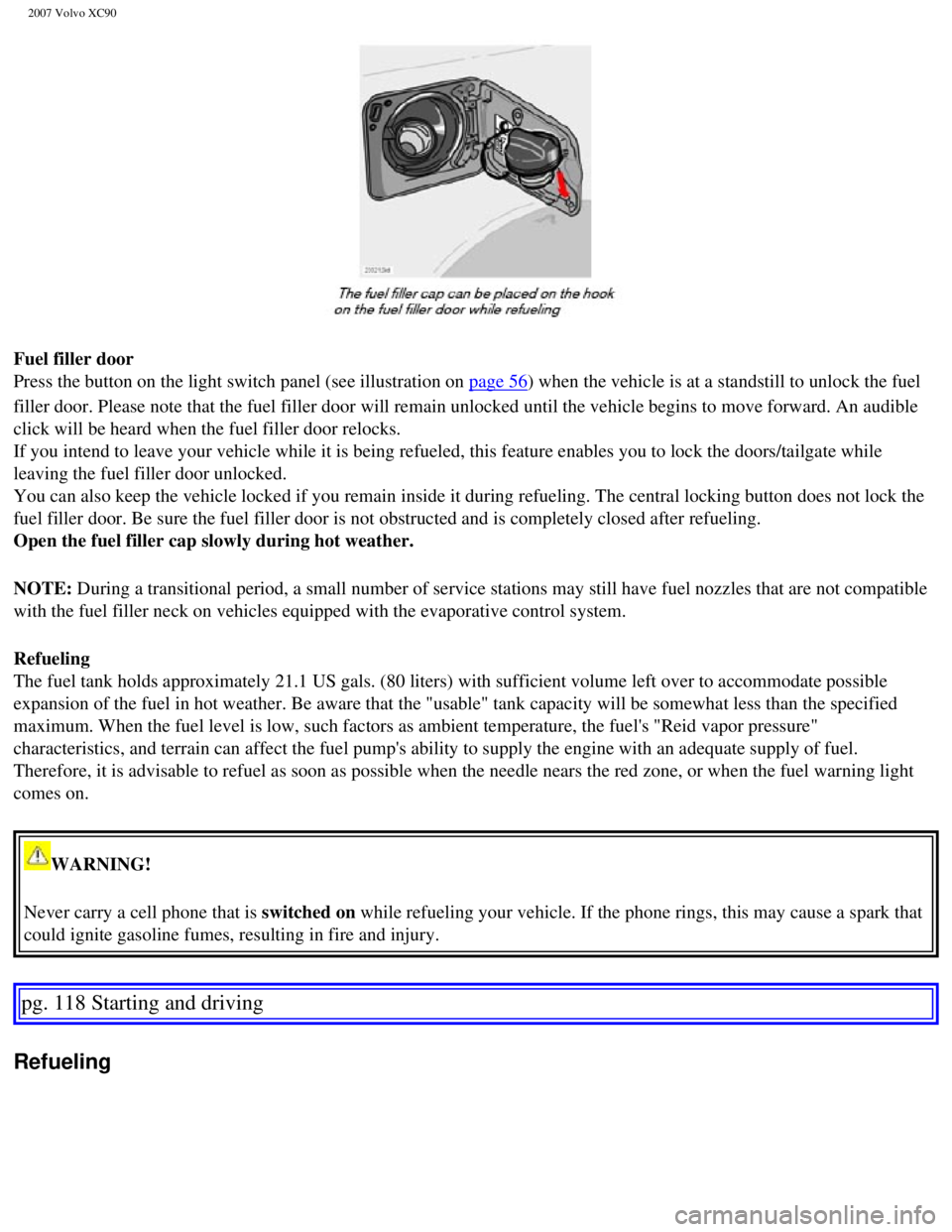
Fuel filler door
Press the button on the light switch panel (see illustration on
page 56) when the vehicle is at a standstill to unlock the fuel
filler door. Please note that the fuel filler door will remain unlocked \
until the vehicle begins to move forward. An audible
click will be heard when the fuel filler door relocks.
If you intend to leave your vehicle while it is being refueled, this fea\
ture enables you to lock the doors/tailgate while
leaving the fuel filler door unlocked.
You can also keep the vehicle locked if you remain inside it during refu\
eling. The central locking button does not lock the
fuel filler door. Be sure the fuel filler door is not obstructed and is \
completely closed after refueling.
Open the fuel filler cap slowly during hot weather.
NOTE: During a transitional period, a small number of service stations may st\
ill have fuel nozzles that are not compatible
with the fuel filler neck on vehicles equipped with the evaporative cont\
rol system.
Refueling
The fuel tank holds approximately 21.1 US gals. (80 liters) with suffi\
cient volume left over to accommodate possible
expansion of the fuel in hot weather. Be aware that the "usable" tank ca\
pacity will be somewhat less than the specified
maximum. When the fuel level is low, such factors as ambient temperature\
, the fuel's "Reid vapor pressure"
characteristics, and terrain can affect the fuel pump's ability to suppl\
y the engine with an adequate supply of fuel.
Therefore, it is advisable to refuel as soon as possible when the needle\
nears the red zone, or when the fuel warning light
comes on.
WARNING!
Never carry a cell phone that is switched on while refueling your vehicle. If the phone rings, this may cause a spar\
k that
could ignite gasoline fumes, resulting in fire and injury.
pg. 118 Starting and driving
Refueling
file:///K|/ownersdocs/2007/2007_XC90/07xc90_06.htm (5 of 32)12/30/2006\
5:53:44 PM
Page 133 of 268
 or\
remove the key from the ignition switch while the
vehicle is in motion. This could cause the steer")
2007 Volvo XC90
WARNING!
Never switch off the ignition (turn the ignition key to position 0) or\
remove the key from the ignition switch while the
vehicle is in motion. This could cause the steering wheel to lock, which\
would make the vehicle impossible to steer.
Economical driving conserves natural resources
Better driving economy may be obtained by thinking ahead, avoiding rapid\
starts and stops and adjusting the speed of your
vehicle to immediate traffic conditions. Observe the following rules:
l Bring the engine to normal operating temperature as soon as possible by \
driving with a light foot on the accelerator
pedal for the first few minutes of operation. A cold engine uses more fu\
el and is subject to increased wear.
l Whenever possible, avoid using the vehicle for driving short distances. \
This does not allow the engine to reach normal
operating temperature.
l Drive carefully and avoid rapid acceleration and hard braking.
l Use the transmission's (D)rive position as often as possible and avoid using "kickdown" to help \
improve fuel economy.
l Do not exceed posted speed limits.
l Avoid carrying unnecessary items (extra load) in the vehicle.
l Maintain correct tire pressure. Check tire pressure regularly (when tir\
es are cold).
l Remove snow tires when threat of snow or ice has ended.
1. The gear selector must be in the (P)ark position (automatic transmission).
2. Please be aware that leaving the key in this position will increase b\
attery drain.
pg. 122 Starting and driving
Economical driving
l Note that roof racks, ski racks, etc, increase air resistance and also f\
uel consumption.
l At highway driving speeds, fuel consumption will be lower with the air c\
onditioning on and the windows closed than
with the air conditioning off and the windows open.
l Using the onboard trip computer's fuel consumption modes can help you le\
arn how to drive more economically.
Other factors that decrease gas mileage are:
l Dirty air cleaner
l Dirty engine oil and clogged oil filter
l Dragging brakes
l Incorrect front end alignment.
Some of the above mentioned items and others are checked at the standard\
Maintenance Service intervals.
CAUTION!
Drive slowly and carefully if going through standing water (i.e. floode\
d roadways, etc.). Damage to the engine could
result if excess water is drawn in through the air intake system. Never \
drive the vehicle in water deeper than 18 inches
(48 cm).
pg. 123 Starting and driving
file:///K|/ownersdocs/2007/2007_XC90/07xc90_06.htm (9 of 32)12/30/2006\
5:53:44 PM
Page 134 of 268

2007 Volvo XC90
Difficult driving conditions
Driving on rough/unpaved surfaces
The Volvo XC90 is designed primarily for on-road driving, and it has exc\
ellent handling characteristics on very rough or
unpaved roads.
When driving on poorly maintained or unpaved roads, please keep the foll\
owing in mind:
l Reduce speed on rough surfaces to minimize possible damage to the vehicl\
e's underbody.
l When driving on soft surfaces such as dry sand or snow, try to avoid sto\
pping if at all possible.
WARNING!
Avoid driving diagonally across steep inclines as this could increase th\
e risk of a roll-over. Try to drive straight up or
down the slope.
If the road is very steep, avoid turning the vehicle around to help avoi\
d the risk of rolling over. Back the vehicle up or
down the incline instead.
NOTE: Avoid driving on steep inclines if the fuel tank is nearly empty. If th\
e flow of fuel to the engine is interrupted due
to the vehicle's angle of inclination, this could result in damage to th\
e three-way catalytic converter. We recommend
keeping the fuel tank at least half full when driving on steep inclines.\
Driving through water
The vehicle can be driven through water up to a depth of approximately 1\
8 inches (48 cm), at a maximum speed of 6 mph
(10 km/h).
Take particular care when driving through flowing water.
Clean the electrical connections for trailer wiring after driving in mud\
or water.
When driving through water, maintain low speed and do not stop in the wa\
ter.
WARNING!
After driving through water, press lightly on the brake pedal to ensure \
that the brakes are functioning normally. Water
or mud can make the brake linings slippery, resulting in delayed braking\
effect.
CAUTION!
l Engine damage will occur if water is drawn into the air cleaner.
l If the vehicle is driven through water deeper than 18 in (48 cm), wate\
r may enter the differential and the
transmission. This reduces the oil's lubricating capacity and may shorte\
n the service life of these components.
l Do not allow the vehicle to stand in water up to the door sills longer t\
han absolutely necessary. This could result in
electrical malfunctions.
l If the engine has been stopped while the car is in water, do not attempt\
to restart the engine. Have the car towed out
of the water.
pg. 124 Starting and driving
file:///K|/ownersdocs/2007/2007_XC90/07xc90_06.htm (10 of 32)12/30/200\
6 5:53:44 PM
Page 138 of 268

2007 Volvo XC90
BRAKE Brake circuit malfunction
The brake system is a hydraulic system consisting of two master cylinder\
s and two separate brake circuits. If a problem
should occur in one of these circuits, it is still possible to stop the \
vehicle with the other brake circuit.
If the brake pedal must be depressed farther than normal and requires gr\
eater foot pressure, the stopping distance will be
longer.
A warning light in the instrument panel will light up to warn the driver\
that a fault has occurred.
If this light comes on while driving or braking, stop immediately and ch\
eck the brake fluid level in the reservoir.
NOTE: Press the brake pedal hard and maintain pressure on the pedal - do not \
pump the brakes.
WARNING!
If the fluid level is below the MIN mark in the reservoir or if a "Brake\
failure - Service urgent" message is displayed in
the text window: DO NOT DRIVE. Have the vehicle towed to a Volvo retaile\
r and have the brake system inspected.
NOTE: When the vehicle is at a standstill and the engine is idling, e.g. at a\
traffic light and the brake pedal is depressed,
the pedal may go down slightly. This is a normal function of the power-a\
ssisted brake system.
Power brakes function only when the engine is running
The power brakes utilize vacuum pressure which is only created when the \
engine is running. Never let the vehicle roll to a
stop with the engine switched off.
If the power brakes are not working, the brake pedal must be pressed app\
roximately four times harder than usual to make
up for the lack of power assistance. This can happen for example when to\
wing your vehicle or if the engine is switched off
when the vehicle is rolling. The brake pedal feels harder than usual.
Water on brake discs and brake pads affects braking
Driving in rain and slush or passing through an automatic car wash can c\
ause water to collect on the brake discs and pads.
This will cause a delay in braking effect when the pedal is depressed. T\
o avoid such a delay when the brakes are needed,
depress the pedal occasionally when driving through rain, slush etc. Thi\
s will remove the water from the brakes. Check
that brake application feels normal. This should also be done after wash\
ing or starting in very damp or cold weather.
Severe strain on the brake system
The brakes will be subject to severe strain when driving in mountains or\
hilly areas, or when towing a trailer. Vehicle
speed is usually slower, which means that the cooling of the brakes is l\
ess efficient than when driving on level roads. To
reduce the strain on the brakes, shift into a lower gear and let the eng\
ine help with the braking. Do not forget that, if you
are towing a trailer, the brakes will be subjected to a greater than nor\
mal load.
pg. 128 Starting and driving
Brake system
Anti-lock brakes (ABS)
If the warning lamp lights up there is a malfunction of the ABS system (\
the standard braking system will however
function) and the vehicle should be driven cautiously to a Volvo retail\
er for inspection. The Anti-lock Braking System
(ABS) helps to improve vehicle control (stopping and steering) durin\
g severe braking conditions by limiting brake lockup.
file:///K|/ownersdocs/2007/2007_XC90/07xc90_06.htm (14 of 32)12/30/200\
6 5:53:44 PM
Page 139 of 268

2007 Volvo XC90
When the system "senses" impending lockup, braking pressure is automatic\
ally modulated in order to help prevent lockup,
which could lead to a skid.
The system performs a self-diagnostic test when the engine is started an\
d when the vehicle first reaches a speed of
approximately 12 mph (20 km/h). The brake pedal will pulsate several times and a sound may be audible f\
rom the ABS
control module. This is normal.
To obtain optimal effect from the ABS system, constant pressure should b\
e kept on the brake pedal. Do not pump the
brake pedal.
The switching of the ABS modulator will be audible and the brake pedal w\
ill pulsate during braking. Please be aware that
ABS does not increase the absolute braking potential of the vehicle. Whi\
le control will be enhanced, ABS will not shorten
stopping distances on slippery surfaces.
ABS with EBD (Electronic Brake Force Distribution)
EBD is an integrated part of the ABS system. EBD regulates the hydraulic\
pressure to the rear brakes to help provide
optimal braking capacity. The brake pedal will pulsate during braking, w\
hich is normal.
If the BRAKE and ABS warning lights come on at the same time, this could\
indicate a fault in the brake system.
- Stop the vehicle in a suitable place and switch off the engine.
- Restart the engine.
- If both warning lights go off, no further action is required.
- If both lights are still on after the engine has been restarted, switc\
h off the engine again and check the brake fluid level
(see
page 185 for the location of the brake fluid reservoir).
WARNING!
If the fluid level is below the MIN mark in the reservoir or if a "Brake\
failure - Service urgent" message is displayed in
the text window: DO NOT DRIVE. Have the vehicle towed to a Volvo retaile\
r and have the brake system inspected.
- If the brake fluid level is above the MIN mark, drive carefully to an \
authorized Volvo retailer and have the brake system
inspected.
Emergency Brake Assistance (EBA)
The EBA function is designed to provide full brake effect immediately in\
the event of sudden, hard braking. The system is
activated by the speed with which you depress the brake pedal.
NOTE:
l When the EBA system is activated, the brake pedal will go down and press\
ure in the brake system immediately
increases to the maximum level. You must maintain full pressure on the b\
rake pedal in order
pg. 129 Starting and driving
Brake system
to utilize the system completely. There will be no braking effect if the\
pedal is released. EBA is automatically deactivated
when the brake pedal is released.
l When the vehicle has been parked for some time, the brake pedal may sink\
more than usual when the engine is started.
file:///K|/ownersdocs/2007/2007_XC90/07xc90_06.htm (15 of 32)12/30/200\
6 5:53:44 PM
Page 141 of 268

2007 Volvo XC90
WARNING!
The car's handling and stability characteristics will be altered if the \
DSTC system functions have been
disabled.
DSTC-related messages in the text window
l "TRACTION CONTROL TEMPORARILY OFF" - The system has been temporarily swi\
tched off due to high brake
temperature and will automatically switch on again when the brakes have \
cooled.
"ANTI SKID SERVICE REQUIRED" - the system has been automatically disenga\
ged due to a fault. An authorized Volvo
retailer should check the system.
pg. 131 Starting and driving
Stability system
Symbols in the instrument panel
The Stability Control indicator light
This light indicates different conditions, depending on how it illuminat\
es.
The Stability Control indicator light illuminates for approximately 2 se\
conds
This indicates that the system is performing a self-diagnostic test when\
the ignition is switched on.
The Stability Control indicator light flashes
This indicates that the stability system is actively functioning to help\
counteract wheel spin and/or a skid.
The Stability Control indicator light glows steadily
"ANTI SKID SERVICE REQUIRED" will be displayed in the text window at the\
same time.
A fault is indicated in the stability system.
- Stop the vehicle in a safe place and switch off the engine.
- Restart the engine.
- If the indicator light goes out, the fault was temporary and no furthe\
r action is required.
- If the indicator light remains on, drive to an authorized Volvo worksh\
op as soon as possible to have the system checked.
The Stability Control indicator light glows steadily
If "DSTC SPIN CONTROL OFF" is displayed in the text window at the same t\
ime, this is a reminder that spin control has
been disabled by the driver.
The warning symbol
The warning symbol glows steadily yellow
The system has been temporarily switched off due to high brake temperatu\
re. "TRACTION CONTROL TEMPORARILY
OFF" will be displayed. The system will automatically switch on again wh\
en the brakes have cooled.
file:///K|/ownersdocs/2007/2007_XC90/07xc90_06.htm (17 of 32)12/30/200\
6 5:53:44 PM
Page 143 of 268
, the signal will become \
constant. If objects are close to both the front and
rear bumpers, the signal will alternate between th")
2007 Volvo XC90
l At a distance of approximately 1 foot (30 cm), the signal will become \
constant. If objects are close to both the front and
rear bumpers, the signal will alternate between the front and rear speak\
ers.
Deactivating the system(s)
- Press the Park assist button on the center console (see
page 52) to temporarily deactivate the system(s).
- The indicator light in the button will go out when the system(s) hav\
e been deactivated.
- If the vehicle is equipped with front and rear park assist, both syste\
ms will be deactivated by pressing the button.
Park assist will be automatically reactivated the next time the engine i\
s started.
NOTE: It may be necessary to deactivate one or both of the park assist system\
s in certain cases.
l Rear park assist: towing a trailer, carrying bicycles in a rear-mounted carrier, etc, co\
uld trigger the rear park assist
system's sensors.
l Front park assist: it may not be possible to combine auxiliary headlights and front park \
assist since these lights could
trigger the system's sensors.
pg. 133 Starting and driving
Front/rear park assist (accessory/option)
Faults in the system
If the yellow warning symbol illuminates and a message is shown in the i\
nformation display, the system is not
functioning properly. Consult a Volvo retailer or authorized service tec\
hnician.
Cleaning the sensors
For the system to function properly, the sensors in the front and/or rea\
r bumpers should be kept clean. They can be cleaned
with car washing detergent and a sponge.
WARNING!
These systems are designed to be a supplementary aid when parking the ve\
hicle. They are not, however, intended to
replace the driver's attention and judgement.
CAUTION!
In certain circumstances, the park assist system may give unexpected war\
ning signals that can be caused by external
sound sources that use the same ultrasound frequencies as the system. Th\
is may include such things as the horns of
other vehicles, wet tires on asphalt, pneumatic brakes, motorcycle exhau\
st pipes, etc. This does not indicate a fault in
the system.
pg. 134 Starting and driving
Towing
file:///K|/ownersdocs/2007/2007_XC90/07xc90_06.htm (19 of 32)12/30/200\
6 5:53:44 PM
Page 152 of 268

2007 Volvo XC90
W - Winter/Wet driving mode - enhanced vehicle traction
l Mode W will only function if the gear selector is in the (D)rive position.
l Press the button at the base of the gear selector to engage/disengage th\
is driving mode.
l An LED in the button will light up to indicate that W is engaged and thi\
s will also be displayed in the instrument panel
(see
page 46).
l This mode may be selected for starting/ moving off on slippery roads.
1. Synthetic oil is not used when the oil is changed at the normal maint\
enance service intervals except at owner request and at
additional charge. Please consult your Volvo retailer.
pg. 144 Starting and driving
Before a long distance trip
It is always worthwhile to have your vehicle checked at a Volvo retailer\
before driving long distances. Your retailer will
also be able to supply you with bulbs, fuses, spark plugs and wiper blad\
es for your use in the event that problems occur.
As a minimum, the following items should be checked before any long trip\
:
l Check that engine runs smoothly and that fuel consumption is normal.
l Check for fuel, oil, and fluid leakage.
l Check transmission oil level1.
l Check condition of drive belts.
l Check state of the battery's charge.
l Examine tires carefully (the spare tire as well), and replace those th\
at are worn. Check tire pressures.
l The brakes, front wheel alignment, and steering gear should be checked b\
y your Volvo retailer only.
l Check all lights, including high beams.
l Reflective warning triangles are legally required in some states/provinc\
es.
l Have a word with your Volvo retailer if you intend to drive in countries\
where it may be difficult to obtain the correct
fuel.
l Consider your destination. If you will be driving through an area where \
snow or ice are likely to occur, consider snow
tires.
1. To prevent injury from contact with hot surfaces, do not inspect your\
vehicle's transmission fluid yourself. Have your vehicle's
transmission fluid level inspected by a qualified Volvo service technici\
an.
pg. 145 Starting and driving
Blind Spot Information System (BLIS) - option
file:///K|/ownersdocs/2007/2007_XC90/07xc90_06.htm (28 of 32)12/30/200\
6 5:53:44 PM