ECU VOLVO XC90 2013 Owner´s Manual
[x] Cancel search | Manufacturer: VOLVO, Model Year: 2013, Model line: XC90, Model: VOLVO XC90 2013Pages: 310, PDF Size: 8.62 MB
Page 193 of 310
07 Wheels and tires
Tire Sealing System
07
191
WARNING
•Never leave the tire sealing system
unattended when it is operating.
•Keep the tire sealing system away from
children.
•Be sure the vehicle is parked safely off
the road and away from moving traffic.
•Apply the parking brake.
Stage 1: Sealing the hole1. Open the cover on the tire sealing kit.
2. Peel off the speed limit sticker and affix it
to the steering wheel hub where it will be
clearly visible to the driver.
3. Ensure that the on/off switch is in position
0 (the 0 side of the switch should be
pressed down).
4. Put on the gloves included in the tire seal-
ing system.
WARNING
Contact with the sealing compound may
cause skin irritation. If contact occurs, wash
the affected area immediately with soap and
water.
5. Unscrew the orange cover over the bottle
holder and unscrew the cap on the bottle
of sealing compound.
NOTE
Do not break the seal on the bottle. This
occurs automatically when the bottle is
screwed into the holder.
6. Screw the bottle into the bottle holder.
WARNING
The bottle is equipped with a catch to keep
it securely in place and help prevent sealing
compound leakage. Once in place, the bot-
tle cannot be unscrewed. This must be done
by a trained and qualified Volvo service
technician.
7. Remove the valve cap from the tire’s infla-
tion valve and screw the tire sealing sys-
tem’s hose connector onto the valve as
tightly as possible by hand.
8. Connect the electrical wire to the nearest
12-volt socket in the vehicle.
NOTE
Be sure that none of the other 12-volt sock-
ets is being used while the compressor is in
operation.
9. Start the vehicle’s engine.
10. Start the tire sealing system’s compressor
by pressing the on/off switch to position I.
WARNING
•Never stand next to the tire being inflated
when the compressor is in operation.
•If cracks, bubbles, etc. form on the tire,
switch off the compressor immediately.
•If there is visible damage to the sidewall
or the rim, the tire cannot be repaired.
The vehicle should not be driven if this
occurs. Contact a towing service or
Volvo On Call Roadside Assistance if
applicable.
Page 195 of 310
07 Wheels and tires
Tire Sealing System
07
193
Replacing the sealing compound
container
The sealing compound container must be
replaced if:
•the tire sealing system has been used to
repair a tire
•the container’s expiration date has passed
(see the date on decal).
NOTE
•After use, the sealing compound bottle,
the hose, and certain other system
components must be replaced. Please
consult your Volvo retailer for replace-
ment parts.
•If the sealing compound bottle’s expi-
ration date has passed, please take it to
a Volvo retailer or a recycling station
that can properly dispose of harmful
substances.
Inflating tires
The tire sealing system can be used to inflate
the tires. To do so:
1. Park the car in a safe place.
2. The compressor should be switched off.
Ensure that the on/off switch is in position
0 (the 0 side of the switch should be
pressed down).
3. Take out the electrical wire and hose.
4. Remove the valve cap from the tire’s infla-
tion valve and screw the hose connector
onto the valve as tightly as possible by
hand.
5. Connect the electrical wire to the nearest
12-volt socket in the vehicle.
6. Start the vehicle’s engine.WARNING
•The vehicle’s engine should be running
when the tire sealing system is used to
avoid battery drain. Therefore, be sure
the vehicle is parked in a well ventilated
place, or outdoors, before using the sys-
tem. The parking brake should be
securely applied and the gear selector
should be in the P (park) position.
•Children should never be left unattended
in the vehicle when the engine is running.
7. Check the tire’s inflation pressure on the
gauge. Switch off the compressor briefly to
get a clear reading from the pressure
gauge.
8. Refer to the tire inflation tables for the cor-
rect inflation pressure. If the tire needs to
be inflated, start the tire sealing system’s
compressor (press the on/off switch to
position I). If necessary, release air from the
tire by turning the air release knob coun-
terclockwise.
CAUTION
The compressor should not be used for
more than 10 minutes at a time to avoid
overheating.
Page 198 of 310
07 Wheels and tires
Changing wheels
07
196
WARNING
When raising or lowering the spare wheel,
please keep in mind that components in the
exhaust system may be very hot.
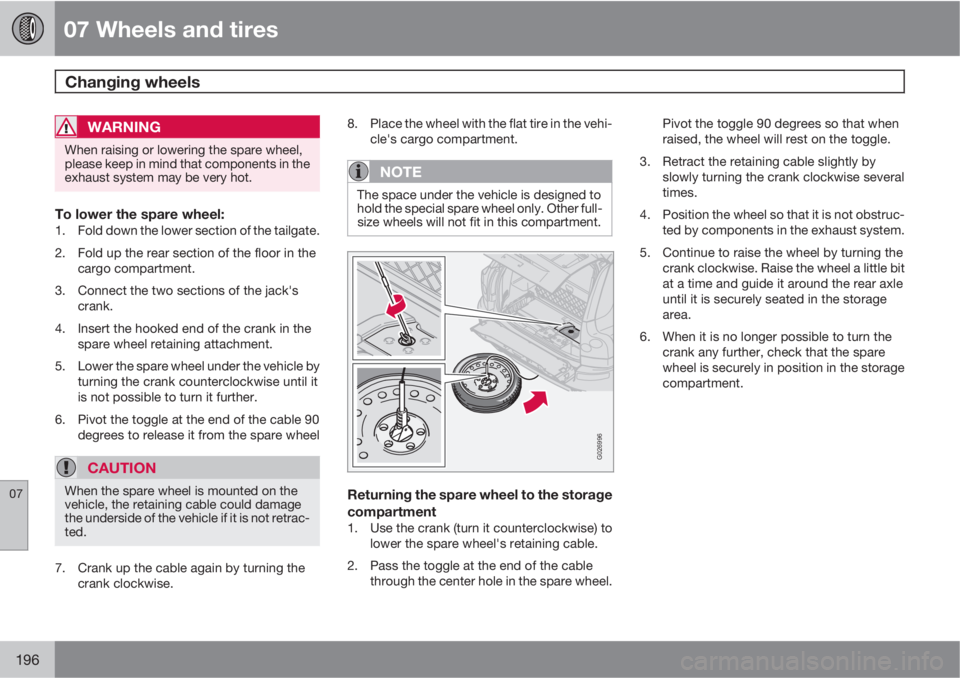
To lower the spare wheel:1. Fold down the lower section of the tailgate.
2. Fold up the rear section of the floor in the
cargo compartment.
3. Connect the two sections of the jack's
crank.
4. Insert the hooked end of the crank in the
spare wheel retaining attachment.
5. Lower the spare wheel under the vehicle by
turning the crank counterclockwise until it
is not possible to turn it further.
6. Pivot the toggle at the end of the cable 90
degrees to release it from the spare wheel
CAUTION
When the spare wheel is mounted on the
vehicle, the retaining cable could damage
the underside of the vehicle if it is not retrac-
ted.
7. Crank up the cable again by turning the
crank clockwise.8. Place the wheel with the flat tire in the vehi-
cle's cargo compartment.
NOTE
The space under the vehicle is designed to
hold the special spare wheel only. Other full-
size wheels will not fit in this compartment.
G026996
Returning the spare wheel to the storage
compartment
1. Use the crank (turn it counterclockwise) to
lower the spare wheel's retaining cable.
2. Pass the toggle at the end of the cable
through the center hole in the spare wheel.Pivot the toggle 90 degrees so that when
raised, the wheel will rest on the toggle.
3. Retract the retaining cable slightly by
slowly turning the crank clockwise several
times.
4. Position the wheel so that it is not obstruc-
ted by components in the exhaust system.
5. Continue to raise the wheel by turning the
crank clockwise. Raise the wheel a little bit
at a time and guide it around the rear axle
until it is securely seated in the storage
area.
6. When it is no longer possible to turn the
crank any further, check that the spare
wheel is securely in position in the storage
compartment.
Page 209 of 310
08 Car care
Washing and cleaning the vehicle
08
207
CAUTION
•Avoid waxing or polishing plastic or rub-
ber components
•Polishing chromed strips can wear
away or damage the surface
•Polishes containing abrasive sub-
stances should not be used
NOTE
When washing the vehicle, remember to
remove dirt from the drain holes in the doors
and sills.
WARNING
•When the vehicle is driven immediately
after being washed, apply the brakes
several times in order to remove any
moisture from the brake linings.
•Engine cleaning agents should not be
used when the engine is warm. This
constitutes a fire risk.
Automatic washing – simple and quick
•We do NOT recommend washing your
vehicle in an automatic wash during thefirst few months (because the paint will not
have hardened sufficiently).
•An automatic wash is a simple and quick
way to clean your vehicle, but it is worth
remembering that it may not be as thor-
ough as when you yourself go over the
vehicle with sponge and water. Keeping
the underbody clean is most important,
especially in the winter. Some automatic
washers do not have facilities for washing
the underbody.
•Before driving into an automatic car wash,
make sure that side view mirrors, auxiliary
lamps, etc, are secure, and that any
antenna(s) are retracted or removed. Oth-
erwise there is risk of the machine dislodg-
ing them.
Exterior lightingCondensation may form temporarily on the
inside of the lenses of exterior lights such as
headlights, fog lights, or tail lights. This is nor-
mal and the lights are designed to withstand
moisture. Normally, condensation will dissi-
pate after the lights have been on for a short
time.
Polishing and waxing
•Normally, polishing is not required during
the first year after delivery, however, wax-
ing may be beneficial.
•Before applying polish or wax the vehicle
must be washed and dried. Tar spots can
be removed with kerosene or tar remover.
Difficult spots may require a fine rubbing
compound.
•After polishing use liquid or paste wax.
•Several commercially available products
contain both polish and wax.
•Waxing alone does not substitute for pol-
ishing a dull surface.
•A wide range of polymer-based car waxes
can be purchased today. These waxes are
easy to use and produce a long-lasting,
high-gloss finish that protects the body-
work against oxidation, road dirt and fad-
ing.
•Do not polish or wax your vehicle in direct
sunlight (the surface of the vehicle should
not be warmer than 113° F (45° C).
Page 226 of 310
09 Maintenance and servicing
Wiper blades 09
224
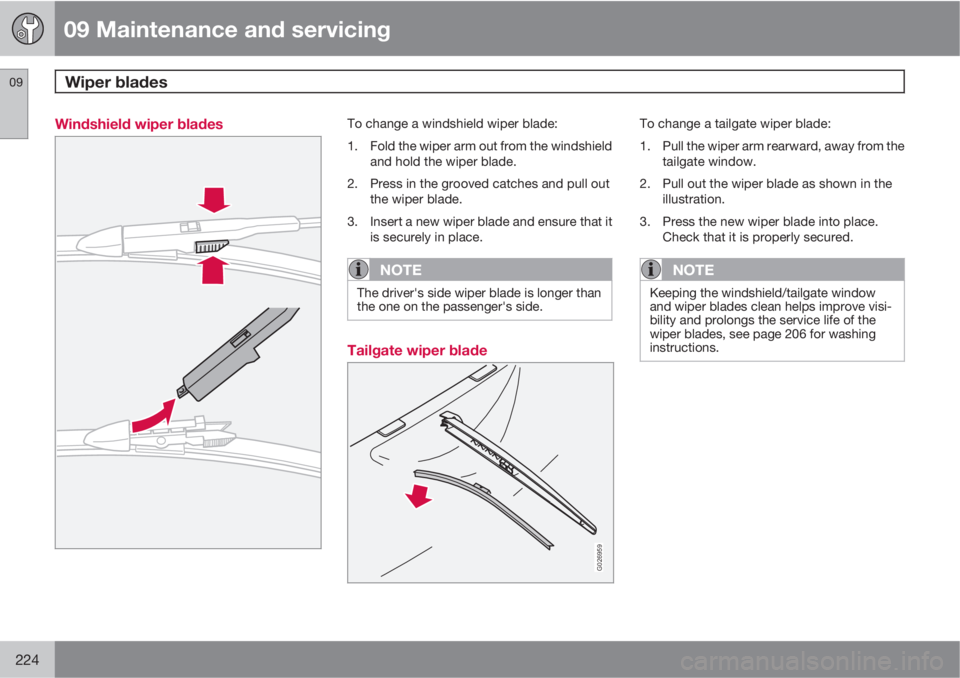
Windshield wiper bladesTo change a windshield wiper blade:
1. Fold the wiper arm out from the windshield
and hold the wiper blade.
2. Press in the grooved catches and pull out
the wiper blade.
3. Insert a new wiper blade and ensure that it
is securely in place.
NOTE
The driver's side wiper blade is longer than
the one on the passenger's side.
Tailgate wiper blade
G026959
To change a tailgate wiper blade:
1. Pull the wiper arm rearward, away from the
tailgate window.
2. Pull out the wiper blade as shown in the
illustration.
3. Press the new wiper blade into place.
Check that it is properly secured.
NOTE
Keeping the windshield/tailgate window
and wiper blades clean helps improve visi-
bility and prolongs the service life of the
wiper blades, see page 206 for washing
instructions.
Page 227 of 310
09 Maintenance and servicing
Battery09
225 Battery maintenance
The battery in your vehicle is located under the
floor of the cargo compartment.
Driving habits and conditions, climate, the
number of starts, etc. all affect the service life
and function of the battery. In order for your
battery to perform satisfactorily, keep the fol-
lowing in mind:
•Use a screw driver to open the caps or
cover and a flashlight to inspect the level.
•If necessary, add distilled water. The level
should never be above the indicator.
•The fluid level should be checked if the
battery has been recharged.
•After inspection, be sure the cap over each
battery cell or the cover is securely in
place.
•Check that the battery cables are correctly
connected and properly tightened.
•Never disconnect the battery when the
engine is running, or when the key is in the
ignition. This could damage the vehicle's
electrical system.
•The battery should be disconnected from
the vehicle when a battery charger is used
directly on the battery.
•To help keep the battery in good condition,
the vehicle should be driven for at least 15minutes a week or connected to a charger
with an automatic charging function.
•If the battery is fully discharged a number
of times, this may shorten its service life.
Keeping the battery fully charged helps
prolong its service life.
•The service life of a battery is affected by
factors such as driving conditions and cli-
mate. Extreme cold may also further
decrease the battery’s starting capacity.
•Because the battery’s starting capacity
decreases with time, it may be necessary
to recharge it if the vehicle is not driven for
an extended period of time or if the vehicle
is usually only driven short distances.
•
WARNING
PROPOSITION 65 WARNING!
Battery posts, terminals, and related acces-
sories contain lead and lead compounds,
chemicals known to the state of California
to cause cancer and reproductive harm.
Wash hands after handling.
WARNING
•Never expose the battery to open flame
or electric spark.
•Do not smoke near the battery.
•Battery fluid contains sulfuric acid. Do
not allow battery fluid to contact eyes,
skin, fabrics or painted surfaces. If con-
tact occurs, flush the affected area
immediately with water. Obtain medical
help immediately if eyes are affected.
NOTE
Used batteries should be properly disposed
of at a recycling station or similar facility, or
taken to your Volvo retailer.
Page 229 of 310
09 Maintenance and servicing
Battery09
227
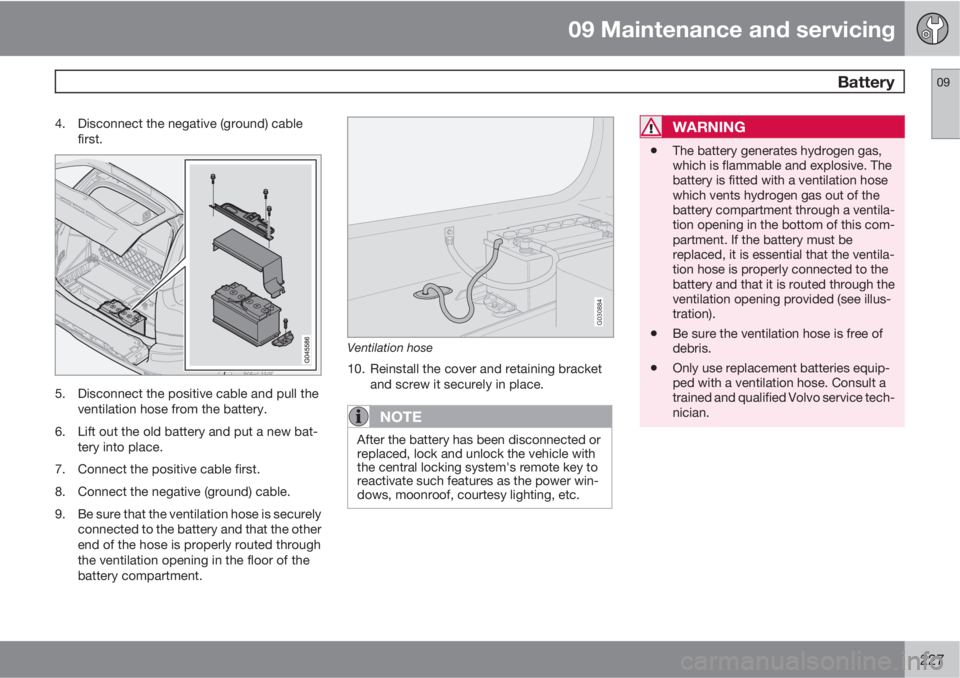
4. Disconnect the negative (ground) cable
first.
5. Disconnect the positive cable and pull the
ventilation hose from the battery.
6. Lift out the old battery and put a new bat-
tery into place.
7. Connect the positive cable first.
8. Connect the negative (ground) cable.
9. Be sure that the ventilation hose is securely
connected to the battery and that the other
end of the hose is properly routed through
the ventilation opening in the floor of the
battery compartment.
G030884
Ventilation hose
10. Reinstall the cover and retaining bracket
and screw it securely in place.
NOTE
After the battery has been disconnected or
replaced, lock and unlock the vehicle with
the central locking system's remote key to
reactivate such features as the power win-
dows, moonroof, courtesy lighting, etc.
WARNING
•The battery generates hydrogen gas,
which is flammable and explosive. The
battery is fitted with a ventilation hose
which vents hydrogen gas out of the
battery compartment through a ventila-
tion opening in the bottom of this com-
partment. If the battery must be
replaced, it is essential that the ventila-
tion hose is properly connected to the
battery and that it is routed through the
ventilation opening provided (see illus-
tration).
•Be sure the ventilation hose is free of
debris.
•Only use replacement batteries equip-
ped with a ventilation hose. Consult a
trained and qualified Volvo service tech-
nician.
Page 238 of 310
09 Maintenance and servicing
Fuses 09
236* Option/accessory, for more information, see Introduction.
Replacing fuses
G032337
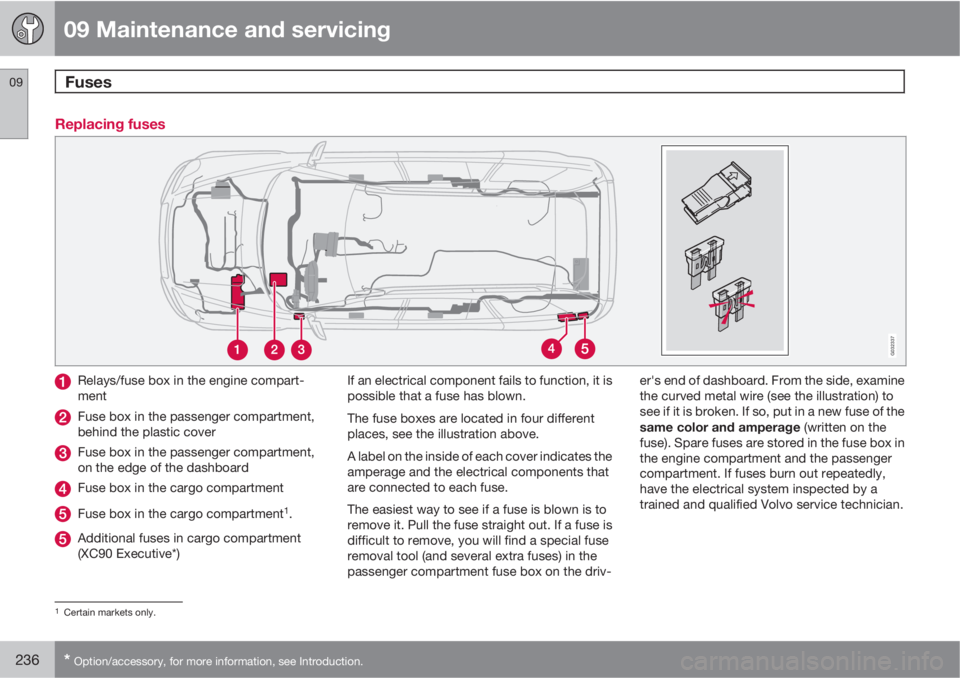
Relays/fuse box in the engine compart-
ment
Fuse box in the passenger compartment,
behind the plastic cover
Fuse box in the passenger compartment,
on the edge of the dashboard
Fuse box in the cargo compartment
Fuse box in the cargo compartment1.
Additional fuses in cargo compartment
(XC90 Executive*)If an electrical component fails to function, it is
possible that a fuse has blown.
The fuse boxes are located in four different
places, see the illustration above.
A label on the inside of each cover indicates the
amperage and the electrical components that
are connected to each fuse.
The easiest way to see if a fuse is blown is to
remove it. Pull the fuse straight out. If a fuse is
difficult to remove, you will find a special fuse
removal tool (and several extra fuses) in the
passenger compartment fuse box on the driv-er's end of dashboard. From the side, examine
the curved metal wire (see the illustration) to
see if it is broken. If so, put in a new fuse of the
same color and amperage (written on the
fuse). Spare fuses are stored in the fuse box in
the engine compartment and the passenger
compartment. If fuses burn out repeatedly,
have the electrical system inspected by a
trained and qualified Volvo service technician.
1Certain markets only.
Page 244 of 310
09 Maintenance and servicing
Fuses 09
242* Option/accessory, for more information, see Introduction.
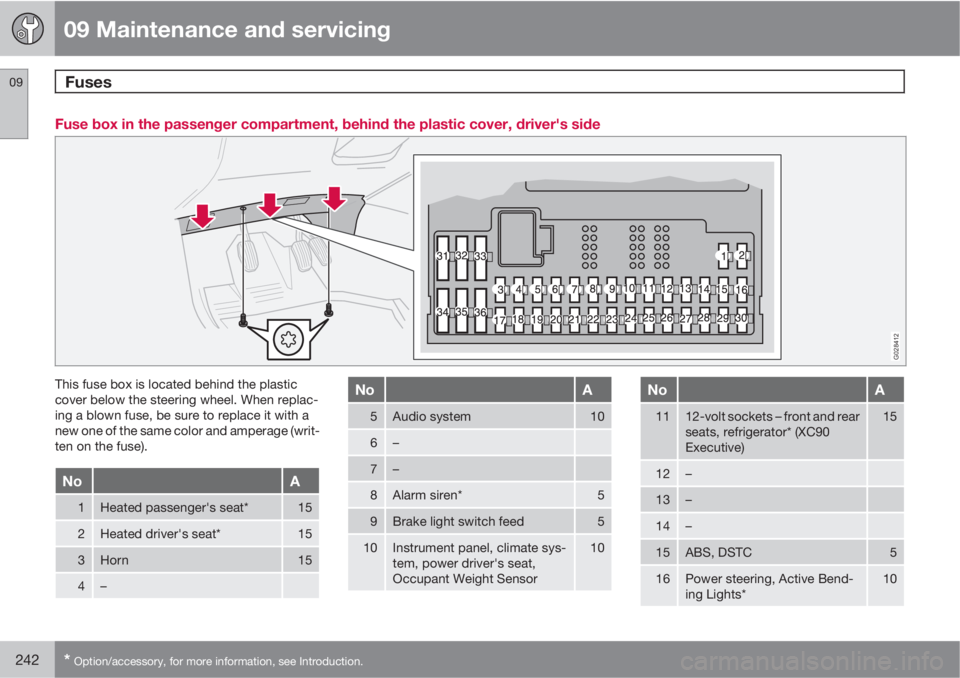
Fuse box in the passenger compartment, behind the plastic cover, driver's side
G028412
This fuse box is located behind the plastic
cover below the steering wheel. When replac-
ing a blown fuse, be sure to replace it with a
new one of the same color and amperage (writ-
ten on the fuse).
NoA
1Heated passenger's seat*15
2Heated driver's seat*15
3Horn15
4–
NoA
5Audio system10
6–
7–
8Alarm siren*5
9Brake light switch feed5
10Instrument panel, climate sys-
tem, power driver's seat,
Occupant Weight Sensor10
NoA
1112-volt sockets – front and rear
seats, refrigerator* (XC90
Executive)15
12–
13–
14–
15ABS, DSTC5
16Power steering, Active Bend-
ing Lights*10
Page 248 of 310
09 Maintenance and servicing
Fuses 09
246* Option/accessory, for more information, see Introduction.
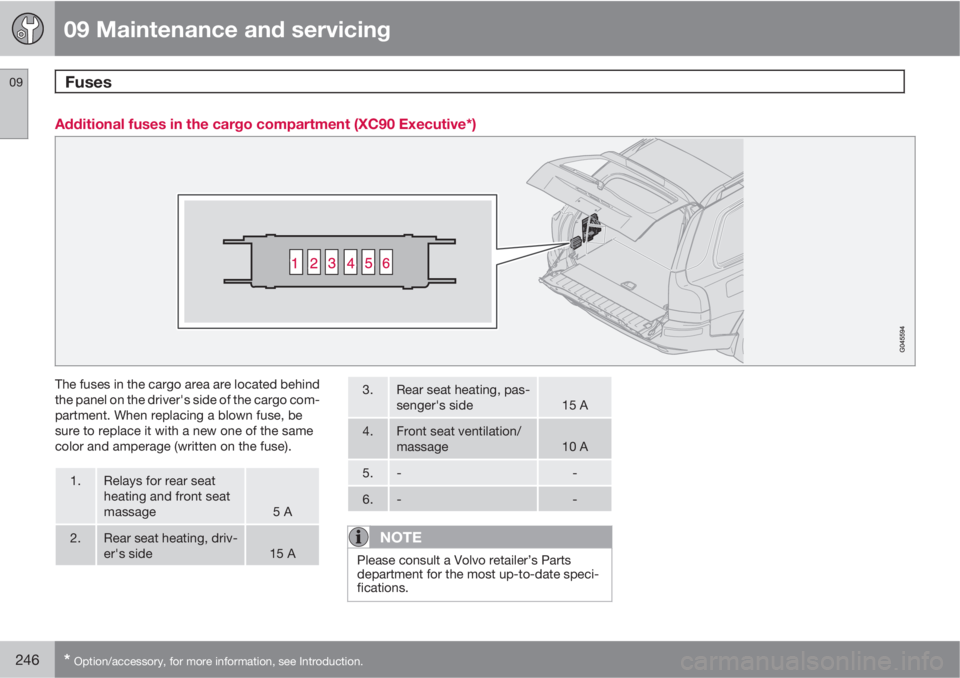
Additional fuses in the cargo compartment (XC90 Executive*)
The fuses in the cargo area are located behind
the panel on the driver's side of the cargo com-
partment. When replacing a blown fuse, be
sure to replace it with a new one of the same
color and amperage (written on the fuse).
1.Relays for rear seat
heating and front seat
massage
5 A
2.Rear seat heating, driv-
er's side15 A
3.Rear seat heating, pas-
senger's side15 A
4.Front seat ventilation/
massage10 A
5.--
6.--
NOTE
Please consult a Volvo retailer’s Parts
department for the most up-to-date speci-
fications.