brake VOLVO XC90 2013 Owner´s Manual
[x] Cancel search | Manufacturer: VOLVO, Model Year: 2013, Model line: XC90, Model: VOLVO XC90 2013Pages: 310, PDF Size: 8.62 MB
Page 171 of 310

06 Starting and driving
Before a long distance trip
06
169
It is always worthwhile to have your vehicle
checked by a trained and qualified Volvo serv-
ice technician before driving long distances.
Your retailer or service technician will also be
able to supply you with bulbs, fuses, spark
plugs and wiper blades for your use in the event
that problems occur.
As a minimum, the following items should be
checked before any long trip:
•Check that engine runs smoothly and that
fuel consumption is normal.
•Check for fuel, oil, and fluid leakage.
•Check transmission oil level1.
•Check condition of drive belts.
•Check state of the battery's charge.
•Examine tires carefully (the spare tire as
well), and replace those that are worn.
Check tire pressures.
•The brakes, front wheel alignment, and
steering gear should be checked by a
trained and qualified Volvo service techni-
cian only.
•Check all lights, including high beams.
•Reflective warning triangles are legally
required in some states/provinces.
•Have a word with your Volvo retailer if you
intend to drive in countries where it may be
difficult to obtain the correct fuel.
•Consider your destination. If you will be
driving through an area where snow or ice
are likely to occur, consider snow tires.
1To prevent injury from contact with hot surfaces, do not inspect your vehicle’s transmission fluid yourself. Have your vehicle’s transmission fluid level inspected by a qualified Volvo service technician.
Page 189 of 310
07 Wheels and tires
Snow chains, snow tires, studded tires
07
187 Snow chains
Snow chains can be used on your Volvo with
the following restrictions:
•Snow chains should be installed on front
wheels only. Use only Volvo approved
snow chains.
•If accessory, aftermarket or "custom" tires
and wheels are installed and are of a size
different than the original tires and wheels,
chains in some cases CANNOT be used.
Sufficient clearances between chains and
brakes, suspension and body components
must be maintained.
•Some strap-on type chains will interfere
with brake components and therefore
CANNOT be used.
•All Wheel Drive models: Snow chains
should only be installed on the front
wheels.
•Certain size tires may not allow the assem-
bly of snow chains/traction devices.
Consult your Volvo retailer for additional snow
chain information.
CAUTION
•Check local regulations regarding the
use of snow chains before installing.
•Always follow the chain manufacturer's
installation instructions carefully. Install
chains as tightly as possible and
retighten periodically.
•Never exceed the chain manufacturer's
specified maximum speed limit. (Under
no circumstances should you exceed
31 mph (50 km/h)).
•Avoid bumps, holes or sharp turns
when driving with snow chains.
•The handling of the vehicle can be
adversely affected when driving with
chains. Avoid fast or sharp turns as well
as locked wheel braking.
Snow tires, studded tires1
Tires for winter use:
•Owners who live in or regularly commute
through areas with sustained periods of
snow or icy driving conditions are strongly
advised to fit suitable winter tires to help
retain the highest degree of traction.
•It is important to install winter tires on all
four wheels to help retain traction duringcornering, braking, and accelerating. Fail-
ure to do so could reduce traction to an
unsafe level or adversely affect handling.
•Do not mix tires of different design as this
could also negatively affect overall tire road
grip.
•Winter tires wear more quickly on dry roads
in warm weather. They should be removed
when the winter driving season has ended.
•Studded tires should be run-in
300-600 miles (500-1000 km) during which
the vehicle should be driven as smoothly
as possible to give the studs the opportu-
nity to seat properly in the tires. The tires
should have the same rotational direction
throughout their entire lifetime.
NOTE
Please consult state or provincial regula-
tions restricting the use of studded winter
tires before installing such tires.
1Where permitted
Page 193 of 310
07 Wheels and tires
Tire Sealing System
07
191
WARNING
•Never leave the tire sealing system
unattended when it is operating.
•Keep the tire sealing system away from
children.
•Be sure the vehicle is parked safely off
the road and away from moving traffic.
•Apply the parking brake.
Stage 1: Sealing the hole1. Open the cover on the tire sealing kit.
2. Peel off the speed limit sticker and affix it
to the steering wheel hub where it will be
clearly visible to the driver.
3. Ensure that the on/off switch is in position
0 (the 0 side of the switch should be
pressed down).
4. Put on the gloves included in the tire seal-
ing system.
WARNING
Contact with the sealing compound may
cause skin irritation. If contact occurs, wash
the affected area immediately with soap and
water.
5. Unscrew the orange cover over the bottle
holder and unscrew the cap on the bottle
of sealing compound.
NOTE
Do not break the seal on the bottle. This
occurs automatically when the bottle is
screwed into the holder.
6. Screw the bottle into the bottle holder.
WARNING
The bottle is equipped with a catch to keep
it securely in place and help prevent sealing
compound leakage. Once in place, the bot-
tle cannot be unscrewed. This must be done
by a trained and qualified Volvo service
technician.
7. Remove the valve cap from the tire’s infla-
tion valve and screw the tire sealing sys-
tem’s hose connector onto the valve as
tightly as possible by hand.
8. Connect the electrical wire to the nearest
12-volt socket in the vehicle.
NOTE
Be sure that none of the other 12-volt sock-
ets is being used while the compressor is in
operation.
9. Start the vehicle’s engine.
10. Start the tire sealing system’s compressor
by pressing the on/off switch to position I.
WARNING
•Never stand next to the tire being inflated
when the compressor is in operation.
•If cracks, bubbles, etc. form on the tire,
switch off the compressor immediately.
•If there is visible damage to the sidewall
or the rim, the tire cannot be repaired.
The vehicle should not be driven if this
occurs. Contact a towing service or
Volvo On Call Roadside Assistance if
applicable.
Page 195 of 310
07 Wheels and tires
Tire Sealing System
07
193
Replacing the sealing compound
container
The sealing compound container must be
replaced if:
•the tire sealing system has been used to
repair a tire
•the container’s expiration date has passed
(see the date on decal).
NOTE
•After use, the sealing compound bottle,
the hose, and certain other system
components must be replaced. Please
consult your Volvo retailer for replace-
ment parts.
•If the sealing compound bottle’s expi-
ration date has passed, please take it to
a Volvo retailer or a recycling station
that can properly dispose of harmful
substances.
Inflating tires
The tire sealing system can be used to inflate
the tires. To do so:
1. Park the car in a safe place.
2. The compressor should be switched off.
Ensure that the on/off switch is in position
0 (the 0 side of the switch should be
pressed down).
3. Take out the electrical wire and hose.
4. Remove the valve cap from the tire’s infla-
tion valve and screw the hose connector
onto the valve as tightly as possible by
hand.
5. Connect the electrical wire to the nearest
12-volt socket in the vehicle.
6. Start the vehicle’s engine.WARNING
•The vehicle’s engine should be running
when the tire sealing system is used to
avoid battery drain. Therefore, be sure
the vehicle is parked in a well ventilated
place, or outdoors, before using the sys-
tem. The parking brake should be
securely applied and the gear selector
should be in the P (park) position.
•Children should never be left unattended
in the vehicle when the engine is running.
7. Check the tire’s inflation pressure on the
gauge. Switch off the compressor briefly to
get a clear reading from the pressure
gauge.
8. Refer to the tire inflation tables for the cor-
rect inflation pressure. If the tire needs to
be inflated, start the tire sealing system’s
compressor (press the on/off switch to
position I). If necessary, release air from the
tire by turning the air release knob coun-
terclockwise.
CAUTION
The compressor should not be used for
more than 10 minutes at a time to avoid
overheating.
Page 199 of 310
07 Wheels and tires
Changing wheels
07
197
G026997
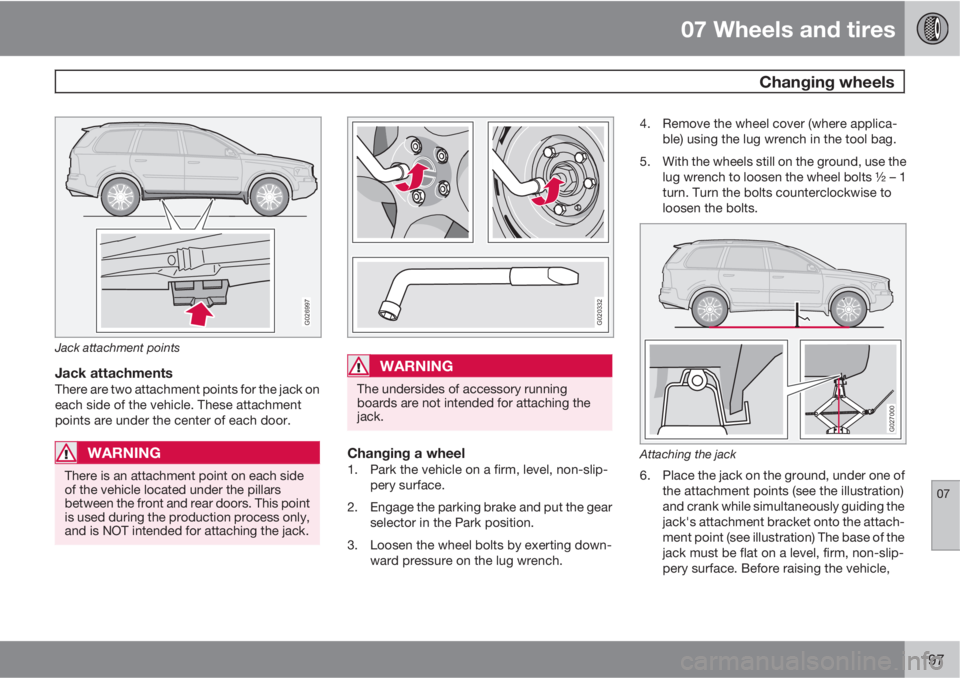
Jack attachment points
Jack attachmentsThere are two attachment points for the jack on
each side of the vehicle. These attachment
points are under the center of each door.
WARNING
There is an attachment point on each side
of the vehicle located under the pillars
between the front and rear doors. This point
is used during the production process only,
and is NOT intended for attaching the jack.
G020332
WARNING
The undersides of accessory running
boards are not intended for attaching the
jack.
Changing a wheel1. Park the vehicle on a firm, level, non-slip-
pery surface.
2. Engage the parking brake and put the gear
selector in the Park position.
3. Loosen the wheel bolts by exerting down-
ward pressure on the lug wrench.4. Remove the wheel cover (where applica-
ble) using the lug wrench in the tool bag.
5. With the wheels still on the ground, use the
lug wrench to loosen the wheel bolts ½ – 1
turn. Turn the bolts counterclockwise to
loosen the bolts.
G027000
Attaching the jack
6. Place the jack on the ground, under one of
the attachment points (see the illustration)
and crank while simultaneously guiding the
jack's attachment bracket onto the attach-
ment point (see illustration) The base of the
jack must be flat on a level, firm, non-slip-
pery surface. Before raising the vehicle,
Page 200 of 310
07 Wheels and tires
Changing wheels
07
198
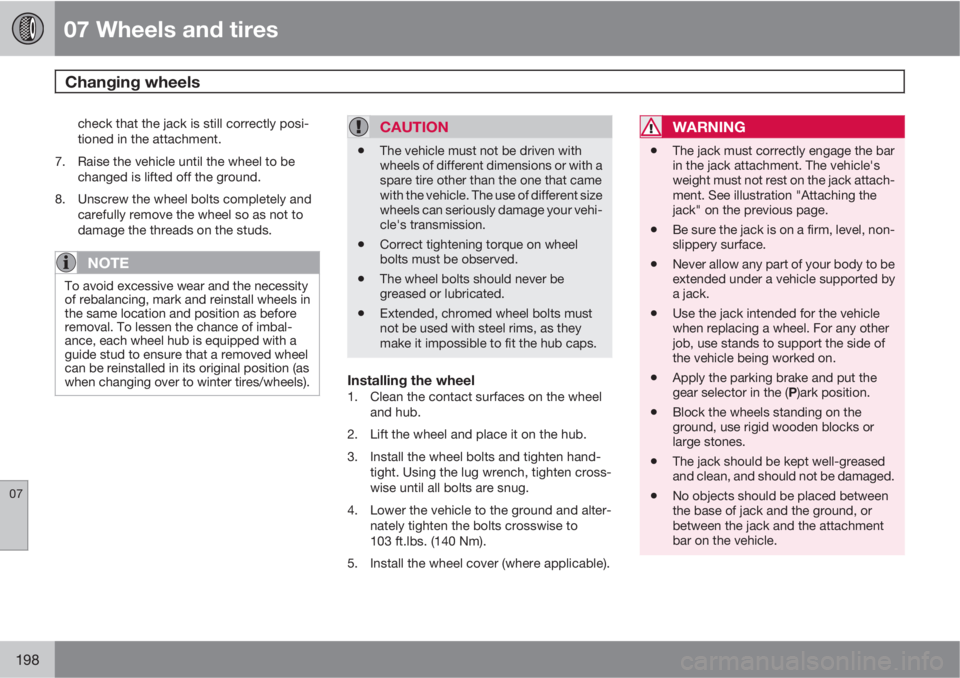
check that the jack is still correctly posi-
tioned in the attachment.
7. Raise the vehicle until the wheel to be
changed is lifted off the ground.
8. Unscrew the wheel bolts completely and
carefully remove the wheel so as not to
damage the threads on the studs.
NOTE
To avoid excessive wear and the necessity
of rebalancing, mark and reinstall wheels in
the same location and position as before
removal. To lessen the chance of imbal-
ance, each wheel hub is equipped with a
guide stud to ensure that a removed wheel
can be reinstalled in its original position (as
when changing over to winter tires/wheels).
CAUTION
•The vehicle must not be driven with
wheels of different dimensions or with a
spare tire other than the one that came
with the vehicle. The use of different size
wheels can seriously damage your vehi-
cle's transmission.
•Correct tightening torque on wheel
bolts must be observed.
•The wheel bolts should never be
greased or lubricated.
•Extended, chromed wheel bolts must
not be used with steel rims, as they
make it impossible to fit the hub caps.
Installing the wheel1. Clean the contact surfaces on the wheel
and hub.
2. Lift the wheel and place it on the hub.
3. Install the wheel bolts and tighten hand-
tight. Using the lug wrench, tighten cross-
wise until all bolts are snug.
4. Lower the vehicle to the ground and alter-
nately tighten the bolts crosswise to
103 ft.lbs. (140 Nm).
5. Install the wheel cover (where applicable).
WARNING
•The jack must correctly engage the bar
in the jack attachment. The vehicle's
weight must not rest on the jack attach-
ment. See illustration "Attaching the
jack" on the previous page.
•Be sure the jack is on a firm, level, non-
slippery surface.
•Never allow any part of your body to be
extended under a vehicle supported by
a jack.
•Use the jack intended for the vehicle
when replacing a wheel. For any other
job, use stands to support the side of
the vehicle being worked on.
•Apply the parking brake and put the
gear selector in the (P)ark position.
•Block the wheels standing on the
ground, use rigid wooden blocks or
large stones.
•The jack should be kept well-greased
and clean, and should not be damaged.
•No objects should be placed between
the base of jack and the ground, or
between the jack and the attachment
bar on the vehicle.
Page 209 of 310
08 Car care
Washing and cleaning the vehicle
08
207
CAUTION
•Avoid waxing or polishing plastic or rub-
ber components
•Polishing chromed strips can wear
away or damage the surface
•Polishes containing abrasive sub-
stances should not be used
NOTE
When washing the vehicle, remember to
remove dirt from the drain holes in the doors
and sills.
WARNING
•When the vehicle is driven immediately
after being washed, apply the brakes
several times in order to remove any
moisture from the brake linings.
•Engine cleaning agents should not be
used when the engine is warm. This
constitutes a fire risk.
Automatic washing – simple and quick
•We do NOT recommend washing your
vehicle in an automatic wash during thefirst few months (because the paint will not
have hardened sufficiently).
•An automatic wash is a simple and quick
way to clean your vehicle, but it is worth
remembering that it may not be as thor-
ough as when you yourself go over the
vehicle with sponge and water. Keeping
the underbody clean is most important,
especially in the winter. Some automatic
washers do not have facilities for washing
the underbody.
•Before driving into an automatic car wash,
make sure that side view mirrors, auxiliary
lamps, etc, are secure, and that any
antenna(s) are retracted or removed. Oth-
erwise there is risk of the machine dislodg-
ing them.
Exterior lightingCondensation may form temporarily on the
inside of the lenses of exterior lights such as
headlights, fog lights, or tail lights. This is nor-
mal and the lights are designed to withstand
moisture. Normally, condensation will dissi-
pate after the lights have been on for a short
time.
Polishing and waxing
•Normally, polishing is not required during
the first year after delivery, however, wax-
ing may be beneficial.
•Before applying polish or wax the vehicle
must be washed and dried. Tar spots can
be removed with kerosene or tar remover.
Difficult spots may require a fine rubbing
compound.
•After polishing use liquid or paste wax.
•Several commercially available products
contain both polish and wax.
•Waxing alone does not substitute for pol-
ishing a dull surface.
•A wide range of polymer-based car waxes
can be purchased today. These waxes are
easy to use and produce a long-lasting,
high-gloss finish that protects the body-
work against oxidation, road dirt and fad-
ing.
•Do not polish or wax your vehicle in direct
sunlight (the surface of the vehicle should
not be warmer than 113° F (45° C).
Page 221 of 310
09 Maintenance and servicing
Engine compartment09
219
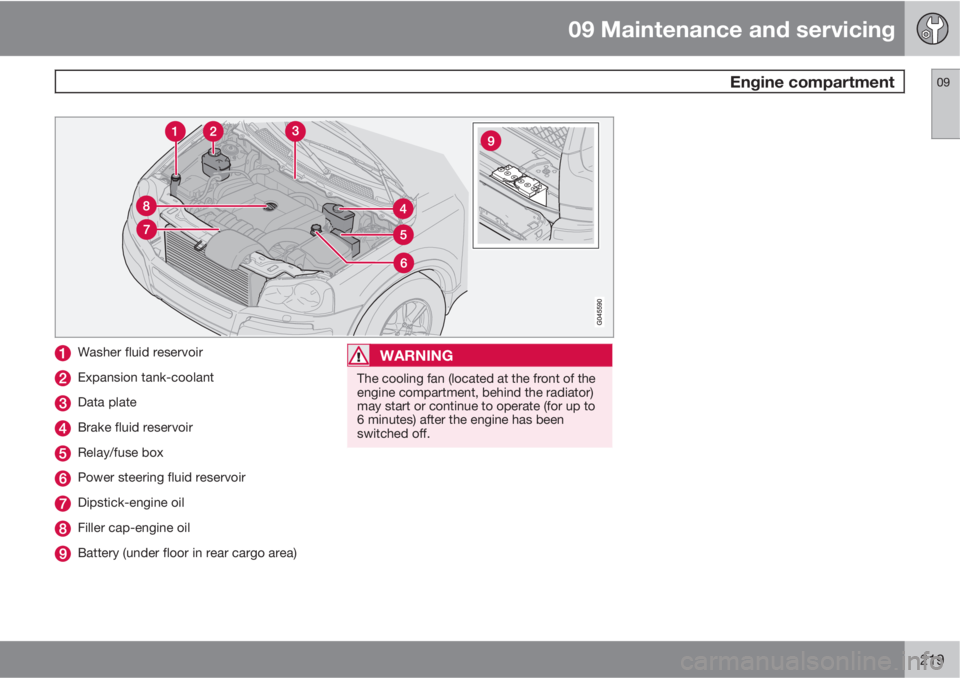
Washer fluid reservoir
Expansion tank-coolant
Data plate
Brake fluid reservoir
Relay/fuse box
Power steering fluid reservoir
Dipstick-engine oil
Filler cap-engine oil
Battery (under floor in rear cargo area)
WARNING
The cooling fan (located at the front of the
engine compartment, behind the radiator)
may start or continue to operate (for up to
6 minutes) after the engine has been
switched off.
Page 225 of 310
09 Maintenance and servicing
Fluids09
223
WARNING
•Never remove the coolant reservoir cap
while the engine is warm. Wait until the
engine cools.
•If it is necessary to top up the coolant
when the engine is warm, unscrew the
coolant reservoir cap slowly so that the
overpressure dissipates.
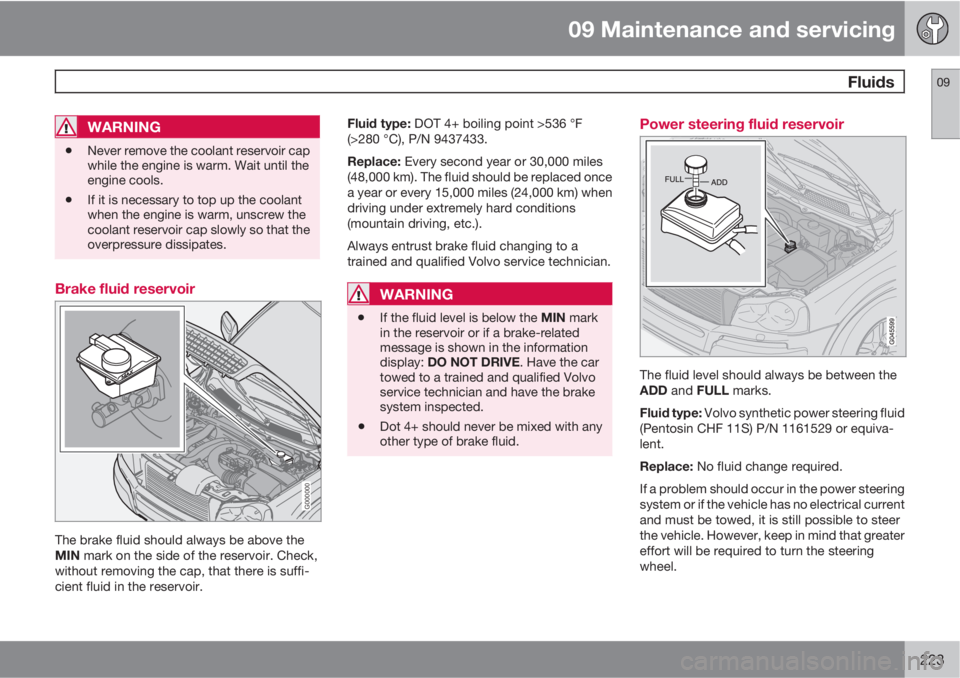
Brake fluid reservoir
G000000
The brake fluid should always be above the
MIN mark on the side of the reservoir. Check,
without removing the cap, that there is suffi-
cient fluid in the reservoir.Fluid type: DOT 4+ boiling point >536 °F
(>280 °C), P/N 9437433.
Replace: Every second year or 30,000 miles
(48,000 km). The fluid should be replaced once
a year or every 15,000 miles (24,000 km) when
driving under extremely hard conditions
(mountain driving, etc.).
Always entrust brake fluid changing to a
trained and qualified Volvo service technician.
WARNING
•If the fluid level is below the MIN mark
in the reservoir or if a brake-related
message is shown in the information
display: DO NOT DRIVE. Have the car
towed to a trained and qualified Volvo
service technician and have the brake
system inspected.
•Dot 4+ should never be mixed with any
other type of brake fluid.
Power steering fluid reservoir
The fluid level should always be between the
ADD and FULL marks.
Fluid type: Volvo synthetic power steering fluid
(Pentosin CHF 11S) P/N 1161529 or equiva-
lent.
Replace: No fluid change required.
If a problem should occur in the power steering
system or if the vehicle has no electrical current
and must be towed, it is still possible to steer
the vehicle. However, keep in mind that greater
effort will be required to turn the steering
wheel.
Page 230 of 310
09 Maintenance and servicing
Replacing bulbs 09
228* Option/accessory, for more information, see Introduction.
When replacing bulbs, keep the following
points in mind:
•Never touch the glass of bulbs with your
fingers. Grease and oils from your fingers
vaporize in the heat and will leave a deposit
on the reflector, which will damage it.
•The optional Active Bending Light bulbs
contain trace amounts of mercury. These
bulbs should always be disposed of by an
authorized Volvo retailer.
The following bulbs should only be replaced by
a trained and qualified Volvo service techni-
cian:
•Active Bending Lights (ABL)
•Daytime running lights (DRL) under the
front bumper
•Turn signals and courtesy lights in the side
door mirrors
•Reading lights and glove compartment
light
•Courtesy (dome) lighting
•Rear parking lights
•Brake lights
•High-mounted brake lights
If a problem occurs with the daytime running
lights (DRL) under the front bumper, the entire
lamp housing will have to be replaced.If a problem occurs with the rear parking lights
or the brake lights, the entire taillight housing
will have to be replaced.
See page 234 for a list of bulb specifications.
Replacing high/low beams/turn signal/
parking light bulbs
WARNING
•The engine should not be running when
changing bulbs.
•If the engine has been running just prior
to replacing bulbs in the headlight hous-
ing, please keep in mind that compo-
nents in the engine compartment will be
hot.
WARNING
Active Bending Lights* - due to the high
voltage used by these headlights, these
bulbs should only be replaced by a trained
and qualified Volvo service technician.
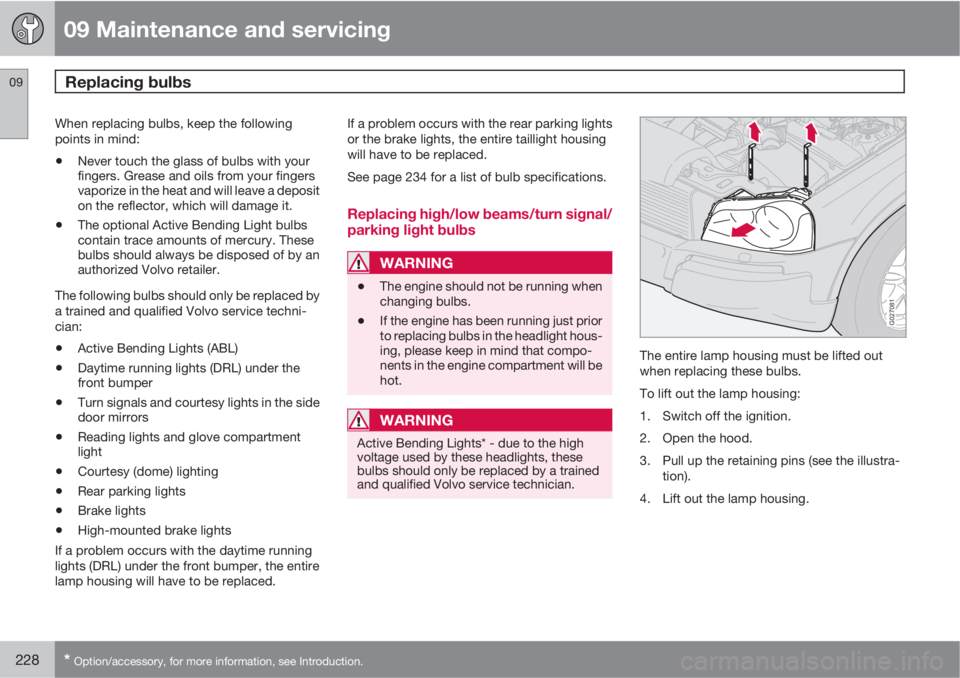
G027081
The entire lamp housing must be lifted out
when replacing these bulbs.
To lift out the lamp housing:
1. Switch off the ignition.
2. Open the hood.
3. Pull up the retaining pins (see the illustra-
tion).
4. Lift out the lamp housing.