ignition VOLVO XC90 2013 Owner´s Manual
[x] Cancel search | Manufacturer: VOLVO, Model Year: 2013, Model line: XC90, Model: VOLVO XC90 2013Pages: 310, PDF Size: 8.62 MB
Page 138 of 310
136* Option/accessory, for more information, see Introduction.
General information............................................................................... 138
Fuel requirements................................................................................. 139
Refueling............................................................................................... 141
Starting the vehicle............................................................................... 143
Ignition switch and steering wheel lock................................................ 145
Economical driving................................................................................ 146
Difficult driving conditions..................................................................... 147
Automatic transmission........................................................................ 148
Jump starting........................................................................................ 151
All Wheel Drive*..................................................................................... 152
Brake system........................................................................................ 153
Parking brake........................................................................................ 156
Stability system..................................................................................... 157
Front/rear park assist*........................................................................... 159
Towing.................................................................................................. 161
Towing a trailer...................................................................................... 163
Detachable trailer hitch......................................................................... 166
Load carriers (accessory)...................................................................... 167
Cold weather precautions..................................................................... 168
Before a long distance trip.................................................................... 169
Blind Spot Information System*............................................................ 170
Page 142 of 310
06 Starting and driving
Fuel requirements
06
140
Gasoline containing alcohol and ethers,
"Oxygenated fuels"
Some fuel suppliers sell gasoline containing
"oxygenates" which are usually alcohols or
ethers. In some areas, state or local laws
require that the service pump be marked indi-
cating use of alcohols or ethers. However,
there are areas in which the pumps are
unmarked. If you are not sure whether there is
alcohol or ethers in the gasoline you buy, check
with the service station operator. To meet sea-
sonal air quality standards, some areas require
the use of "oxygenated" fuel.
Volvo allows the use of the following "oxygen-
ated" fuels; however, the octane ratings listed
on page 139 must still be met.
Alcohol – EthanolFuels containing up to 10% ethanol by volume
may be used. Ethanol may also be referred to
as Ethyl alcohol, or "Gasohol".
Ethers – MTBE: Fuels containing up to
15% MTBE may be used.
MethanolDo not use gasolines containing methanol
(methyl alcohol, wood alcohol). This practice
can result in vehicle performance deterioration
and can damage critical parts in the fuel sys-
tem. Such damage may not be covered under
the New Vehicle Limited Warranty.
Weight distribution affects handlingAt the specified curb weight your vehicle has a
tendency to understeer, which means that the
steering wheel has to be turned more than
might seem appropriate for the curvature of a
bend.
This ensures good stability and reduces the
risk of rear wheel skid. Remember that these
properties can alter with the vehicle load.
The heavier the load in the cargo area, the less
the tendency to understeer.
Handling, roadholdingVehicle load, tire design and inflation pressure
all affect vehicle handling. Therefore, check
that the tires are inflated to the recommended
pressure according to the vehicle load. See
"Tire pressure" section.
Loads should be distributed so that capacity
weight or maximum permissible axle loads are
not exceeded.
Conserving electrical currentKeep the following in mind to help minimize
battery drain:
•When the engine is not running, avoid turn-
ing the ignition key to position II (see
page 145). Many electrical systems (the
audio system, the optional infotainment/
navigation systems, power windows, etc)
will function with the ignition key in positionI. This position reduces drain on the bat-
tery.
•Please keep in mind that using systems,
accessories, etc that consume a great deal
of current when the engine is not running
could result in the battery being completely
drained. Driving or having the engine run-
ning for approximately 15 minutes will help
keep the battery charged.
NOTE
A warning message will be displayed in the
text window in the instrument panel when
the battery charge is low.
Page 144 of 310
06 Starting and driving
Refueling
06
142
CAUTION
•Do not refuel with the engine running1.
Turn the ignition off or to position I. If the
ignition is on, an incorrect reading could
occur in the fuel gauge.
•After refueling, close the fuel filler cap
by turning it clockwise until it clicks into
place
1.
•Avoid overfilling the fuel tank. Do not
press the handle on the filler nozzle
more than one extra time. Too much fuel
in the tank in hot weather conditions can
cause the fuel to overflow. Overfilling
could also cause damage to the emis-
sion control systems.
•Avoid spilling gasoline during refueling.
In addition to causing damage to the
environment, gasolines containing
alcohol can cause damage to painted
surfaces, which may not be covered
under the New Vehicle Limited War-
ranty.
•Do not use gasolines containing meth-
anol (methyl alcohol, wood alcohol).
This practice can result in vehicle per-
formance deterioration and can dam-
age critical parts in the fuel system.
Such damage may not be covered
under the New Vehicle Limited War-
ranty.
1If the fuel filler cap is not closed tightly or if the engine is running when the vehicle is refueled, the Check Engine Light (malfunction indicator lamp) may indicate a fault. However, your vehicle's
performance will not be affected. Use only Volvo original or approved fuel filler caps.
Page 145 of 310
06 Starting and driving
Starting the vehicle
06
143 Starting the engine
WARNING
Before starting, check that the seat, steering
wheel and mirrors are adjusted properly.
Make sure the brake pedal can be
depressed completely. Adjust the seat if
necessary, see page 104.
1. Fasten the seat belt.
2. Apply the parking brake (hand brake) if not
already set. The gear selector is locked in
the P position (SHIFTLOCK).
3. Without touching the accelerator pedal,
turn the ignition key
1 to the starting posi-
tion. Allow the starter to operate for up to
10 seconds. Release the key as soon as
the engine starts
2. If the engine fails to
start, repeat this step.
CAUTION
If the engine does not start after the third try,
wait for approximately 3 minutes before try-
ing to start it again to give the battery time
to recover its starting capacity.
WARNING
•Never use more than one floor mat at a
time on the driver's floor. An extra mat
on the driver's floor can cause the
accelerator and/or brake pedal to
catch. Check that the movement of
these pedals is not impeded.
•Volvo's floor mats are specially manu-
factured for your car. They must be
firmly secured in the clips on the floor so
that they cannot slide and become trap-
ped under the pedals on the driver's
side.
NOTE
•If the key blade section of the remote is
not fully folded out when starting the
vehicle, the immobilizer function may
make it impossible to start the engine.
•After a cold start, idle speed may be
noticeably higher than normal for a
short period. This is done to help bring
components in the emission control
system to their normal operating tem-
perature as quickly as possible, which
enables them to control emissions and
help reduce the vehicle's impact on the
environment.
•To release the gear selector from the P
(Park) position, the engine must be run-
ning (or the ignition key must be in posi-
tion II) and the brake pedal must be
depressed.
•Select the desired gear. The gear
engages after a very slight delay which
is especially noticeable when selecting
R.
1If two of the keys to your vehicle are close together, e.g. on the same key ring when you try to start the vehicle, this could cause interference in the immobilizer system and result in the vehicle not
starting. If this should occur, remove one of the keys from the key ring before trying to start the vehicle again.
2On vehicles equipped with the autostart feature, release the key immediately. See also page 145.
Page 146 of 310
06 Starting and driving
Starting the vehicle
06
144
NOTE
Your vehicle is equipped with a KEYLOCK
system. When the engine is switched off,
the gear selector must be in the P position
before the key can be removed from the
ignition switch.
When starting in cold weather, the trans-
mission may shift up at slightly higher
engine speeds than normal until the auto-
matic transmission fluid reaches normal
operating temperature.
NOTE
Do not race a cold engine immediately after
starting. Oil flow may not reach some lubri-
cation points fast enough to prevent engine
damage.
WARNING
Always place the gear selector in Park and
apply the parking brake before leaving the
vehicle. Never leave the vehicle unattended
with the engine running.
•Always open garage doors fully before
starting the engine inside a garage to
ensure adequate ventilation. The
exhaust gases contain carbon monox-
ide, which is invisible and odorless but
very poisonous.
CAUTION
Automatic transmission
•The engine should be idling when you
move the gear selector. Never acceler-
ate until after you feel the transmission
engage! Accelerating immediately after
selecting a gear will cause harsh
engagement and premature transmis-
sion wear.
•Selecting P or N when idling at a stand-
still for prolonged periods of time will
help prevent overheating of the auto-
matic transmission fluid.
Page 147 of 310
06 Starting and driving
Ignition switch and steering wheel lock
06
145 Ignition switch and steering wheel lock
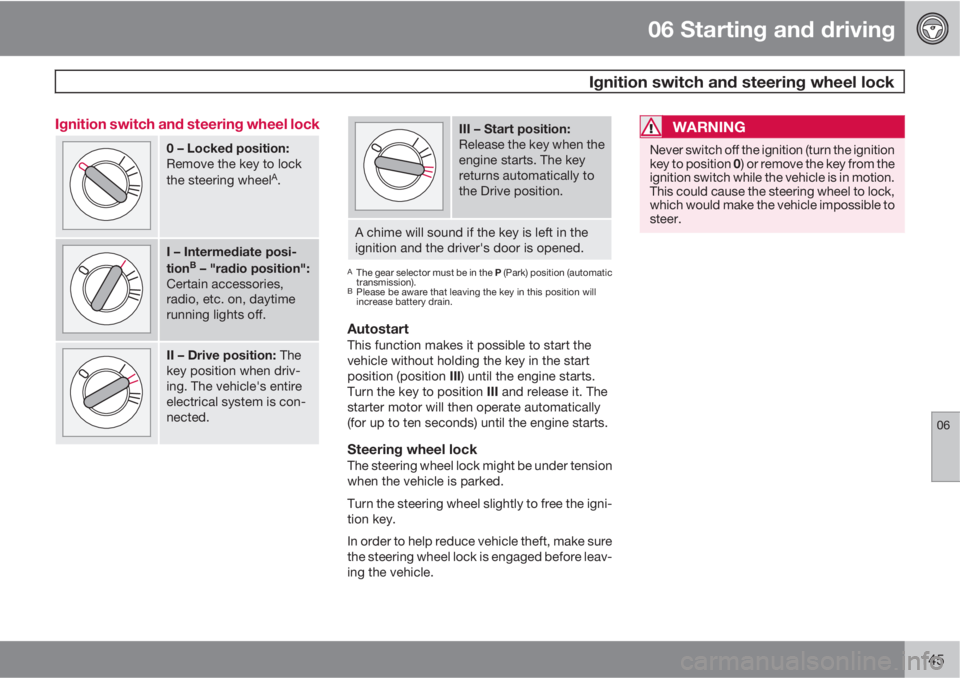
0 – Locked position:
Remove the key to lock
the steering wheel
A.
I – Intermediate posi-
tionB – "radio position":
Certain accessories,
radio, etc. on, daytime
running lights off.
II – Drive position: The
key position when driv-
ing. The vehicle's entire
electrical system is con-
nected.
III – Start position:
Release the key when the
engine starts. The key
returns automatically to
the Drive position.
A chime will sound if the key is left in the
ignition and the driver's door is opened.
AThe gear selector must be in the P (Park) position (automatic
transmission).
BPlease be aware that leaving the key in this position will
increase battery drain.
AutostartThis function makes it possible to start the
vehicle without holding the key in the start
position (position III) until the engine starts.
Turn the key to position III and release it. The
starter motor will then operate automatically
(for up to ten seconds) until the engine starts.
Steering wheel lockThe steering wheel lock might be under tension
when the vehicle is parked.
Turn the steering wheel slightly to free the igni-
tion key.
In order to help reduce vehicle theft, make sure
the steering wheel lock is engaged before leav-
ing the vehicle.
WARNING
Never switch off the ignition (turn the ignition
key to position 0) or remove the key from the
ignition switch while the vehicle is in motion.
This could cause the steering wheel to lock,
which would make the vehicle impossible to
steer.
Page 150 of 310
06 Starting and driving
Automatic transmission
06
148
G026990
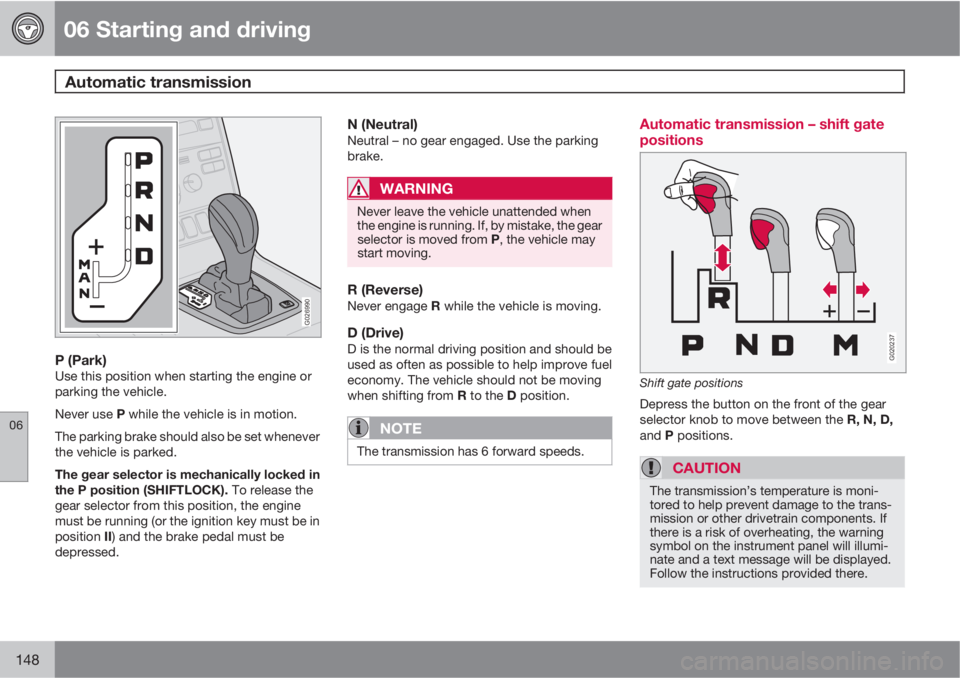
P (Park)Use this position when starting the engine or
parking the vehicle.
Never use P while the vehicle is in motion.
The parking brake should also be set whenever
the vehicle is parked.
The gear selector is mechanically locked in
the P position (SHIFTLOCK). To release the
gear selector from this position, the engine
must be running (or the ignition key must be in
position II) and the brake pedal must be
depressed.
N (Neutral)Neutral – no gear engaged. Use the parking
brake.
WARNING
Never leave the vehicle unattended when
the engine is running. If, by mistake, the gear
selector is moved from P, the vehicle may
start moving.
R (Reverse)Never engage R while the vehicle is moving.
D (Drive)D is the normal driving position and should be
used as often as possible to help improve fuel
economy. The vehicle should not be moving
when shifting from R to the D position.
NOTE
The transmission has 6 forward speeds.
Automatic transmission – shift gate
positions
G020237
Shift gate positions
Depress the button on the front of the gear
selector knob to move between the R, N, D,
and P positions.
CAUTION
The transmission’s temperature is moni-
tored to help prevent damage to the trans-
mission or other drivetrain components. If
there is a risk of overheating, the warning
symbol on the instrument panel will illumi-
nate and a text message will be displayed.
Follow the instructions provided there.
Page 153 of 310
06 Starting and driving
Jump starting
06
151
G030860
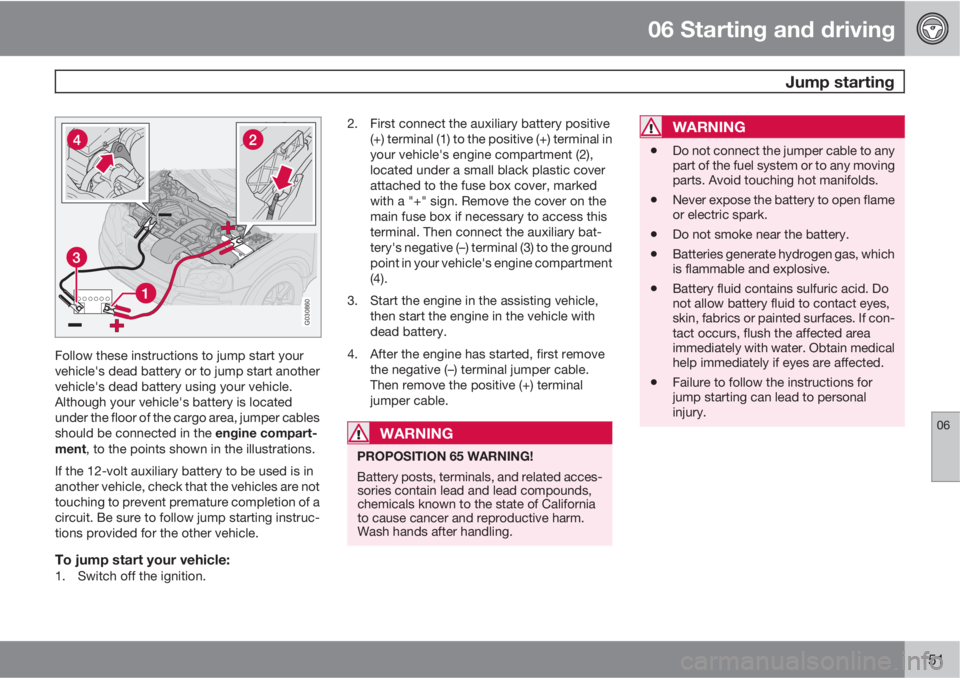
Follow these instructions to jump start your
vehicle's dead battery or to jump start another
vehicle's dead battery using your vehicle.
Although your vehicle's battery is located
under the floor of the cargo area, jumper cables
should be connected in the engine compart-
ment, to the points shown in the illustrations.
If the 12-volt auxiliary battery to be used is in
another vehicle, check that the vehicles are not
touching to prevent premature completion of a
circuit. Be sure to follow jump starting instruc-
tions provided for the other vehicle.
To jump start your vehicle:1. Switch off the ignition.2. First connect the auxiliary battery positive
(+) terminal (1) to the positive (+) terminal in
your vehicle's engine compartment (2),
located under a small black plastic cover
attached to the fuse box cover, marked
with a "+" sign. Remove the cover on the
main fuse box if necessary to access this
terminal. Then connect the auxiliary bat-
tery's negative (–) terminal (3) to the ground
point in your vehicle's engine compartment
(4).
3. Start the engine in the assisting vehicle,
then start the engine in the vehicle with
dead battery.
4. After the engine has started, first remove
the negative (–) terminal jumper cable.
Then remove the positive (+) terminal
jumper cable.
WARNING
PROPOSITION 65 WARNING!
Battery posts, terminals, and related acces-
sories contain lead and lead compounds,
chemicals known to the state of California
to cause cancer and reproductive harm.
Wash hands after handling.
WARNING
•Do not connect the jumper cable to any
part of the fuel system or to any moving
parts. Avoid touching hot manifolds.
•Never expose the battery to open flame
or electric spark.
•Do not smoke near the battery.
•Batteries generate hydrogen gas, which
is flammable and explosive.
•Battery fluid contains sulfuric acid. Do
not allow battery fluid to contact eyes,
skin, fabrics or painted surfaces. If con-
tact occurs, flush the affected area
immediately with water. Obtain medical
help immediately if eyes are affected.
•Failure to follow the instructions for
jump starting can lead to personal
injury.
Page 160 of 310
06 Starting and driving
Stability system
06
158
DSTC-related messages in the text
window
•TRACTION CONTROL TEMPORARILY
OFF : The system has been temporarily
switched off due to high brake temperature
and will automatically switch on again
when the brakes have cooled.
•ANTI-SKID SERVICE REQUIRED: The
system has been automatically disen-
gaged due to a fault. A trained and qualified
Volvo service technician should check the
system.
Symbols in the instrument panel
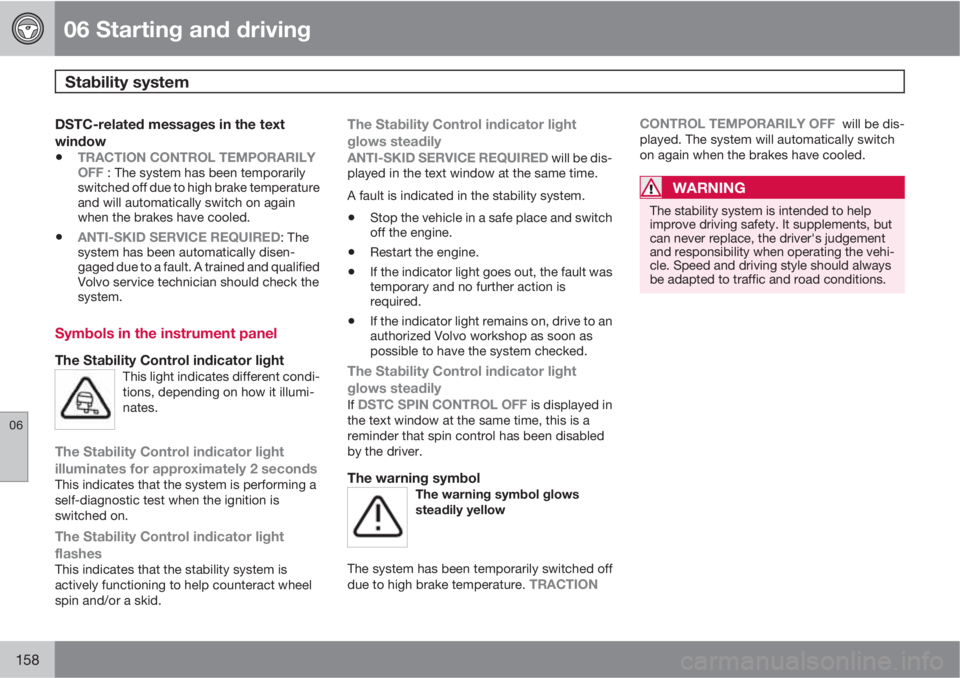
The Stability Control indicator lightThis light indicates different condi-
tions, depending on how it illumi-
nates.
The Stability Control indicator light
illuminates for approximately 2 seconds
This indicates that the system is performing a
self-diagnostic test when the ignition is
switched on.
The Stability Control indicator light
flashes
This indicates that the stability system is
actively functioning to help counteract wheel
spin and/or a skid.
The Stability Control indicator light
glows steadily
ANTI-SKID SERVICE REQUIRED will be dis-
played in the text window at the same time.
A fault is indicated in the stability system.
•Stop the vehicle in a safe place and switch
off the engine.
•Restart the engine.
•If the indicator light goes out, the fault was
temporary and no further action is
required.
•If the indicator light remains on, drive to an
authorized Volvo workshop as soon as
possible to have the system checked.
The Stability Control indicator light
glows steadily
If DSTC SPIN CONTROL OFF is displayed in
the text window at the same time, this is a
reminder that spin control has been disabled
by the driver.
The warning symbolThe warning symbol glows
steadily yellow
The system has been temporarily switched off
due to high brake temperature. TRACTIONCONTROL TEMPORARILY OFF
will be dis-
played. The system will automatically switch
on again when the brakes have cooled.
WARNING
The stability system is intended to help
improve driving safety. It supplements, but
can never replace, the driver's judgement
and responsibility when operating the vehi-
cle. Speed and driving style should always
be adapted to traffic and road conditions.
Page 163 of 310
06 Starting and driving
Towing
06
161
G027042
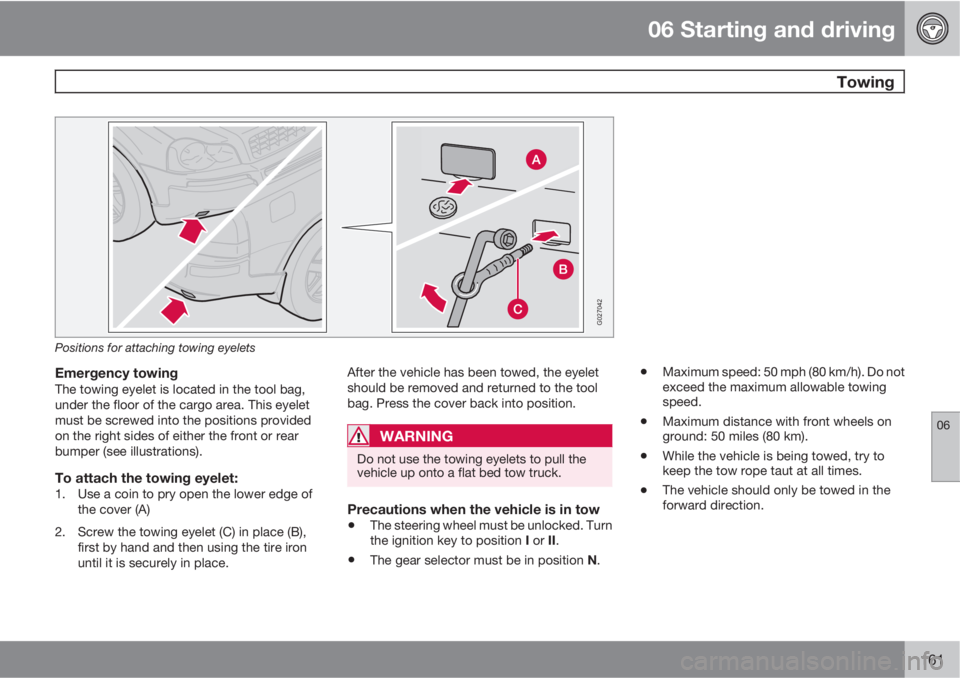
Positions for attaching towing eyelets
Emergency towingThe towing eyelet is located in the tool bag,
under the floor of the cargo area. This eyelet
must be screwed into the positions provided
on the right sides of either the front or rear
bumper (see illustrations).
To attach the towing eyelet:1. Use a coin to pry open the lower edge of
the cover (A)
2. Screw the towing eyelet (C) in place (B),
first by hand and then using the tire iron
until it is securely in place.After the vehicle has been towed, the eyelet
should be removed and returned to the tool
bag. Press the cover back into position.
WARNING
Do not use the towing eyelets to pull the
vehicle up onto a flat bed tow truck.
Precautions when the vehicle is in tow
•The steering wheel must be unlocked. Turn
the ignition key to position I or II.
•The gear selector must be in position N.
•Maximum speed: 50 mph (80 km/h). Do not
exceed the maximum allowable towing
speed.
•Maximum distance with front wheels on
ground: 50 miles (80 km).
•While the vehicle is being towed, try to
keep the tow rope taut at all times.
•The vehicle should only be towed in the
forward direction.