light VOLVO XC90 2013 Owner´s Manual
[x] Cancel search | Manufacturer: VOLVO, Model Year: 2013, Model line: XC90, Model: VOLVO XC90 2013Pages: 310, PDF Size: 8.62 MB
Page 129 of 310
05 Locks and alarm
Remote keys and key blades
05
127 Remote keys
G026963
Your vehicle is equipped with two coded
remote key transmitters with integrated ignition
keys called Key Integrated Remote (KIR).
The remote key transmitters will also activate
or allow "keyless" entry into the passenger
compartment or the tailgate. These transmit-
ters use a radio frequency that will enable you
to lock/unlock all doors and the tailgate from a
distance of 10 – 15 feet (3 – 5 meters). They will
also activate or deactivate your vehicle's alarm
system(s). The vehicle can also be locked/
unlocked with the key.
If either of the remote keys is lost, the other
should be taken with the car to a Volvo retailer.As an anti-theft measure, the code of the lost
remote key must be erased from the system.
NOTE
Additional or duplicate remote control keys
can be obtained from any Authorized Volvo
Retailer.
You can also obtain additional or duplicate
remote control keys from certain independ-
ent repair facilities and locksmiths that are
qualified to make remote control keys. Each
key must be programmed to work with your
vehicle.
California Only:
A list of independent repair facilities and/or
locksmiths known to Volvo that can cut and
code replacement keys can be found:
•on the Volvo website at
http://www.volvocars.com/us/keys
•by calling Volvo Customer Care at
1-800-458-1552
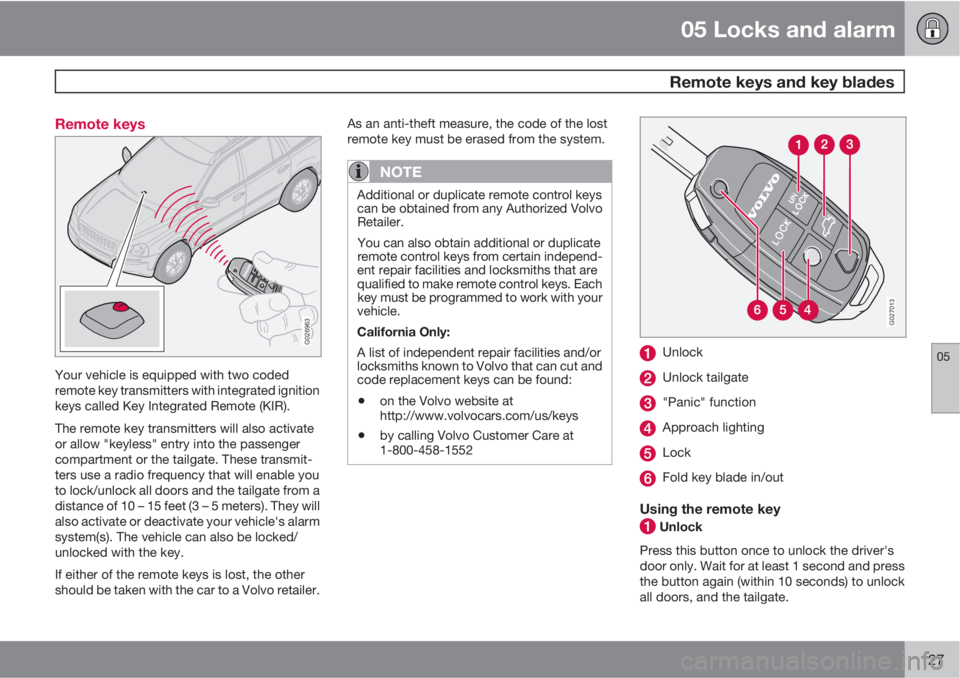
G027013
Unlock
Unlock tailgate
"Panic" function
Approach lighting
Lock
Fold key blade in/out
Using the remote key
Unlock
Press this button once to unlock the driver's
door only. Wait for at least 1 second and press
the button again (within 10 seconds) to unlock
all doors, and the tailgate.
Page 130 of 310
05 Locks and alarm
Remote keys and key blades
05
128
Tailgate unlock
Press this button to unlock the tailgate (without
unlocking the other doors). This function will
not open the tailgate.
Panic function
For more information on this function, see
page 133.
Approach lighting
Press this button when approaching the vehi-
cle at night to light up the interior courtesy light,
parking lights, license plate lights and the lights
in the door mirrors.
Lock
Press once to lock all doors, and the tailgate.
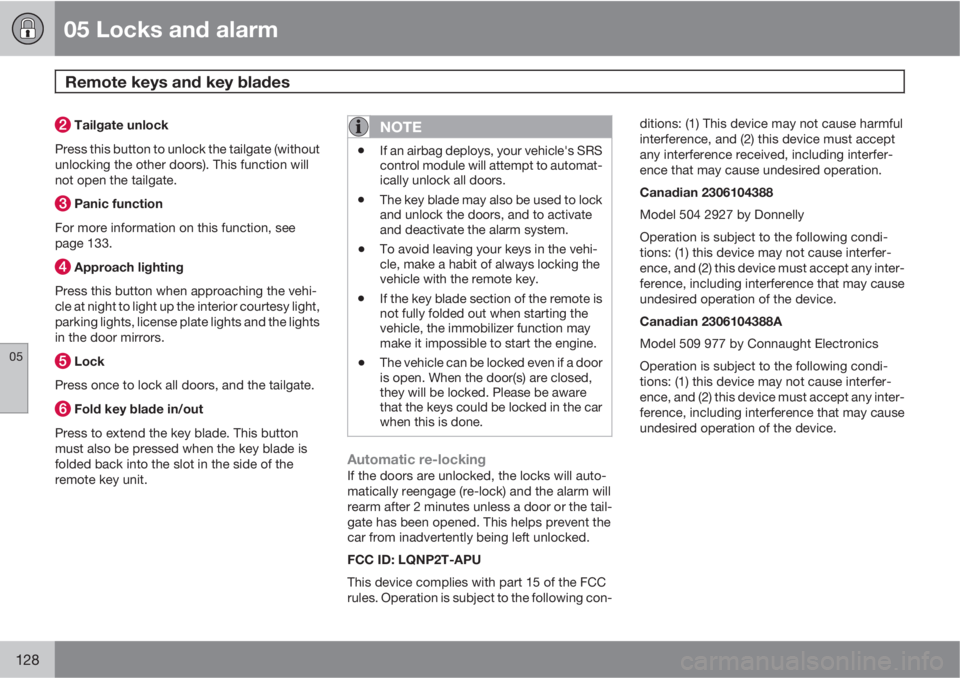
Fold key blade in/out
Press to extend the key blade. This button
must also be pressed when the key blade is
folded back into the slot in the side of the
remote key unit.
NOTE
•If an airbag deploys, your vehicle's SRS
control module will attempt to automat-
ically unlock all doors.
•The key blade may also be used to lock
and unlock the doors, and to activate
and deactivate the alarm system.
•To avoid leaving your keys in the vehi-
cle, make a habit of always locking the
vehicle with the remote key.
•If the key blade section of the remote is
not fully folded out when starting the
vehicle, the immobilizer function may
make it impossible to start the engine.
•The vehicle can be locked even if a door
is open. When the door(s) are closed,
they will be locked. Please be aware
that the keys could be locked in the car
when this is done.
Automatic re-lockingIf the doors are unlocked, the locks will auto-
matically reengage (re-lock) and the alarm will
rearm after 2 minutes unless a door or the tail-
gate has been opened. This helps prevent the
car from inadvertently being left unlocked.
FCC ID: LQNP2T-APU
This device complies with part 15 of the FCC
rules. Operation is subject to the following con-ditions: (1) This device may not cause harmful
interference, and (2) this device must accept
any interference received, including interfer-
ence that may cause undesired operation.
Canadian 2306104388
Model 504 2927 by Donnelly
Operation is subject to the following condi-
tions: (1) this device may not cause interfer-
ence, and (2) this device must accept any inter-
ference, including interference that may cause
undesired operation of the device.
Canadian 2306104388A
Model 509 977 by Connaught Electronics
Operation is subject to the following condi-
tions: (1) this device may not cause interfer-
ence, and (2) this device must accept any inter-
ference, including interference that may cause
undesired operation of the device.
Page 131 of 310
05 Locks and alarm
Remote keys and key blades
05
129
WARNING
Never use the transmitter to lock the doors
from inside the vehicle.
•Doing so would ACTIVATE:
•the break-in alarm, which would sound
if one of the doors were opened
•the optional interior motion and inclina-
tion alarm sensors.
•Doing so would DEACTIVATE:
•the moonroof and interior courtesy light
controls.
•the central locking buttons on the front
door armrests, although the interior
door handles would still function to
allow occupants to leave the vehicle.
•Disabled features would remain disa-
bled until the remote is used again to
unlock the vehicle.
•In addition, locking an occupied vehicle
would hinder rapid access to the occu-
pants in an accident or emergency.
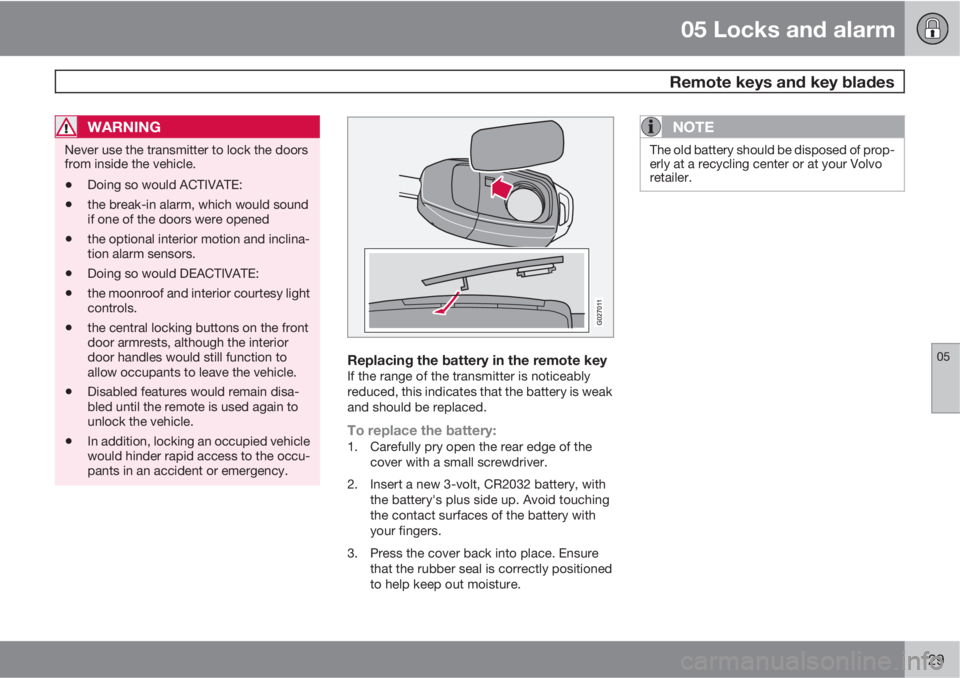
Replacing the battery in the remote keyIf the range of the transmitter is noticeably
reduced, this indicates that the battery is weak
and should be replaced.
To replace the battery:1. Carefully pry open the rear edge of the
cover with a small screwdriver.
2. Insert a new 3-volt, CR2032 battery, with
the battery's plus side up. Avoid touching
the contact surfaces of the battery with
your fingers.
3. Press the cover back into place. Ensure
that the rubber seal is correctly positioned
to help keep out moisture.
NOTE
The old battery should be disposed of prop-
erly at a recycling center or at your Volvo
retailer.
Page 134 of 310
05 Locks and alarm
Child safety locks
05
132* Option/accessory, for more information, see Introduction.
G021513
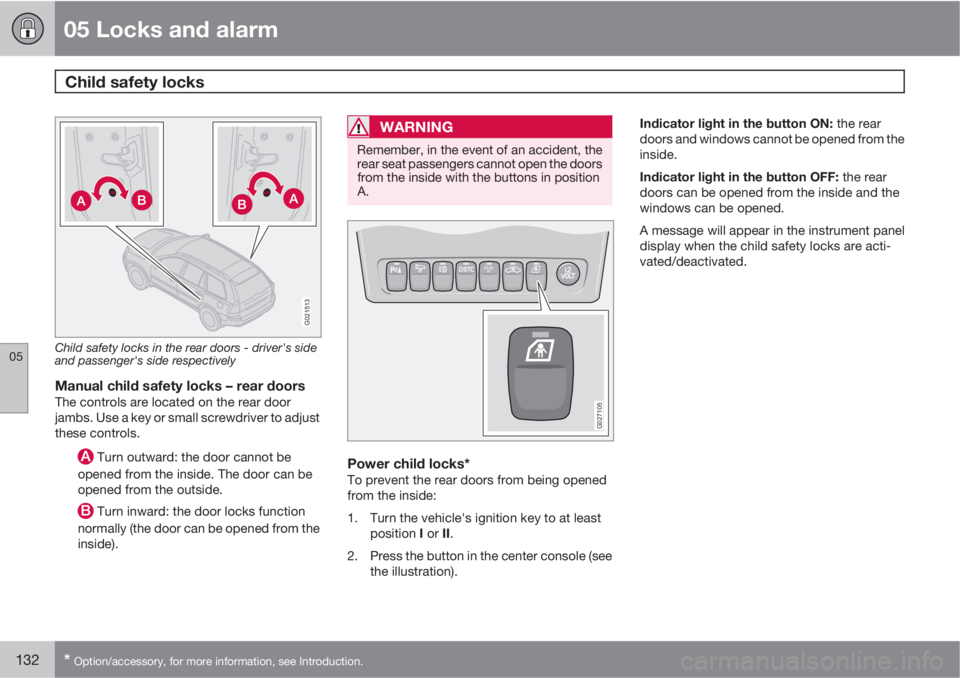
Child safety locks in the rear doors - driver's side
and passenger's side respectively
Manual child safety locks – rear doorsThe controls are located on the rear door
jambs. Use a key or small screwdriver to adjust
these controls.
Turn outward: the door cannot be
opened from the inside. The door can be
opened from the outside.
Turn inward: the door locks function
normally (the door can be opened from the
inside).
WARNING
Remember, in the event of an accident, the
rear seat passengers cannot open the doors
from the inside with the buttons in position
A.
REAR
AC
G027105
Power child locks*To prevent the rear doors from being opened
from the inside:
1. Turn the vehicle's ignition key to at least
position I or II.
2. Press the button in the center console (see
the illustration).Indicator light in the button ON: the rear
doors and windows cannot be opened from the
inside.
Indicator light in the button OFF: the rear
doors can be opened from the inside and the
windows can be opened.
A message will appear in the instrument panel
display when the child safety locks are acti-
vated/deactivated.
Page 135 of 310
05 Locks and alarm
Alarm
05
* Option/accessory, for more information, see Introduction.133
The alarm is automatically armed whenever
you lock your vehicle.
When armed, the alarm continuously monitors
a number of points on the vehicle. The follow-
ing conditions will set off the alarm:
•The hood is forced open.
•The tailgate is forced open.
•A door is forced open.
•The ignition switch is tampered with.
•If there is movement in the passenger com-
partment (if the vehicle is equipped with
the optional movement sensor).
•The vehicle is lifted or towed (if the vehicle
is equipped with the optional inclination
sensor).
•The battery is disconnected (while the
alarm is armed).
•The siren is disconnected when the alarm
is disarmed.
Arming the alarm1.
Press the LOCK button on the remote key.
2. Lock the vehicle using the key blade in the
driver's door or press the central lock but-
ton on the driver's door with the door open.
One long flash of the turn signals will confirm
that the alarm is armed.
Movement sensor*In addition to triggering the alarm if there is
movement in the passenger compartment,
currents of air may also affect the movement
sensor. This means that locking the vehicle
with the windows or the moonroof open, or
using an accessory portable passenger com-
partment heater, could trigger the alarm.
To help avoid this, close the windows and
moonroof before locking the vehicle. If a pas-
senger compartment heater is used when the
vehicle is locked, direct airflow from the heat-
er's vent(s) so that it isn't directed upward in
the passenger compartment.
Disarming the alarmPress the UNLOCK button on the remote key
or unlock the doors with the key blade.
Turning off (stopping) the alarmIf the alarm is sounding, it can be stopped by
pressing the UNLOCK button on the remote
key or by unlocking the driver's door with the
key blade.
Visual alarm signalThe visual alarm signal is given by flashing all
turn signals and turning on the interior lighting
for approximately 5 minutes.
Audible alarm signalAn audible alarm signal is given by a battery
powered siren. One alarm cycle lasts for
25 seconds.
"Panic" buttonIn an emergency situation, this feature can be
used to attract attention.
Activate the "panic" button by pressing the red
button on the remote key ( see page 127 for
illustration) for at least 3 seconds or by press-
ing this button twice within 3 seconds. The turn
signals will flash, and the vehicle's horn will
sound.
The function can be turned off by pressing any
of the buttons on the remote key or will stop
automatically after 25 seconds. When a button
is pressed, there is a 5 second delay before the
panic alarm is deactivated.
NOTE
This button will NOT unlock the vehicle.
LED alarm status signalsThe status of the alarm system is indicated by
the red LED at the top of the dash:
•LED off – the alarm is not armed
•LED flashes once per second – the alarm
is armed
Page 140 of 310
06 Starting and driving
General information
06
138
Engine oil
Although some oil consumption occurs during
normal engine operation, more oil is consumed
when the engine is new as the internal parts
generate higher friction while wearing-in to
each other. From the time the engine is new
until the first maintenance is performed, the oil
consumption could be higher than normal. For
this reason, it is especially important to check
the oil regularly during this period, see
page 220.
Fuel requirements
Deposit control gasoline (detergent
additives)
Volvo recommends the use of detergent gas-
oline to control engine deposits. Detergent
gasoline is effective in keeping injectors and
intake valves clean. Consistent use of deposit
control gasolines will help ensure good driva-
bility and fuel economy. If you are not sure
whether the gasoline contains deposit control
additives, check with the service station oper-
ator.
NOTE
Volvo does not recommend the use of exter-
nal fuel injector cleaning systems.
Unleaded fuelEach Volvo has a three-way catalytic converter
and must use only unleaded gasoline. U.S. and
Canadian regulations require that pumps deliv-
ering unleaded gasoline be labelled "UNLEA-
DED". Only these pumps have nozzles which
fit your vehicle's filler inlet. It is unlawful to dis-
pense leaded fuel into a vehicle labelled
"unleaded gasoline only". Leaded gasoline
damages the three-way catalytic converter and
the heated oxygen sensor system. Repeated
use of leaded gasoline will lessen the effective-
ness of the emission control system and could
result in loss of emission warranty coverage.
State and local vehicle inspection programs
will make detection of misfueling easier, pos-
sibly resulting in emission test failure for mis-
fueled vehicles.
NOTE
Some U.S. and Canadian gasolines contain
an octane enhancing additive called methyl-
cyclopentadienyl manganese tricarbonyl
(MMT). If such fuels are used, your Emission
Control System performance may be affec-
ted, and the Check Engine Light (malfunc-
tion indicator lamp) located on your instru-
ment panel may light. If this occurs, please
return your vehicle to a trained and qualified
Volvo service technician for maintenance.
Gasoline containing alcohol and ethers"Oxygenated fuels"
Some fuel suppliers sell gasoline containing
"oxygenates" which are usually alcohols or
ethers. In some areas, state or local laws
require that the service pump be marked indi-
cating use of alcohols or ethers. However,
there are areas in which the pumps are
unmarked. If you are not sure whether there is
alcohol or ethers in the gasoline you buy, check
with the service station operator. To meet sea-
sonal air quality standards, some areas require
the use of "oxygenated" fuel.
Volvo allows the use of the following "oxygen-
ated" fuels; however, the octane ratings listed
on page 139 must still be met.
Alcohol – Ethanol: Fuels containing up to 10%
ethanol by volume may be used. Ethanol may
also be referred to as Ethyl alcohol, or "Gaso-
hol".
Ethers – MTBE: Fuels containing up to 15%
MTBE may be used.
Page 143 of 310
06 Starting and driving
Refueling
06
141 Fuel filler door
G027073
The fuel filler cap can be placed on the hook on
the fuel filler door while refueling
Press the button on the light switch panel (see
the illustration on page 67) when the vehicle is
at a standstill to unlock the fuel filler door.
Please note that the fuel filler door will remain
unlocked until the vehicle begins to move for-
ward. An audible click will be heard when the
fuel filler door relocks.
If you intend to leave your vehicle while it is
being refueled, this feature enables you to lock
the doors/tailgate while leaving the fuel filler
door unlocked.You can also keep the vehicle locked if you
remain inside it during refueling. The central
locking button does not lock the fuel filler door.
Be sure the fuel filler door is not obstructed and
is completely closed after refueling.
Open the fuel filler cap slowly during hot
weather.
NOTE
During a transitional period, a small number
of service stations may still have fuel noz-
zles that are not compatible with the fuel
filler neck on vehicles equipped with the
evaporative control system.
RefuelingThe fuel tank is designed to accommodate
possible expansion of the fuel in hot weather.
See page 290 for fuel tank volume. Be aware
that the "usable" tank capacity will be some-
what less than the specified maximum. When
the fuel level is low, such factors as ambient
temperature, the fuel's "Reid vapor pressure"
characteristics, and terrain can affect the fuel
pump's ability to supply the engine with an
adequate supply of fuel. Therefore, it is advis-
able to refuel as soon as possible when theneedle nears the red zone, or when the fuel
warning light comes on.
WARNING
Never carry a cell phone that is switched on
while refueling your vehicle. If the phone
rings, this may cause a spark that could
ignite gasoline fumes, resulting in fire and
injury.
Page 144 of 310
06 Starting and driving
Refueling
06
142
CAUTION
•Do not refuel with the engine running1.
Turn the ignition off or to position I. If the
ignition is on, an incorrect reading could
occur in the fuel gauge.
•After refueling, close the fuel filler cap
by turning it clockwise until it clicks into
place
1.
•Avoid overfilling the fuel tank. Do not
press the handle on the filler nozzle
more than one extra time. Too much fuel
in the tank in hot weather conditions can
cause the fuel to overflow. Overfilling
could also cause damage to the emis-
sion control systems.
•Avoid spilling gasoline during refueling.
In addition to causing damage to the
environment, gasolines containing
alcohol can cause damage to painted
surfaces, which may not be covered
under the New Vehicle Limited War-
ranty.
•Do not use gasolines containing meth-
anol (methyl alcohol, wood alcohol).
This practice can result in vehicle per-
formance deterioration and can dam-
age critical parts in the fuel system.
Such damage may not be covered
under the New Vehicle Limited War-
ranty.
1If the fuel filler cap is not closed tightly or if the engine is running when the vehicle is refueled, the Check Engine Light (malfunction indicator lamp) may indicate a fault. However, your vehicle's
performance will not be affected. Use only Volvo original or approved fuel filler caps.
Page 145 of 310
06 Starting and driving
Starting the vehicle
06
143 Starting the engine
WARNING
Before starting, check that the seat, steering
wheel and mirrors are adjusted properly.
Make sure the brake pedal can be
depressed completely. Adjust the seat if
necessary, see page 104.
1. Fasten the seat belt.
2. Apply the parking brake (hand brake) if not
already set. The gear selector is locked in
the P position (SHIFTLOCK).
3. Without touching the accelerator pedal,
turn the ignition key
1 to the starting posi-
tion. Allow the starter to operate for up to
10 seconds. Release the key as soon as
the engine starts
2. If the engine fails to
start, repeat this step.
CAUTION
If the engine does not start after the third try,
wait for approximately 3 minutes before try-
ing to start it again to give the battery time
to recover its starting capacity.
WARNING
•Never use more than one floor mat at a
time on the driver's floor. An extra mat
on the driver's floor can cause the
accelerator and/or brake pedal to
catch. Check that the movement of
these pedals is not impeded.
•Volvo's floor mats are specially manu-
factured for your car. They must be
firmly secured in the clips on the floor so
that they cannot slide and become trap-
ped under the pedals on the driver's
side.
NOTE
•If the key blade section of the remote is
not fully folded out when starting the
vehicle, the immobilizer function may
make it impossible to start the engine.
•After a cold start, idle speed may be
noticeably higher than normal for a
short period. This is done to help bring
components in the emission control
system to their normal operating tem-
perature as quickly as possible, which
enables them to control emissions and
help reduce the vehicle's impact on the
environment.
•To release the gear selector from the P
(Park) position, the engine must be run-
ning (or the ignition key must be in posi-
tion II) and the brake pedal must be
depressed.
•Select the desired gear. The gear
engages after a very slight delay which
is especially noticeable when selecting
R.
1If two of the keys to your vehicle are close together, e.g. on the same key ring when you try to start the vehicle, this could cause interference in the immobilizer system and result in the vehicle not
starting. If this should occur, remove one of the keys from the key ring before trying to start the vehicle again.
2On vehicles equipped with the autostart feature, release the key immediately. See also page 145.
Page 146 of 310
06 Starting and driving
Starting the vehicle
06
144
NOTE
Your vehicle is equipped with a KEYLOCK
system. When the engine is switched off,
the gear selector must be in the P position
before the key can be removed from the
ignition switch.
When starting in cold weather, the trans-
mission may shift up at slightly higher
engine speeds than normal until the auto-
matic transmission fluid reaches normal
operating temperature.
NOTE
Do not race a cold engine immediately after
starting. Oil flow may not reach some lubri-
cation points fast enough to prevent engine
damage.
WARNING
Always place the gear selector in Park and
apply the parking brake before leaving the
vehicle. Never leave the vehicle unattended
with the engine running.
•Always open garage doors fully before
starting the engine inside a garage to
ensure adequate ventilation. The
exhaust gases contain carbon monox-
ide, which is invisible and odorless but
very poisonous.
CAUTION
Automatic transmission
•The engine should be idling when you
move the gear selector. Never acceler-
ate until after you feel the transmission
engage! Accelerating immediately after
selecting a gear will cause harsh
engagement and premature transmis-
sion wear.
•Selecting P or N when idling at a stand-
still for prolonged periods of time will
help prevent overheating of the auto-
matic transmission fluid.