light VOLVO XC90 2013 Owner´s Manual
[x] Cancel search | Manufacturer: VOLVO, Model Year: 2013, Model line: XC90, Model: VOLVO XC90 2013Pages: 310, PDF Size: 8.62 MB
Page 164 of 310
06 Starting and driving
Towing
06
162
CAUTION
Vehicles with AWD (All Wheel Drive) with the
front wheels off the ground should not be
towed at speeds above 50 mph (70 km/h) or
for distances longer than 30 miles (50 km).
CAUTION
•Please check with state and local
authorities before attempting this type
of towing, as vehicles being towed are
subject to regulations regarding maxi-
mum towing speed, length and type of
towing device, lighting, etc.
•If the vehicle's battery is dead, do not
attempt to start the vehicle by pushing
or pulling it as this will damage the
three-way catalytic converter(s). The
engine must be jump started using an
auxiliary battery (see page 151).
•If the vehicle is being towed on a flat bed
truck, the towing eyelets must not be
used to pull the vehicle up onto the flat
bed or to secure the vehicle on the flat
bed. Consult the tow truck operator.
WARNING
•The power brakes and power steering
will not function when the engine is not
running. Approximately 5 times more
pressure will be required on the brake
pedal and the steering wheel will be
considerably harder to turn.
•The towing eyelets must not be used for
pulling the vehicle out of a ditch or for
any similar purpose involving severe
strain. Do not use the towing eyelets to
pull the vehicle up onto a flat bed tow
truck.
G030862
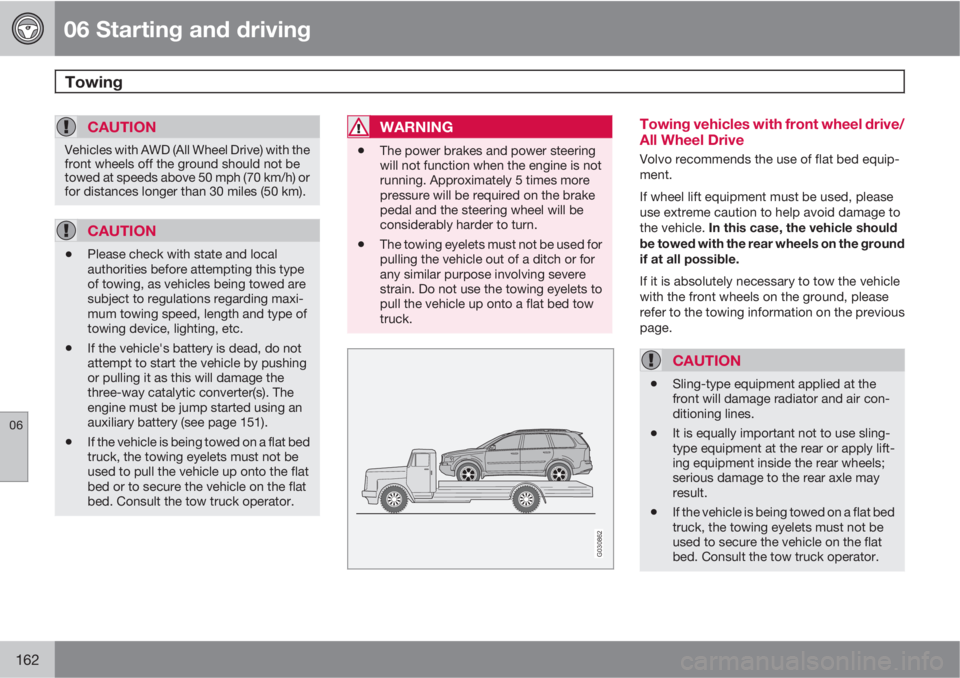
Towing vehicles with front wheel drive/
All Wheel Drive
Volvo recommends the use of flat bed equip-
ment.
If wheel lift equipment must be used, please
use extreme caution to help avoid damage to
the vehicle. In this case, the vehicle should
be towed with the rear wheels on the ground
if at all possible.
If it is absolutely necessary to tow the vehicle
with the front wheels on the ground, please
refer to the towing information on the previous
page.
CAUTION
•Sling-type equipment applied at the
front will damage radiator and air con-
ditioning lines.
•It is equally important not to use sling-
type equipment at the rear or apply lift-
ing equipment inside the rear wheels;
serious damage to the rear axle may
result.
•If the vehicle is being towed on a flat bed
truck, the towing eyelets must not be
used to secure the vehicle on the flat
bed. Consult the tow truck operator.
Page 167 of 310
06 Starting and driving
Towing a trailer
06
165
WARNING
•Bumper-attached trailer hitches must
not be used on Volvos, nor should
safety chains be attached to the
bumper.
•Trailer hitches attaching to the vehicle
rear axle must not be used.
•Never connect a trailer's hydraulic
brake system directly to the vehicle
brake system, nor a trailer's lighting
system directly to the vehicle lighting
system. Consult a trained and qualified
Volvo service technician for correct
installation.
•When towing a trailer, the trailer's safety
wire must be correctly fastened to the
hole or hook provided in the trailer hitch
on the vehicle. The safety wire should
never be fastened to or wound around
the drawbar ball.
LevelingIf your vehicle is equipped with automatic lev-
eling, the rear suspension always retains the
correct ride height regardless of the load.
•The system adjusts the rear suspension to
the correct level after the vehicle has been
driven a short distance.
•When the vehicle is stationary, the rear
suspension lowers, which is normal.
Page 170 of 310
06 Starting and driving
Cold weather precautions
06
168
If you wish to check your vehicle before the
approach of cold weather, the following advice
is worth noting:
•Make sure that the engine coolant contains
50 percent antifreeze. Any other mixture
will reduce freeze protection. This gives
protection against freezing down to –31 °F
(–35 °C). See section "Coolant".
•The use of "recycled" antifreeze is not
approved by Volvo. Different types of
antifreeze must not be mixed.
•Volvo recommends using only genuine
Volvo antifreeze in your vehicle's radiator.
Your Volvo retailer stocks plenty of Volvo
engine coolant to protect your vehicle dur-
ing cold weather.
•Try to keep the fuel tank well filled – this
prevents the formation of condensation in
the tank. In addition, in extremely cold
weather conditions it is worthwhile to add
fuel line de-icer before refueling.
•The viscosity of the engine oil is important.
Oil with low viscosity (thinner oil) improves
cold-weather starting as well as decreas-
ing fuel consumption while the engine is
warming up. 0W-30 oil is recommended for
driving in areas with sustained low temper-
atures.
•The load placed on the battery is greater
during the winter since the windshield wip-
ers, lighting, etc. are used more often.Moreover, the capacity of the battery
decreases as the temperature drops. In
very cold weather, a poorly charged bat-
tery can freeze and be damaged. It is there-
fore advisable to check the state of charge
more frequently and spray an antirust oil on
the battery posts.
•Volvo recommends the use of snow tires
on all four wheels for winter driving – see
section "Wheels and tires."
•To prevent the washer fluid reservoir
from freezing, add washer solvents con-
taining antifreeze (see page 222 for the
location of the washer fluid reservoir). This
is important since dirt is often splashed on
the windshield during winter driving,
requiring the frequent use of the washers
and wipers. Volvo Washer Solvent should
be diluted as follows:
•Down to 14 ° F (–10 ° C): 1 part washer
solvent and 4 parts water
•Down to 5 ° F (–15 ° C): 1 part washer sol-
vent and 3 parts water
•Down to 0 ° F (–18 ° C):1 part washer sol-
vent and 2 parts water
•Down to –18 ° F (–28 ° C): 1 part washer
solvent and 1 part water
•Use Volvo Teflon Lock Spray in the locks.
NOTE
Avoid the use of de-icing sprays as they can
cause damage to the locks.
W – Winter/Wet driving mode – enhanced
vehicle traction
•Mode W will only function if the gear selec-
tor is in the (D)rive position.
•Press the button at the base of the gear
selector to engage/disengage this driving
mode.
•An LED in the button will light up to indicate
that W is engaged and this will also be dis-
played in the instrument panel (see
page 58).
•This mode may be selected for starting/
moving off on slippery roads.
Page 171 of 310

06 Starting and driving
Before a long distance trip
06
169
It is always worthwhile to have your vehicle
checked by a trained and qualified Volvo serv-
ice technician before driving long distances.
Your retailer or service technician will also be
able to supply you with bulbs, fuses, spark
plugs and wiper blades for your use in the event
that problems occur.
As a minimum, the following items should be
checked before any long trip:
•Check that engine runs smoothly and that
fuel consumption is normal.
•Check for fuel, oil, and fluid leakage.
•Check transmission oil level1.
•Check condition of drive belts.
•Check state of the battery's charge.
•Examine tires carefully (the spare tire as
well), and replace those that are worn.
Check tire pressures.
•The brakes, front wheel alignment, and
steering gear should be checked by a
trained and qualified Volvo service techni-
cian only.
•Check all lights, including high beams.
•Reflective warning triangles are legally
required in some states/provinces.
•Have a word with your Volvo retailer if you
intend to drive in countries where it may be
difficult to obtain the correct fuel.
•Consider your destination. If you will be
driving through an area where snow or ice
are likely to occur, consider snow tires.
1To prevent injury from contact with hot surfaces, do not inspect your vehicle’s transmission fluid yourself. Have your vehicle’s transmission fluid level inspected by a qualified Volvo service technician.
Page 172 of 310
06 Starting and driving
Blind Spot Information System*
06
170* Option/accessory, for more information, see Introduction.
G020295
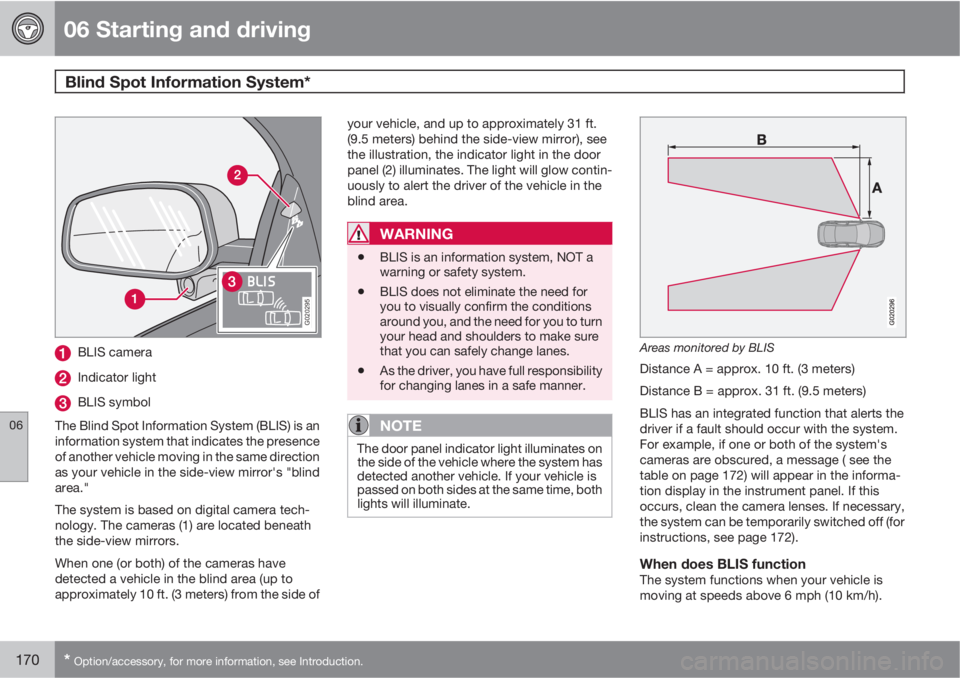
BLIS camera
Indicator light
BLIS symbol
The Blind Spot Information System (BLIS) is an
information system that indicates the presence
of another vehicle moving in the same direction
as your vehicle in the side-view mirror's "blind
area."
The system is based on digital camera tech-
nology. The cameras (1) are located beneath
the side-view mirrors.
When one (or both) of the cameras have
detected a vehicle in the blind area (up to
approximately 10 ft. (3 meters) from the side ofyour vehicle, and up to approximately 31 ft.
(9.5 meters) behind the side-view mirror), see
the illustration, the indicator light in the door
panel (2) illuminates. The light will glow contin-
uously to alert the driver of the vehicle in the
blind area.
WARNING
•BLIS is an information system, NOT a
warning or safety system.
•BLIS does not eliminate the need for
you to visually confirm the conditions
around you, and the need for you to turn
your head and shoulders to make sure
that you can safely change lanes.
•As the driver, you have full responsibility
for changing lanes in a safe manner.
NOTE
The door panel indicator light illuminates on
the side of the vehicle where the system has
detected another vehicle. If your vehicle is
passed on both sides at the same time, both
lights will illuminate.
Areas monitored by BLIS
Distance A = approx. 10 ft. (3 meters)
Distance B = approx. 31 ft. (9.5 meters)
BLIS has an integrated function that alerts the
driver if a fault should occur with the system.
For example, if one or both of the system's
cameras are obscured, a message ( see the
table on page 172) will appear in the informa-
tion display in the instrument panel. If this
occurs, clean the camera lenses. If necessary,
the system can be temporarily switched off (for
instructions, see page 172).
When does BLIS functionThe system functions when your vehicle is
moving at speeds above 6 mph (10 km/h).
Page 173 of 310
06 Starting and driving
Blind Spot Information System*
06
* Option/accessory, for more information, see Introduction.171
When you pass another vehicle:
The system reacts when you pass another
vehicle at a speed of up to 6 mph (10 km/h)
faster than that vehicle.
When you are passed by another vehicle:
The system reacts if your vehicle is passed by
another vehicle at a speed of up to 43 mph
(70 km/h) faster than your vehicle.
WARNING
•BLIS does not function in sharp curves.
•BLIS does not function when your vehi-
cle is backing up.
•If you are towing a wide trailer, this may
prevent the BLIS cameras from detect-
ing other vehicles in adjacent lanes.
How BLIS functions in daylight and
darkness
Daylight
BLIS reacts to the shape of surrounding vehi-
cles. The system is designed to help detect
motor vehicles such as cars, trucks, buses,
motorcycles, etc.
Darkness
BLIS reacts to the headlights of surrounding
vehicles. In order to be detected by BLIS, avehicle in the blind area must have its head-
lights on. This means, for example, that the
system will not detect a trailer without head-
lights that is being towed behind a car or truck.
WARNING
•BLIS does not react to cyclists or
mopeds.
•BLIS does not react to vehicles that are
standing still.
•The BLIS cameras have the same limi-
tation as the human eye. In other words,
their "vision is impaired" by adverse
weather conditions such as heavy
snowfall, intense light directly into the
camera, dense fog, etc.
Cleaning the BLIS camera lensesIn order to function optimally, the BLIS camera
lenses must be kept clean. They can be wiped
clean with a soft cloth or wet sponge.
CAUTION
•Clean the lenses carefully to avoid
scratching.
•The lenses are electrically heated to
help melt ice or snow. If necessary, gen-
tly brush away snow from the lenses.
LimitationsIn certain situations, the BLIS indicator light(s)
may illuminate even when there are no other
vehicles in the area monitored by the system.
NOTE
If the BLIS indicator lights illuminate occa-
sionally even when there are no other vehi-
cles in the blind area, this does not indicate
a fault in the system.
In the event of a fault,
Blind spot syst.
service required will be displayed.
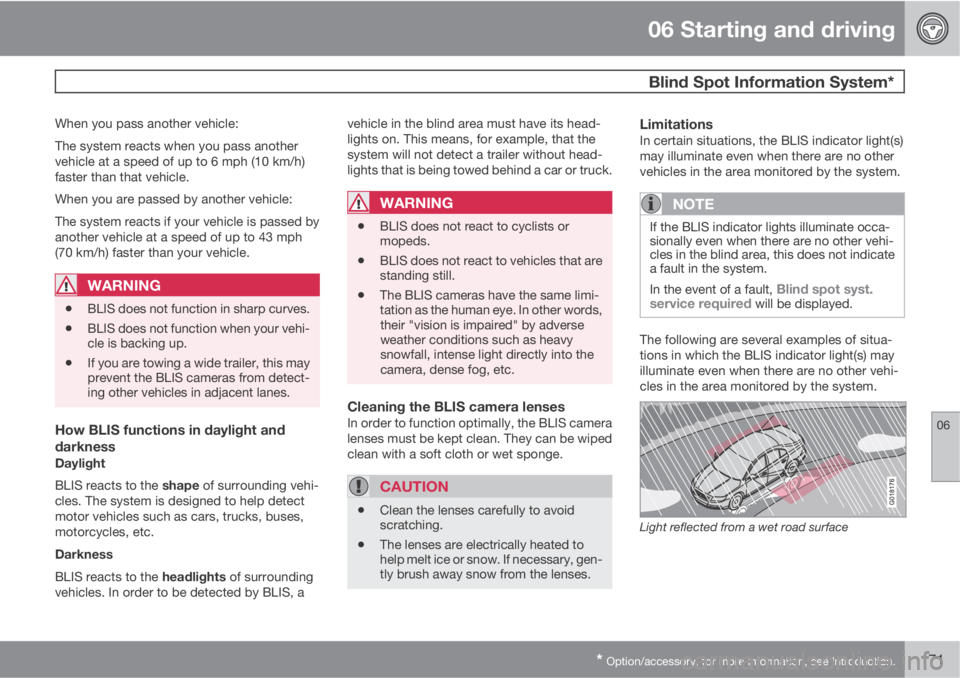
The following are several examples of situa-
tions in which the BLIS indicator light(s) may
illuminate even when there are no other vehi-
cles in the area monitored by the system.
Light reflected from a wet road surface
Page 174 of 310
06 Starting and driving
Blind Spot Information System*
06
172* Option/accessory, for more information, see Introduction.
G018177
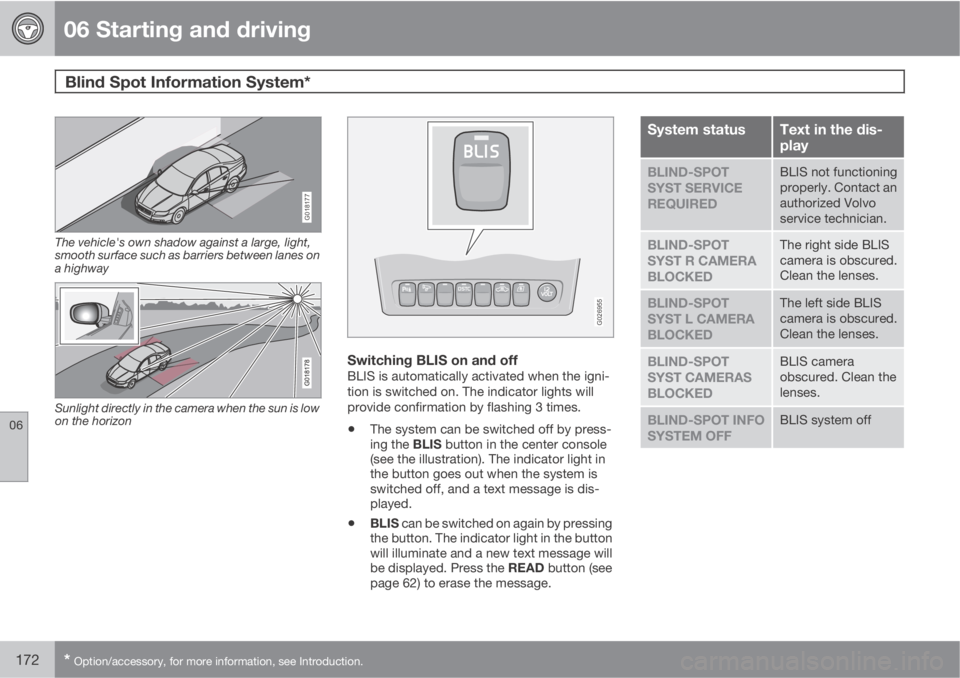
The vehicle's own shadow against a large, light,
smooth surface such as barriers between lanes on
a highway
Sunlight directly in the camera when the sun is low
on the horizon
G026955
Switching BLIS on and offBLIS is automatically activated when the igni-
tion is switched on. The indicator lights will
provide confirmation by flashing 3 times.
•The system can be switched off by press-
ing the BLIS button in the center console
(see the illustration). The indicator light in
the button goes out when the system is
switched off, and a text message is dis-
played.
•BLIS can be switched on again by pressing
the button. The indicator light in the button
will illuminate and a new text message will
be displayed. Press the READ button (see
page 62) to erase the message.
System statusText in the dis-
play
BLIND-SPOT
SYST SERVICE
REQUIREDBLIS not functioning
properly. Contact an
authorized Volvo
service technician.
BLIND-SPOT
SYST R CAMERA
BLOCKEDThe right side BLIS
camera is obscured.
Clean the lenses.
BLIND-SPOT
SYST L CAMERA
BLOCKEDThe left side BLIS
camera is obscured.
Clean the lenses.
BLIND-SPOT
SYST CAMERAS
BLOCKEDBLIS camera
obscured. Clean the
lenses.
BLIND-SPOT INFO
SYSTEM OFFBLIS system off
Page 198 of 310
07 Wheels and tires
Changing wheels
07
196
WARNING
When raising or lowering the spare wheel,
please keep in mind that components in the
exhaust system may be very hot.
To lower the spare wheel:1. Fold down the lower section of the tailgate.
2. Fold up the rear section of the floor in the
cargo compartment.
3. Connect the two sections of the jack's
crank.
4. Insert the hooked end of the crank in the
spare wheel retaining attachment.
5. Lower the spare wheel under the vehicle by
turning the crank counterclockwise until it
is not possible to turn it further.
6. Pivot the toggle at the end of the cable 90
degrees to release it from the spare wheel
CAUTION
When the spare wheel is mounted on the
vehicle, the retaining cable could damage
the underside of the vehicle if it is not retrac-
ted.
7. Crank up the cable again by turning the
crank clockwise.8. Place the wheel with the flat tire in the vehi-
cle's cargo compartment.
NOTE
The space under the vehicle is designed to
hold the special spare wheel only. Other full-
size wheels will not fit in this compartment.
G026996
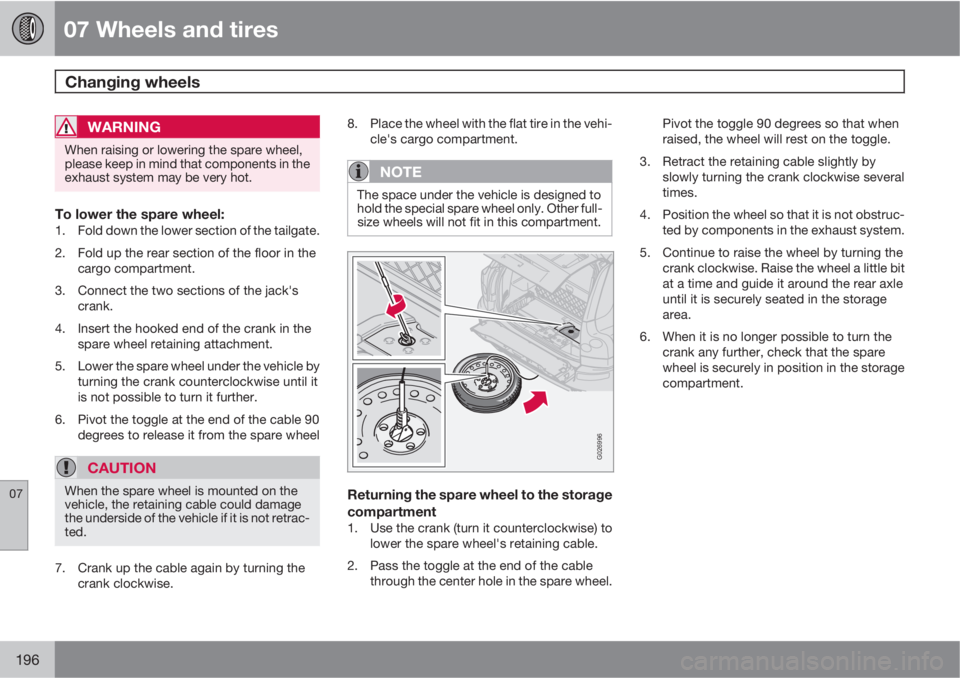
Returning the spare wheel to the storage
compartment
1. Use the crank (turn it counterclockwise) to
lower the spare wheel's retaining cable.
2. Pass the toggle at the end of the cable
through the center hole in the spare wheel.Pivot the toggle 90 degrees so that when
raised, the wheel will rest on the toggle.
3. Retract the retaining cable slightly by
slowly turning the crank clockwise several
times.
4. Position the wheel so that it is not obstruc-
ted by components in the exhaust system.
5. Continue to raise the wheel by turning the
crank clockwise. Raise the wheel a little bit
at a time and guide it around the rear axle
until it is securely seated in the storage
area.
6. When it is no longer possible to turn the
crank any further, check that the spare
wheel is securely in position in the storage
compartment.
Page 202 of 310
07 Wheels and tires
Tire Pressure Monitoring System (TPMS)
07
200
The tire pressure monitoring system1 uses sen-
sors mounted in the tire valves to check infla-
tion pressure levels. When the vehicle is mov-
ing at a speed of approximately 20 mph
(30 km/h) or faster, these sensors transmit
inflation pressure data to a receiver located in
the vehicle.
USA – FCC ID: MRXG403MA4A
This device complies with part 15 of the FCC
rules. Operation is subject to the following
conditions: (1) This device may not cause
harmful interference, and (2) this device
must accept any interference received,
including interference that may cause unde-
sired operation.
When low inflation pressure is detected,
TPMS will light up the tire pressure warning
light (also referred to as a telltale) in the
instrument panel (see page 61), and will dis-
play a message in the text window. The
wording of this message is determined by
the degree of inflation pressure loss.
AOn certain models, the FCC code is MRXTG315AM04
When low inflation pressure is detected, TPMS
will light up the tire pressure warning light
(also referred to as a telltale) in the instrumentpanel and will display one of the following mes-
sages in the text window:
LOW TIRE PRESS.
CHECK TIRES or VERY LOW TIRE
PRESSURE.
NOTE
If a fault occurs in TPMS, the tire pressure
warning light will flash for approximately
1 minute and
TIRE PRESS SYST
SERVICE REQUIRED will be displayed.
Each tire, including the spare (if provided),
should be checked monthly when cold and
inflated to the inflation pressure recommended
by the vehicle manufacturer on the vehicle
placard or tire inflation pressure label. (If your
vehicle has tires of a different size than the size
indicated on the vehicle placard or tire inflation
pressure label, you should determine the
proper tire inflation pressure for those tires.)
As an added safety feature, your vehicle has
been equipped with a tire pressure monitoring
system (TPMS) that illuminates a low tire pres-
sure telltale when one or more of your tires is
significantly under-inflated. Accordingly, when
the low tire pressure telltale illuminates, you
should stop and check your tires as soon as
possible, and inflate them to the proper pres-
sure. Driving on a significantly under-inflatedtire causes the tire to overheat and can lead to
tire failure. Under-inflation also reduces fuel
efficiency and tire tread life, and may affect the
vehicle's handling and stopping ability.
Please note that the TPMS is not a substitute
for proper tire maintenance, and it is the driv-
er's responsibility to maintain correct tire pres-
sure, even if under-inflation has not reached
the level to trigger illumination of the TPMS low
tire pressure telltale.
Your vehicle has also been equipped with a
TPMS malfunction indicator to indicate when
the system is not operating properly. The
TPMS malfunction indicator is combined with
the low tire pressure telltale. When the system
detects a malfunction, the telltale will flash for
approximately one minute and then remain
continuously illuminated. This sequence will
continue upon subsequent vehicle start-ups as
long as the malfunction exists. When the mal-
function indicator is illuminated, the system
may not be able to detect or signal low tire
pressure as intended. TPMS malfunctions may
occur for a variety of reasons, including the
installation of replacement or alternate tires or
wheels on the vehicle that prevent the TPMS
from functioning properly. Always check the
TPMS malfunction telltale after replacing one
or more tires or wheels on your vehicle to
1This system is standard on U.S. models and optional on Canadian models
Page 203 of 310
07 Wheels and tires
Tire Pressure Monitoring System (TPMS)
07
201
ensure that the replacement or alternate tires
and wheels allow the TPMS to continue to
function properly.
NOTE
TPMS indicates low tire pressure but does
not replace normal tire maintenance. For
information on correct tire pressure, please
refer to the tire inflation pressure table in this
chapter or consult your Volvo retailer.
Erasing warning messagesWhen a low tire pressure warning message has
been displayed, and the tire pressure warning
light has come on:
1. Use a tire pressure gauge to check the
inflation pressure of all four tires.
2. Re-inflate the tire(s) to the correct pressure
(consult the tire pressure placard or the
table see page 181).
3. Drive the vehicle for several minutes at a
speed of 20 mph (30 km/h) or faster.
> This will erase the warning text and the
warning light will go out.
WARNING
Incorrect inflation pressure could lead to tire
failure, resulting in a loss of control of the
vehicle.
Changing wheels with TPMSPlease note the following when changing or
replacing the factory installed TPMS wheels/
tires on the vehicle:
•Only the factory-mounted wheels are
equipped with TPMS sensors in the valves.
•If the vehicle is equipped with a temporary
spare tire, this tire does not have a TPMS
sensor.
•If wheels without TPMS sensors are moun-
ted on the vehicle, TIRE PRESS SYST.
SERVICE REQUIRED will be displayed
each time the vehicle is driven above
25 mph (40 km/h) for 10 minutes or more.
•Once TPMS sensors are properly installed,
the warning message should not reappear.
•Volvo recommends that TPMS sensors be
fitted on all wheels used on the vehicle.
Volvo does not recommend moving sen-
sors back and forth between sets of
wheels.
NOTE
If a tire is changed or if the TPMS sensor is
moved to another wheel, the sensor’s valve
and valve core should be replaced.
CAUTION
When inflating tires with TPMS valves, press
the pump's mouthpiece straight onto the
valve to help avoid bending or otherwise
damaging the valve.
Recalibrating TPMS (Canadian models
only)
In certain cases, it may be necessary to reca-
librate TPMS to conform to Volvo's recom-
mended tire inflation pressures (see the infla-
tion pressure table on page 181), for example,
if higher inflation pressure is necessary when
transporting heavy loads, etc.
To recalibrate:
1. Switch off the engine.
2. Inflate the tires to the desired pressure and
turn the ignition key to position I or II (see
page 145 for additional information).
3. Turn the thumb wheel on the left-side
steering wheel lever until
Tire pressure
Calibration appears in the display.
4.
Press and hold the Reset button on the
left-side steering wheel lever until
TIRE
PRESSURE CALIBRATED is displayed.