parking brake VOLVO XC90 2014 Owner´s Manual
[x] Cancel search | Manufacturer: VOLVO, Model Year: 2014, Model line: XC90, Model: VOLVO XC90 2014Pages: 308, PDF Size: 13.31 MB
Page 159 of 308
06 Starting and driving
Parking brake
06
157
G026992
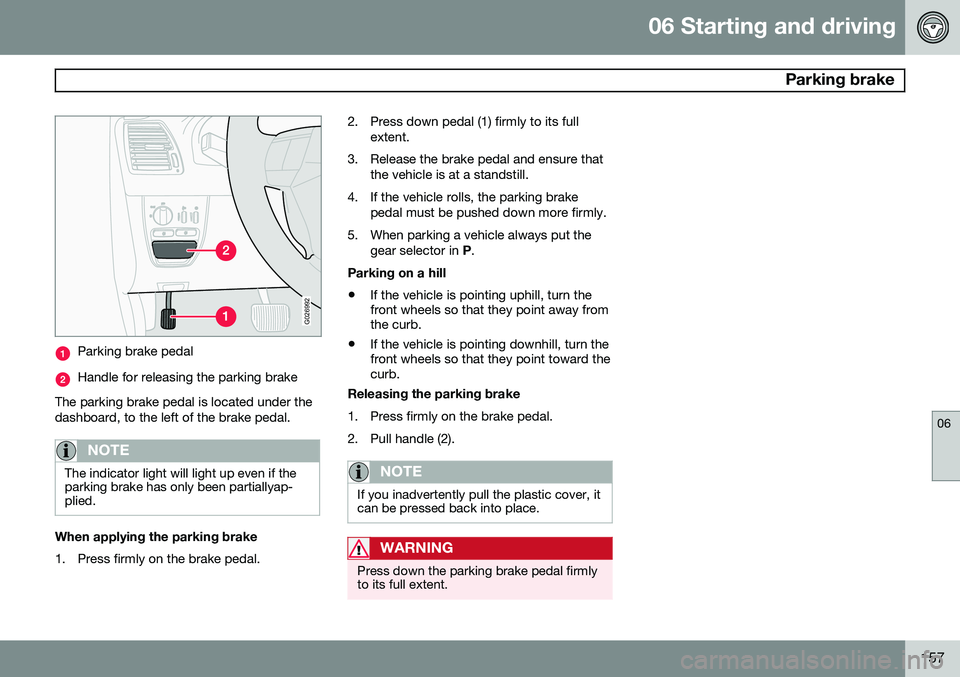
Parking brake pedal
Handle for releasing the parking brake
The parking brake pedal is located under the dashboard, to the left of the brake pedal.
NOTE
The indicator light will light up even if the parking brake has only been partiallyap-plied.
When applying the parking brake
1. Press firmly on the brake pedal. 2. Press down pedal (1) firmly to its full
extent.
3. Release the brake pedal and ensure that the vehicle is at a standstill.
4. If the vehicle rolls, the parking brake pedal must be pushed down more firmly.
5. When parking a vehicle always put the gear selector in P.
Parking on a hill • If the vehicle is pointing uphill, turn the front wheels so that they point away fromthe curb.
• If the vehicle is pointing downhill, turn thefront wheels so that they point toward thecurb.
Releasing the parking brake
1. Press firmly on the brake pedal.
2. Pull handle (2).
NOTE
If you inadvertently pull the plastic cover, it can be pressed back into place.
WARNING
Press down the parking brake pedal firmly to its full extent.
Page 163 of 308
06 Starting and driving
Front/rear park assist*
06
* Option/accessory, for more information, see Introduction.161
NOTE
• Front park assist is disengaged auto- matically when the parking brake isapplied.
• If the vehicle is equipped with frontand rear park assist, both systems willbe deactivated by pressing the button.
Audible signals from the park assist system
The Park Assist system uses an intermittent tone that pulses faster as you come close toan object, and becomes constant when youare within approximately 1 ft (30 cm) of anobject in front of or behind the vehicle. If thevolume of another source from the audio sys-tem is high, this will be automatically lowered. If there are objects within this distance both behind and in front of the vehicle, the signalalternates between front and rear speakers.
Faults in the system
If the yellow warning symbol illu- minates and PARK ASSIST
SERVICE REQUIRED is shown
on the information display, this indicates that the system is not
functioning properly and has been disen-gaged. Consult a trained and qualified Volvoservice technician.
CAUTION
In certain circumstances, the park assist system may give unexpected warning sig-nals that can be caused by external soundsources that use the same ultrasound fre-quencies as the system. This may includesuch things as the horns of other vehicles,wet tires on asphalt, pneumatic brakes,motorcycle exhaust pipes, etc. This doesnot indicate a fault in the system.
Cleaning the sensors
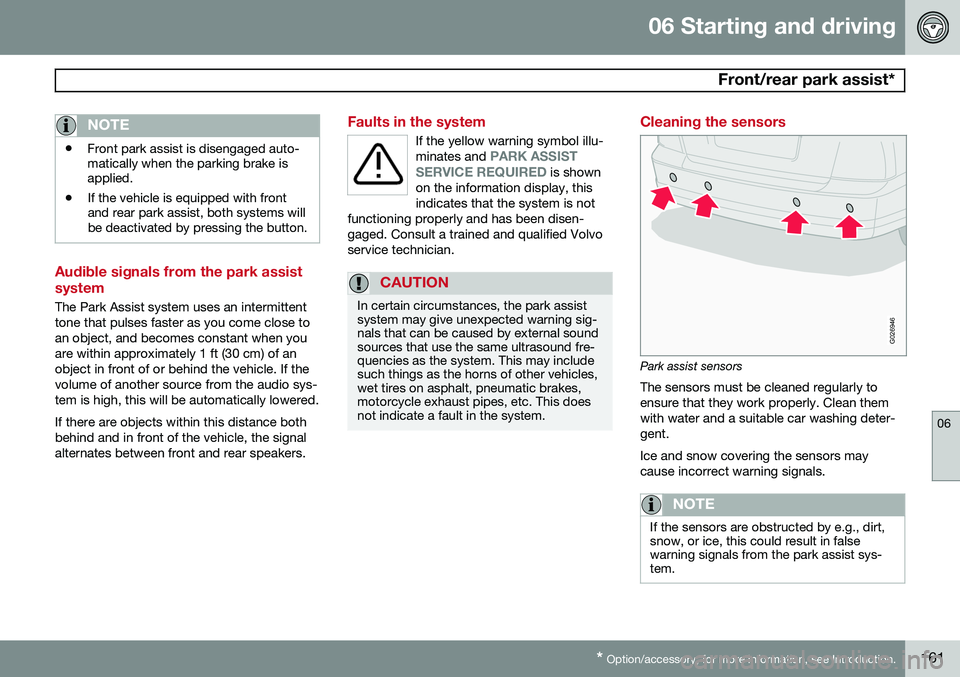
G026946
Park assist sensors The sensors must be cleaned regularly to ensure that they work properly. Clean themwith water and a suitable car washing deter-gent. Ice and snow covering the sensors may cause incorrect warning signals.
NOTE
If the sensors are obstructed by e.g., dirt, snow, or ice, this could result in falsewarning signals from the park assist sys-tem.
Page 167 of 308
06 Starting and driving
Towing a trailer
06
165
Points to keep in mind when towing a trailer
•When towing trailers
without brakes, the
maximum permissible trailer weight is 1,700 lbs (750 kg).
• If necessary, redistribute the weight ofany cargo in the trailer to avoid excessiveweight on the trailer hitch.
• The maximum trailer weight listed in thetable for All Wheel Drive models,5,000 lbs (2250 kg) is only applicablewhen there are not more than two occu-pants in the vehicle, in the front seats,with a combined weight of 300 lbs(135 kg), with no other cargo in the vehi-cle.
• The maximum weight listed for FrontWheel Drive models, 4,000 lbs (1800 kg)is only applicable when there are notmore than four occupants in the vehicle,in the front seats and second row ofseats, with a combined weight of 600 lbs(270 kg), with no other cargo in the vehi-cle.
• Vehicles used for towing a trailer on aregular basis, or for long-distance high-way towing should be equipped with anautomatic transmission oil cooler andVolvo's automatic self-leveling system forthe rear suspension. Consult your Volvoretailer. •
Volvo recommends the use of Volvotrailer hitches that are specially designedfor the vehicle.
• All Volvo models are equipped withenergy-absorbing shock-mounted bump-ers. Trailer hitch installation should notinterfere with the proper operation of thisbumper system.
• Increase tire pressure to recommendedfull inflation pressure. See chapter"Wheels and tires."
• When your vehicle is new, avoid towingheavy trailers during the first 620 miles(1,000 km).
• Engine and transmission are subject toincreased loads. Therefore, engine cool-ant temperature should be closelywatched when driving in hot climates orhilly terrain. Use a lower gear and turn offthe air conditioner if the temperaturegauge needle enters the red range.
• If the automatic transmission begins tooverheat, a message will be displayed inthe text window.
• Hauling a trailer affects handling, durabil-ity, and economy.
• It is necessary to balance trailer brakeswith the towing vehicle brakes to providea safe stop (check and observe state/local regulations). •
Do not connect the trailer's brake systemdirectly to the vehicle's brake system.
• Remove the ball and drawbar assemblywhen the hitch is not being used.
• Volvo recommends the use of syntheticengine oil when towing a trailer over longdistances or in mountainous areas.
NOTE
•When parking the vehicle with a trailer on a hill, apply the parking brakebefore putting the gear selector in
P.
When starting on a hill, put the gearselector in D before releasing the park-
ing brake. Always follow the trailermanufacturer's recommendations forwheel chocking.
• If you use the manual (Geartronic) shiftpositions while towing a trailer, makesure the gear you select does not puttoo much strain on the engine (usingtoo high a gear).
Page 196 of 308
07 Wheels and tires
Tire Sealing System
07
194
WARNING
•Never leave the tire sealing system unattended when it is operating.
• Keep the tire sealing system awayfrom children.
• Be sure the vehicle is parked safely offthe road and away from moving traffic.
• Apply the parking brake.
Stage 1: Sealing the hole1. Peel off the speed limit sticker and affix it
to the steering wheel hub where it will be clearly visible to the driver.
2. Ensure that the on/off switch is in position 0 (the 0 side of the switch should be
pressed down).
3. Put on the gloves included in the tire sealing system.
WARNING
Contact with the sealing compound may cause skin irritation. If contact occurs,wash the affected area immediately withsoap and water.
4. Unscrew the orange cover over the bottleholder and unscrew the cap on the bottle of sealing compound.
NOTE
Do not break the seal on the bottle. This occurs automatically when the bottle isscrewed into the holder.
5. Screw the bottle into the bottle holder.
WARNING
The bottle is equipped with a catch to keep it securely in place and help preventsealing compound leakage. Once in place,the bottle cannot be unscrewed. This mustbe done by a trained and qualified Volvoservice technician.
6. Remove the valve cap from the tire’sinflation valve and screw the tire sealing system’s hose connector onto the valveas tightly as possible by hand.
7. Connect the electrical wire to the nearest 12-volt socket in the vehicle.
NOTE
Be sure that none of the other 12-volt sockets is being used while the compres-sor is in operation.
8. Start the vehicle’s engine.
9. Start the tire sealing system’s compres- sor by pressing the on/off switch to posi- tion I.
WARNING
• Never stand next to the tire being infla- ted when the compressor is in opera-tion.
• If cracks, bubbles, etc. form on the tire,switch off the compressor immediately.
• If there is visible damage to the sidewallor the rim, the tire cannot be repaired.The vehicle should not be driven if thisoccurs. Contact a towing service orVolvo On Call Roadside Assistance ifapplicable.
Page 198 of 308
07 Wheels and tires
Tire Sealing System
07
196
system’s compressor. If necessary, release air from the tire by turning the airrelease knob counterclockwise.
CAUTION
The compressor should not be used for more than 10 minutes at a time to avoidoverheating.
WARNING
If you interrupt your trip for more than 1 hour, check the inflation pressure in thedamaged tire again before continuing.
Replacing the sealing compound container
The sealing compound container must be replaced if:• the tire sealing system has been used to repair a tire
• the container’s expiration date haspassed (see the date on decal).
NOTE
• After use, the sealing compound bot- tle, the hose, and certain other systemcomponents must be replaced. Pleaseconsult your Volvo retailer for replace-ment parts.
• If the sealing compound bottle’s expi-ration date has passed, please take itto a Volvo retailer or a recycling stationthat can properly dispose of harmfulsubstances.
Inflating tires
The tire sealing system can be used to inflate the tires. To do so:
1. Park the car in a safe place.
2. The compressor should be switched off.
Ensure that the on/off switch is in position 0 (the 0 side of the switch should be
pressed down).
3. Take out the electrical wire and hose.
4. Remove the valve cap from the tire’s inflation valve and screw the hose con- nector onto the valve as tightly as possi-ble by hand.
5. Connect the electrical wire to the nearest 12-volt socket in the vehicle. 6. Start the vehicle’s engine.
WARNING
•
The vehicle’s engine should be running when the tire sealing system is used toavoid battery drain. Therefore, be surethe vehicle is parked in a well ventilatedplace, or outdoors, before using thesystem. The parking brake should besecurely applied and the gear selectorshould be in the
P (park) position.
• Children should never be left unatten-ded in the vehicle when the engine isrunning.
7. Check the tire’s inflation pressure on the
gauge. Switch off the compressor briefly to get a clear reading from the pressuregauge.
8. Refer to the tire inflation tables for the correct inflation pressure. If the tire needsto be inflated, start the tire sealing sys-tem’s compressor (press the on/offswitch to position I). If necessary, releaseair from the tire by turning the air releaseknob counterclockwise.
Page 202 of 308
07 Wheels and tires
Changing wheels
07
200
G026997
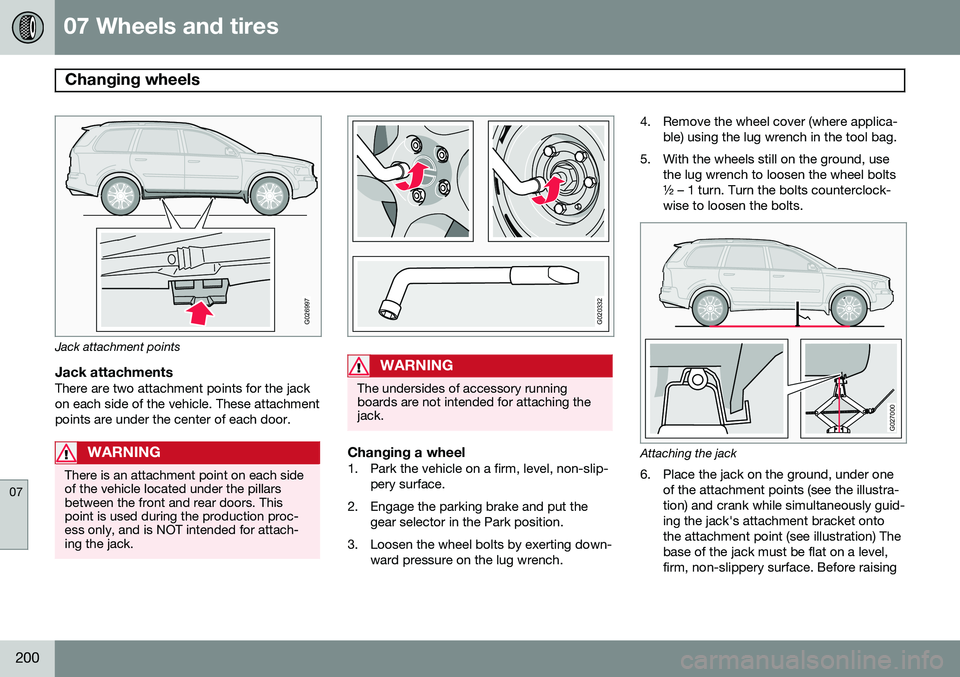
Jack attachment points
Jack attachmentsThere are two attachment points for the jack on each side of the vehicle. These attachmentpoints are under the center of each door.
WARNING
There is an attachment point on each side of the vehicle located under the pillarsbetween the front and rear doors. Thispoint is used during the production proc-ess only, and is NOT intended for attach-ing the jack.
G020332
WARNING
The undersides of accessory running boards are not intended for attaching thejack.
Changing a wheel1. Park the vehicle on a firm, level, non-slip-pery surface.
2. Engage the parking brake and put the gear selector in the Park position.
3. Loosen the wheel bolts by exerting down- ward pressure on the lug wrench. 4. Remove the wheel cover (where applica-
ble) using the lug wrench in the tool bag.
5. With the wheels still on the ground, use the lug wrench to loosen the wheel bolts ½ – 1 turn. Turn the bolts counterclock-wise to loosen the bolts.
G027000
Attaching the jack
6. Place the jack on the ground, under oneof the attachment points (see the illustra- tion) and crank while simultaneously guid-ing the jack's attachment bracket ontothe attachment point (see illustration) Thebase of the jack must be flat on a level,firm, non-slippery surface. Before raising
Page 203 of 308
07 Wheels and tires
Changing wheels
07
201
the vehicle, check that the jack is still cor- rectly positioned in the attachment.
7. Raise the vehicle until the wheel to be changed is lifted off the ground.
8. Unscrew the wheel bolts completely and carefully remove the wheel so as not todamage the threads on the studs.
NOTE
To avoid excessive wear and the necessity of rebalancing, mark and reinstall wheelsin the same location and position as beforeremoval. To lessen the chance of imbal-ance, each wheel hub is equipped with aguide stud to ensure that a removed wheelcan be reinstalled in its original position (aswhen changing over to winter tires/wheels).
CAUTION
•The vehicle must not be driven with wheels of different dimensions or witha spare tire other than the one thatcame with the vehicle. The use of dif-ferent size wheels can seriously dam-age your vehicle's transmission.
• Correct tightening torque on wheelbolts must be observed.
• The wheel bolts should never begreased or lubricated.
• Extended, chromed wheel bolts mustnot be used with steel rims, as theymake it impossible to fit the hub caps.
Installing the wheel1. Clean the contact surfaces on the wheel
and hub.
2. Lift the wheel and place it on the hub.
3. Install the wheel bolts and tighten hand- tight. Using the lug wrench, tighten cross- wise until all bolts are snug.
4. Lower the vehicle to the ground and alter- nately tighten the bolts crosswise to103 ft.lbs. (140 Nm).
5. Install the wheel cover (where applicable).
WARNING
• The jack must correctly engage the bar in the jack attachment. The vehicle'sweight must not rest on the jackattachment. See illustration "Attachingthe jack" on the previous page.
• Be sure the jack is on a firm, level,non-slippery surface.
• Never allow any part of your body tobe extended under a vehicle suppor-ted by a jack.
• Use the jack intended for the vehiclewhen replacing a wheel. For any otherjob, use stands to support the side ofthe vehicle being worked on.
• Apply the parking brake and put thegear selector in the (
P)ark position.
• Block the wheels standing on theground, use rigid wooden blocks orlarge stones.
• The jack should be kept well-greasedand clean, and should not be dam-aged.
• No objects should be placed betweenthe base of jack and the ground, orbetween the jack and the attachmentbar on the vehicle.
Page 232 of 308
09 Maintenance and servicing
Replacing bulbs 09
230* Option/accessory, for more information, see Introduction.
When replacing bulbs, keep the following points in mind:
• Never touch the glass of bulbs with your fingers. Grease and oils from your fingersvaporize in the heat and will leave adeposit on the reflector, which will dam-age it.
• The optional Active Bending Light bulbscontain trace amounts of mercury. Thesebulbs should always be disposed of by anauthorized Volvo retailer.
The following bulbs should only be replaced by a trained and qualified Volvo service tech-nician:
• Active Bending Lights (ABL)
• Daytime running lights (DRL) under the front bumper
• Turn signals and courtesy lights in theside door mirrors
• Reading lights and glove compartmentlight
• Courtesy (dome) lighting
• Rear parking lights
• Brake lights
• High-mounted brake lights
If a problem occurs with the daytime running lights (DRL) under the front bumper, the entirelamp housing will have to be replaced. If a problem occurs with the rear parkinglights or the brake lights, the entire taillighthousing will have to be replaced. See page 236 for a list of bulb specifications.
Replacing high/low beams/turn signal/parking light bulbs
WARNING
•
The engine should not be running when changing bulbs.
• If the engine has been running justprior to replacing bulbs in the head-light housing, please keep in mind thatcomponents in the engine compart-ment will be hot.
WARNING
Active Bending Lights* - due to the high voltage used by these headlights, thesebulbs should only be replaced by a trainedand qualified Volvo service technician.
G027081
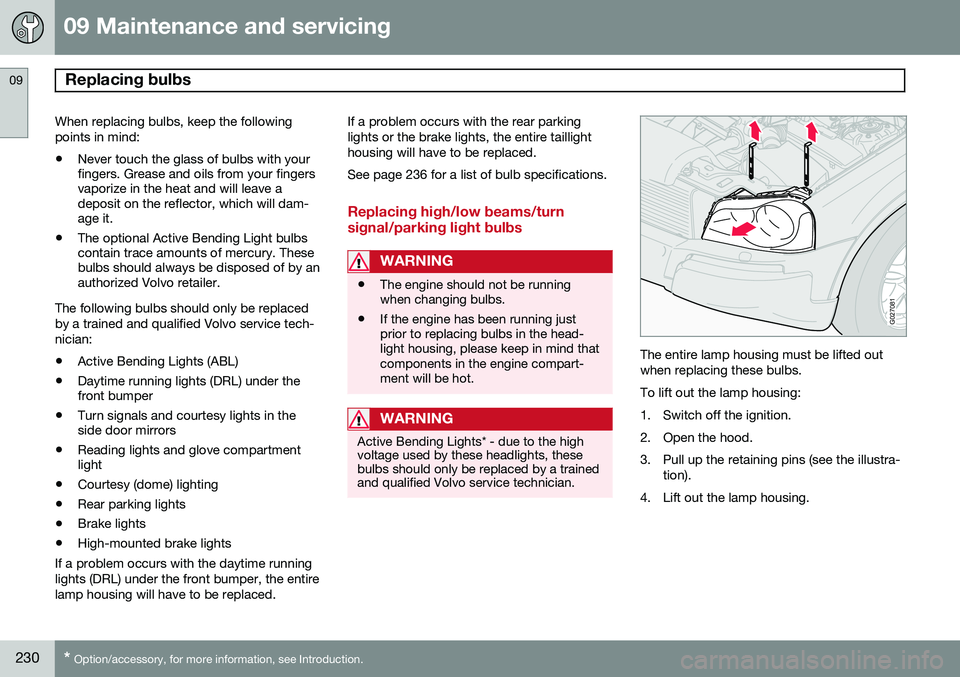
The entire lamp housing must be lifted out when replacing these bulbs. To lift out the lamp housing:
1. Switch off the ignition.
2. Open the hood.
3. Pull up the retaining pins (see the illustra-
tion).
4. Lift out the lamp housing.
Page 248 of 308
09 Maintenance and servicing
Fuses 09
246* Option/accessory, for more information, see Introduction.
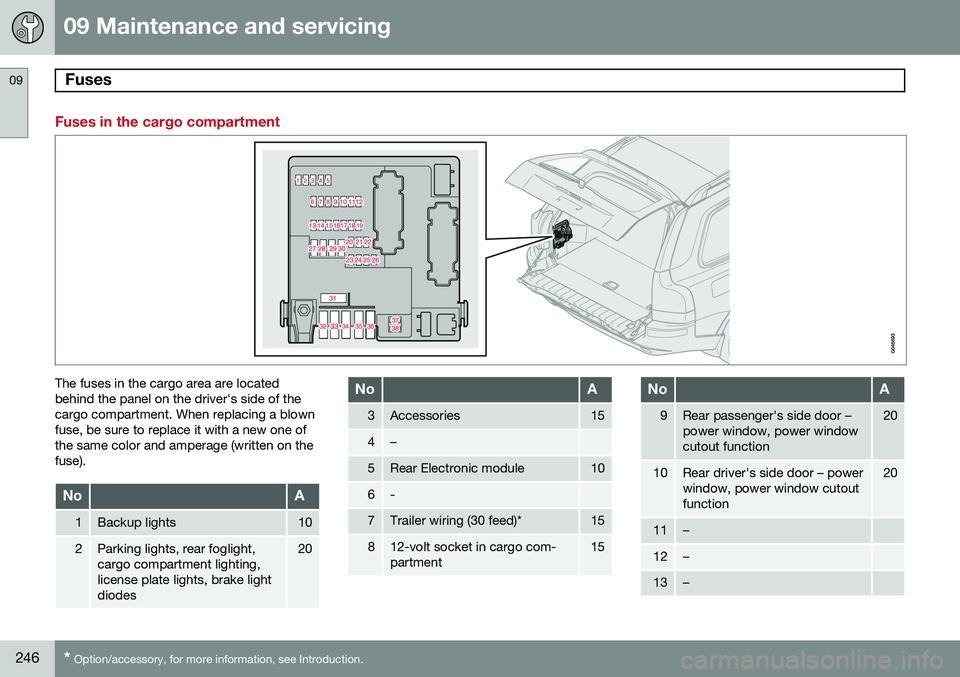
Fuses in the cargo compartment
The fuses in the cargo area are located behind the panel on the driver's side of thecargo compartment. When replacing a blownfuse, be sure to replace it with a new one ofthe same color and amperage (written on thefuse).
NoA
1Backup lights10
2Parking lights, rear foglight, cargo compartment lighting,license plate lights, brake lightdiodes20
NoA
3Accessories15
4–
5Rear Electronic module10
6-
7Trailer wiring (30 feed)*15
812-volt socket in cargo com- partment15
NoA
9Rear passenger's side door – power window, power windowcutout function20
10Rear driver's side door – power window, power window cutoutfunction20
11–
12–
13–
Page 249 of 308
09 Maintenance and servicing
Fuses09
}}
* Option/accessory, for more information, see Introduction.247
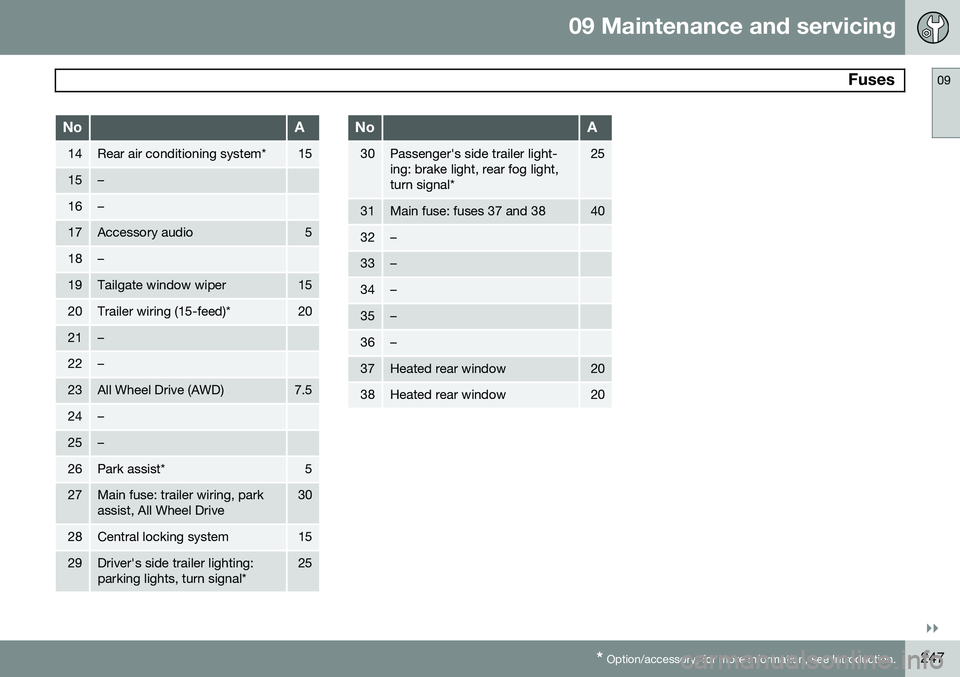
NoA
14Rear air conditioning system*15
15–
16–
17Accessory audio5
18–
19Tailgate window wiper15
20Trailer wiring (15-feed)*20
21–
22–
23All Wheel Drive (AWD)7.5
24–
25–
26Park assist*5
27Main fuse: trailer wiring, park assist, All Wheel Drive30
28Central locking system15
29Driver's side trailer lighting: parking lights, turn signal*25
NoA
30Passenger's side trailer light- ing: brake light, rear fog light,turn signal*25
31Main fuse: fuses 37 and 3840
32–
33–
34–
35–
36–
37Heated rear window20
38Heated rear window20