service VOLVO XC90 2014 Owner´s Manual
[x] Cancel search | Manufacturer: VOLVO, Model Year: 2014, Model line: XC90, Model: VOLVO XC90 2014Pages: 308, PDF Size: 13.31 MB
Page 29 of 308
01 Safety
Front airbags01
27
WARNING
•No objects or accessory equipment, e.g. dashboard covers, may be placedon, attached to, or installed near theair bag hatch (the area above the glovecompartment) or the area affected byairbag deployment.
• There should be no loose articles, e.g.coffee cups, on the floor, seat, ordashboard area.
• Never try to open the airbag cover onthe steering wheel or the passenger'sside dashboard. This should only bedone by a trained and qualified Volvoservice technician.
Failure to follow these instructions can result in injury to the vehicle occupants.
Page 30 of 308
01 Safety
Occupant Weight Sensor 01
28
Disabling the passenger's side front airbag
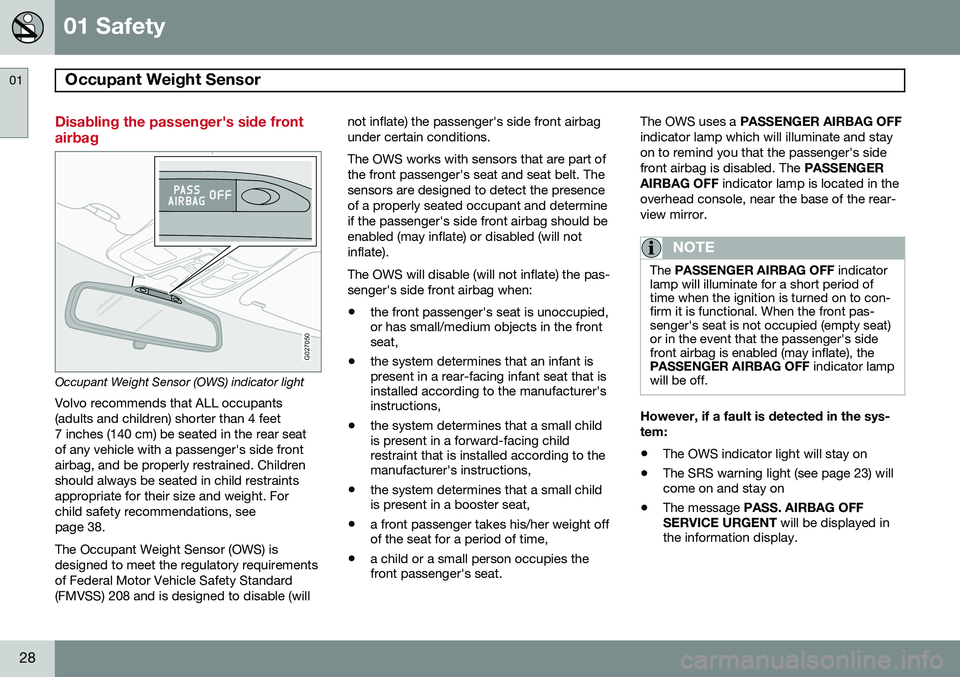
G027050
Occupant Weight Sensor (OWS) indicator light
Volvo recommends that ALL occupants (adults and children) shorter than 4 feet7 inches (140 cm) be seated in the rear seatof any vehicle with a passenger's side frontairbag, and be properly restrained. Childrenshould always be seated in child restraintsappropriate for their size and weight. Forchild safety recommendations, seepage 38. The Occupant Weight Sensor (OWS) is designed to meet the regulatory requirementsof Federal Motor Vehicle Safety Standard(FMVSS) 208 and is designed to disable (will not inflate) the passenger's side front airbagunder certain conditions. The OWS works with sensors that are part of the front passenger's seat and seat belt. Thesensors are designed to detect the presenceof a properly seated occupant and determineif the passenger's side front airbag should beenabled (may inflate) or disabled (will notinflate). The OWS will disable (will not inflate) the pas- senger's side front airbag when:
• the front passenger's seat is unoccupied, or has small/medium objects in the frontseat,
• the system determines that an infant ispresent in a rear-facing infant seat that isinstalled according to the manufacturer'sinstructions,
• the system determines that a small childis present in a forward-facing childrestraint that is installed according to themanufacturer's instructions,
• the system determines that a small childis present in a booster seat,
• a front passenger takes his/her weight offof the seat for a period of time,
• a child or a small person occupies thefront passenger's seat. The OWS uses a
PASSENGER AIRBAG OFF
indicator lamp which will illuminate and stay on to remind you that the passenger's sidefront airbag is disabled. The PASSENGER
AIRBAG OFF indicator lamp is located in the
overhead console, near the base of the rear-view mirror.
NOTE
The PASSENGER AIRBAG OFF indicator
lamp will illuminate for a short period of time when the ignition is turned on to con-firm it is functional. When the front pas-senger's seat is not occupied (empty seat)or in the event that the passenger's sidefront airbag is enabled (may inflate), thePASSENGER AIRBAG OFF indicator lamp
will be off.
However, if a fault is detected in the sys- tem: • The OWS indicator light will stay on
• The SRS warning light (see page 23) will come on and stay on
• The message
PASS. AIRBAG OFF
SERVICE URGENT will be displayed in
the information display.
Page 31 of 308
01 Safety
Occupant Weight Sensor01
29
WARNING
•If a fault in the system is detected and indicated as explained, be aware thatthe passenger's side front airbag willnot deploy in the event of a collision.
• In this case, the safety systems andOccupant Weight Sensor should beinspected by a trained and qualifiedVolvo service technician as soon aspossible.
WARNING
•Never try to open, remove, or repair any components in the OWS system.This could result in system malfunc-tion. Maintenance or repairs shouldonly be carried out by a trained andqualified Volvo service technician.
• The front passenger's seat should notbe modified in any way. This couldreduce pressure on the seat cushion,which might interfere with the OWSsystem's function.
The OWS is designed to disable (will not inflate) the passenger's side front airbagwhen a rear facing infant seat, a forward-fac-ing child restraint, or a booster seat isdetected. The
PASSENGER AIRBAG OFF indicator lamp will illuminate and stay on toremind you that the passenger's side frontairbag is disabled (see the following table).
Passeng- er's seatoccu-pancystatusOWS indicatorlight sta-tusPasseng- er's sidefront air-bag status
Seat unoc- cupiedOWS indi- cator light
is not
lit
Passenger's side front air-bag disabled
Seat occu- pied by lowweightoccupant/ object AOWS indi- cator light
lights
up
Passenger's side front air-bag disabled
Seat occu- pied byheavy occu-pant/objectOWS indi- cator light
is not
lit
Passenger's side front air-bag enabled
A
Volvo recommends that children always be properly restrained in appropriate child restraints in the rear seats.Inrare situations when the seat belt is not properly fastened,some child restraints may not be detected by the OWSbecause there is very little weight on the vehicle seat cush-ion. In these cases the passenger's side front airbag maybe disabled, but the PASSENGER AIRBAG OFF indicator
lamp will not be lit. Do not assume that the passenger'sside front airbag is disabled unless the PASSENGERAIRBAG OFF
indicator lamp is lit. Make sure the child
restraint is properly installed (turn the vehicle off, removethe child restraint from the vehicle and reinstall the restraintfollowing the child restraint manufacturer's instructions)and that the PASSENGER AIRBAG OFF indicator lamp is
on, or move the child restraint to the rear seat.
The OWS is designed to enable (may inflate) the passenger's side front airbag in the eventof a collision anytime the system senses thata person of adult size is sitting properly in thefront passenger's seat. The PASSENGER
AIRBAG OFF indicator lamp will be off and
remain off. If a person of adult size is sitting in the front passenger's seat, but the PASSENGER
AIRBAG OFF indicator lamp is on, it is possi-
ble that the person isn't sitting properly in theseat. If this happens:
1. Turn the vehicle off and ask the person to place the seat back in an upright position.
2. Have the person sit upright in the seat, centered on the seat cushion, with the person's legs comfortably extended.
3. Restart the vehicle and have the person remain in this position for about twominutes. This will allow the system todetect that person and enable the pas-senger's frontal airbag.
4. If the PASSENGER AIRBAG OFF indica-
tor lamp remains on even after this, the
Page 32 of 308
01 Safety
Occupant Weight Sensor 01
30
person should be advised to ride in the rear seat.
This condition reflects limitations of the OWSclassification capability. It does not indicateOWS malfunction.
ModificationsIf you are considering modifying your vehiclein any way to accommodate a disability, forexample by altering or adapting the driver'sor front passenger's seat(s) and/or airbagsystems, please contact Volvo at: In the USA Volvo Cars of North America, LLC Customer Care Center1 Volvo DriveP.O. Box 914 Rockleigh,New Jersey 076471-800-458-1552 In Canada Volvo Cars of Canada Corp. National Customer Service9130 Leslie Street, Suite 101Richmond Hill, Ontario L4B 0B91-800-663-8255
WARNING
• No objects that add to the total weight on the seat should be placed on thefront passenger's seat. If a child isseated in the front passenger's seatwith any additional weight, this extraweight could cause the OWS systemto enable the airbag, which mightcause it to deploy in the event of a col-lision, thereby injuring the child.
• The seat belt should never be wrappedaround an object on the front pas-senger's seat. This could interfere withthe OWS system's function.
• The front passenger's seat belt shouldnever be used in a way that exertsmore pressure on the passenger thannormal. This could increase the pres-sure exerted on the weight sensor by achild, and could result in the airbagbeing enabled, which might cause it todeploy in the event of a collision,thereby injuring the child.
WARNING
Keep the following points in mind with respect to the OWS system. Failure to fol-low these instructions could adverselyaffect the system's function and result inserious injury to the occupant of the frontpassenger's seat:
• The full weight of the front seat pas- senger should always be on the seatcushion. The passenger should neverlift him/herself off the seat cushionusing the armrest in the door or thecenter console, by pressing the feet onthe floor, by sitting on the edge of theseat cushion, or by pressing againstthe backrest in a way that reducespressure on the seat cushion. Thiscould cause OWS to disable the frontpassenger's side airbag.
• Do not place any type of object on thefront passenger's seat in such a waythat jamming, pressing, or squeezingoccurs between the object and thefront seat, other than as a direct resultof the correct use of the AutomaticLocking Retractor/Emergency LockingRetractor (ALR/ELR) seat belt (seepage 39).
• No objects should be placed under thefront passenger's seat. This could
Page 35 of 308
01 Safety
Side impact protection airbags01
33
WARNING
•The SIPS airbag system is a supple- ment to the structural Side ImpactProtection System and the three-pointseat belt system. It is not designed todeploy during collisions from the frontor rear of the vehicle or in rollover sit-uations.
• The use of seat covers on the frontseats may impede SIPS airbag deploy-ment.
• No objects, accessory equipment orstickers may be placed on, attached toor installed near the SIPS airbag sys-tem or in the area affected by SIPS air-bag deployment.
• Never try to open or repair any compo-nents of the SIPS airbag system. Thisshould be done only by a trained andqualified Volvo service technician.
• In order for the SIPS airbag to provideits best protection, both front seatoccupants should sit in an uprightposition with the seat belt properly fas-tened.
• Failure to follow these instructions canresult in injury to the occupants of thevehicle in the event of an accident.
Page 36 of 308
01 Safety
Inflatable Curtain 01
34
The Inflatable Curtain (IC)
G027047
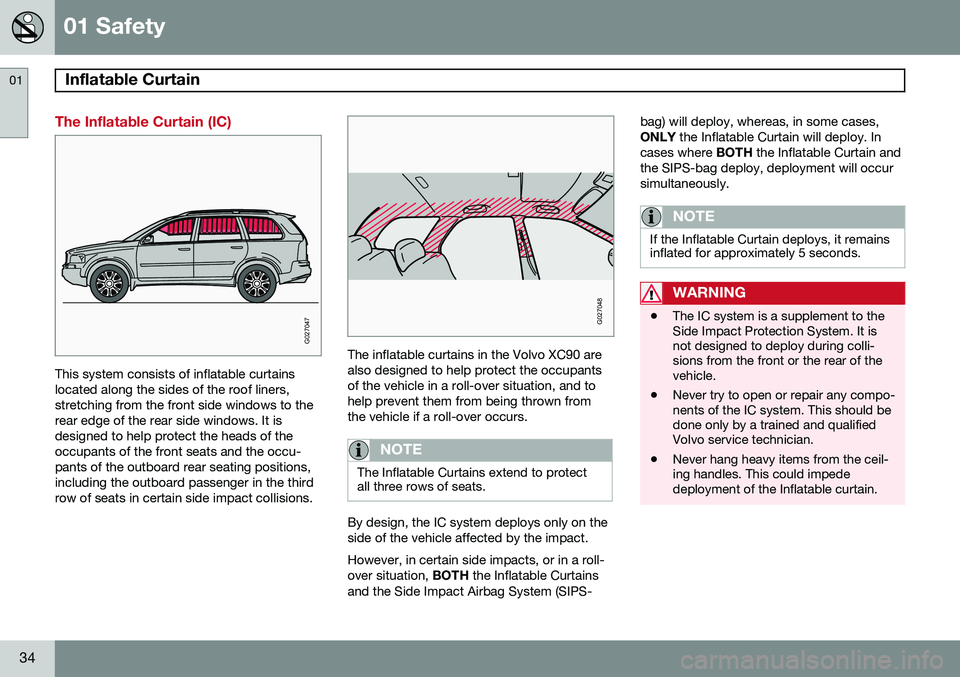
This system consists of inflatable curtains located along the sides of the roof liners,stretching from the front side windows to therear edge of the rear side windows. It isdesigned to help protect the heads of theoccupants of the front seats and the occu-pants of the outboard rear seating positions,including the outboard passenger in the thirdrow of seats in certain side impact collisions.
G027048
The inflatable curtains in the Volvo XC90 are also designed to help protect the occupantsof the vehicle in a roll-over situation, and tohelp prevent them from being thrown fromthe vehicle if a roll-over occurs.
NOTE
The Inflatable Curtains extend to protect all three rows of seats.
By design, the IC system deploys only on the side of the vehicle affected by the impact. However, in certain side impacts, or in a roll- over situation, BOTH the Inflatable Curtains
and the Side Impact Airbag System (SIPS- bag) will deploy, whereas, in some cases,ONLY
the Inflatable Curtain will deploy. In
cases where BOTH the Inflatable Curtain and
the SIPS-bag deploy, deployment will occursimultaneously.
NOTE
If the Inflatable Curtain deploys, it remains inflated for approximately 5 seconds.
WARNING
• The IC system is a supplement to the Side Impact Protection System. It isnot designed to deploy during colli-sions from the front or the rear of thevehicle.
• Never try to open or repair any compo-nents of the IC system. This should bedone only by a trained and qualifiedVolvo service technician.
• Never hang heavy items from the ceil-ing handles. This could impededeployment of the Inflatable curtain.
Page 39 of 308
01 Safety
Whiplash Protection System01
37
WARNING
•If your vehicle has been involved in a rear-end collision, the front seat back-rests must be inspected by a trainedand qualified Volvo service technician,even if the seats appear to be undam-aged. Certain components in theWHIPS system may need to bereplaced.
• Do not attempt to service any compo-nent in the WHIPS system yourself.
G020125
WARNING
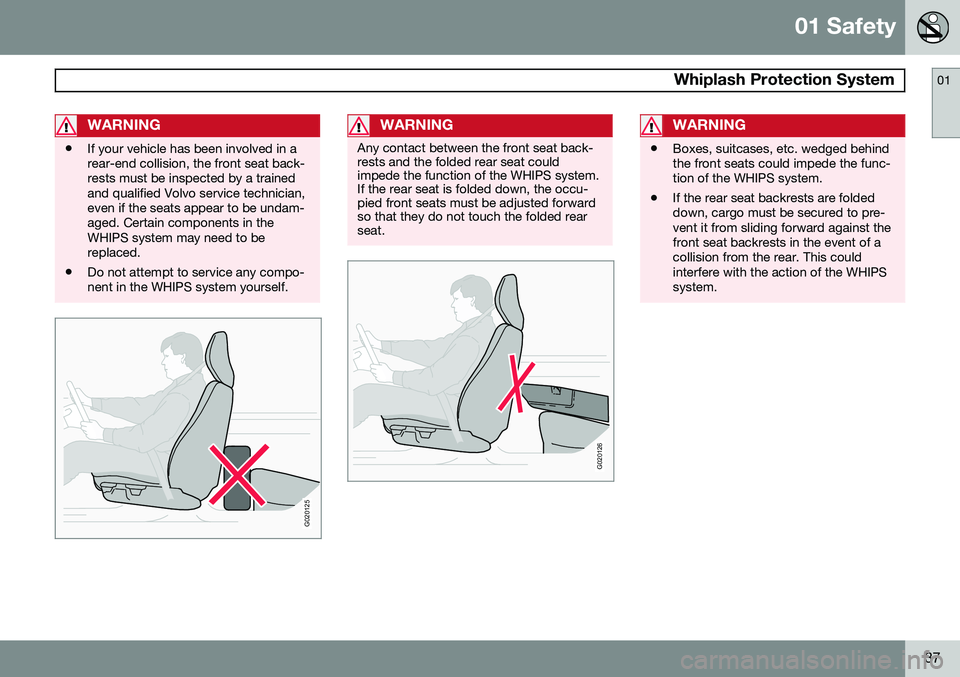
Any contact between the front seat back- rests and the folded rear seat couldimpede the function of the WHIPS system.If the rear seat is folded down, the occu-pied front seats must be adjusted forwardso that they do not touch the folded rearseat.
G020126
WARNING
•Boxes, suitcases, etc. wedged behind the front seats could impede the func-tion of the WHIPS system.
• If the rear seat backrests are foldeddown, cargo must be secured to pre-vent it from sliding forward against thefront seat backrests in the event of acollision from the rear. This couldinterfere with the action of the WHIPSsystem.
Page 61 of 308
02 Instruments and controls
Instrument panel
02
59
Gear and driving mode indicator – The currently selected driving mode is dis-played here. If you use the Geartronicfunction on the automatic transmission,the currently selected gear will be dis-played.
Ambient temperature gauge – This dis- play indicates the air temperature outsideyour vehicle. A "snowflake" symbol in thetext window is displayed when the tem-perature is in the range of 23 – 36 °F (–5 –+2 °C). Please note that this symbol doesnot indicate a fault with your vehicle. Atlow speeds or when the vehicle is notmoving, the temperature readings may beslightly higher than the actual ambienttemperature.
Clock/set button – Turn the button to set the clock.
Fuel gauge – see page 288 for fuel tank volume. When the warning light in thegauge comes on, the vehicle should berefueled as soon as possible. The tripcomputer section (see page 76) pro-vides more information on fuel level andconsumption.
Indicator and warning symbols – The indi- cator and warning symbols1
light up when you turn the ignition key to the driving position (position II) before starting.
G027134
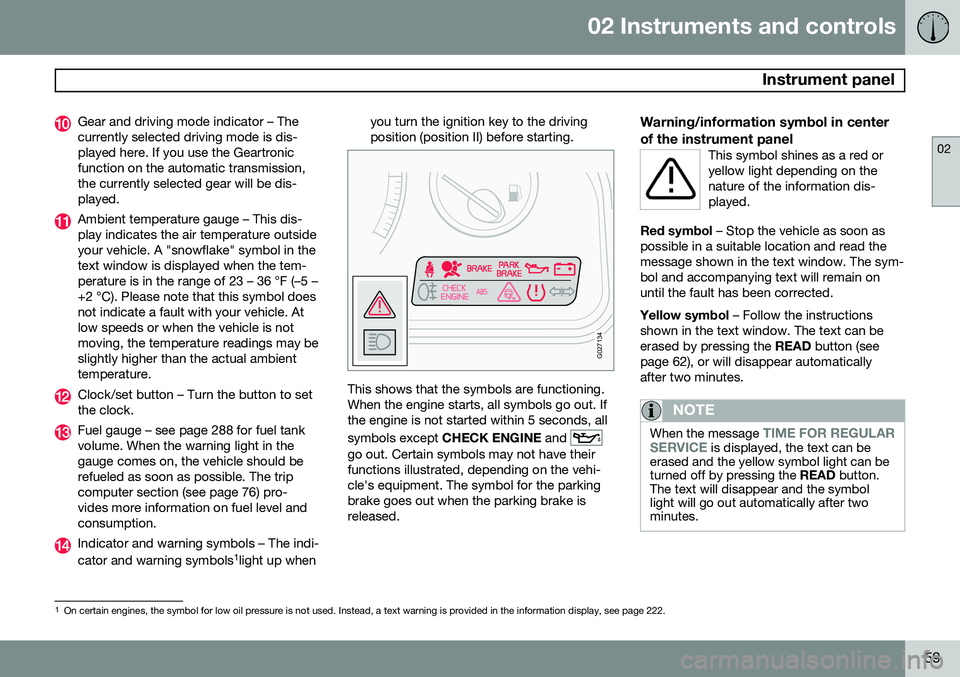
This shows that the symbols are functioning. When the engine starts, all symbols go out. Ifthe engine is not started within 5 seconds, all symbols except
CHECK ENGINE and
go out. Certain symbols may not have their functions illustrated, depending on the vehi-cle's equipment. The symbol for the parkingbrake goes out when the parking brake isreleased.
Warning/information symbol in center of the instrument panel
This symbol shines as a red or yellow light depending on thenature of the information dis-played.
Red symbol – Stop the vehicle as soon as
possible in a suitable location and read the message shown in the text window. The sym-bol and accompanying text will remain onuntil the fault has been corrected. Yellow symbol – Follow the instructions
shown in the text window. The text can be erased by pressing the READ button (see
page 62), or will disappear automaticallyafter two minutes.
NOTE
When the message TIME FOR REGULAR
SERVICE is displayed, the text can be
erased and the yellow symbol light can be turned off by pressing the READ button.
The text will disappear and the symbollight will go out automatically after twominutes.
1 On certain engines, the symbol for low oil pressure is not used. Instead, a text warning is provided in the information display, see page 222.
Page 62 of 308
02 Instruments and controls
Instrument panel
02
60
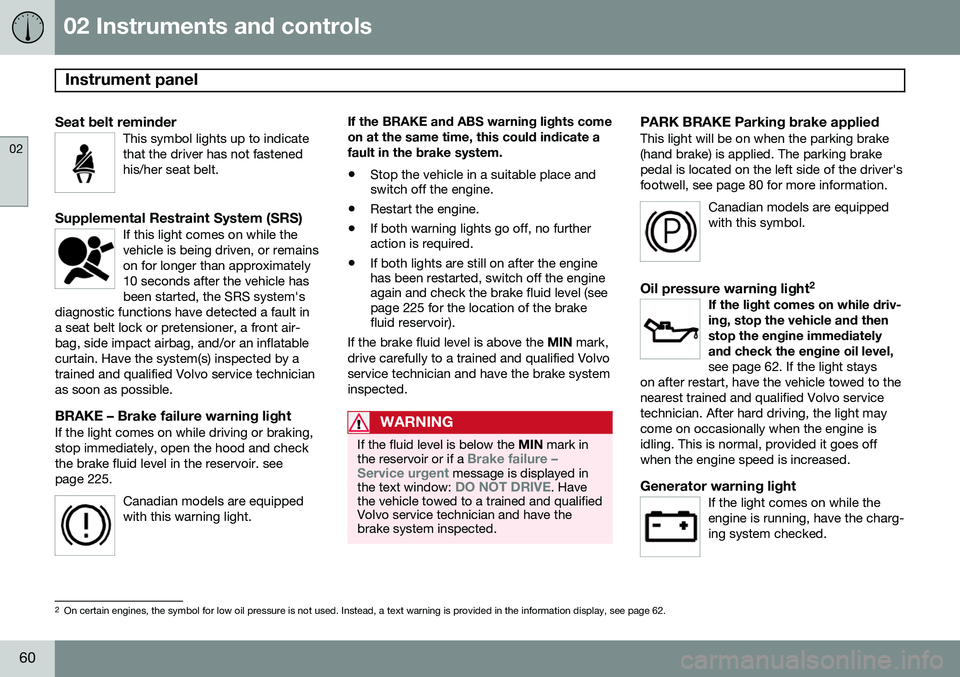
Seat belt reminderThis symbol lights up to indicate that the driver has not fastenedhis/her seat belt.
Supplemental Restraint System (SRS)If this light comes on while the vehicle is being driven, or remainson for longer than approximately10 seconds after the vehicle hasbeen started, the SRS system's
diagnostic functions have detected a fault ina seat belt lock or pretensioner, a front air-bag, side impact airbag, and/or an inflatablecurtain. Have the system(s) inspected by atrained and qualified Volvo service technicianas soon as possible.
BRAKE – Brake failure warning lightIf the light comes on while driving or braking, stop immediately, open the hood and checkthe brake fluid level in the reservoir. seepage 225.
Canadian models are equippedwith this warning light.
If the BRAKE and ABS warning lights come on at the same time, this could indicate afault in the brake system.
• Stop the vehicle in a suitable place and switch off the engine.
• Restart the engine.
• If both warning lights go off, no furtheraction is required.
• If both lights are still on after the enginehas been restarted, switch off the engineagain and check the brake fluid level (seepage 225 for the location of the brakefluid reservoir).
If the brake fluid level is above the MIN mark,
drive carefully to a trained and qualified Volvo service technician and have the brake systeminspected.
WARNING
If the fluid level is below the MIN mark in
the reservoir or if a Brake failure –
Service urgent message is displayed in
the text window: DO NOT DRIVE. Have
the vehicle towed to a trained and qualified Volvo service technician and have thebrake system inspected.
PARK BRAKE Parking brake appliedThis light will be on when the parking brake (hand brake) is applied. The parking brakepedal is located on the left side of the driver'sfootwell, see page 80 for more information.
Canadian models are equippedwith this symbol.
Oil pressure warning light 2If the light comes on while driv- ing, stop the vehicle and thenstop the engine immediatelyand check the engine oil level, see page 62. If the light stays
on after restart, have the vehicle towed to the nearest trained and qualified Volvo servicetechnician. After hard driving, the light maycome on occasionally when the engine isidling. This is normal, provided it goes offwhen the engine speed is increased.
Generator warning lightIf the light comes on while the engine is running, have the charg-ing system checked.
2 On certain engines, the symbol for low oil pressure is not used. Instead, a text warning is provided in the information display, see page 62.
Page 63 of 308
02 Instruments and controls
Instrument panel
02
61
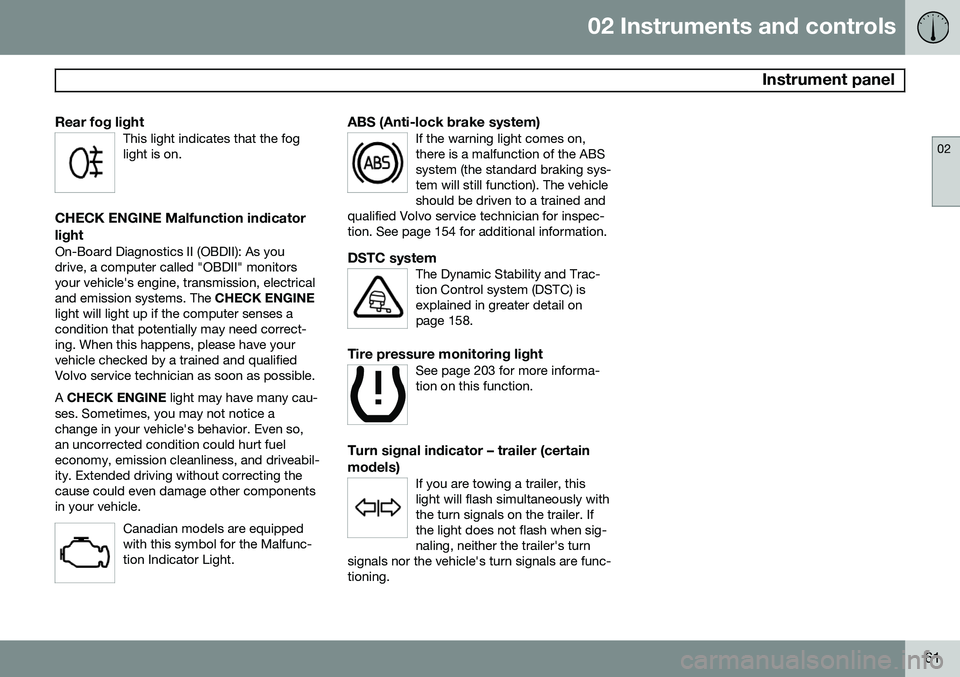
Rear fog lightThis light indicates that the fog light is on.
CHECK ENGINE Malfunction indicator light
On-Board Diagnostics II (OBDII): As you drive, a computer called "OBDII" monitorsyour vehicle's engine, transmission, electricaland emission systems. The CHECK ENGINE
light will light up if the computer senses acondition that potentially may need correct-ing. When this happens, please have yourvehicle checked by a trained and qualifiedVolvo service technician as soon as possible. A CHECK ENGINE light may have many cau-
ses. Sometimes, you may not notice a change in your vehicle's behavior. Even so,an uncorrected condition could hurt fueleconomy, emission cleanliness, and driveabil-ity. Extended driving without correcting thecause could even damage other componentsin your vehicle.
Canadian models are equippedwith this symbol for the Malfunc-tion Indicator Light.
ABS (Anti-lock brake system)If the warning light comes on, there is a malfunction of the ABSsystem (the standard braking sys-tem will still function). The vehicleshould be driven to a trained and
qualified Volvo service technician for inspec-tion. See page 154 for additional information.
DSTC systemThe Dynamic Stability and Trac- tion Control system (DSTC) isexplained in greater detail onpage 158.
Tire pressure monitoring lightSee page 203 for more informa- tion on this function.
Turn signal indicator – trailer (certain models)
If you are towing a trailer, this light will flash simultaneously withthe turn signals on the trailer. Ifthe light does not flash when sig-naling, neither the trailer's turn
signals nor the vehicle's turn signals are func-tioning.