service VOLVO XC90 2014 Owner´s Manual
[x] Cancel search | Manufacturer: VOLVO, Model Year: 2014, Model line: XC90, Model: VOLVO XC90 2014Pages: 308, PDF Size: 13.31 MB
Page 64 of 308
02 Instruments and controls
Information display
02
62
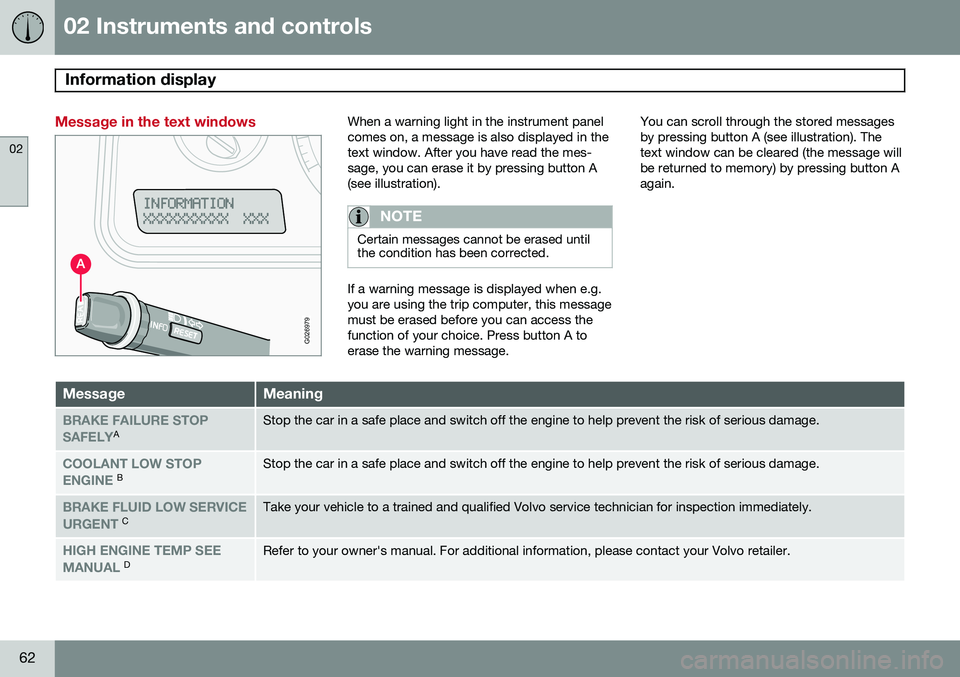
Message in the text windows
G026979
When a warning light in the instrument panel comes on, a message is also displayed in thetext window. After you have read the mes-sage, you can erase it by pressing button A(see illustration).
NOTE
Certain messages cannot be erased until the condition has been corrected.
If a warning message is displayed when e.g. you are using the trip computer, this messagemust be erased before you can access thefunction of your choice. Press button A toerase the warning message.You can scroll through the stored messagesby pressing button A (see illustration). Thetext window can be cleared (the message willbe returned to memory) by pressing button Aagain.
MessageMeaning
BRAKE FAILURE STOP SAFELYAStop the car in a safe place and switch off the engine to help prevent the risk of serious damage.
COOLANT LOW STOP ENGINE BStop the car in a safe place and switch off the engine to help prevent the risk of serious damage.
BRAKE FLUID LOW SERVICE URGENT CTake your vehicle to a trained and qualified Volvo service technician for inspection immediately.
HIGH ENGINE TEMP SEE MANUAL DRefer to your owner's manual. For additional information, please contact your Volvo retailer.
Page 65 of 308
02 Instruments and controls
Information display
02
63
MessageMeaning
ABS SERVICE REQUIREDETake your vehicle to a trained and qualified Volvo service technician for inspection at your convenience (but preferably before the next scheduled maintenance service).
TIME FOR REGULAR MAIN- TENANCEThis message will be displayed at 10,000 mile (16,000 km) intervals, after 500 hours of driving or after 12 months, whichever occurs first, to remind the driver that the service interval has been exceeded. The mes-sage will be displayed for 2 minutes each time the vehicle is started until reset by a trained and qualified Volvoservice technician.
DSTC SPIN CONTROL OFFThe stability system's spin control function has been turned off, see page 158 for details.
AThis is one example of several similar texts containing "stop safely"
B This is one example of several similar texts containing "stop engine"
C This is one example of several similar texts containing "service urgent"
D This is one example of several similar texts containing "see manual"
E This is one example of several similar texts containing "service required"
Page 73 of 308
02 Instruments and controls
Left-side steering wheel lever
02
71
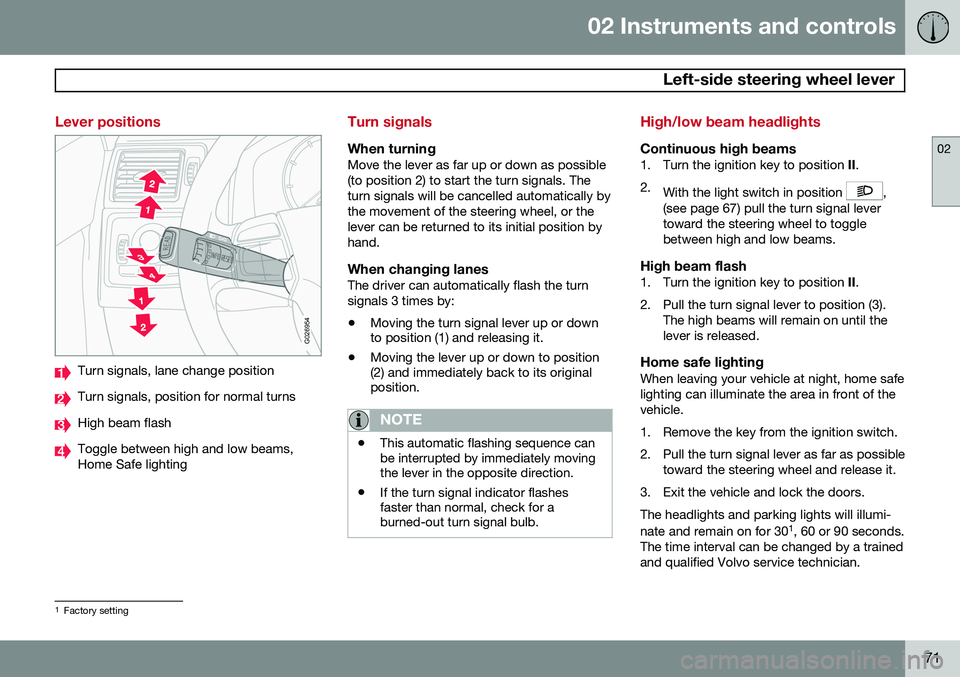
Lever positions
G026954
Turn signals, lane change position
Turn signals, position for normal turns
High beam flash
Toggle between high and low beams, Home Safe lighting
Turn signals
When turningMove the lever as far up or down as possible (to position 2) to start the turn signals. Theturn signals will be cancelled automatically bythe movement of the steering wheel, or thelever can be returned to its initial position byhand.
When changing lanesThe driver can automatically flash the turnsignals 3 times by:• Moving the turn signal lever up or down to position (1) and releasing it.
• Moving the lever up or down to position(2) and immediately back to its originalposition.
NOTE
• This automatic flashing sequence can be interrupted by immediately movingthe lever in the opposite direction.
• If the turn signal indicator flashesfaster than normal, check for aburned-out turn signal bulb.
High/low beam headlights
Continuous high beams1. Turn the ignition key to position
II.
2. With the light switch in position
,
(see page 67) pull the turn signal lever toward the steering wheel to togglebetween high and low beams.
High beam flash1. Turn the ignition key to position II.
2. Pull the turn signal lever to position (3). The high beams will remain on until thelever is released.
Home safe lightingWhen leaving your vehicle at night, home safelighting can illuminate the area in front of thevehicle.
1. Remove the key from the ignition switch.
2. Pull the turn signal lever as far as possibletoward the steering wheel and release it.
3. Exit the vehicle and lock the doors.The headlights and parking lights will illumi- nate and remain on for 30 1
, 60 or 90 seconds.
The time interval can be changed by a trained and qualified Volvo service technician.
1 Factory setting
Page 96 of 308
03 Climate
Climate control system – general information
03
94* Option/accessory, for more information, see Introduction.
Condensation on the inside of the windows
Keeping the insides of the windows clean will help reduce the amount of condensation thatforms on the windows. Use a commercialwindow cleaning agent to clean the windows.
Ice and snow
Always keep the air intake grille at the base of the windshield free of snow.
Cabin air filter
Replace the cabin air filter with a new one at the recommended intervals. Please refer toyour Warranty and Service Records Informa-tion booklet, or consult a trained and qualifiedVolvo service technician for these intervals.The filter should be replaced more often whendriving under dirty and dusty conditions. Thefilter cannot be cleaned and therefore shouldalways be replaced with a new one.
Sensors
The sunlight sensor on the dashboard and passenger compartment temperature sensorin the ECC control panel should not be cov-ered in any way as this could cause incorrectinformation to be sent to the ECC system.
Parking the vehicle in warm weather
If your vehicle has been parked in the sun in warm weather, opening the windows andmoonroof* for several minutes before drivingwill help release the warm air from the pas-senger compartment. When the engine is run-ning, close the windows and moonroof anduse the recirculation function for severalminutes to enable the air conditioning to coolthe compartment as quickly as possible.
Windows and optional moonroof
The ECC system will function best if the win- dows and optional moonroof are closed. Ifyou drive with the moonroof open, we recom-mend that you manually adjust the tempera-ture and blower control (the LED in the AUTO
switch should be off).
Acceleration
The air conditioning is momentarily disen- gaged during full-throttle acceleration.
Climate control maintenance
Special tools and equipment are required to maintain and carry out repairs on the climatesystem. Work of this type should only bedone by a trained and qualified Volvo servicetechnician.
Refrigerant
Volvo cares about the environment. The air conditioning system in your vehicle containsa CFC-free refrigerant – R134a (HFC134a).This substance will not deplete the ozonelayer. The approximate amount of R134acontained in the system is a follows: 6-cylinder engine Single A/C system: 1.5 lbs (700 g) Dual 1
A/C system: 2.2 lbs (1000 g)
The system also uses PAG oil.
1 Includes the optional rear A/C system
Page 103 of 308
03 Climate
Electronic climate control (ECC)
03
* Option/accessory, for more information, see Introduction.101
Blower control for rear climate
system*
Turn the control to increase or decrease blower speed.
OperationPress to operate the air quality sensor (nor-mal setting). or: Select one of the following three functions by pressing 1, 2 or 3 times.
1. The AUT LED lights. The air quality sen-
sor is now activated.
2. No LED lights. Recirculation is not acti- vated unless needed to cool the passen- ger compartment in a warm climate.
3. The MAN LED lights. Recirculation is now
activated.
Keep in mind the following:
• Make it a rule to have the air quality sen- sor activated at all times.
• Recirculation is limited in cold climates toavoid fogging.
• If window fogging occurs, you shoulddeactivate the air quality sensor. Also usethe defroster functions for the windshield,side windows and rear window, seepage 98. •
The filter should be changed at the inter-vals recommended in the service sched-ule. However, if the vehicle is used in aseverely contaminated environment, itmay be necessary to change the filtermore frequently.
Page 113 of 308
04 Interior
Interior lighting
04
}}
111
Reading lights and courtesy light
G026960
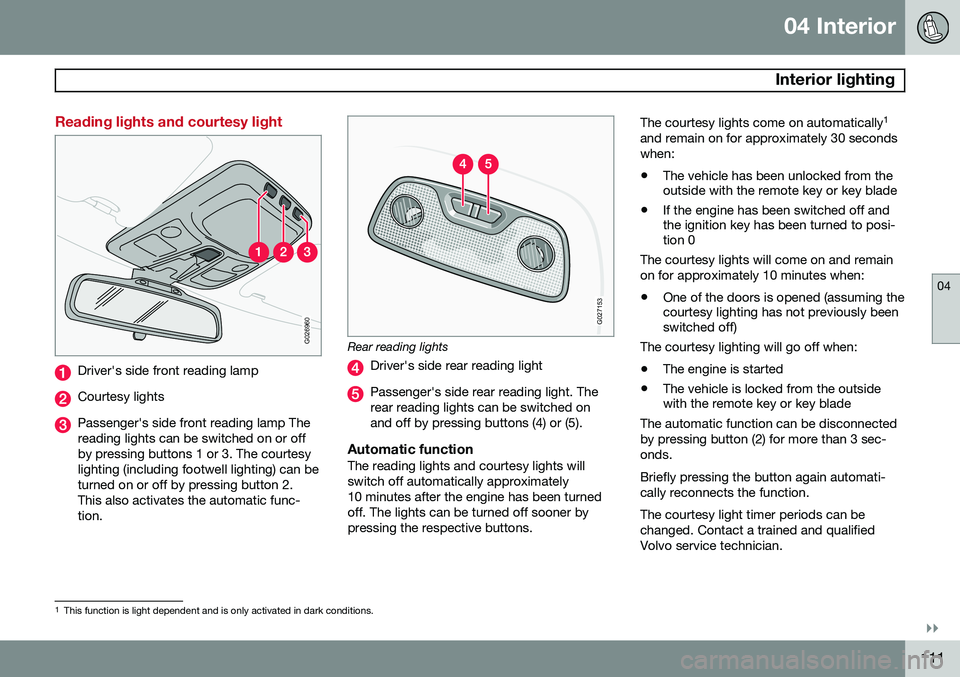
Driver's side front reading lamp
Courtesy lights
Passenger's side front reading lamp The reading lights can be switched on or offby pressing buttons 1 or 3. The courtesylighting (including footwell lighting) can beturned on or off by pressing button 2.This also activates the automatic func-tion.
G027153
Rear reading lights
Driver's side rear reading light
Passenger's side rear reading light. The rear reading lights can be switched onand off by pressing buttons (4) or (5).
Automatic functionThe reading lights and courtesy lights willswitch off automatically approximately10 minutes after the engine has been turnedoff. The lights can be turned off sooner bypressing the respective buttons.The courtesy lights come on automatically
1
and remain on for approximately 30 secondswhen: • The vehicle has been unlocked from the outside with the remote key or key blade
• If the engine has been switched off andthe ignition key has been turned to posi-tion 0
The courtesy lights will come on and remain on for approximately 10 minutes when:
• One of the doors is opened (assuming the courtesy lighting has not previously beenswitched off)
The courtesy lighting will go off when:
• The engine is started
• The vehicle is locked from the outsidewith the remote key or key blade
The automatic function can be disconnected by pressing button (2) for more than 3 sec-onds. Briefly pressing the button again automati- cally reconnects the function. The courtesy light timer periods can be changed. Contact a trained and qualifiedVolvo service technician.
1 This function is light dependent and is only activated in dark conditions.
Page 136 of 308
05 Locks and alarm
Alarm
05
134
•LED flashes rapidly before the ignition is switched on – the alarm has been trig-gered
• Fault in the alarm system:
If a fault has
been detected in the alarm system, amessage will be displayed in the text win-dow. Contact a trained and qualifiedVolvo service technician.
Automatic re-lock/re-arm systemIf the vehicle is unlocked with the remote, the vehicle will re-lock and the alarm will re-armafter 2 minutes unless a door or the tailgatehas been opened.
Page 140 of 308
06 Starting and driving
General information
06
138
Engine oil
Although some oil consumption occurs dur- ing normal engine operation, more oil is con-sumed when the engine is new as the internalparts generate higher friction while wearing-into each other. From the time the engine isnew until the first maintenance is performed,the oil consumption could be higher than nor-mal. For this reason, it is especially importantto check the oil regularly during this period,see page 222.
Fuel requirements
Deposit control gasoline (detergent additives)
Volvo recommends the use of detergent gas- oline to control engine deposits. Detergentgasoline is effective in keeping injectors andintake valves clean. Consistent use of depositcontrol gasolines will help ensure good driva-bility and fuel economy. If you are not surewhether the gasoline contains deposit controladditives, check with the service station oper-ator.
NOTE
Volvo does not recommend the use of external fuel injector cleaning systems.
Unleaded fuelEach Volvo has a three-way catalytic con- verter and must use only unleaded gasoline.U.S. and Canadian regulations require thatpumps delivering unleaded gasoline be label-led "UNLEADED". Only these pumps havenozzles which fit your vehicle's filler inlet. It isunlawful to dispense leaded fuel into a vehiclelabelled "unleaded gasoline only". Leadedgasoline damages the three-way catalyticconverter and the heated oxygen sensor sys-tem. Repeated use of leaded gasoline willlessen the effectiveness of the emission con-trol system and could result in loss of emis-sion warranty coverage. State and local vehi-cle inspection programs will make detectionof misfueling easier, possibly resulting inemission test failure for misfueled vehicles.
NOTE
Some U.S. and Canadian gasolines con- tain an octane enhancing additive calledmethyl-cyclopentadienyl manganese tri-carbonyl (MMT). If such fuels are used,your Emission Control System perform-ance may be affected, and the CheckEngine Light (malfunction indicator lamp)located on your instrument panel maylight. If this occurs, please return yourvehicle to a trained and qualified Volvoservice technician for maintenance.
Gasoline containing alcohol and ethers"Oxygenated fuels" Some fuel suppliers sell gasoline containing "oxygenates" which are usually alcohols orethers. In some areas, state or local lawsrequire that the service pump be marked indi-cating use of alcohols or ethers. However,there are areas in which the pumps areunmarked. If you are not sure whether there isalcohol or ethers in the gasoline you buy,check with the service station operator. Tomeet seasonal air quality standards, someareas require the use of "oxygenated" fuel. Volvo allows the use of the following "oxy- genated" fuels; however, the octane ratingslisted on page 139 must still be met. Alcohol – Ethanol: Fuels containing up to 10% ethanol by volume may be used. Ethanolmay also be referred to as Ethyl alcohol, or"Gasohol". Ethers – MTBE: Fuels containing up to 15% MTBE may be used.
Page 141 of 308
06 Starting and driving
Fuel requirements
06
139
Octane rating
Minimum octane
G028920
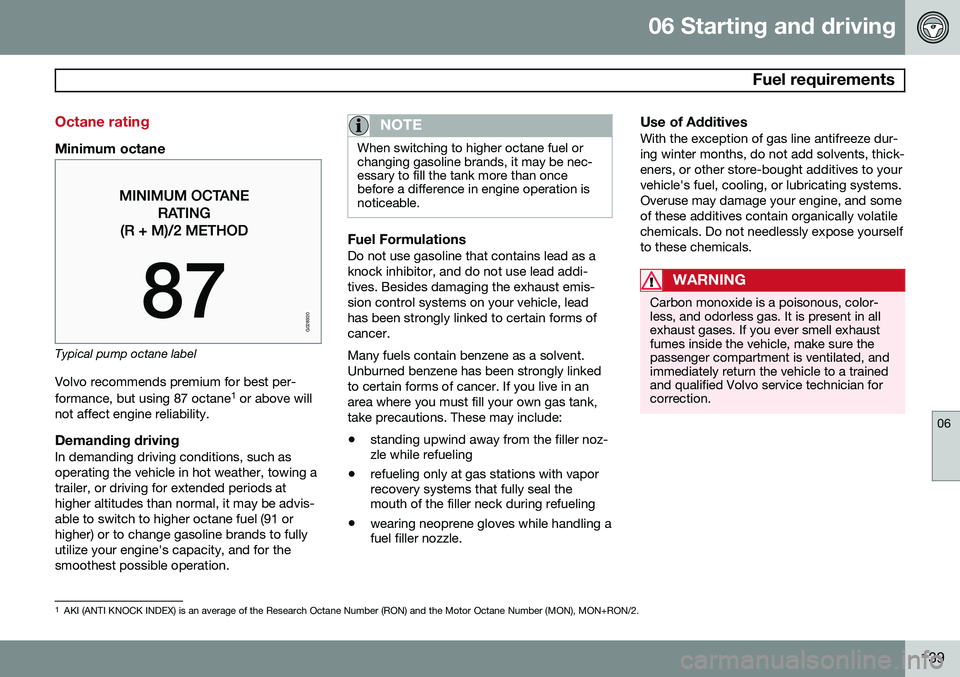
Typical pump octane labelVolvo recommends premium for best per- formance, but using 87 octane 1
or above will
not affect engine reliability.
Demanding drivingIn demanding driving conditions, such as operating the vehicle in hot weather, towing atrailer, or driving for extended periods athigher altitudes than normal, it may be advis-able to switch to higher octane fuel (91 orhigher) or to change gasoline brands to fullyutilize your engine's capacity, and for thesmoothest possible operation.
NOTE
When switching to higher octane fuel or changing gasoline brands, it may be nec-essary to fill the tank more than oncebefore a difference in engine operation isnoticeable.
Fuel FormulationsDo not use gasoline that contains lead as a knock inhibitor, and do not use lead addi-tives. Besides damaging the exhaust emis-sion control systems on your vehicle, leadhas been strongly linked to certain forms ofcancer. Many fuels contain benzene as a solvent. Unburned benzene has been strongly linkedto certain forms of cancer. If you live in anarea where you must fill your own gas tank,take precautions. These may include:
• standing upwind away from the filler noz- zle while refueling
• refueling only at gas stations with vaporrecovery systems that fully seal themouth of the filler neck during refueling
• wearing neoprene gloves while handling afuel filler nozzle.
Use of AdditivesWith the exception of gas line antifreeze dur- ing winter months, do not add solvents, thick-eners, or other store-bought additives to yourvehicle's fuel, cooling, or lubricating systems.Overuse may damage your engine, and someof these additives contain organically volatilechemicals. Do not needlessly expose yourselfto these chemicals.
WARNING
Carbon monoxide is a poisonous, color- less, and odorless gas. It is present in allexhaust gases. If you ever smell exhaustfumes inside the vehicle, make sure thepassenger compartment is ventilated, andimmediately return the vehicle to a trainedand qualified Volvo service technician forcorrection.
1
AKI (ANTI KNOCK INDEX) is an average of the Research Octane Number (RON) and the Motor Octane Number (MON), MON+RON/2.
Page 142 of 308
06 Starting and driving
Fuel requirements
06
140
WARNING
Driving with the tailgate open: Driving
with the tailgate open could lead to poi- sonous exhaust gases entering the pas-senger compartment.
• If the tailgate must be kept open for any reason, proceed as follows:
• Close the windows
• Set the ventilation system control to airflow to floor, windshield and side win-dows and blower control to its highestsetting.
Gasoline containing alcohol and ethers, "Oxygenated fuels"
Some fuel suppliers sell gasoline containing "oxygenates" which are usually alcohols orethers. In some areas, state or local lawsrequire that the service pump be marked indi-cating use of alcohols or ethers. However,there are areas in which the pumps areunmarked. If you are not sure whether there isalcohol or ethers in the gasoline you buy,check with the service station operator. Tomeet seasonal air quality standards, someareas require the use of "oxygenated" fuel. Volvo allows the use of the following "oxy- genated" fuels; however, the octane ratingslisted on page 139 must still be met.
Alcohol – EthanolFuels containing up to 10% ethanol by vol- ume may be used. Ethanol may also be refer-red to as Ethyl alcohol, or "Gasohol". Ethers – MTBE: Fuels containing up to 15% MTBE may be used.
MethanolDo not use gasolines containing methanol(methyl alcohol, wood alcohol). This practicecan result in vehicle performance deteriora-tion and can damage critical parts in the fuelsystem. Such damage may not be coveredunder the New Vehicle Limited Warranty.
Weight distribution affects handlingAt the specified curb weight your vehicle hasa tendency to understeer, which means thatthe steering wheel has to be turned morethan might seem appropriate for the curva-ture of a bend. This ensures good stability and reduces the risk of rear wheel skid. Remember that theseproperties can alter with the vehicle load. The heavier the load in the cargo area, the less the tendency to understeer.
Handling, roadholdingVehicle load, tire design and inflation pres-sure all affect vehicle handling. Therefore,check that the tires are inflated to the recom- mended pressure according to the vehicleload. See "Tire pressure" section. Loads should be distributed so that capacity weight or maximum permissible axle loadsare not exceeded.
Conserving electrical currentKeep the following in mind to help minimizebattery drain:
• When the engine is not running, avoid turning the ignition key to position
II (see
page 145). Many electrical systems (theaudio system, the optional infotainment/navigation systems, power windows, etc)will function with the ignition key in posi-tion I. This position reduces drain on the
battery.
• Please keep in mind that using systems,accessories, etc that consume a greatdeal of current when the engine is notrunning could result in the battery beingcompletely drained. Driving or having theengine running for approximately15 minutes will help keep the batterycharged.
NOTE
A warning message will be displayed in the text window in the instrument panel whenthe battery charge is low.