spare tire VOLVO XC90 2014 Owner´s Manual
[x] Cancel search | Manufacturer: VOLVO, Model Year: 2014, Model line: XC90, Model: VOLVO XC90 2014Pages: 308, PDF Size: 13.31 MB
Page 201 of 308
07 Wheels and tires
Changing wheels
07
199
WARNING
When raising or lowering the spare wheel, please keep in mind that components inthe exhaust system may be very hot.
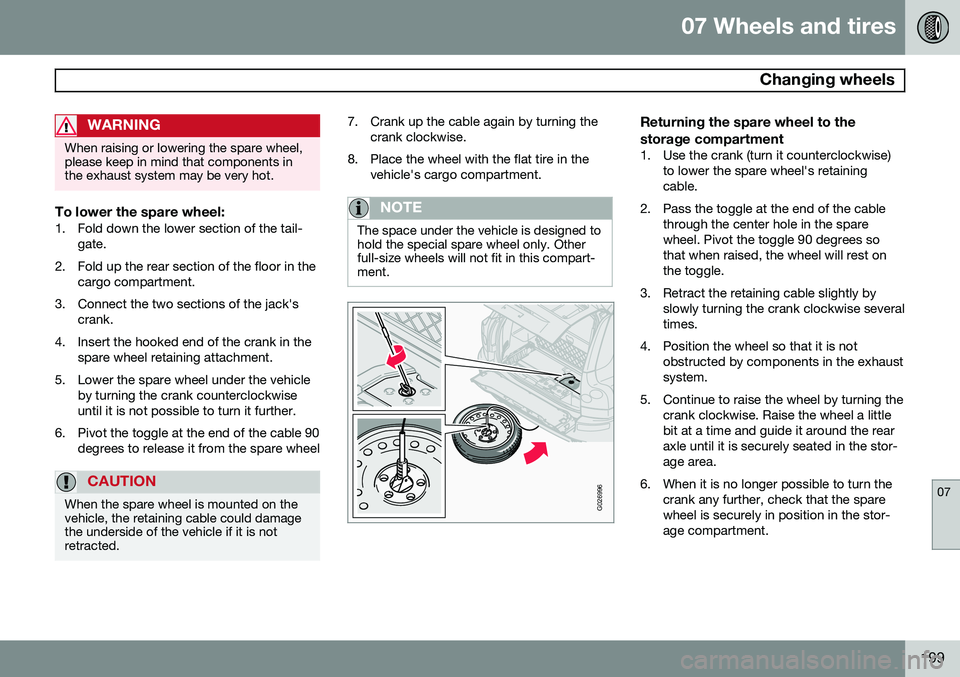
To lower the spare wheel:1. Fold down the lower section of the tail-gate.
2. Fold up the rear section of the floor in the cargo compartment.
3. Connect the two sections of the jack's crank.
4. Insert the hooked end of the crank in the spare wheel retaining attachment.
5. Lower the spare wheel under the vehicle by turning the crank counterclockwise until it is not possible to turn it further.
6. Pivot the toggle at the end of the cable 90 degrees to release it from the spare wheel
CAUTION
When the spare wheel is mounted on the vehicle, the retaining cable could damagethe underside of the vehicle if it is notretracted.
7. Crank up the cable again by turning thecrank clockwise.
8. Place the wheel with the flat tire in the vehicle's cargo compartment.
NOTE
The space under the vehicle is designed to hold the special spare wheel only. Otherfull-size wheels will not fit in this compart-ment.
G026996
Returning the spare wheel to the storage compartment
1. Use the crank (turn it counterclockwise) to lower the spare wheel's retaining cable.
2. Pass the toggle at the end of the cable through the center hole in the sparewheel. Pivot the toggle 90 degrees sothat when raised, the wheel will rest onthe toggle.
3. Retract the retaining cable slightly by slowly turning the crank clockwise severaltimes.
4. Position the wheel so that it is not obstructed by components in the exhaustsystem.
5. Continue to raise the wheel by turning the crank clockwise. Raise the wheel a littlebit at a time and guide it around the rearaxle until it is securely seated in the stor-age area.
6. When it is no longer possible to turn the crank any further, check that the sparewheel is securely in position in the stor-age compartment.
Page 203 of 308
07 Wheels and tires
Changing wheels
07
201
the vehicle, check that the jack is still cor- rectly positioned in the attachment.
7. Raise the vehicle until the wheel to be changed is lifted off the ground.
8. Unscrew the wheel bolts completely and carefully remove the wheel so as not todamage the threads on the studs.
NOTE
To avoid excessive wear and the necessity of rebalancing, mark and reinstall wheelsin the same location and position as beforeremoval. To lessen the chance of imbal-ance, each wheel hub is equipped with aguide stud to ensure that a removed wheelcan be reinstalled in its original position (aswhen changing over to winter tires/wheels).
CAUTION
•The vehicle must not be driven with wheels of different dimensions or witha spare tire other than the one thatcame with the vehicle. The use of dif-ferent size wheels can seriously dam-age your vehicle's transmission.
• Correct tightening torque on wheelbolts must be observed.
• The wheel bolts should never begreased or lubricated.
• Extended, chromed wheel bolts mustnot be used with steel rims, as theymake it impossible to fit the hub caps.
Installing the wheel1. Clean the contact surfaces on the wheel
and hub.
2. Lift the wheel and place it on the hub.
3. Install the wheel bolts and tighten hand- tight. Using the lug wrench, tighten cross- wise until all bolts are snug.
4. Lower the vehicle to the ground and alter- nately tighten the bolts crosswise to103 ft.lbs. (140 Nm).
5. Install the wheel cover (where applicable).
WARNING
• The jack must correctly engage the bar in the jack attachment. The vehicle'sweight must not rest on the jackattachment. See illustration "Attachingthe jack" on the previous page.
• Be sure the jack is on a firm, level,non-slippery surface.
• Never allow any part of your body tobe extended under a vehicle suppor-ted by a jack.
• Use the jack intended for the vehiclewhen replacing a wheel. For any otherjob, use stands to support the side ofthe vehicle being worked on.
• Apply the parking brake and put thegear selector in the (
P)ark position.
• Block the wheels standing on theground, use rigid wooden blocks orlarge stones.
• The jack should be kept well-greasedand clean, and should not be dam-aged.
• No objects should be placed betweenthe base of jack and the ground, orbetween the jack and the attachmentbar on the vehicle.
Page 205 of 308
07 Wheels and tires
Tire Pressure Monitoring System (TPMS)
07
203
The tire pressure monitoring system
1
uses
sensors mounted in the tire valves to check inflation pressure levels. When the vehicle ismoving at a speed of approximately 20 mph(30 km/h) or faster, these sensors transmitinflation pressure data to a receiver located inthe vehicle.
USA – FCC ID: MRXG403MA4 A
This device complies with part 15 of the
FCC rules. Operation is subject to the fol- lowing conditions: (1) This device may notcause harmful interference, and (2) thisdevice must accept any interferencereceived, including interference that maycause undesired operation. When low inflation pressure is detected, TPMS will light up the tire pressure warn-ing light (also referred to as a telltale) in theinstrument panel (see page 61), and willdisplay a message in the text window. Thewording of this message is determined bythe degree of inflation pressure loss.
A On certain models, the FCC code is MRXTG315AM04
When low inflation pressure is detected, TPMS will light up the tire pressure warning light
(also referred to as a telltale) in the instrument panel and will display one of the following messages in the text window:
LOW
TIRE PRESS. CHECK TIRES or VERY LOW
TIRE PRESSURE.
NOTE
If a fault occurs in TPMS, the tire pressure warning light will flash for approximately 1 minute and
TIRE PRESS SYST
SERVICE REQUIRED will be displayed.
Each tire, including the spare (if provided), should be checked monthly when cold andinflated to the inflation pressure recom-mended by the vehicle manufacturer on thevehicle placard or tire inflation pressure label.(If your vehicle has tires of a different sizethan the size indicated on the vehicle placardor tire inflation pressure label, you shoulddetermine the proper tire inflation pressure forthose tires.) As an added safety feature, your vehicle has been equipped with a tire pressure monitor-ing system (TPMS) that illuminates a low tirepressure telltale when one or more of yourtires is significantly under-inflated. Accord-ingly, when the low tire pressure telltale illu-minates, you should stop and check yourtires as soon as possible, and inflate them to the proper pressure. Driving on a significantlyunder-inflated tire causes the tire to overheatand can lead to tire failure. Under-inflationalso reduces fuel efficiency and tire tread life,and may affect the vehicle's handling andstopping ability. Please note that the TPMS is not a substitute for proper tire maintenance, and it is the driv-er's responsibility to maintain correct tirepressure, even if under-inflation has notreached the level to trigger illumination of theTPMS low tire pressure telltale. Your vehicle has also been equipped with a TPMS malfunction indicator to indicate whenthe system is not operating properly. TheTPMS malfunction indicator is combined withthe low tire pressure telltale. When the sys-tem detects a malfunction, the telltale willflash for approximately one minute and thenremain continuously illuminated. Thissequence will continue upon subsequentvehicle start-ups as long as the malfunctionexists. When the malfunction indicator is illu-minated, the system may not be able todetect or signal low tire pressure as intended.TPMS malfunctions may occur for a variety ofreasons, including the installation of replace-ment or alternate tires or wheels on the vehi-cle that prevent the TPMS from functioning
1
This system is standard on U.S. models and optional on Canadian models
Page 206 of 308
07 Wheels and tires
Tire Pressure Monitoring System (TPMS)
07
204
properly. Always check the TPMS malfunc- tion telltale after replacing one or more tiresor wheels on your vehicle to ensure that thereplacement or alternate tires and wheelsallow the TPMS to continue to function prop-erly.
NOTE
TPMS indicates low tire pressure but does not replace normal tire maintenance. Forinformation on correct tire pressure, pleaserefer to the tire inflation pressure table inthis chapter or consult your Volvo retailer.
Erasing warning messagesWhen a low tire pressure warning message has been displayed, and the tire pressurewarning light has come on:
1. Use a tire pressure gauge to check theinflation pressure of all four tires.
2. Re-inflate the tire(s) to the correct pres- sure (consult the tire pressure placard or the table see page 183).
3. Drive the vehicle for several minutes at a speed of 20 mph (30 km/h) or faster.
> This will erase the warning text and thewarning light will go out.
WARNING
Incorrect inflation pressure could lead to tire failure, resulting in a loss of control ofthe vehicle.
Changing wheels with TPMSPlease note the following when changing or replacing the factory installed TPMS wheels/tires on the vehicle:
• Only the factory-mounted wheels are equipped with TPMS sensors in thevalves.
• If the vehicle is equipped with a tempo-rary spare tire, this tire does not have aTPMS sensor.
• If wheels without TPMS sensors are mounted on the vehicle,
TIRE PRESS
SYST. SERVICE REQUIRED will be dis-
played each time the vehicle is driven above 25 mph (40 km/h) for 10 minutes ormore.
• Once TPMS sensors are properly instal-led, the warning message should notreappear.
• Volvo recommends that TPMS sensorsbe fitted on all wheels used on the vehi-cle. Volvo does not recommend movingsensors back and forth between sets ofwheels.
NOTE
If a tire is changed or if the TPMS sensor is moved to another wheel, the sensor’svalve and valve core should be replaced.
CAUTION
When inflating tires with TPMS valves, press the pump's mouthpiece straightonto the valve to help avoid bending orotherwise damaging the valve.
Recalibrating TPMS (Canadian models only)
In certain cases, it may be necessary to reca- librate TPMS to conform to Volvo's recom-mended tire inflation pressures (see the infla-tion pressure table on page 183), for exam-ple, if higher inflation pressure is necessarywhen transporting heavy loads, etc. To recalibrate:
1. Switch off the engine.
2. Inflate the tires to the desired pressure
and turn the ignition key to position I or II
(see page 145 for additional information).
3. Turn the thumb wheel on the left-side steering wheel lever until
Tire pressure
Calibration appears in the display.
Page 304 of 308
12 Index
12
302
Radio functions........................................ 255HD digital radio................................... 260
Rain sensor - windshield wipers................ 73
Rear fog light............................................. 69
Rear suspension...................................... 289
Rearview mirror with compass.................. 84
Rear window defroster.............................. 75
Recalls, child restraints.............................. 40
Recirculation.............................................. 99
REDUCE SPEED........................................ 62
Refrigerant (A/C system)............................ 94
Refrigerator (XC90 Executive).................. 118
Registering child restraints........................ 40
Remote key.............................................. 127 replacing the battery........................... 129
Reporting safety defects............................ 19
S
Safety defects, reporting........................... 19
Safety locks, child.................................... 132
Seat belt..................................................... 20 Seat belts
Automatic locking retractor/Emer-
gency locking retractor......................... 39
Seats........................................................ 104
Shiftlock............................................. 11, 143 override................................................. 23
Side impact protection (SIPS) airbags....... 32SiriusXM ™ satellite radio......................... 263
Snow chains............................................ 190
Snow tires................................................ 190
Spare tire................................................. 191
Spare tire – accessing............................. 198
Spare wheel, lowering............................. 198
Speedometer............................................. 58
Starting the car........................................ 143
Start inhibitor (immobilizer)...................... 126
Steering wheel lock................................. 145
Stone chips, touching up......................... 213
Storage compartments............ 114, 116, 117
Studded tires........................................... 190
Sun visor.................................................... 88
Symbols, overview................................... 294
T
Tachometer................................................ 58 Tailgate locking/unlocking................................ 131
opening................................................. 81
Tailgate wipers......................................... 226
Technician certification............................ 296
Temperature control................................ 100
Temperature gauge................................... 58
Temporary spare tire............................... 191
Three-way catalytic converter................. 293
TIME FOR REGULAR SERVICE................. 62
Tire inflation pressure.............................. 183
Tire Pressure Monitoring System (TPMS) 203
Tires......................................................... 178 age...................................................... 178
changing............................................. 198
changing from summer to winter........ 179
designations....................................... 184
improving economy............................ 179
inflation............................................... 181
inflation pressure, checking................ 181
inflation pressure table....................... 183
load ratings......................................... 182
Page 305 of 308
12 Index
12
303
rotation............................................... 178
Self-supporting run flat tires (SST)..... 205
spare................................................... 191
speed ratings...................................... 182
storing................................................. 180
tire sealing system.............................. 192
tread wear indicator............................ 179
Tire sealing system.................................. 192
Towing a trailer........................................ 164
Towing - cars with All Wheel Drive.......... 163
Towing the vehicle................................... 162
Trailer hitch - detachable......................... 167
Trailer towing........................................... 164Transmission shiftlock override.................................. 23
Transmission, automatic.......................... 149
Tread wear indicator................................ 179
Treble....................................................... 255
Trip computer............................................ 76
Trip odometer............................................ 58
Turn signals............................................... 71
U
Uniform Tire Quality Grading................... 189
Unlocking fuel filler door............................ 69
Unlocking the car..................................... 130 Unpaved roads, driving on...................... 147
V
Vanity mirror............................................ 112
Vehicle dimensions.................................. 284
Vehicle Identification Number (VIN)......... 283
Vehicle loading........................................ 187
Vehicle maintenance................................ 216
Vehicle weights........................................ 286
Ventilated seats......................................... 97
Volvo and the environment........................ 13
Volvo maintenance.................................. 216
Volvo On Call Roadside Assistance........ 296
W
Warning symbol......................................... 58
Warning symbol in center of dashboard.... 58
Warranties................................................ 216
Washer fluid reservoir...................... 221, 224
Washing the vehicle................................. 208
Water, driving through............................. 147
Waxing..................................................... 209
Weights.................................................... 286
Wheels..................................................... 178 storing................................................. 180
Windshield IR coating............................................. 74
Windshield washer fluid reservoir............ 224
Windshield wipers.................................... 226
Winter/Wet driving mode......................... 169
Wipers...................................................... 226
W – Winter............................................... 150