trailer VOLVO XC90 2014 Owner´s Manual
[x] Cancel search | Manufacturer: VOLVO, Model Year: 2014, Model line: XC90, Model: VOLVO XC90 2014Pages: 308, PDF Size: 13.31 MB
Page 168 of 308
06 Starting and driving
Towing a trailer
06
166
WARNING
•Bumper-attached trailer hitches must not be used on Volvos, nor shouldsafety chains be attached to thebumper.
• Trailer hitches attaching to the vehiclerear axle must not be used.
• Never connect a trailer's hydraulicbrake system directly to the vehiclebrake system, nor a trailer's lightingsystem directly to the vehicle lightingsystem. Consult a trained and qualifiedVolvo service technician for correctinstallation.
• When towing a trailer, the trailer'ssafety wire must be correctly fastenedto the hole or hook provided in thetrailer hitch on the vehicle. The safetywire should never be fastened to orwound around the drawbar ball.
LevelingIf your vehicle is equipped with automatic lev- eling, the rear suspension always retains thecorrect ride height regardless of the load.
• The system adjusts the rear suspension to the correct level after the vehicle hasbeen driven a short distance.
• When the vehicle is stationary, the rearsuspension lowers, which is normal.
Page 169 of 308
06 Starting and driving
Detachable trailer hitch
06
167
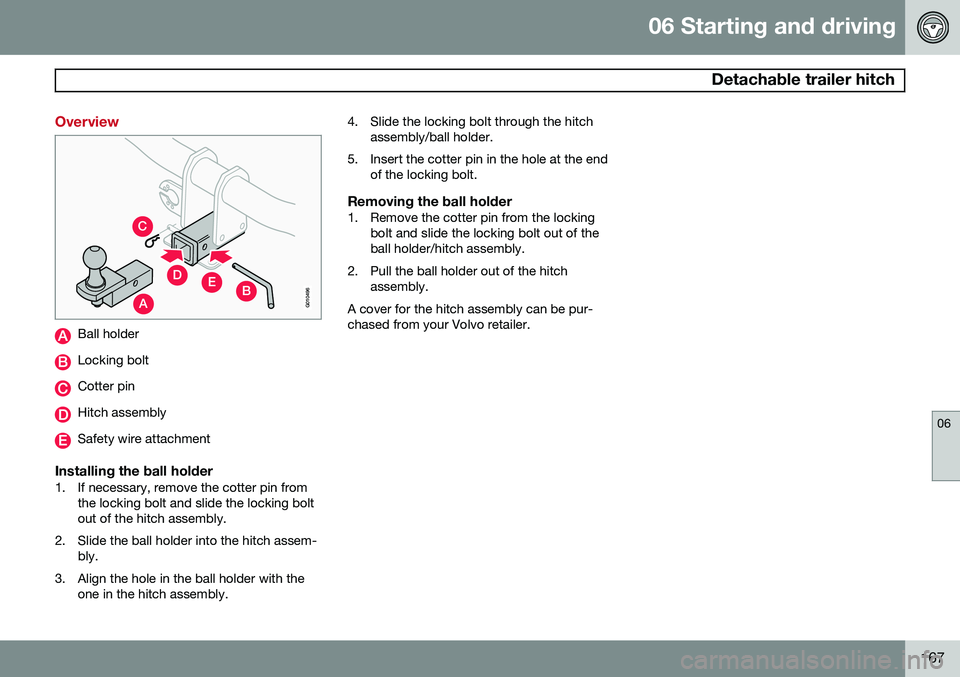
Overview
A
C
EDBG010496
Ball holder
Locking bolt
Cotter pin
Hitch assembly
Safety wire attachment
Installing the ball holder1. If necessary, remove the cotter pin fromthe locking bolt and slide the locking bolt out of the hitch assembly.
2. Slide the ball holder into the hitch assem- bly.
3. Align the hole in the ball holder with the one in the hitch assembly. 4. Slide the locking bolt through the hitch
assembly/ball holder.
5. Insert the cotter pin in the hole at the end of the locking bolt.
Removing the ball holder1. Remove the cotter pin from the lockingbolt and slide the locking bolt out of theball holder/hitch assembly.
2. Pull the ball holder out of the hitch assembly.
A cover for the hitch assembly can be pur-chased from your Volvo retailer.
Page 174 of 308
06 Starting and driving
Blind Spot Information System*
06
172* Option/accessory, for more information, see Introduction.
When you pass another vehicle: The system reacts when you pass another vehicle at a speed of up to 6 mph (10 km/h)faster than that vehicle. When you are passed by another vehicle:The system reacts if your vehicle is passed by another vehicle at a speed of up to 43 mph(70 km/h) faster than your vehicle.
WARNING
• BLIS does not function in sharp curves.
• BLIS does not function when yourvehicle is backing up.
• If you are towing a wide trailer, thismay prevent the BLIS cameras fromdetecting other vehicles in adjacentlanes.
How BLIS functions in daylight and darkness
Daylight BLIS reacts to the
shape of surrounding vehi-
cles. The system is designed to help detect motor vehicles such as cars, trucks, buses,motorcycles, etc. Darkness BLIS reacts to the
headlights of surrounding
vehicles. In order to be detected by BLIS, a vehicle in the blind area must have its head-lights on. This means, for example, that thesystem will not detect a trailer without head-lights that is being towed behind a car ortruck.
WARNING
• BLIS does not react to cyclists or mopeds.
• BLIS does not react to vehicles thatare standing still.
• The BLIS cameras have the same limi-tation as the human eye. In otherwords, their "vision is impaired" byadverse weather conditions such asheavy snowfall, intense light directlyinto the camera, dense fog, etc.
Cleaning the BLIS camera lensesIn order to function optimally, the BLIS cam- era lenses must be kept clean. They can bewiped clean with a soft cloth or wet sponge.
CAUTION
• Clean the lenses carefully to avoid scratching.
• The lenses are electrically heated tohelp melt ice or snow. If necessary,gently brush away snow from the len-ses.
LimitationsIn certain situations, the BLIS indicator light(s) may illuminate even when there are no othervehicles in the area monitored by the system.
NOTE
If the BLIS indicator lights illuminate occa- sionally even when there are no other vehi-cles in the blind area, this does not indi-cate a fault in the system. In the event of a fault,
Blind spot syst.
service required will be displayed.
The following are several examples of situa- tions in which the BLIS indicator light(s) mayilluminate even when there are no other vehi-cles in the area monitored by the system.
Page 189 of 308
07 Wheels and tires
Vehicle loading
07
187
Properly loading your vehicle will provide maximum return of vehicle design perform-ance. Before loading your vehicle, familiarize your- self with the following terms for determiningyour vehicle's weight ratings, with or withouta trailer, from the vehicle's Federal/ CanadianMotor Vehicle Safety Standards (FMVSS/CMVSS) label, and the vehicle's tire informa-tion placard.
Curb weightThe weight of the vehicle including a full tankof fuel and all standard equipment. It doesnot include passengers, cargo, or optionalequipment.
Capacity weightAll weight added to the curb weight, includingcargo and optional equipment. When towing,trailer hitch tongue load is also part of cargoweight.
NOTE
For trailer towing information, please refer to the section "Towing a trailer."
Permissible axle weightThe maximum allowable weight that can be carried by a single axle (front or rear). Thesenumbers are shown on the Federal/CanadianMotor Vehicle Safety Standards (FMVSS/CMVSS) label. The total load on each axlemust never exceed its maximum permissibleweight.
Gross vehicle weight (GVW)The vehicle's curb weight + cargo + passen-gers. A table listing important weight limits for your vehicle, is in chapter "Dimension andweights". For the location of the various labels in your vehicle, see page 282
Steps for Determining Correct Load Limit
•
Locate the statement "the combined weight of occupants and cargo shouldnever exceed XXX pounds" on your vehi-cle's placard.
• Determine the combined weight of thedriver and passengers that will be ridingin your vehicle. •
Subtract the combined weight of thedriver and passengers from XXX kilo-grams or XXX pounds.
• The resulting figure equals the availableamount of cargo and luggage loadcapacity. For example, if the "XXX"amount equals 1400 lbs. and there will befive 150 lb. passengers in your vehicle,the amount of available cargo and lug-gage load capacity is 650 lbs. (1400-750(5 x 150) = 650 lbs.)
• Determine the combined weight of lug-gage and cargo being loaded on the vehi-cle. That weight may not safely exceedthe available cargo and luggage loadcapacity calculated in Step 4.
• If your vehicle will be towing a trailer, loadfrom your trailer will be transferred to your vehicle. Consult this manual 1
to deter-
mine how this reduces the available cargo and luggage load capacity of yourvehicle.
1 For "Towing a trailer" see page 164.
Page 248 of 308
09 Maintenance and servicing
Fuses 09
246* Option/accessory, for more information, see Introduction.
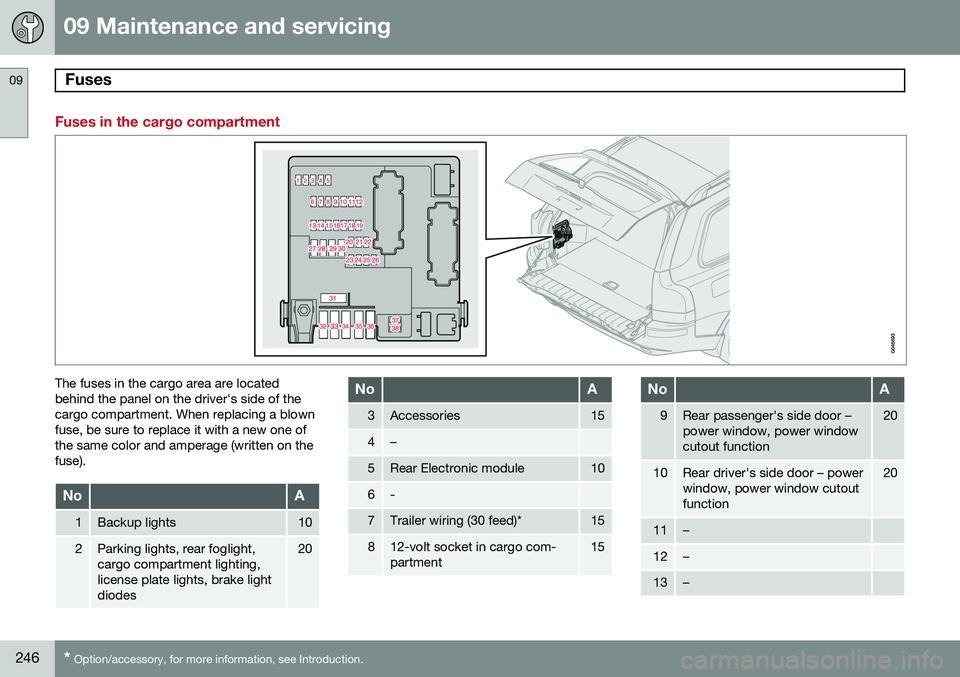
Fuses in the cargo compartment
The fuses in the cargo area are located behind the panel on the driver's side of thecargo compartment. When replacing a blownfuse, be sure to replace it with a new one ofthe same color and amperage (written on thefuse).
NoA
1Backup lights10
2Parking lights, rear foglight, cargo compartment lighting,license plate lights, brake lightdiodes20
NoA
3Accessories15
4–
5Rear Electronic module10
6-
7Trailer wiring (30 feed)*15
812-volt socket in cargo com- partment15
NoA
9Rear passenger's side door – power window, power windowcutout function20
10Rear driver's side door – power window, power window cutoutfunction20
11–
12–
13–
Page 249 of 308
09 Maintenance and servicing
Fuses09
}}
* Option/accessory, for more information, see Introduction.247
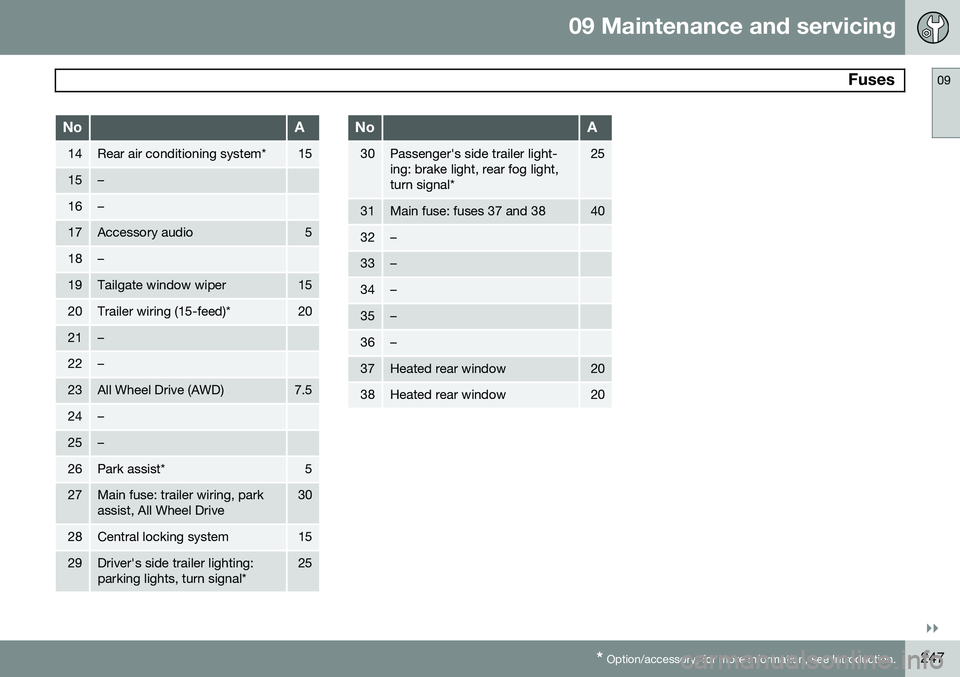
NoA
14Rear air conditioning system*15
15–
16–
17Accessory audio5
18–
19Tailgate window wiper15
20Trailer wiring (15-feed)*20
21–
22–
23All Wheel Drive (AWD)7.5
24–
25–
26Park assist*5
27Main fuse: trailer wiring, park assist, All Wheel Drive30
28Central locking system15
29Driver's side trailer lighting: parking lights, turn signal*25
NoA
30Passenger's side trailer light- ing: brake light, rear fog light,turn signal*25
31Main fuse: fuses 37 and 3840
32–
33–
34–
35–
36–
37Heated rear window20
38Heated rear window20
Page 288 of 308
11 Specifications
Weights
11
286
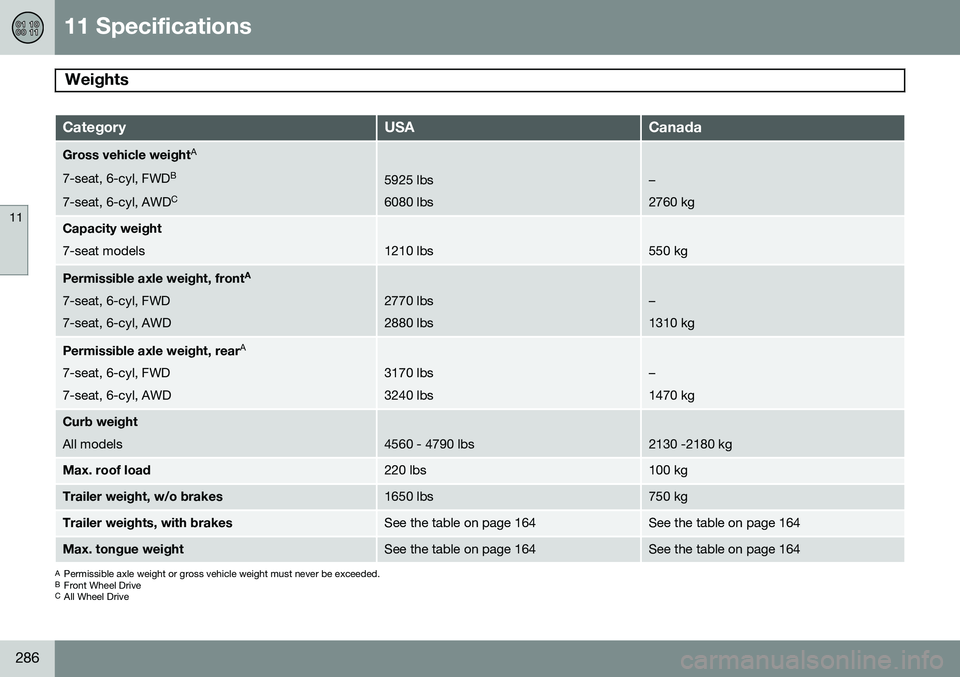
CategoryUSACanada
Gross vehicle weightA
7-seat, 6-cyl, FWD B
7-seat, 6-cyl, AWD C
5925 lbs 6080 lbs– 2760 kg
Capacity weight 7-seat models
1210 lbs550 kg
Permissible axle weight, front A
7-seat, 6-cyl, FWD 7-seat, 6-cyl, AWD
2770 lbs 2880 lbs– 1310 kg
Permissible axle weight, rear A
7-seat, 6-cyl, FWD 7-seat, 6-cyl, AWD
3170 lbs 3240 lbs– 1470 kg
Curb weight All models
4560 - 4790 lbs2130 -2180 kg
Max. roof load220 lbs100 kg
Trailer weight, w/o brakes1650 lbs750 kg
Trailer weights, with brakesSee the table on page 164See the table on page 164
Max. tongue weightSee the table on page 164See the table on page 164
A Permissible axle weight or gross vehicle weight must never be exceeded.
B Front Wheel Drive
C All Wheel Drive
Page 290 of 308
11 Specifications
Fluids
11
288* Option/accessory, for more information, see Introduction.
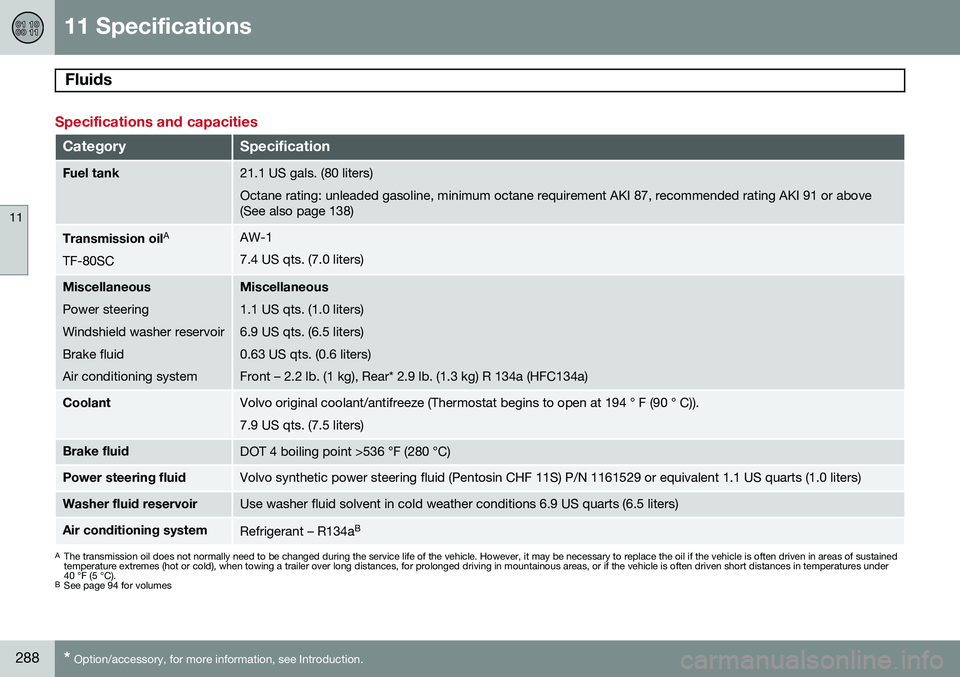
Specifications and capacities
CategorySpecification
Fuel tank21.1 US gals. (80 liters) Octane rating: unleaded gasoline, minimum octane requirement AKI 87, recommended rating AKI 91 or above (See also page 138)
Transmission oil A
TF-80SCAW-1 7.4 US qts. (7.0 liters)
Miscellaneous Power steering Windshield washer reservoirBrake fluidAir conditioning systemMiscellaneous 1.1 US qts. (1.0 liters) 6.9 US qts. (6.5 liters)0.63 US qts. (0.6 liters)Front – 2.2 lb. (1 kg), Rear* 2.9 lb. (1.3 kg) R 134a (HFC134a)
CoolantVolvo original coolant/antifreeze (Thermostat begins to open at 194 ° F (90 ° C)). 7.9 US qts. (7.5 liters)
Brake fluidDOT 4 boiling point >536 °F (280 °C)
Power steering fluidVolvo synthetic power steering fluid (Pentosin CHF 11S) P/N 1161529 or equivalent 1.1 US quarts (1.0 liters)
Washer fluid reservoirUse washer fluid solvent in cold weather conditions 6.9 US quarts (6.5 liters)
Air conditioning systemRefrigerant – R134a B
A
The transmission oil does not normally need to be changed during the service life of the vehicle. However, it may be necessary to replace the oil if the vehicle is often driven in areas of sustained temperature extremes (hot or cold), when towing a trailer over long distances, for prolonged driving in mountainous areas, or if the vehicle is often driven short distances in temperatures under40 °F (5 °C).
B See page 94 for volumes
Page 296 of 308
11 Specifications
Overview of information and warning symbols
11
294
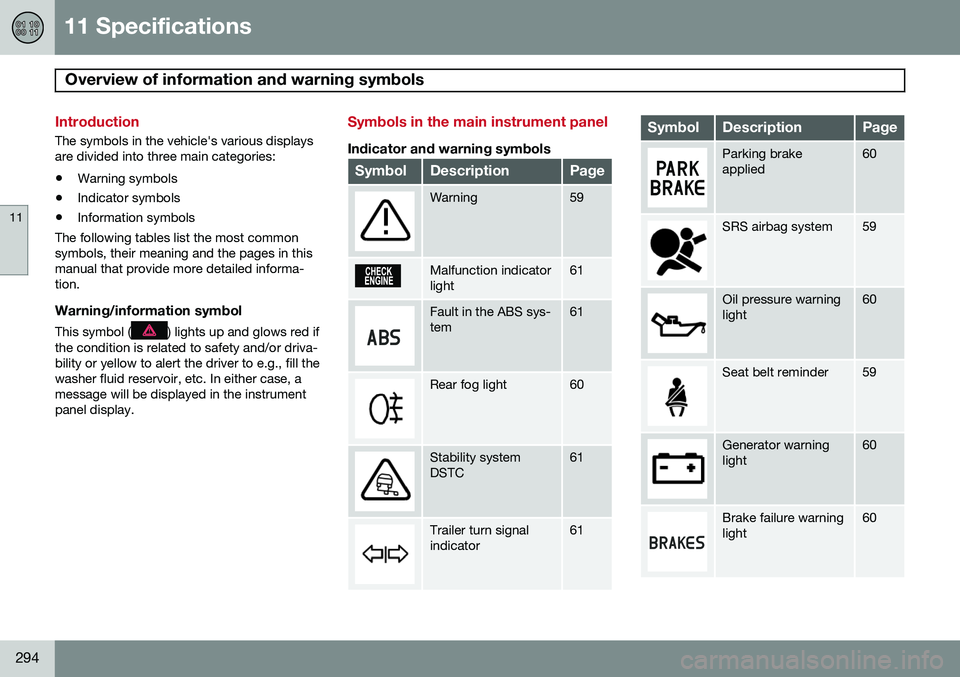
Introduction
The symbols in the vehicle's various displays are divided into three main categories:• Warning symbols
• Indicator symbols
• Information symbols
The following tables list the most commonsymbols, their meaning and the pages in thismanual that provide more detailed informa-tion.
Warning/information symbol
This symbol () lights up and glows red if
the condition is related to safety and/or driva- bility or yellow to alert the driver to e.g., fill thewasher fluid reservoir, etc. In either case, amessage will be displayed in the instrumentpanel display.
Symbols in the main instrument panel
Indicator and warning symbols
SymbolDescriptionPage
Warning59
Malfunction indicator light61
Fault in the ABS sys- tem61
Rear fog light60
Stability system DSTC61
Trailer turn signal indicator61
SymbolDescriptionPage
Parking brake applied60
SRS airbag system59
Oil pressure warning light60
Seat belt reminder59
Generator warning light60
Brake failure warning light60
Page 301 of 308
12 Index
12
299
Central locking system - remote key....... 127
Changing a wheel.................................... 200
Changing coolant.................................... 220
Charge air cooler..................................... 291
Check Engine warning light....................... 61
Child restraint anchors......................... 49, 51Child restraints recalls and registration......................... 40
Child restraint systems.............................. 41
Child safety................................................ 38
Child safety locks.................................... 132
Climate system.......................................... 94 refrigerant............................................. 94
Clock reset button..................................... 58
Coat hanger............................................. 117
Cold weather precautions........................ 169Compact disc care CD care............................................... 272
Convertible seats....................................... 45
Coolant.................................................... 224 changing............................................. 220
Courtesy light........................................... 111Cup holder rear seat.............................................. 116 Curb weight............................................. 187
Current fuel consumption.......................... 76
D
Daytime running lights............................... 68 Defroster
rear window and door mirrors.............. 75
rear window and mirrors..................... 100
windshield............................................. 99
Detachable trailer hitch............................ 167
Dimensions.............................................. 284Disabling the passenger's side front air-
bag............................................................. 28
Display, instrument panel.......................... 58
Dolby Pro Logic II (DPL II)........................ 255
Door mirrors............................................... 85 defroster............................................... 75
Door mirrors, folding.................................. 64
Driver distraction warning.......................... 14
Driving conditions, difficult...................... 147
Driving economically................................ 146
Driving through water.............................. 147
E
Economical driving.................................. 146
Electrically operated moonroof.................. 87
Electrical system...................................... 292
Emergency locking retractor...................... 39
Emission inspection readiness................ 217Engine specifications...................................... 291
starting................................................ 143
Engine oil................................................. 222 checking............................................. 222
specifications...................................... 290
Environment............................................... 13
F
Federal Clean Air Act............................... 216 Flat tires changing............................................. 198
repairing with tire sealing system....... 192
Floor mats cleaning.............................................. 211
placing correctly................................. 143
Fog light............................................... 60, 69