weight VOLVO XC90 2014 Owner´s Manual
[x] Cancel search | Manufacturer: VOLVO, Model Year: 2014, Model line: XC90, Model: VOLVO XC90 2014Pages: 308, PDF Size: 13.31 MB
Page 167 of 308
06 Starting and driving
Towing a trailer
06
165
Points to keep in mind when towing a trailer
•When towing trailers
without brakes, the
maximum permissible trailer weight is 1,700 lbs (750 kg).
• If necessary, redistribute the weight ofany cargo in the trailer to avoid excessiveweight on the trailer hitch.
• The maximum trailer weight listed in thetable for All Wheel Drive models,5,000 lbs (2250 kg) is only applicablewhen there are not more than two occu-pants in the vehicle, in the front seats,with a combined weight of 300 lbs(135 kg), with no other cargo in the vehi-cle.
• The maximum weight listed for FrontWheel Drive models, 4,000 lbs (1800 kg)is only applicable when there are notmore than four occupants in the vehicle,in the front seats and second row ofseats, with a combined weight of 600 lbs(270 kg), with no other cargo in the vehi-cle.
• Vehicles used for towing a trailer on aregular basis, or for long-distance high-way towing should be equipped with anautomatic transmission oil cooler andVolvo's automatic self-leveling system forthe rear suspension. Consult your Volvoretailer. •
Volvo recommends the use of Volvotrailer hitches that are specially designedfor the vehicle.
• All Volvo models are equipped withenergy-absorbing shock-mounted bump-ers. Trailer hitch installation should notinterfere with the proper operation of thisbumper system.
• Increase tire pressure to recommendedfull inflation pressure. See chapter"Wheels and tires."
• When your vehicle is new, avoid towingheavy trailers during the first 620 miles(1,000 km).
• Engine and transmission are subject toincreased loads. Therefore, engine cool-ant temperature should be closelywatched when driving in hot climates orhilly terrain. Use a lower gear and turn offthe air conditioner if the temperaturegauge needle enters the red range.
• If the automatic transmission begins tooverheat, a message will be displayed inthe text window.
• Hauling a trailer affects handling, durabil-ity, and economy.
• It is necessary to balance trailer brakeswith the towing vehicle brakes to providea safe stop (check and observe state/local regulations). •
Do not connect the trailer's brake systemdirectly to the vehicle's brake system.
• Remove the ball and drawbar assemblywhen the hitch is not being used.
• Volvo recommends the use of syntheticengine oil when towing a trailer over longdistances or in mountainous areas.
NOTE
•When parking the vehicle with a trailer on a hill, apply the parking brakebefore putting the gear selector in
P.
When starting on a hill, put the gearselector in D before releasing the park-
ing brake. Always follow the trailermanufacturer's recommendations forwheel chocking.
• If you use the manual (Geartronic) shiftpositions while towing a trailer, makesure the gear you select does not puttoo much strain on the engine (usingtoo high a gear).
Page 170 of 308
06 Starting and driving
Load carriers (accessory)
06
168
Positioning load carriersIf wing-shaped load carriers are used, make sure that they are installed on the roof railswith the rounded edge forward. Load carriersof this type are identical and can be placedanywhere along the roof rails. When not in use, we recommend that the front load carrier be placed approximately2 inches (5 cm) in front of the center roof railanchorage point and the rear load carrierapproximately 1.5 inches (3.5 cm) in front ofthe rear rail anchorage. This will help toreduce wind noise.
Installing load carriersMake sure that the load carriers are pressedfirmly out against the roof rail and securelytightened place. Check regularly that any loadcarriers are securely in place.
WARNING
Loads carried on the vehicle's roof should not exceed 220 lbs (100 kg), including theweight of the load carriers and any otherload carrying equipment (ski boxes, bicy-cle racks, etc.). Excessive loads on theroof can adversely affect the handling androadholding characteristics of the vehicle.
Page 188 of 308
07 Wheels and tires
Glossary of tire terminology
07
186
•Tire information placard:
A placard
showing the OE (Original Equipment) tire sizes, recommended inflation pressure,and the maximum weight the vehicle cancarry.
• Tire Identification Number (TIN):
A
number on the sidewall of each tire pro-viding information about the tire brandand manufacturing plant, tire size anddate of manufacturer.
• Inflation pressure:
A measure of the
amount of air in a tire.
• Standard load:
A class of P-metric or
Metric tires designed to carry a maximumload at 35 psi [37 psi (2.5 bar) for Metrictires]. Increasing the inflation pressurebeyond this pressure will not increase thetires load carrying capability.
• Extra load:
A class of P-metric or Metric
tires designed to carry a heavier maxi-mum load at 41 psi [43 psi (2.9 bar) forMetric tires]. Increasing the inflation pres-sure beyond this pressure will notincrease the tires load carrying capability.
• kPa:
Kilopascal, a metric unit of air pres-
sure.
• PSI:
Pounds per square inch, a standard
unit of air pressure.
• B-pillar:
The structural member at the
side of the vehicle behind the front door. •
Bead area of the tire:
Area of the tire
next to the rim.
• Sidewall of the tire:
Area between the
bead area and the tread.
• Tread area of the tire:
Area of the perim-
eter of the tire that contacts the roadwhen mounted on the vehicle.
• Rim:
The metal support (wheel) for a tire
or a tire and tube assembly upon whichthe tire beads are seated.
• Maximum load rating:
a figure indicating
the maximum load in pounds and kilo-grams that can be carried by the tire. Thisrating is established by the tire manufac-turer.
• Maximum permissible inflation pres- sure:
the greatest amount of air pressure
that should ever be put in the tire. This limit is set by the tire manufacturer.
• Recommended tire inflation pressure: inflation pressure, established by Volvo, which is based on the type of tires thatare mounted on a vehicle at the factory.This information can be found on the tireinflation placard(s) located on the driver'sside B-pillar and in the tire inflation tablein this chapter.
• Cold tires:
The tires are considered to be
cold when they have the same tempera-ture as the surrounding (ambient) air. Thistemperature is normally reached after the vehicle has been parked for at least 3hours.
Page 189 of 308
07 Wheels and tires
Vehicle loading
07
187
Properly loading your vehicle will provide maximum return of vehicle design perform-ance. Before loading your vehicle, familiarize your- self with the following terms for determiningyour vehicle's weight ratings, with or withouta trailer, from the vehicle's Federal/ CanadianMotor Vehicle Safety Standards (FMVSS/CMVSS) label, and the vehicle's tire informa-tion placard.
Curb weightThe weight of the vehicle including a full tankof fuel and all standard equipment. It doesnot include passengers, cargo, or optionalequipment.
Capacity weightAll weight added to the curb weight, includingcargo and optional equipment. When towing,trailer hitch tongue load is also part of cargoweight.
NOTE
For trailer towing information, please refer to the section "Towing a trailer."
Permissible axle weightThe maximum allowable weight that can be carried by a single axle (front or rear). Thesenumbers are shown on the Federal/CanadianMotor Vehicle Safety Standards (FMVSS/CMVSS) label. The total load on each axlemust never exceed its maximum permissibleweight.
Gross vehicle weight (GVW)The vehicle's curb weight + cargo + passen-gers. A table listing important weight limits for your vehicle, is in chapter "Dimension andweights". For the location of the various labels in your vehicle, see page 282
Steps for Determining Correct Load Limit
•
Locate the statement "the combined weight of occupants and cargo shouldnever exceed XXX pounds" on your vehi-cle's placard.
• Determine the combined weight of thedriver and passengers that will be ridingin your vehicle. •
Subtract the combined weight of thedriver and passengers from XXX kilo-grams or XXX pounds.
• The resulting figure equals the availableamount of cargo and luggage loadcapacity. For example, if the "XXX"amount equals 1400 lbs. and there will befive 150 lb. passengers in your vehicle,the amount of available cargo and lug-gage load capacity is 650 lbs. (1400-750(5 x 150) = 650 lbs.)
• Determine the combined weight of lug-gage and cargo being loaded on the vehi-cle. That weight may not safely exceedthe available cargo and luggage loadcapacity calculated in Step 4.
• If your vehicle will be towing a trailer, loadfrom your trailer will be transferred to your vehicle. Consult this manual 1
to deter-
mine how this reduces the available cargo and luggage load capacity of yourvehicle.
1 For "Towing a trailer" see page 164.
Page 190 of 308
07 Wheels and tires
Vehicle loading
07
188
WARNING
•Exceeding the permissible axle weight, gross vehicle weight, or any otherweight rating limits can cause tireoverheating resulting in permanentdeformation or catastrophic failure.
• Do not use replacement tires withlower load carrying capacities than thetires that were original equipment onthe vehicle because this will lower thevehicle's GVW rating. Use only tireswith the correct load carrying capacity.Consult your Volvo retailer for informa-tion.
Page 203 of 308
07 Wheels and tires
Changing wheels
07
201
the vehicle, check that the jack is still cor- rectly positioned in the attachment.
7. Raise the vehicle until the wheel to be changed is lifted off the ground.
8. Unscrew the wheel bolts completely and carefully remove the wheel so as not todamage the threads on the studs.
NOTE
To avoid excessive wear and the necessity of rebalancing, mark and reinstall wheelsin the same location and position as beforeremoval. To lessen the chance of imbal-ance, each wheel hub is equipped with aguide stud to ensure that a removed wheelcan be reinstalled in its original position (aswhen changing over to winter tires/wheels).
CAUTION
•The vehicle must not be driven with wheels of different dimensions or witha spare tire other than the one thatcame with the vehicle. The use of dif-ferent size wheels can seriously dam-age your vehicle's transmission.
• Correct tightening torque on wheelbolts must be observed.
• The wheel bolts should never begreased or lubricated.
• Extended, chromed wheel bolts mustnot be used with steel rims, as theymake it impossible to fit the hub caps.
Installing the wheel1. Clean the contact surfaces on the wheel
and hub.
2. Lift the wheel and place it on the hub.
3. Install the wheel bolts and tighten hand- tight. Using the lug wrench, tighten cross- wise until all bolts are snug.
4. Lower the vehicle to the ground and alter- nately tighten the bolts crosswise to103 ft.lbs. (140 Nm).
5. Install the wheel cover (where applicable).
WARNING
• The jack must correctly engage the bar in the jack attachment. The vehicle'sweight must not rest on the jackattachment. See illustration "Attachingthe jack" on the previous page.
• Be sure the jack is on a firm, level,non-slippery surface.
• Never allow any part of your body tobe extended under a vehicle suppor-ted by a jack.
• Use the jack intended for the vehiclewhen replacing a wheel. For any otherjob, use stands to support the side ofthe vehicle being worked on.
• Apply the parking brake and put thegear selector in the (
P)ark position.
• Block the wheels standing on theground, use rigid wooden blocks orlarge stones.
• The jack should be kept well-greasedand clean, and should not be dam-aged.
• No objects should be placed betweenthe base of jack and the ground, orbetween the jack and the attachmentbar on the vehicle.
Page 221 of 308
09 Maintenance and servicing
Working on your vehicle09
219
Note the following before you begin work- ing on your vehicle:
Battery
•
Ensure that the battery cables are cor- rectly connected and tightened.
• Never disconnect the battery when theengine is running (e.g., when replacingthe battery).
• Never use a fast charger to charge thebattery. The battery cables should be dis-connected when recharging.
• The battery contains acid that is both cor-rosive and poisonous. It is important thatthe battery is handled in an environmen-tally friendly way. See page 227 for moreinformation on handling the battery.
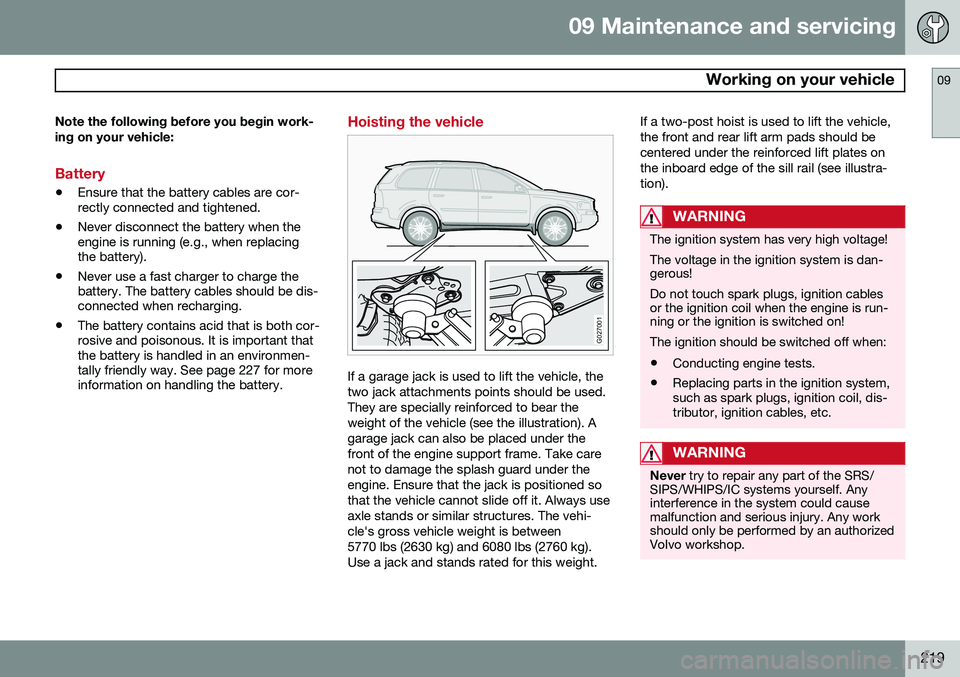
Hoisting the vehicle
G027001
If a garage jack is used to lift the vehicle, the two jack attachments points should be used.They are specially reinforced to bear theweight of the vehicle (see the illustration). Agarage jack can also be placed under thefront of the engine support frame. Take carenot to damage the splash guard under theengine. Ensure that the jack is positioned sothat the vehicle cannot slide off it. Always useaxle stands or similar structures. The vehi-cle's gross vehicle weight is between5770 lbs (2630 kg) and 6080 lbs (2760 kg).Use a jack and stands rated for this weight. If a two-post hoist is used to lift the vehicle,the front and rear lift arm pads should becentered under the reinforced lift plates onthe inboard edge of the sill rail (see illustra-tion).
WARNING
The ignition system has very high voltage! The voltage in the ignition system is dan- gerous! Do not touch spark plugs, ignition cables or the ignition coil when the engine is run-ning or the ignition is switched on! The ignition should be switched off when: •
Conducting engine tests.
• Replacing parts in the ignition system, such as spark plugs, ignition coil, dis-tributor, ignition cables, etc.
WARNING
Never
try to repair any part of the SRS/
SIPS/WHIPS/IC systems yourself. Any interference in the system could causemalfunction and serious injury. Any workshould only be performed by an authorizedVolvo workshop.
Page 246 of 308
09 Maintenance and servicing
Fuses 09
244* Option/accessory, for more information, see Introduction.
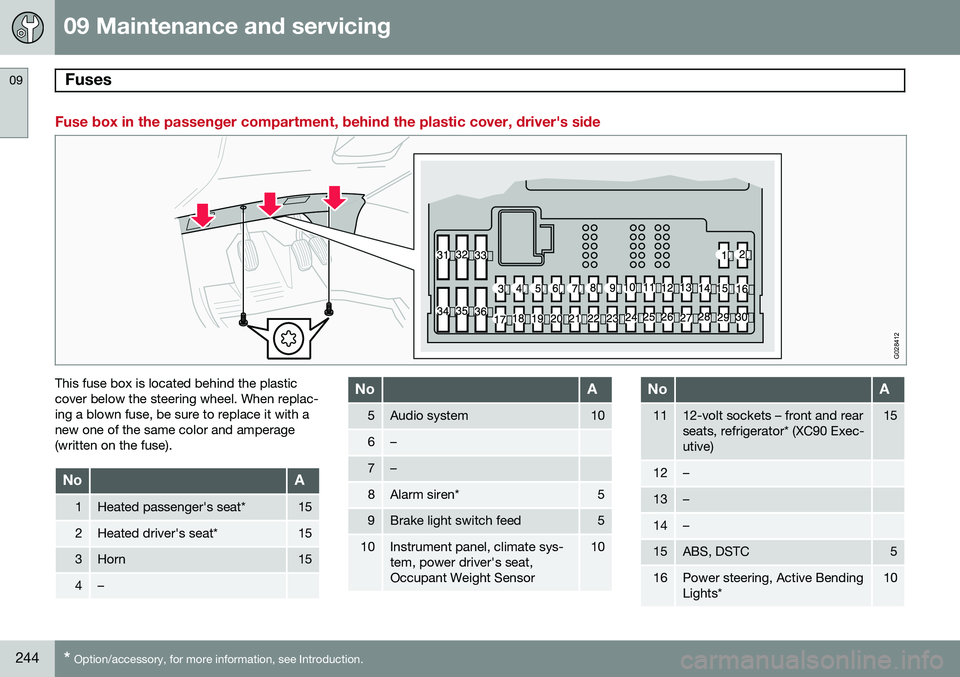
Fuse box in the passenger compartment, behind the plastic cover, driver's side
G028412
This fuse box is located behind the plastic cover below the steering wheel. When replac-ing a blown fuse, be sure to replace it with anew one of the same color and amperage(written on the fuse).
NoA
1Heated passenger's seat*15
2Heated driver's seat*15
3Horn15
4–
NoA
5Audio system10
6–
7–
8Alarm siren*5
9Brake light switch feed5
10Instrument panel, climate sys- tem, power driver's seat,Occupant Weight Sensor10
NoA
1112-volt sockets – front and rear seats, refrigerator* (XC90 Exec-utive)15
12–
13–
14–
15ABS, DSTC5
16Power steering, Active Bending Lights*10
Page 282 of 308
280
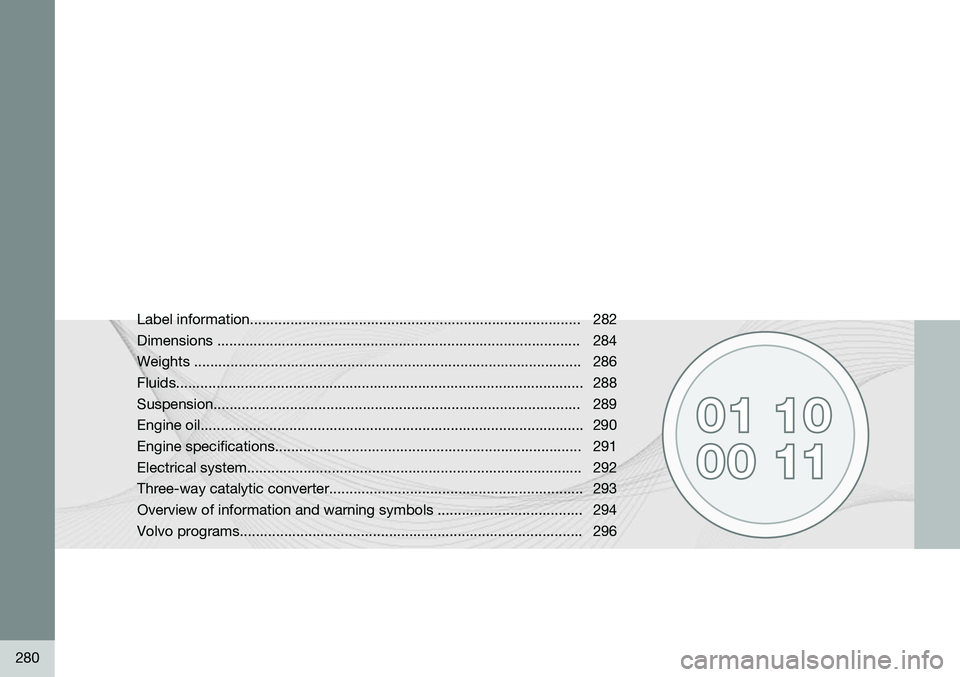
Label information.................................................................................. 282 Dimensions .......................................................................................... 284Weights ................................................................................................ 286Fluids..................................................................................................... 288Suspension........................................................................................... 289Engine oil............................................................................................... 290
Engine specifications............................................................................ 291
Electrical system...................................................................................292
Three-way catalytic converter............................................................... 293
Overview of information and warning symbols .................................... 294
Volvo programs..................................................................................... 296
Page 288 of 308
11 Specifications
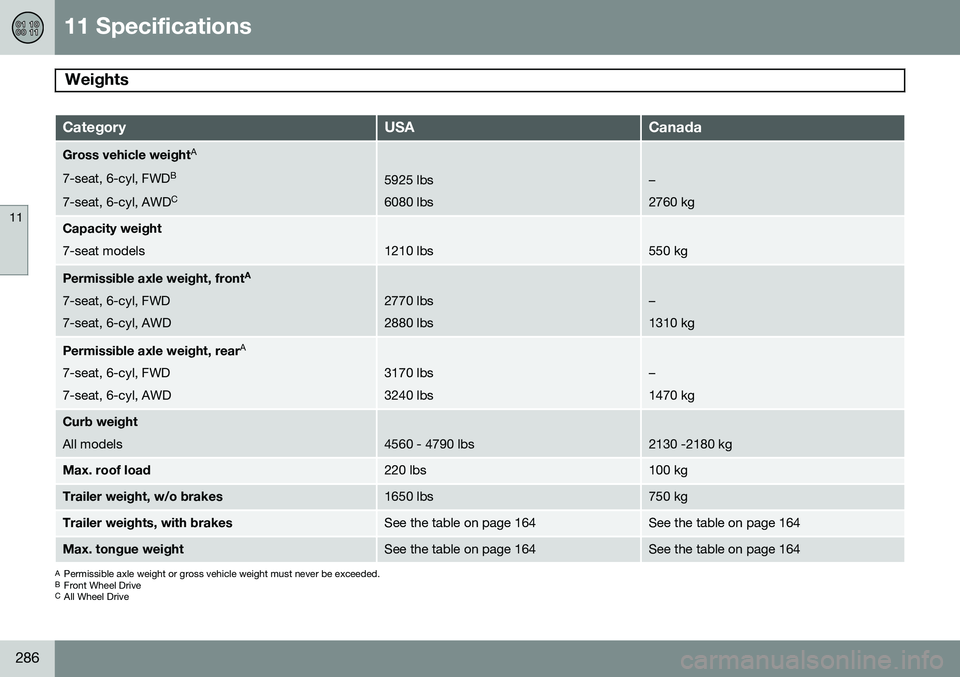
Weights
11
286
CategoryUSACanada
Gross vehicle weightA
7-seat, 6-cyl, FWD B
7-seat, 6-cyl, AWD C
5925 lbs 6080 lbs– 2760 kg
Capacity weight 7-seat models
1210 lbs550 kg
Permissible axle weight, front A
7-seat, 6-cyl, FWD 7-seat, 6-cyl, AWD
2770 lbs 2880 lbs– 1310 kg
Permissible axle weight, rear A
7-seat, 6-cyl, FWD 7-seat, 6-cyl, AWD
3170 lbs 3240 lbs– 1470 kg
Curb weight All models
4560 - 4790 lbs2130 -2180 kg
Max. roof load220 lbs100 kg
Trailer weight, w/o brakes1650 lbs750 kg
Trailer weights, with brakesSee the table on page 164See the table on page 164
Max. tongue weightSee the table on page 164See the table on page 164
A Permissible axle weight or gross vehicle weight must never be exceeded.
B Front Wheel Drive
C All Wheel Drive