weight VOLVO XC90 2014 Owner´s Manual
[x] Cancel search | Manufacturer: VOLVO, Model Year: 2014, Model line: XC90, Model: VOLVO XC90 2014Pages: 308, PDF Size: 13.31 MB
Page 43 of 308
01 Safety
Child restraint systems01
41
Child restraints
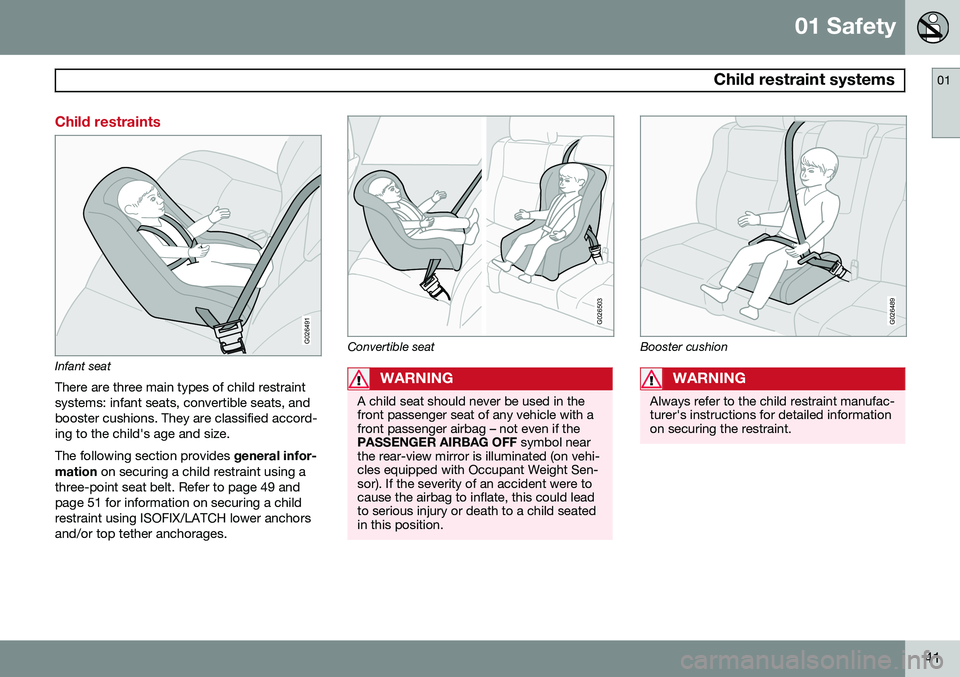
G026491
Infant seat
There are three main types of child restraint systems: infant seats, convertible seats, andbooster cushions. They are classified accord-ing to the child's age and size. The following section provides general infor-
mation on securing a child restraint using a
three-point seat belt. Refer to page 49 and page 51 for information on securing a childrestraint using ISOFIX/LATCH lower anchorsand/or top tether anchorages.
G026503
Convertible seat
WARNING
A child seat should never be used in the front passenger seat of any vehicle with afront passenger airbag – not even if thePASSENGER AIRBAG OFF symbol near
the rear-view mirror is illuminated (on vehi-cles equipped with Occupant Weight Sen-sor). If the severity of an accident were tocause the airbag to inflate, this could leadto serious injury or death to a child seatedin this position.
G026489
Booster cushion
WARNING
Always refer to the child restraint manufac- turer's instructions for detailed informationon securing the restraint.
Page 44 of 308
01 Safety
Child restraint systems 01
42
WARNING
•When not in use, keep the child restraint system secured or remove itfrom the passenger compartment tohelp prevent it from injuring passen-gers in the event of a sudden stop orcollision.
• A small child's head represents a con-siderable part of its total weight and itsneck is still very weak. Volvo recom-mends that children up to age 4 travel,properly restrained, facing rearward. Inaddition, Volvo recommends that chil-dren should ride rearward facing,properly restrained, as long as possi-ble.
Page 45 of 308
01 Safety
Infant seats01
43
Securing an infant seat with a seat belt
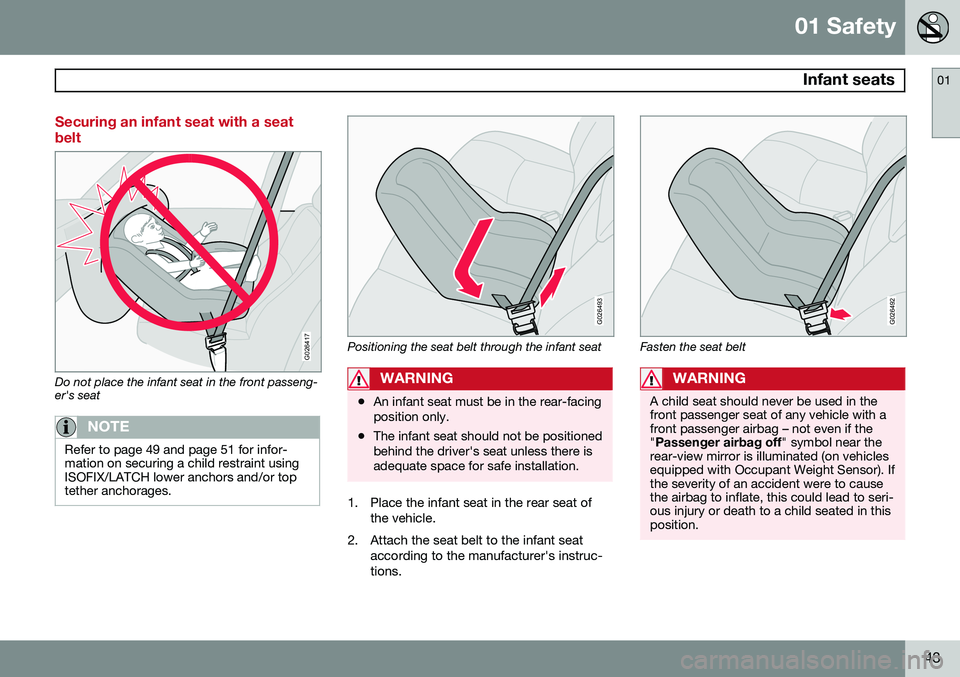
G026417
Do not place the infant seat in the front passeng- er's seat
NOTE
Refer to page 49 and page 51 for infor- mation on securing a child restraint usingISOFIX/LATCH lower anchors and/or toptether anchorages.
G026493
Positioning the seat belt through the infant seat
WARNING
•An infant seat must be in the rear-facing position only.
• The infant seat should not be positionedbehind the driver's seat unless there isadequate space for safe installation.
1. Place the infant seat in the rear seat of
the vehicle.
2. Attach the seat belt to the infant seat according to the manufacturer's instruc- tions.
G026492
Fasten the seat belt
WARNING
A child seat should never be used in the front passenger seat of any vehicle with afront passenger airbag – not even if the"Passenger airbag off " symbol near the
rear-view mirror is illuminated (on vehiclesequipped with Occupant Weight Sensor). Ifthe severity of an accident were to causethe airbag to inflate, this could lead to seri-ous injury or death to a child seated in thisposition.
Page 47 of 308
01 Safety
Convertible seats01
45
Securing a convertible seat with a seat belt
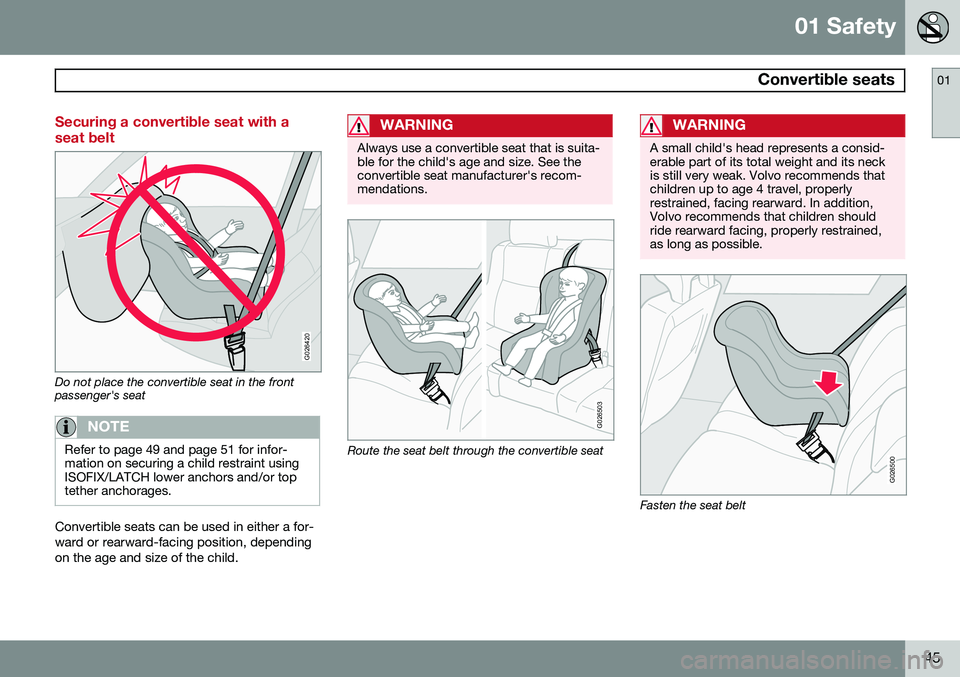
G026420
Do not place the convertible seat in the front passenger's seat
NOTE
Refer to page 49 and page 51 for infor- mation on securing a child restraint usingISOFIX/LATCH lower anchors and/or toptether anchorages.
Convertible seats can be used in either a for- ward or rearward-facing position, dependingon the age and size of the child.
WARNING
Always use a convertible seat that is suita- ble for the child's age and size. See theconvertible seat manufacturer's recom-mendations.
G026503
Route the seat belt through the convertible seat
WARNING
A small child's head represents a consid- erable part of its total weight and its neckis still very weak. Volvo recommends thatchildren up to age 4 travel, properlyrestrained, facing rearward. In addition,Volvo recommends that children shouldride rearward facing, properly restrained,as long as possible.
G026500
Fasten the seat belt
Page 49 of 308
01 Safety
Convertible seats01
47
WARNING
A child seat should never be used in the front passenger seat of any vehicle with afront passenger airbag – not even if thePASSENGER AIRBAG OFF symbol near
the rear-view mirror is illuminated (on vehi-cles equipped with Occupant Weight Sen-sor). If the severity of an accident were tocause the airbag to inflate, this could leadto serious injury or death to a child seatedin this position.
Page 51 of 308

01 Safety
ISOFIX/LATCH lower anchors01
49
Using the ISOFIX/LATCH lower child seat anchors
G015268
ISOFIX/LATCH lower child restraint anchorsLower anchors for ISOFIX/LATCH-equipped child seats are located in the second row,outboard seats, hidden below the backrestcushions. Symbols on the seat back uphols-tery mark the anchor positions (see the illus-tration).
To access the anchors:1. Put the child restraint in position.
2. Kneel on the child restraint to press down the seat cushion and locate the anchors by feel. 3. Fasten the attachment on the child
restraint's lower straps to the ISOFIX/LATCH lower anchors.
4. Firmly tension the lower child seat straps according to the manufacturer's instruc-tions.
WARNING
Volvo's ISOFIX/LATCH anchors conform to FMVSS/CMVSS standards. Always refer tothe child restraint system's manual forweight and size ratings.
WARNING
The ISOFIX/LATCH lower child restraint anchors are only intended for use withchild seats positioned in the outboardseating positions. These anchors are notcertified for use with any child restraintthat is positioned in the center seatingposition. When securing a child restraint inthe center seating position, use only thevehicle's center seat belt.
NOTE
•The rear seat's center position is not equipped with ISOFIX/LATCH loweranchors. When installing a childrestraint in this position, attach therestraint's top tether strap (if it is soequipped) to the top tether anchoragepoint and secure the restraint with thevehicle's center seat belt.
• Always follow your child seat manufac-turer's installation instructions, anduse both ISOFIX/LATCH lower anchorsand top tethers whenever possible.
G031682
Fasten the attachment correctly to the ISOFIX/ LATCH lower anchors
Page 54 of 308
01 Safety
Integrated booster cushion 01
52* Option/accessory, for more information, see Introduction.
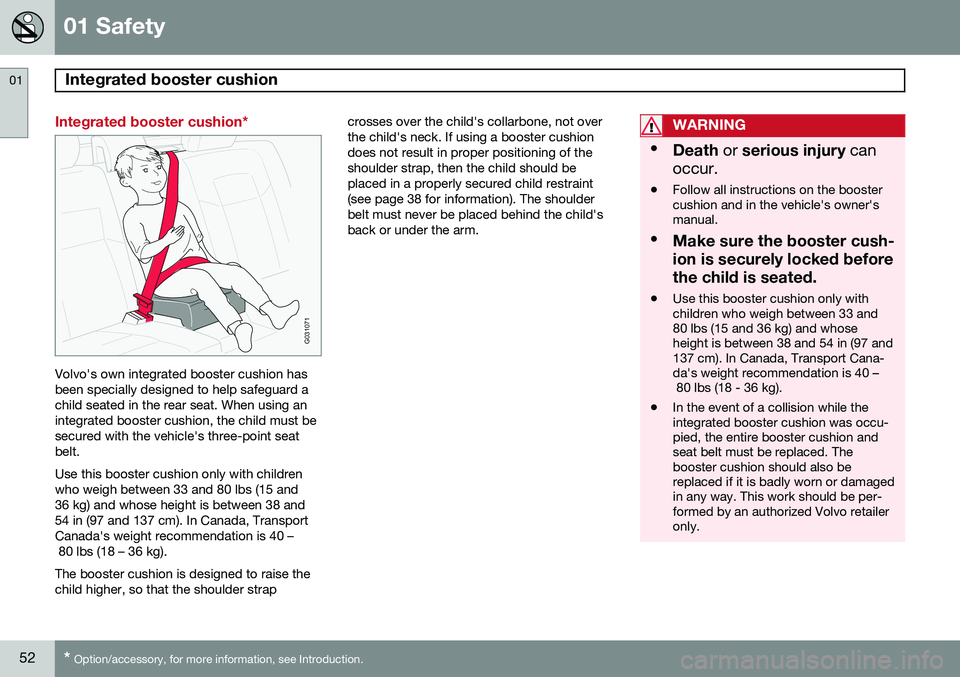
Integrated booster cushion*
G031071
Volvo's own integrated booster cushion has been specially designed to help safeguard achild seated in the rear seat. When using anintegrated booster cushion, the child must besecured with the vehicle's three-point seatbelt. Use this booster cushion only with children who weigh between 33 and 80 lbs (15 and36 kg) and whose height is between 38 and54 in (97 and 137 cm). In Canada, TransportCanada's weight recommendation is 40 – 80 lbs (18 – 36 kg). The booster cushion is designed to raise the child higher, so that the shoulder strap crosses over the child's collarbone, not overthe child's neck. If using a booster cushiondoes not result in proper positioning of theshoulder strap, then the child should beplaced in a properly secured child restraint(see page 38 for information). The shoulderbelt must never be placed behind the child'sback or under the arm.
WARNING
•
Death or serious injury can
occur.
• Follow all instructions on the booster cushion and in the vehicle's owner'smanual.
• Make sure the booster cush- ion is securely locked beforethe child is seated.
• Use this booster cushion only with children who weigh between 33 and80 lbs (15 and 36 kg) and whoseheight is between 38 and 54 in (97 and137 cm). In Canada, Transport Cana-da's weight recommendation is 40 – 80 lbs (18 - 36 kg).
• In the event of a collision while theintegrated booster cushion was occu-pied, the entire booster cushion andseat belt must be replaced. Thebooster cushion should also bereplaced if it is badly worn or damagedin any way. This work should be per-formed by an authorized Volvo retaileronly.
Page 121 of 308
04 Interior
Securing cargo
04
119
G027031
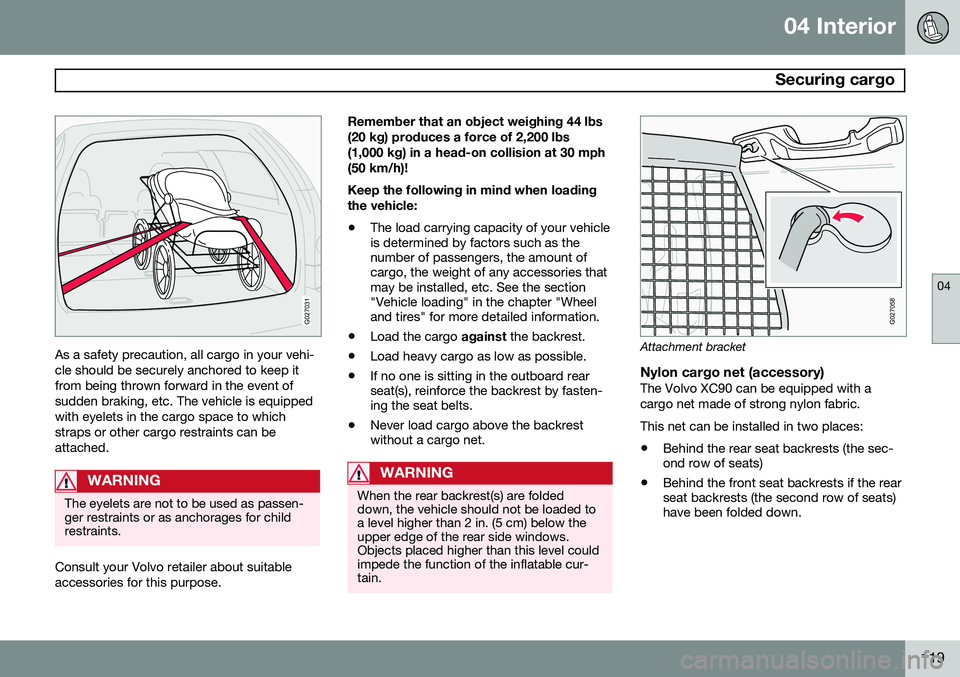
As a safety precaution, all cargo in your vehi- cle should be securely anchored to keep itfrom being thrown forward in the event ofsudden braking, etc. The vehicle is equippedwith eyelets in the cargo space to whichstraps or other cargo restraints can beattached.
WARNING
The eyelets are not to be used as passen- ger restraints or as anchorages for childrestraints.
Consult your Volvo retailer about suitable accessories for this purpose.Remember that an object weighing 44 lbs(20 kg) produces a force of 2,200 lbs(1,000 kg) in a head-on collision at 30 mph(50 km/h)! Keep the following in mind when loading the vehicle:
• The load carrying capacity of your vehicle is determined by factors such as thenumber of passengers, the amount ofcargo, the weight of any accessories thatmay be installed, etc. See the section"Vehicle loading" in the chapter "Wheeland tires" for more detailed information.
• Load the cargo
against the backrest.
• Load heavy cargo as low as possible.
• If no one is sitting in the outboard rearseat(s), reinforce the backrest by fasten-ing the seat belts.
• Never load cargo above the backrestwithout a cargo net.
WARNING
When the rear backrest(s) are folded down, the vehicle should not be loaded toa level higher than 2 in. (5 cm) below theupper edge of the rear side windows.Objects placed higher than this level couldimpede the function of the inflatable cur-tain.
G027058
Attachment bracket
Nylon cargo net (accessory)The Volvo XC90 can be equipped with a cargo net made of strong nylon fabric. This net can be installed in two places:
• Behind the rear seat backrests (the sec- ond row of seats)
• Behind the front seat backrests if the rearseat backrests (the second row of seats)have been folded down.
Page 142 of 308
06 Starting and driving
Fuel requirements
06
140
WARNING
Driving with the tailgate open: Driving
with the tailgate open could lead to poi- sonous exhaust gases entering the pas-senger compartment.
• If the tailgate must be kept open for any reason, proceed as follows:
• Close the windows
• Set the ventilation system control to airflow to floor, windshield and side win-dows and blower control to its highestsetting.
Gasoline containing alcohol and ethers, "Oxygenated fuels"
Some fuel suppliers sell gasoline containing "oxygenates" which are usually alcohols orethers. In some areas, state or local lawsrequire that the service pump be marked indi-cating use of alcohols or ethers. However,there are areas in which the pumps areunmarked. If you are not sure whether there isalcohol or ethers in the gasoline you buy,check with the service station operator. Tomeet seasonal air quality standards, someareas require the use of "oxygenated" fuel. Volvo allows the use of the following "oxy- genated" fuels; however, the octane ratingslisted on page 139 must still be met.
Alcohol – EthanolFuels containing up to 10% ethanol by vol- ume may be used. Ethanol may also be refer-red to as Ethyl alcohol, or "Gasohol". Ethers – MTBE: Fuels containing up to 15% MTBE may be used.
MethanolDo not use gasolines containing methanol(methyl alcohol, wood alcohol). This practicecan result in vehicle performance deteriora-tion and can damage critical parts in the fuelsystem. Such damage may not be coveredunder the New Vehicle Limited Warranty.
Weight distribution affects handlingAt the specified curb weight your vehicle hasa tendency to understeer, which means thatthe steering wheel has to be turned morethan might seem appropriate for the curva-ture of a bend. This ensures good stability and reduces the risk of rear wheel skid. Remember that theseproperties can alter with the vehicle load. The heavier the load in the cargo area, the less the tendency to understeer.
Handling, roadholdingVehicle load, tire design and inflation pres-sure all affect vehicle handling. Therefore,check that the tires are inflated to the recom- mended pressure according to the vehicleload. See "Tire pressure" section. Loads should be distributed so that capacity weight or maximum permissible axle loadsare not exceeded.
Conserving electrical currentKeep the following in mind to help minimizebattery drain:
• When the engine is not running, avoid turning the ignition key to position
II (see
page 145). Many electrical systems (theaudio system, the optional infotainment/navigation systems, power windows, etc)will function with the ignition key in posi-tion I. This position reduces drain on the
battery.
• Please keep in mind that using systems,accessories, etc that consume a greatdeal of current when the engine is notrunning could result in the battery beingcompletely drained. Driving or having theengine running for approximately15 minutes will help keep the batterycharged.
NOTE
A warning message will be displayed in the text window in the instrument panel whenthe battery charge is low.
Page 166 of 308
06 Starting and driving
Towing a trailer
06
164* Option/accessory, for more information, see Introduction.
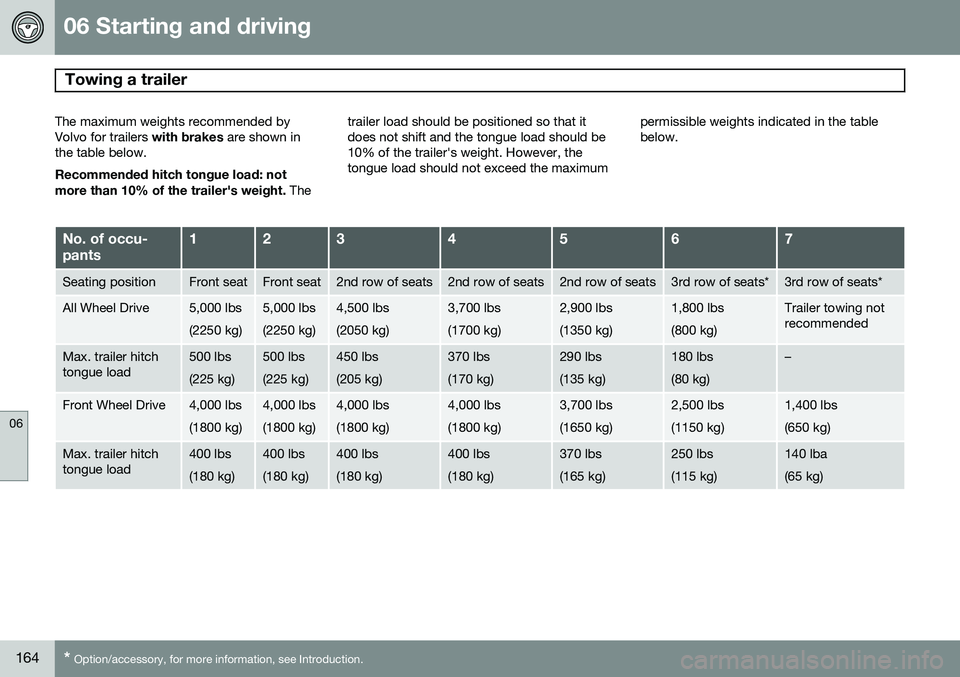
The maximum weights recommended by Volvo for trailers with brakes are shown in
the table below. Recommended hitch tongue load: not more than 10% of the trailer's weight. Thetrailer load should be positioned so that it does not shift and the tongue load should be10% of the trailer's weight. However, thetongue load should not exceed the maximum
permissible weights indicated in the tablebelow.
No. of occu- pants1234567
Seating positionFront seatFront seat2nd row of seats2nd row of seats2nd row of seats3rd row of seats*3rd row of seats*
All Wheel Drive5,000 lbs (2250 kg)5,000 lbs (2250 kg)4,500 lbs (2050 kg)3,700 lbs (1700 kg)2,900 lbs (1350 kg)1,800 lbs (800 kg)Trailer towing not recommended
Max. trailer hitch tongue load500 lbs (225 kg)500 lbs (225 kg)450 lbs (205 kg)370 lbs (170 kg)290 lbs (135 kg)180 lbs (80 kg)–
Front Wheel Drive4,000 lbs (1800 kg)4,000 lbs (1800 kg)4,000 lbs (1800 kg)4,000 lbs (1800 kg)3,700 lbs (1650 kg)2,500 lbs (1150 kg)1,400 lbs (650 kg)
Max. trailer hitch tongue load400 lbs (180 kg)400 lbs (180 kg)400 lbs (180 kg)400 lbs (180 kg)370 lbs (165 kg)250 lbs (115 kg)140 lba (65 kg)