wheel VOLVO XC90 2014 Owner´s Manual
[x] Cancel search | Manufacturer: VOLVO, Model Year: 2014, Model line: XC90, Model: VOLVO XC90 2014Pages: 308, PDF Size: 13.31 MB
Page 132 of 308
05 Locks and alarm
Locking and unlocking
05
130
G029646
Locking and unlocking the vehicle from
the inside
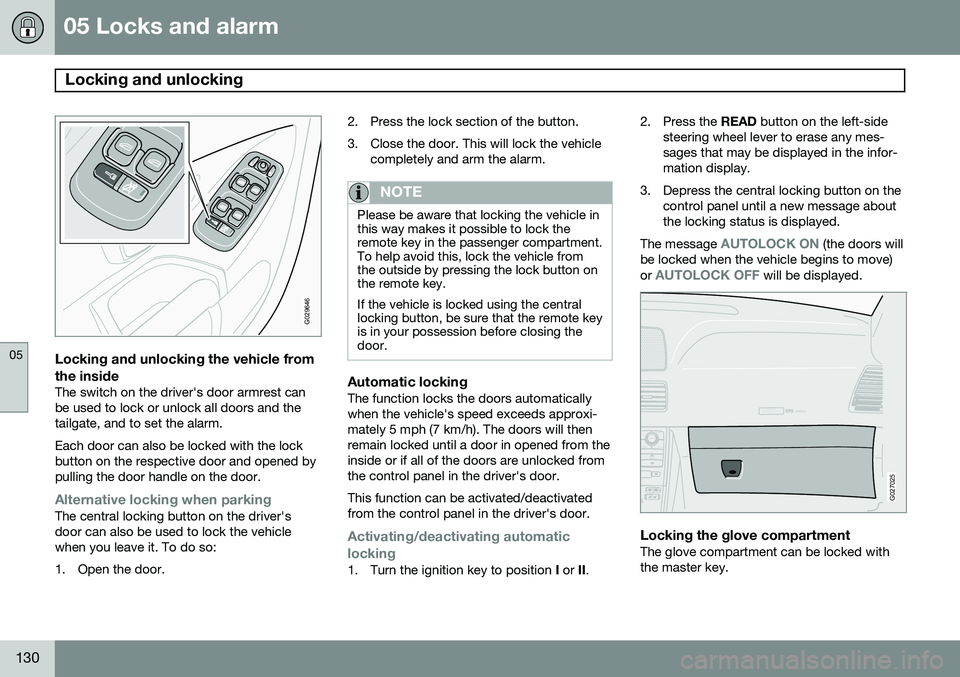
The switch on the driver's door armrest can be used to lock or unlock all doors and thetailgate, and to set the alarm. Each door can also be locked with the lock button on the respective door and opened bypulling the door handle on the door.
Alternative locking when parkingThe central locking button on the driver's door can also be used to lock the vehiclewhen you leave it. To do so:
1. Open the door. 2. Press the lock section of the button.
3. Close the door. This will lock the vehicle
completely and arm the alarm.
NOTE
Please be aware that locking the vehicle in this way makes it possible to lock theremote key in the passenger compartment.To help avoid this, lock the vehicle fromthe outside by pressing the lock button onthe remote key. If the vehicle is locked using the central locking button, be sure that the remote keyis in your possession before closing thedoor.
Automatic lockingThe function locks the doors automatically when the vehicle's speed exceeds approxi-mately 5 mph (7 km/h). The doors will thenremain locked until a door in opened from theinside or if all of the doors are unlocked fromthe control panel in the driver's door. This function can be activated/deactivated from the control panel in the driver's door.
Activating/deactivating automatic
locking
1. Turn the ignition key to position I or II. 2. Press the
READ button on the left-side
steering wheel lever to erase any mes- sages that may be displayed in the infor-mation display.
3. Depress the central locking button on the control panel until a new message aboutthe locking status is displayed.
The message
AUTOLOCK ON (the doors will
be locked when the vehicle begins to move) or
AUTOLOCK OFF will be displayed.
ATTENTIONPakjdskdl ioiuip kjöpp opoodidåuswi
CSOUND
MENU
80
ENTERLSEEEXITMY KEYRTO
AIRBAG
G027025
Locking the glove compartmentThe glove compartment can be locked with the master key.
Page 138 of 308
136* Option/accessory, for more information, see Introduction. General information............................................................................... 138
Fuel requirements................................................................................. 139Refueling............................................................................................... 141
Starting the vehicle............................................................................... 143
Ignition switch and steering wheel lock................................................ 145
Economical driving................................................................................ 146
Difficult driving conditions..................................................................... 147
Automatic transmission........................................................................ 149Jump starting........................................................................................ 152All Wheel Drive*..................................................................................... 153
Brake system........................................................................................154Parking brake........................................................................................ 157Stability system..................................................................................... 158
Front/rear park assist*........................................................................... 160Towing.................................................................................................. 162Towing a trailer...................................................................................... 164
Detachable trailer hitch......................................................................... 167
Load carriers (accessory)...................................................................... 168
Cold weather precautions..................................................................... 169
Before a long distance trip.................................................................... 170
Blind Spot Information System*............................................................ 171
Page 142 of 308
06 Starting and driving
Fuel requirements
06
140
WARNING
Driving with the tailgate open: Driving
with the tailgate open could lead to poi- sonous exhaust gases entering the pas-senger compartment.
• If the tailgate must be kept open for any reason, proceed as follows:
• Close the windows
• Set the ventilation system control to airflow to floor, windshield and side win-dows and blower control to its highestsetting.
Gasoline containing alcohol and ethers, "Oxygenated fuels"
Some fuel suppliers sell gasoline containing "oxygenates" which are usually alcohols orethers. In some areas, state or local lawsrequire that the service pump be marked indi-cating use of alcohols or ethers. However,there are areas in which the pumps areunmarked. If you are not sure whether there isalcohol or ethers in the gasoline you buy,check with the service station operator. Tomeet seasonal air quality standards, someareas require the use of "oxygenated" fuel. Volvo allows the use of the following "oxy- genated" fuels; however, the octane ratingslisted on page 139 must still be met.
Alcohol – EthanolFuels containing up to 10% ethanol by vol- ume may be used. Ethanol may also be refer-red to as Ethyl alcohol, or "Gasohol". Ethers – MTBE: Fuels containing up to 15% MTBE may be used.
MethanolDo not use gasolines containing methanol(methyl alcohol, wood alcohol). This practicecan result in vehicle performance deteriora-tion and can damage critical parts in the fuelsystem. Such damage may not be coveredunder the New Vehicle Limited Warranty.
Weight distribution affects handlingAt the specified curb weight your vehicle hasa tendency to understeer, which means thatthe steering wheel has to be turned morethan might seem appropriate for the curva-ture of a bend. This ensures good stability and reduces the risk of rear wheel skid. Remember that theseproperties can alter with the vehicle load. The heavier the load in the cargo area, the less the tendency to understeer.
Handling, roadholdingVehicle load, tire design and inflation pres-sure all affect vehicle handling. Therefore,check that the tires are inflated to the recom- mended pressure according to the vehicleload. See "Tire pressure" section. Loads should be distributed so that capacity weight or maximum permissible axle loadsare not exceeded.
Conserving electrical currentKeep the following in mind to help minimizebattery drain:
• When the engine is not running, avoid turning the ignition key to position
II (see
page 145). Many electrical systems (theaudio system, the optional infotainment/navigation systems, power windows, etc)will function with the ignition key in posi-tion I. This position reduces drain on the
battery.
• Please keep in mind that using systems,accessories, etc that consume a greatdeal of current when the engine is notrunning could result in the battery beingcompletely drained. Driving or having theengine running for approximately15 minutes will help keep the batterycharged.
NOTE
A warning message will be displayed in the text window in the instrument panel whenthe battery charge is low.
Page 145 of 308

06 Starting and driving
Starting the vehicle
06
143
Starting the engine
WARNING
Before starting, check that the seat, steer- ing wheel and mirrors are adjusted prop-erly. Make sure the brake pedal can bedepressed completely. Adjust the seat ifnecessary, see page 104.
1. Fasten the seat belt.
2. Apply the parking brake (hand brake) ifnot already set. The gear selector is locked in the P position (SHIFTLOCK).
3. Without touching the accelerator pedal, turn the ignition key 1
to the starting posi-
tion. Allow the starter to operate for up to10 seconds. Release the key as soon as the engine starts 2
. If the engine fails to
start, repeat this step.
CAUTION
If the engine does not start after the third try, wait for approximately 3 minutesbefore trying to start it again to give thebattery time to recover its startingcapacity.
WARNING
• Never use more than one floor mat at a time on the driver's floor. An extramat on the driver's floor can cause theaccelerator and/or brake pedal tocatch. Check that the movement ofthese pedals is not impeded.
• Volvo's floor mats are specially manu-factured for your car. They must befirmly secured in the clips on the floorso that they cannot slide and becometrapped under the pedals on the driv-er's side.
NOTE
•If the key blade section of the remote is not fully folded out when starting thevehicle, the immobilizer function maymake it impossible to start the engine.
• After a cold start, idle speed may benoticeably higher than normal for ashort period. This is done to help bringcomponents in the emission controlsystem to their normal operating tem-perature as quickly as possible, whichenables them to control emissions andhelp reduce the vehicle's impact onthe environment.
• To release the gear selector from the
P
(Park) position, the engine must berunning (or the ignition key must be inposition II) and the brake pedal must
be depressed.
• Select the desired gear. The gearengages after a very slight delay whichis especially noticeable when selecting R.
1
If two of the keys to your vehicle are close together, e.g. on the same key ring when you try to start the vehicle, this could cause interference in the immobilizer system and result in the vehicle not starting. If this should occur, remove one of the keys from the key ring before trying to start the vehicle again.
2 On vehicles equipped with the autostart feature, release the key immediately. See also page 145.
Page 147 of 308
06 Starting and driving
Ignition switch and steering wheel lock
06
145
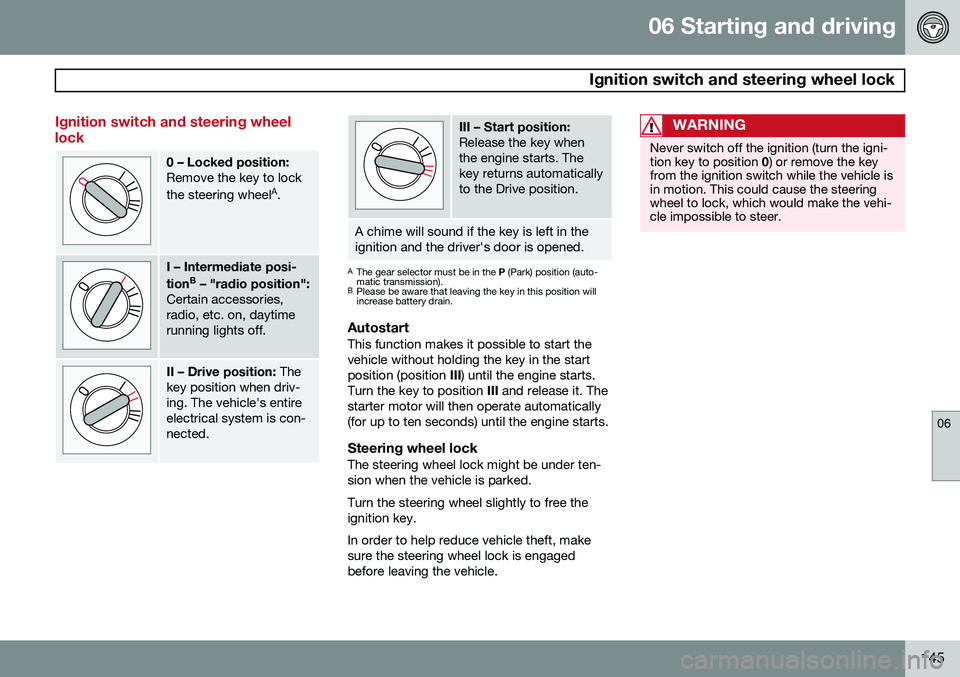
Ignition switch and steering wheel lock
0 – Locked position: Remove the key to lock the steering wheelA
.
I – Intermediate posi- tion B
– "radio position":
Certain accessories, radio, etc. on, daytimerunning lights off.
II – Drive position: The
key position when driv- ing. The vehicle's entireelectrical system is con-nected.
III – Start position: Release the key when the engine starts. Thekey returns automaticallyto the Drive position.
A chime will sound if the key is left in the ignition and the driver's door is opened.
A The gear selector must be in the P (Park) position (auto-
matic transmission).
B Please be aware that leaving the key in this position will increase battery drain.
AutostartThis function makes it possible to start the vehicle without holding the key in the startposition (position III) until the engine starts.
Turn the key to position III and release it. The
starter motor will then operate automatically(for up to ten seconds) until the engine starts.
Steering wheel lockThe steering wheel lock might be under ten-sion when the vehicle is parked. Turn the steering wheel slightly to free the ignition key. In order to help reduce vehicle theft, make sure the steering wheel lock is engagedbefore leaving the vehicle.
WARNING
Never switch off the ignition (turn the igni- tion key to position 0) or remove the key
from the ignition switch while the vehicle isin motion. This could cause the steeringwheel to lock, which would make the vehi-cle impossible to steer.
Page 155 of 308
06 Starting and driving
All Wheel Drive*
06
* Option/accessory, for more information, see Introduction.153
All Wheel Drive (AWD) – general information
Your Volvo can be equipped with an electron- ically controlled All Wheel Drive system*,which means that power is distributed auto-matically between the front and rear wheels.Under normal driving conditions, most of theengine's power is directed to the frontwheels. However, if there is any tendency forthe front wheels to spin, an electronicallycontrolled coupling distributes power to thewheels that have the best traction.
Tire dimensionsVolvo recommends that you always drive ontires of the same brand, size, construction(radial), tread pattern, load-, speed-, traction-,temperature-, and treadwear rating. Neverdrive on mixed tires, except for brief periodswhen the temporary spare tire is in use. Always use properly inflated tires of correct dimensions. Tire size and inflation pressuresare shown on the tire inflation pressure plac-ards, located on the driver's side B-pillar (thestructural member at the side of the vehicle,at the rear of the driver's door opening), or onthe inside of the fuel filler door on Canadianmodels.
Temporary SpareThe temporary spare tire is for temporary,low-speed, short-distance use only. Replaceit with a full-sized tire as soon as possible. Donot drive on the temporary spare at speedsabove 50 m.p.h. (80 km/h).
NOTE
Never install snow chains on a temporary spare.
Page 156 of 308
06 Starting and driving
Brake system
06
154* Option/accessory, for more information, see Introduction.
BRAKE Brake circuit malfunction
The brake system is a hydraulic system con- sisting of two master cylinders and two sepa-rate brake circuits. If a problem should occurin one of these circuits, it is still possible tostop the vehicle with the other brake circuit. If the brake pedal must be depressed farther than normal and requires greater foot pres-sure, the stopping distance will be longer. A warning light in the instrument panel will light up to warn the driver that a fault hasoccurred. If this light comes on while driving or braking, stop immediately and check the brake fluidlevel in the reservoir.
NOTE
Press the brake pedal hard and maintain pressure on the pedal – do not pump thebrakes.
WARNING
If the fluid level is below the MIN mark in
the reservoir or if a BRAKE FAILURE
STOP SAFELY message is displayed in
the text window: DO NOT DRIVE. Have
the vehicle towed to a trained and qualified Volvo service technician and have thebrake system inspected.
NOTE
When the vehicle is at a standstill and the engine is idling, e.g. at a traffic light andthe brake pedal is depressed, the pedalmay go down slightly. This is a normalfunction of the power-assisted brake sys-tem.
Brake pad inspectionOn vehicles equipped with a jack*, the condi- tion of the brake pads can be checked byraising the vehicle (see page 198 for informa-tion about using the jack and removing awheel) and performing a visual inspection ofthe brake pads.
WARNING
• If the vehicle has been driven immedi- ately prior to a brake pad inspection,the wheel hub, brake components,etc., will be very hot. Allow time forthese components to cool before car-rying out the inspection.
• Apply the parking brake and put thegear selector in the Park (
P) position.
• Block the wheels standing on theground, use rigid wooden blocks orlarge stones.
Page 159 of 308
06 Starting and driving
Parking brake
06
157
G026992
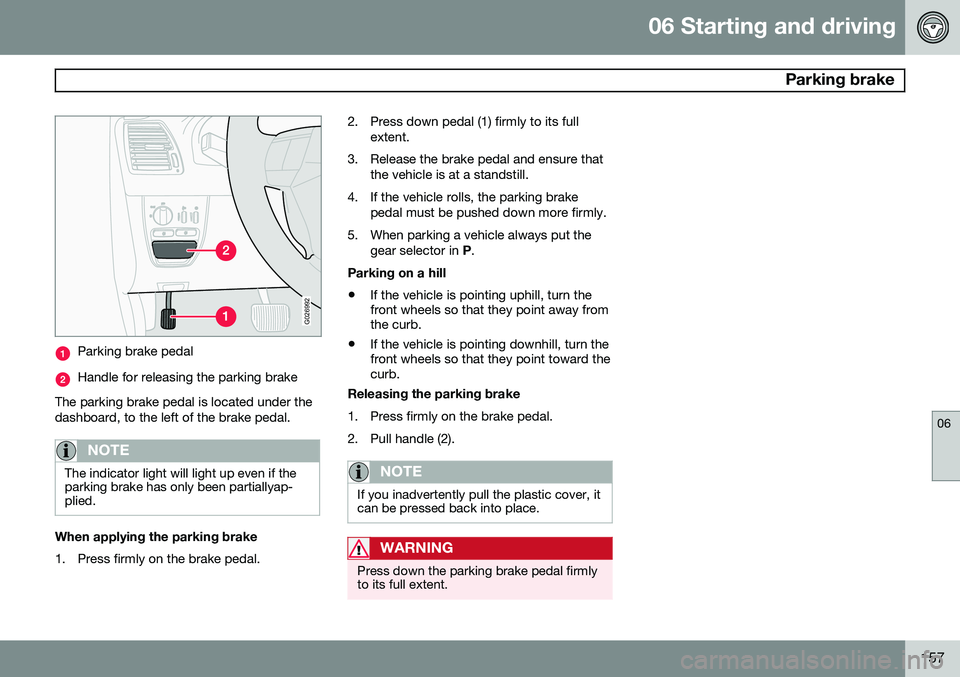
Parking brake pedal
Handle for releasing the parking brake
The parking brake pedal is located under the dashboard, to the left of the brake pedal.
NOTE
The indicator light will light up even if the parking brake has only been partiallyap-plied.
When applying the parking brake
1. Press firmly on the brake pedal. 2. Press down pedal (1) firmly to its full
extent.
3. Release the brake pedal and ensure that the vehicle is at a standstill.
4. If the vehicle rolls, the parking brake pedal must be pushed down more firmly.
5. When parking a vehicle always put the gear selector in P.
Parking on a hill • If the vehicle is pointing uphill, turn the front wheels so that they point away fromthe curb.
• If the vehicle is pointing downhill, turn thefront wheels so that they point toward thecurb.
Releasing the parking brake
1. Press firmly on the brake pedal.
2. Pull handle (2).
NOTE
If you inadvertently pull the plastic cover, it can be pressed back into place.
WARNING
Press down the parking brake pedal firmly to its full extent.
Page 160 of 308
06 Starting and driving
Stability system
06
158
Dynamic Stability Traction Control (DSTC)
The stability system consists of a number of functions designed help reduce wheel spin,counteract skidding, and to generally helpimprove directional stability.
NOTE
A pulsating sound will be audible when the system is actively operating and is normal.
Traction control (TC)This function is designed to help reduce wheel spin by transferring power from a drivewheel that begins to lose traction to thewheel on the opposite side of the vehicle (onthe same axle). TC is most active at low speeds.This is one of DSTC's permanent functions and cannot be switched off.
Spin control (SC)The spin control function is designed to helpprevent the drive wheels from spinning whilethe vehicle is accelerating. Under certain circumstances, such as when driving with snow chains, or driving in deepsnow or loose sand, it may be advisable totemporarily switch off this function for maxi-mum tractive force.
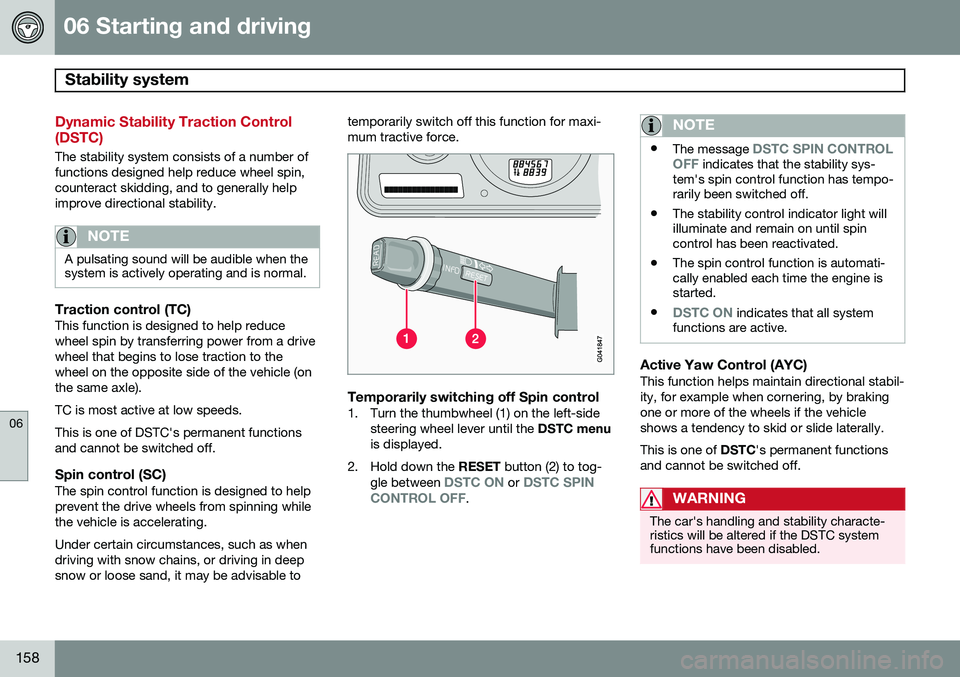
Temporarily switching off Spin control1. Turn the thumbwheel (1) on the left-side
steering wheel lever until the DSTC menu
is displayed.
2. Hold down the RESET button (2) to tog-
gle between
DSTC ON or DSTC SPIN
CONTROL OFF.
NOTE
• The message DSTC SPIN CONTROL
OFF indicates that the stability sys-
tem's spin control function has tempo- rarily been switched off.
• The stability control indicator light willilluminate and remain on until spincontrol has been reactivated.
• The spin control function is automati-cally enabled each time the engine isstarted.
•
DSTC ON indicates that all system
functions are active.
Active Yaw Control (AYC)This function helps maintain directional stabil- ity, for example when cornering, by brakingone or more of the wheels if the vehicleshows a tendency to skid or slide laterally. This is one of DSTC's permanent functions
and cannot be switched off.
WARNING
The car's handling and stability characte- ristics will be altered if the DSTC systemfunctions have been disabled.
Page 161 of 308
06 Starting and driving
Stability system
06
159
DSTC-related messages in the text window
•TRACTION CONTROL TEMPORARILY OFF : The system has been temporarily
switched off due to high brake tempera- ture and will automatically switch onagain when the brakes have cooled.
•
ANTI-SKID SERVICE REQUIRED: The
system has been automatically disen- gaged due to a fault. A trained and quali-fied Volvo service technician shouldcheck the system.
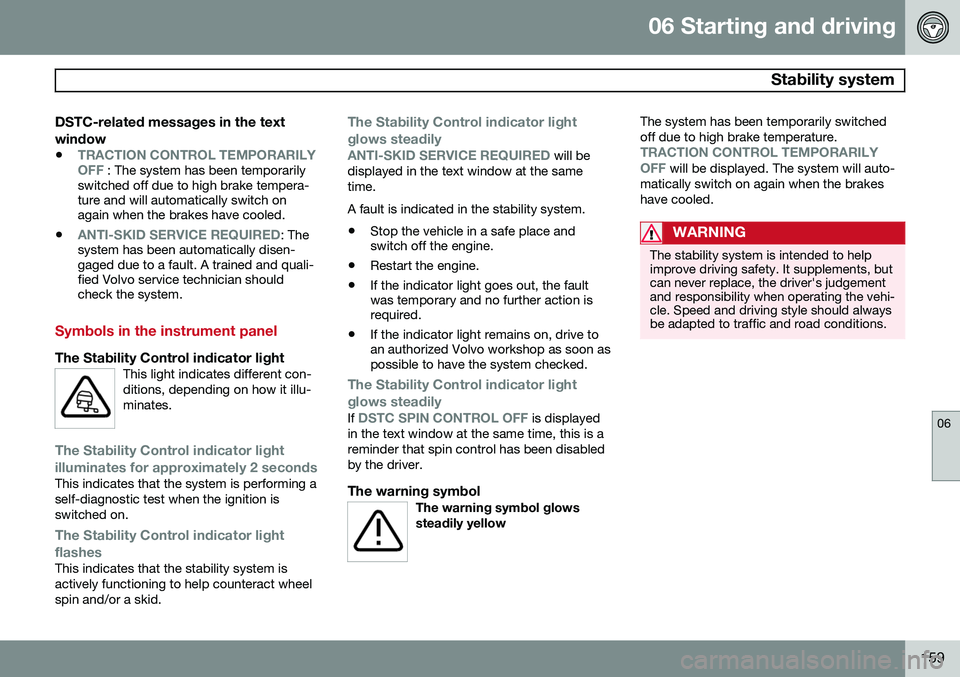
Symbols in the instrument panel
The Stability Control indicator lightThis light indicates different con- ditions, depending on how it illu-minates.
The Stability Control indicator light illuminates for approximately 2 seconds
This indicates that the system is performing a self-diagnostic test when the ignition isswitched on.
The Stability Control indicator light
flashes
This indicates that the stability system is actively functioning to help counteract wheelspin and/or a skid.
The Stability Control indicator light glows steadily
ANTI-SKID SERVICE REQUIRED will be
displayed in the text window at the same time. A fault is indicated in the stability system.
• Stop the vehicle in a safe place and switch off the engine.
• Restart the engine.
• If the indicator light goes out, the faultwas temporary and no further action isrequired.
• If the indicator light remains on, drive toan authorized Volvo workshop as soon aspossible to have the system checked.
The Stability Control indicator light
glows steadily
If DSTC SPIN CONTROL OFF is displayed
in the text window at the same time, this is a reminder that spin control has been disabledby the driver.
The warning symbolThe warning symbol glowssteadily yellow
The system has been temporarily switched off due to high brake temperature.
TRACTION CONTROL TEMPORARILY OFF will be displayed. The system will auto-
matically switch on again when the brakes have cooled.
WARNING
The stability system is intended to help improve driving safety. It supplements, butcan never replace, the driver's judgementand responsibility when operating the vehi-cle. Speed and driving style should alwaysbe adapted to traffic and road conditions.