tow VOLVO XC90 2014 Owner´s Manual
[x] Cancel search | Manufacturer: VOLVO, Model Year: 2014, Model line: XC90, Model: VOLVO XC90 2014Pages: 308, PDF Size: 13.31 MB
Page 197 of 308
07 Wheels and tires
Tire Sealing System
07
195
NOTE
The air pressure gauge will temporarily show an increase in pressure to approxi-mately 88 psi (6 bar) while the sealingcompound is being pumped into the tire.The pressure should return to a normallevel after approximately 30 seconds.
10. Within seven minutes, inflate the tire tobetween 22—44 psi (1.8—3.0 bar). Switch off the compressor briefly to get aclear reading from the pressure gauge.
CAUTION
The compressor should not be used for more than 10 minutes at a time to avoidoverheating.
WARNING
If the pressure remains below 22 psi (1.8 bar) after approximately sevenminutes, turn off the compressor. In thiscase, the hole is too large to be sealed andthe vehicle should not be driven.
11. Switch off the compressor and discon-nect the electrical wire from the 12-volt socket. 12. Unscrew the hose from the tire’s inflation
valve and reinstall the valve cap.
CAUTION
•After pumping the tires, always reinstall the valve cap to help avoid damage tothe valve from dirt, gravel, etc.
• Use plastic valve caps only. Metal capscould corrode and become difficult toremove.
13. Immediately drive the vehicle for approxi-
mately 2 miles (3 km) at a maximum speed of 50 mph (80 km/h) to distributethe sealing compound in the tire.
CAUTION
If your vehicle is equipped with the Tire Pressure Monitoring System (TPMS), theuse of the sealing compound may lead toincorrect tire pressure readings or in rarecases, damage to the tire pressure sensor.Use the tire sealing system to check andadjust the damaged tire's inflation pres-sure.
NOTE
•Safely stow the tire sealing system in a convenient place as it will soon beused again to check the tire’s inflationpressure.
• The empty bottle of sealing compoundcannot be removed from the bottleholder. Consult a trained and qualifiedVolvo service technician to have thebottle removed and properly disposedof.
WARNING
If heavy vibrations, unsteady steering behavior, or noises should occur whiledriving, reduce speed and park the vehiclein a safe place. Recheck the tire forbumps, cracks, or other visible damage,and recheck its inflation pressure. If thepressure is below 19 psi (1.3 bar), do notcontinue driving. Have the vehicle towedto a trained and qualified Volvo servicetechnician.
Stage 2: Checking inflation pressure1. Connect the tire sealing system as
described in stage 1.
2. Refer to the inflation pressure tables for the correct inflation pressure. If the tire needs to be inflated, start the tire sealing
Page 200 of 308
07 Wheels and tires
Changing wheels
07
198
G030879
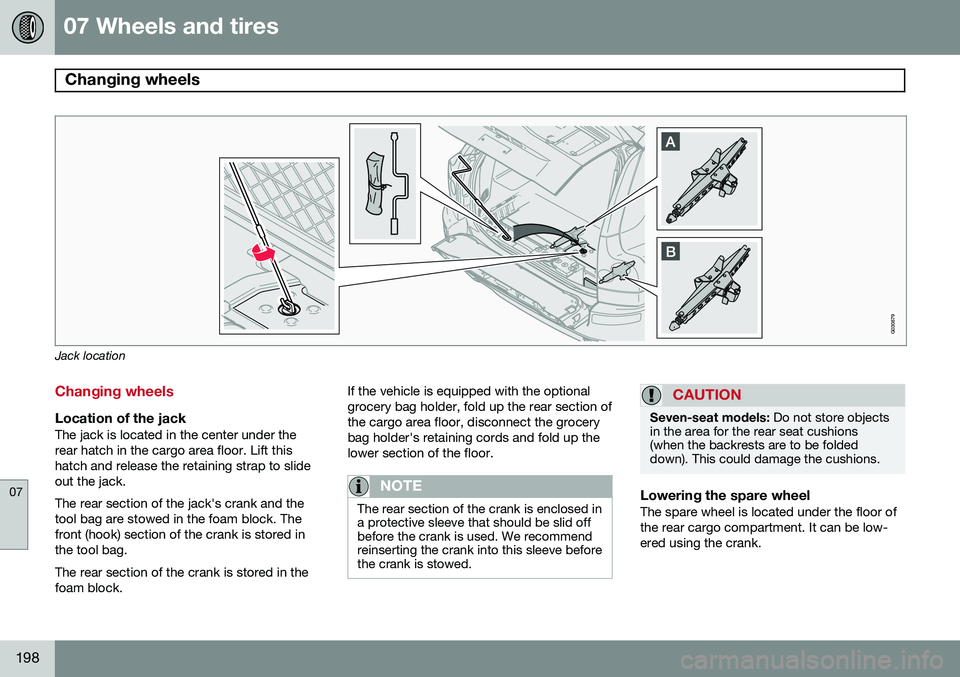
Jack location
Changing wheels
Location of the jackThe jack is located in the center under the rear hatch in the cargo area floor. Lift thishatch and release the retaining strap to slideout the jack. The rear section of the jack's crank and the tool bag are stowed in the foam block. Thefront (hook) section of the crank is stored inthe tool bag. The rear section of the crank is stored in the foam block.If the vehicle is equipped with the optionalgrocery bag holder, fold up the rear section ofthe cargo area floor, disconnect the grocerybag holder's retaining cords and fold up thelower section of the floor.
NOTE
The rear section of the crank is enclosed in a protective sleeve that should be slid offbefore the crank is used. We recommendreinserting the crank into this sleeve beforethe crank is stowed.
CAUTION
Seven-seat models:
Do not store objects
in the area for the rear seat cushions (when the backrests are to be foldeddown). This could damage the cushions.
Lowering the spare wheelThe spare wheel is located under the floor of the rear cargo compartment. It can be low-ered using the crank.
Page 210 of 308
08 Car care
Washing and cleaning the vehicle
08
208
Washing
•The vehicle should be washed at regular intervals since dirt, dust, insects and tarspots adhere to the paint and may causedamage. It is particularly important towash the vehicle frequently in the winter-time to prevent corrosion, when salt hasbeen used on the roads.
• When washing the vehicle, do not exposeit to direct sunlight. Use lukewarm waterto soften the dirt before you wash with asponge, and plenty of water, to avoidscratching.
• Bird droppings: Remove from paintworkas soon as possible. Otherwise the finishmay be permanently damaged.
• A detergent can be used to facilitate thesoftening of dirt and oil.
CAUTION
Chromed wheels
: Clean chrome-plated
wheels using the same detergents used for the body of the vehicle. Aggressive wheelcleaning agents can permanently stainchrome-plated wheels.
• Dry the vehicle with a clean chamois and remember to clean the drain holes in thedoors and rocker panels.
• Tar spots can be removed with tarremover after the vehicle has beenwashed.
• A stiff-bristle brush and lukewarm soapywater can be used to clean the wiperblades. Frequent cleaning of the wind-shield and wiper blades improves visibilityconsiderably and also helps prolong theservice life of the wiper blades.
• Wash off the dirt from the underside(wheel housings, fenders, etc.).
• In areas of high industrial fallout, morefrequent washing is recommended.
Suitable detergentsSpecial vehicle washing detergents should be used. A suitable mixture is about 2.5 fl. oz.(8.5 cl) of detergent to 2.6 US gal. (10 liters) ofwarm water. After washing with a detergentthe vehicle should be well rinsed with cleanwater.
CAUTION
•Avoid waxing or polishing plastic or rubber components
• Polishing chromed strips can wearaway or damage the surface
• Polishes containing abrasive sub-stances should not be used
CAUTION
•Dirt, snow, etc., on the headlights can reduce lighting capacity considerably.Clean the headlights regularly, forexample when refueling.
• During high pressure washing, thespray mouthpiece must never becloser to the vehicle than 13 " (30 cm).Do not spray into the locks.
Special moonroof cautions:
• Always close the moonroof and sunshade before washing your vehicle.
• Never use abrasive cleaning agents onthe moonroof.
• Never use wax on the rubber sealsaround the moonroof.
Page 213 of 308
08 Car care
Washing and cleaning the vehicle
08
211
3. Dampen the stain thoroughly with the
sponge. Let the sponge absorb the stain, do not rub.
4. Dry the stain with soft paper towels or a towel, and allow the leather to dry com-pletely.
Protecting leather upholstery1. Put a small amount of protectant cream on a cloth and apply a thin coating of cream to the upholstery with light circularmovements.
2. Allow the leather to dry for 20 minutes. This will help the leather resist staining and protect against sunlight's harmful UV rays.
CAUTION
• Under no circumstances should gaso- line, naphtha or similar cleaning agentsbe used on the plastic or the leathersince these can cause damage.
• Take extra care when removing stainssuch as ink or lipstick since the color-ing can spread.
• Use solvents sparingly. Too much sol-vent can damage the seat padding.
• Start from the outside of the stain andwork toward the center.
• Sharp objects (e.g. pencils or pens in apocket) or velcro fasteners on clothingmay damage the textile upholstery.
• Clothing that is not colorfast, such asnew jeans or suede garments, maystain the upholstery.
Cleaning a leather-covered steering wheel
•
Remove soil, dust, etc., with a damp sponge and a neutral soap solution.
• Leather should be allowed to breath.Never cover the steering wheel with aplastic protector.
• Volvo recommends cleaning, protectingand conditioning the steering wheel withVolvo's Leather Care Kit 951 0251 andLeather Softener 943 7429. If there are stains on the steering wheel: Type 1
(ink, wine, coffee, milk, sweat or
blood)
–Use a soft cloth or sponge. Wipe the wheel with a solution with 5% ammonia.For blood stains, mix approx. 1 cup (2 dl)of water and one ounce (25g) of salt andwipe the stain.
Type 2 (fat, oil, sauces, or chocolate)
1. Same procedure as for type I stains.
2. Finish by rubbing the wheel with absorb- ent paper or a towel.
Type 3 (dry soil or dust)
1. Remove the soil/dust with a soft brush.
2. Same procedure as for type I stains.
CAUTION
Sharp objects, such as rings, could dam- age the leather on the steering wheel.
Cleaning the seat beltsClean only with lukewarm water and a mild soap solution.
Cleaning floor matsThe floor mats should be vacuumed orbrushed clean regularly, especially duringwinter when they should be taken out for dry-
Page 219 of 308
09 Maintenance and servicing
Maintaining your vehicle09
}}
217
Owner maintenance
Periodic maintenance requirements and inter- vals are described in your vehicle's Warrantyand Service Records Information booklet. The following points can be carried out between the normally scheduled maintenanceservices.
Each time the vehicle is refueled
•Check the engine oil level
• Clean the windshield, windshield wipers, headlights, and tail lights
Monthly
•Check cold tire pressure in all tires.Inspect the tires for wear.
• Check that engine coolant and other fluidlevels are between the indicated "
min"
and " max" markings.
• Clean interior glass surfaces with a glasscleaner and soft paper towels.
• Wipe driver information displays with asoft cloth.
• Visually inspect battery terminals for cor-rosion. Corrosion may indicate a looseterminal connector, or a battery near theend of its useful service life. Consult atrained and qualified Volvo service techni-cian for additional information.
As needed
•
Wash the vehicle, including the undercar-riage, to reduce wear that can be causedby a buildup of dirt, and corrosion thatcan be caused by salt residues.
• Clean leaves and twigs from air intakevents at the base of the windshield, andfrom other places where they may collect.
• Complete service information for qualifiedtechnicians is available online for pur-chase or subscription at www.volvote-chinfo.com.
Emission inspection readiness
What is an Onboard Diagnostic System
(OBD II)?
OBD II is part of your vehicle's computerized engine management system. It stores diag-nostic information about your vehicle's emis-sion controls. It can light the Check Enginelight (MIL) if it detects an emission control"fault." A "fault" is a component or systemthat is not performing within an expectedrange. A fault may be permanent or tempo-rary. OBD II will store a message about anyfault.
How do states use OBD II for emission
inspections?
Many states connect a computer directly to avehicle's OBD II system. The inspector can then read "faults." In some states, this type ofinspection has replaced the tailpipe emissiontest.
How can my vehicle fail OBD II emission
inspection?
Your vehicle can fail OBD II emission inspec-tion for any of the following reasons.
• If your Check Engine (MIL) light is lit, your vehicle may fail inspection.
• If your vehicle's Check Engine light waslit, but went out without any action onyour part, OBD II will still have a recordedfault. Your vehicle may pass or fail,depending on the inspection practices inyour area.
• If you had recent service that requireddisconnecting the battery, OBD II diag-nostic information may be incompleteand "not ready" for inspection. A vehiclethat is not ready may fail inspection.
How can I prepare for my next OBD II
emission inspection?
• If your Check Engine (MIL) light is lit – orwas lit but went out without service, haveyour vehicle diagnosed and, if necessary,serviced by a qualified Volvo technician.
• If you recently had service for a lit CheckEngine light, or if you had service thatrequired disconnecting the battery, aperiod of driving is necessary to bring the
Page 227 of 308
09 Maintenance and servicing
Fluids09
225
WARNING
•Never remove the coolant reservoir cap while the engine is warm. Waituntil the engine cools.
• If it is necessary to top up the coolantwhen the engine is warm, unscrew thecoolant reservoir cap slowly so thatthe overpressure dissipates.
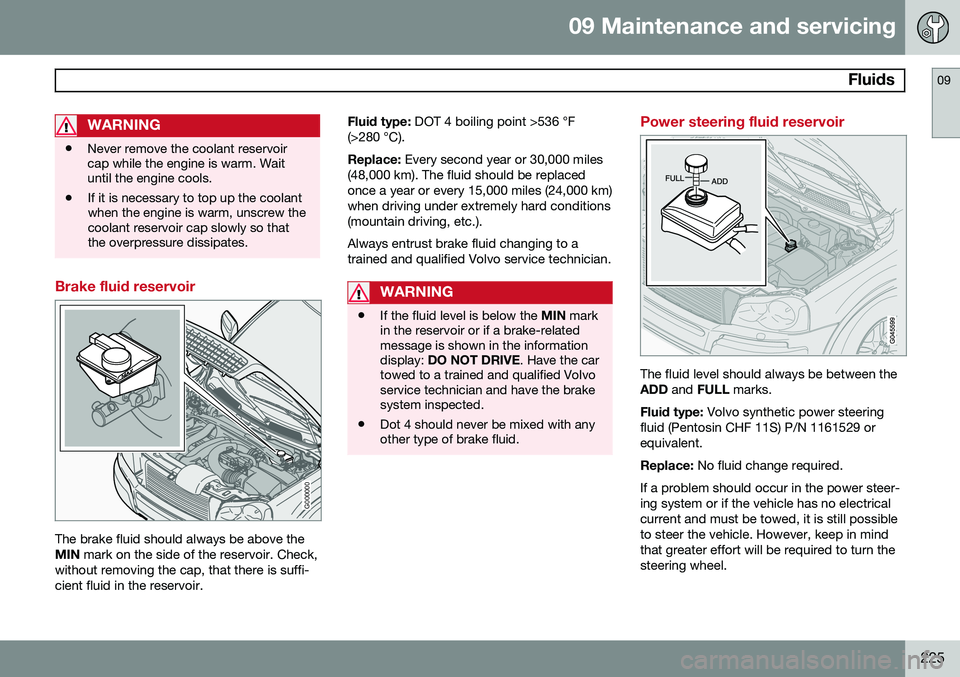
Brake fluid reservoir
G000000
The brake fluid should always be above the MIN
mark on the side of the reservoir. Check,
without removing the cap, that there is suffi-cient fluid in the reservoir. Fluid type:
DOT 4 boiling point >536 °F
(>280 °C). Replace: Every second year or 30,000 miles
(48,000 km). The fluid should be replaced once a year or every 15,000 miles (24,000 km)when driving under extremely hard conditions(mountain driving, etc.). Always entrust brake fluid changing to a trained and qualified Volvo service technician.
WARNING
• If the fluid level is below the
MIN mark
in the reservoir or if a brake-related message is shown in the informationdisplay: DO NOT DRIVE . Have the car
towed to a trained and qualified Volvoservice technician and have the brakesystem inspected.
• Dot 4 should never be mixed with anyother type of brake fluid.
Power steering fluid reservoir
The fluid level should always be between the ADD
and FULL marks.
Fluid type: Volvo synthetic power steering
fluid (Pentosin CHF 11S) P/N 1161529 orequivalent. Replace: No fluid change required.
If a problem should occur in the power steer- ing system or if the vehicle has no electricalcurrent and must be towed, it is still possibleto steer the vehicle. However, keep in mindthat greater effort will be required to turn thesteering wheel.
Page 236 of 308
09 Maintenance and servicing
Replacing bulbs 09
234
Replacing bulbs in the taillight cluster
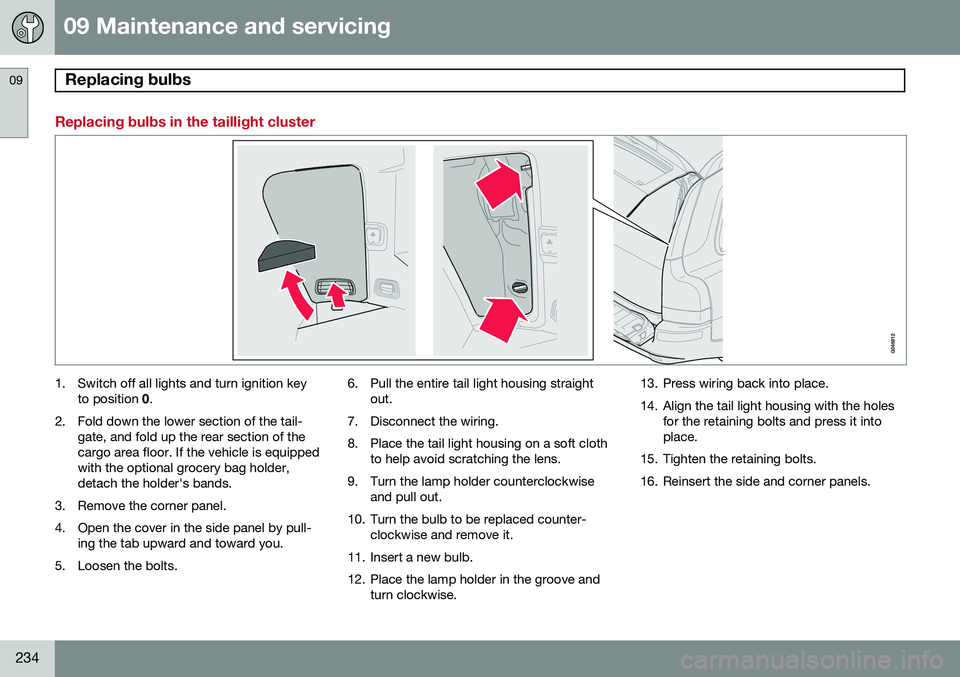
1. Switch off all lights and turn ignition keyto position 0.
2. Fold down the lower section of the tail- gate, and fold up the rear section of the cargo area floor. If the vehicle is equippedwith the optional grocery bag holder,detach the holder's bands.
3. Remove the corner panel.
4. Open the cover in the side panel by pull- ing the tab upward and toward you.
5. Loosen the bolts. 6. Pull the entire tail light housing straight
out.
7. Disconnect the wiring.
8. Place the tail light housing on a soft cloth to help avoid scratching the lens.
9. Turn the lamp holder counterclockwise and pull out.
10. Turn the bulb to be replaced counter- clockwise and remove it.
11. Insert a new bulb.
12. Place the lamp holder in the groove and turn clockwise. 13. Press wiring back into place.
14. Align the tail light housing with the holes
for the retaining bolts and press it into place.
15. Tighten the retaining bolts.
16. Reinsert the side and corner panels.
Page 290 of 308
11 Specifications
Fluids
11
288* Option/accessory, for more information, see Introduction.
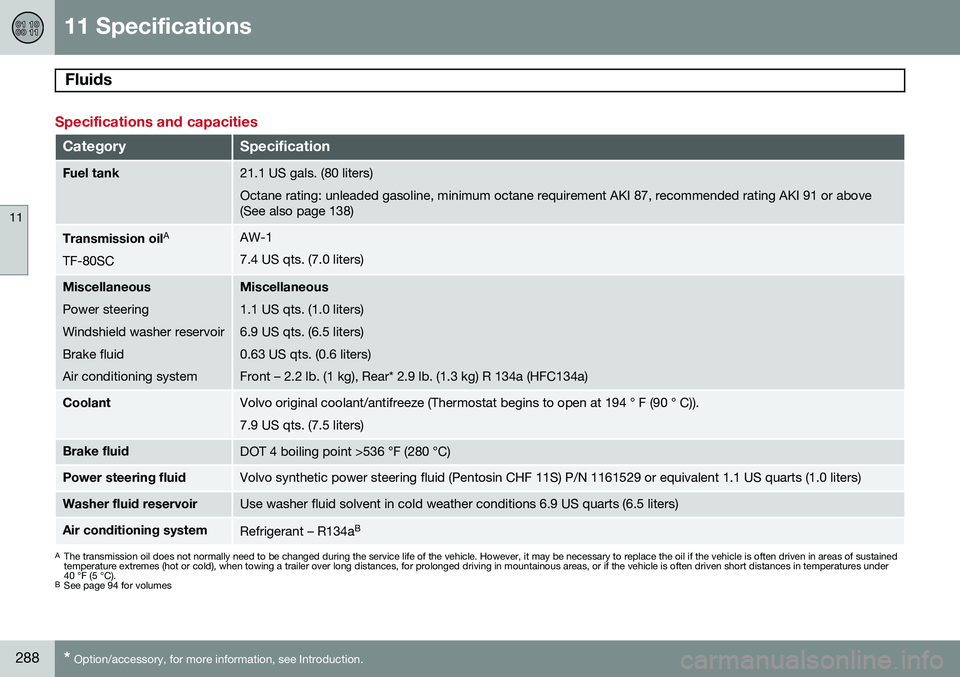
Specifications and capacities
CategorySpecification
Fuel tank21.1 US gals. (80 liters) Octane rating: unleaded gasoline, minimum octane requirement AKI 87, recommended rating AKI 91 or above (See also page 138)
Transmission oil A
TF-80SCAW-1 7.4 US qts. (7.0 liters)
Miscellaneous Power steering Windshield washer reservoirBrake fluidAir conditioning systemMiscellaneous 1.1 US qts. (1.0 liters) 6.9 US qts. (6.5 liters)0.63 US qts. (0.6 liters)Front – 2.2 lb. (1 kg), Rear* 2.9 lb. (1.3 kg) R 134a (HFC134a)
CoolantVolvo original coolant/antifreeze (Thermostat begins to open at 194 ° F (90 ° C)). 7.9 US qts. (7.5 liters)
Brake fluidDOT 4 boiling point >536 °F (280 °C)
Power steering fluidVolvo synthetic power steering fluid (Pentosin CHF 11S) P/N 1161529 or equivalent 1.1 US quarts (1.0 liters)
Washer fluid reservoirUse washer fluid solvent in cold weather conditions 6.9 US quarts (6.5 liters)
Air conditioning systemRefrigerant – R134a B
A
The transmission oil does not normally need to be changed during the service life of the vehicle. However, it may be necessary to replace the oil if the vehicle is often driven in areas of sustained temperature extremes (hot or cold), when towing a trailer over long distances, for prolonged driving in mountainous areas, or if the vehicle is often driven short distances in temperatures under40 °F (5 °C).
B See page 94 for volumes
Page 300 of 308
12 Index
12
298
1, 2, 3 ...
12-volt sockets.......................................... 80
A
A/C (air conditioning)........................... 98, 99
ABS.......................................................... 155Accessory installation warning.................. 14
Airbag system............................................ 23
Air cleaner................................................ 221
Air conditioning.......................................... 94
Air distribution...................................... 96, 99
Air quality sensor....................................... 98
Air vents..................................................... 96
Alarm........................................................ 133
All Wheel Drive......................................... 153
All Wheel Drive – towing.......................... 163Anti-lock brake system warning light......................................... 60
Anti-lock Brake System (ABS)................. 155
Ashtray..................................................... 115 Audio
system introduction............................ 252
Audio system Bluetooth streaming audio................. 268
HD digital radio................................... 260SiriusXM ™ satellite radio.................... 263
AUTO (climate control)....................... 99, 100
Automatic locking retractor....................... 39
Automatic transmission........................... 149 shiftlock override.................................. 23
Autostart.......................................... 143, 145
AUX (audio system)................................. 267
Average speed........................................... 76
AWD......................................................... 153
B
Bass......................................................... 255
Battery..................................................... 219 maintenance....................................... 227
specifications...................................... 292
Battery – replacing................................... 228
Belt check................................................ 220
Blind Spot Information System (BLIS)..... 171 Blower (fan).............................................. 100
Bluetooth cell phone connection............. 274Booster cushion
accessory............................................. 48
integrated.............................................. 52
Brake fluid................................................ 225
Brake system........................................... 154 Brake pad inspection.......................... 154
Bulbs........................................................ 230 specifications...................................... 236
Bulbs, replacing....................................... 230
C
Capacities, fluids..................................... 288
Capacity weight....................................... 187
Cargo area cover..................................... 122
Cargo grid................................................ 121
Cargo net................................................. 119
Catalytic converter, three-way................. 293
CD Pause................................................. 270
Cell phone, hands-free connection......... 274
Center console buttons............................. 64
Page 305 of 308
12 Index
12
303
rotation............................................... 178
Self-supporting run flat tires (SST)..... 205
spare................................................... 191
speed ratings...................................... 182
storing................................................. 180
tire sealing system.............................. 192
tread wear indicator............................ 179
Tire sealing system.................................. 192
Towing a trailer........................................ 164
Towing - cars with All Wheel Drive.......... 163
Towing the vehicle................................... 162
Trailer hitch - detachable......................... 167
Trailer towing........................................... 164Transmission shiftlock override.................................. 23
Transmission, automatic.......................... 149
Tread wear indicator................................ 179
Treble....................................................... 255
Trip computer............................................ 76
Trip odometer............................................ 58
Turn signals............................................... 71
U
Uniform Tire Quality Grading................... 189
Unlocking fuel filler door............................ 69
Unlocking the car..................................... 130 Unpaved roads, driving on...................... 147
V
Vanity mirror............................................ 112
Vehicle dimensions.................................. 284
Vehicle Identification Number (VIN)......... 283
Vehicle loading........................................ 187
Vehicle maintenance................................ 216
Vehicle weights........................................ 286
Ventilated seats......................................... 97
Volvo and the environment........................ 13
Volvo maintenance.................................. 216
Volvo On Call Roadside Assistance........ 296
W
Warning symbol......................................... 58
Warning symbol in center of dashboard.... 58
Warranties................................................ 216
Washer fluid reservoir...................... 221, 224
Washing the vehicle................................. 208
Water, driving through............................. 147
Waxing..................................................... 209
Weights.................................................... 286
Wheels..................................................... 178 storing................................................. 180
Windshield IR coating............................................. 74
Windshield washer fluid reservoir............ 224
Windshield wipers.................................... 226
Winter/Wet driving mode......................... 169
Wipers...................................................... 226
W – Winter............................................... 150