start battery VOLVO XC90 2018 Owner´s Manual
[x] Cancel search | Manufacturer: VOLVO, Model Year: 2018, Model line: XC90, Model: VOLVO XC90 2018Pages: 666, PDF Size: 11.32 MB
Page 564 of 666
LOADING, STORAGE AND PASSENGER COMPARTMENT
* Option/accessory.
562
Using the electrical outlets
The 12 V outlet can be used for devices intended for this such as MP3 players, coolersand cellular phones. The high-voltage outlet * can be used for devices
intended for this, such as chargers, laptops, etc.
The ignition must be in at least mode I for the
outlets to supply current. The outlets will then be active as long as there is sufficient charge in thestart battery. If the engine is turned off and the vehicle is locked, the outlets will be deactivated. If theengine is turned off and the vehicle remainsunlocked, the sockets will remain active for up to7 minutes.
NOTE
Bear in mind that using the electrical outlets when the engine is off could cause the starterbattery to have too low of a charge level,which could limit other functionality. Accessories connected to the electrical out- lets can be activated even when the vehicleelectrical system is off or if preconditioning isused. For this reason, disconnect plugs whenthey are not in use to prevent the starter bat-tery from becoming discharged.
WARNING
• Do not use accessories with large or heavy plugs – they could damage the out-let or come loose while you are driving.
• Do not use accessories that could causedisruptions to e.g. the vehicle's radioreceiver or electrical system.
• Position the accessory so that there is norisk of it injuring the driver or passengersin the event of heavy braking or a colli-sion.
• Pay attention to connected accessoriesas they can generate heat that could burnpassengers or the interior.
Using 12 V outlets1. Remove the stopper (tunnel console) or fold
down the cover (trunk/cargo compartment)over the socket and plug in the device.
2. Unplug the device and put the stopper back in (tunnel console) or fold up the cover(trunk/cargo compartment) when the socketis not in use or left unattended.
CAUTION
The maximum power is 120 W (10 A) per outlet.
Using high-voltage outletsThe ignition must be in at least mode I for outlets
to supply current. The outlets will then be active as long as there is sufficient charge in the startbattery. 1. Slide down the cover over the outlet and plug in the device. >
The LED 2
light on the outlet will indicate
its status.
2. The outlet is supplying electrical current when the light is glowing steadily green.
3. Disconnect the device by pulling out the plug (do not pull on the cord). Pull up the cover when the outlet is not in use or is left unattended.
CAUTION
The maximum power is 150 W.
WARNING
Do not attempt to alter or repair the high-volt- age outlet on your own. Volvo recommendscontacting an authorized Volvo workshop.
2LED (Light Emitting Diode)
Page 600 of 666
MAINTENANCE AND SERVICE
598
Start battery
The vehicle has a single-pole electrical system that uses the chassis and engine mount as con-ductors. The start battery is used to start the electrical system and power the starter motor and otherelectrical equipment in the vehicle. The start battery should only be replaced by a workshop 18
.
The vehicle has a voltage-regulated alternating current generator. The starter battery is a 12 V battery, designed for the carbon dioxide reducing functions Start/Stopand regenerative charging, and to support thefunctionality of the car's different systems. The service life and performance of the start bat- tery are affected by factors such as driving style,driving conditions, climate, battery discharges,number of starts, etc.
• Never disconnect the start battery while theengine is running.
• Make sure the cables to the start battery arecorrectly connected and the clamps aresecurely tightened.
WARNING
•Batteries generate hydrogen gas, which is flammable and explosive.
• Do not connect the jumper cable to anypart of the fuel system or to any movingparts. Avoid touching hot manifolds.
• Battery fluid contains sulfuric acid. Do notallow battery fluid to contact eyes, skin,fabrics or painted surfaces.
• If contact occurs, flush the affected areaimmediately with water. Obtain medicalhelp immediately if eyes are affected.
• Never expose the battery to open flameor electric spark. Do not smoke near thebattery. Failure to follow the instructionsfor jump starting can lead to injury.
Connection points
WARNING
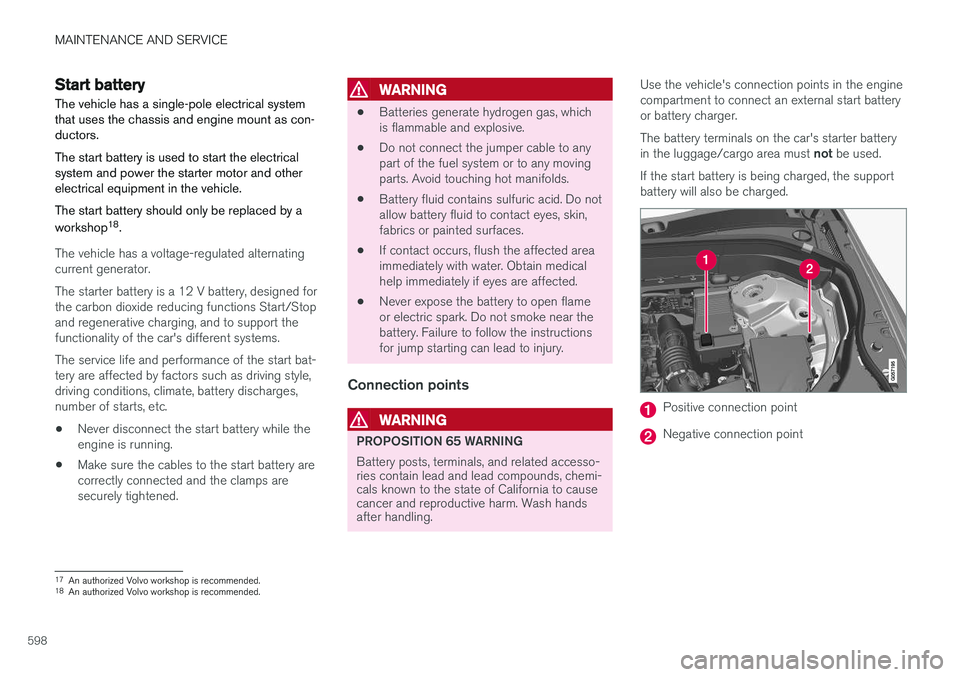
PROPOSITION 65 WARNING Battery posts, terminals, and related accesso- ries contain lead and lead compounds, chemi-cals known to the state of California to causecancer and reproductive harm. Wash handsafter handling. Use the vehicle's connection points in the engine compartment to connect an external start batteryor battery charger. The battery terminals on the car's starter battery in the luggage/cargo area must
not be used.
If the start battery is being charged, the support battery will also be charged.
Positive connection point
Negative connection point
17 An authorized Volvo workshop is recommended.
18 An authorized Volvo workshop is recommended.
Page 601 of 666
MAINTENANCE AND SERVICE
}}
599
CAUTION
Only a modern battery charger with controlled charge voltage should be used to charge thestarter battery and support battery. The rapidcharging function should not be used as thiscould damage the battery.
CAUTION
Failure to observe the following could cause the infotainment energy save mode to tempo-rarily stop working and/or a message in thedriver's display regarding the state of chargeof the starter battery may be temporarilyincorrect after an external starter battery orbattery charger has been connected:
• The negative battery terminal of the vehi- cle's starter battery must
never be used
to connect an external starter battery orbattery charger – only the vehicle's neg-
ative charging point should be used as
a grounding point.
NOTE
If the starter battery becomes discharged too many times, it will shorten its service life. The service life of the starter battery is affec- ted by several factors, such as driving condi-tions and climate. The starting capacity of thebattery reduces gradually over time. The bat-tery must therefore be recharged if the vehi-cle is not used or a long period of time or if itis only driven short distances. Severe cold fur-ther limits the starting capacity. To keep the starter battery in a good condi- tion, the vehicle should be driven at least15 minutes per week or the battery should beconnected to a battery charger with automatictrickle charging. A starter battery that is always kept fully charged has the maximum service life.
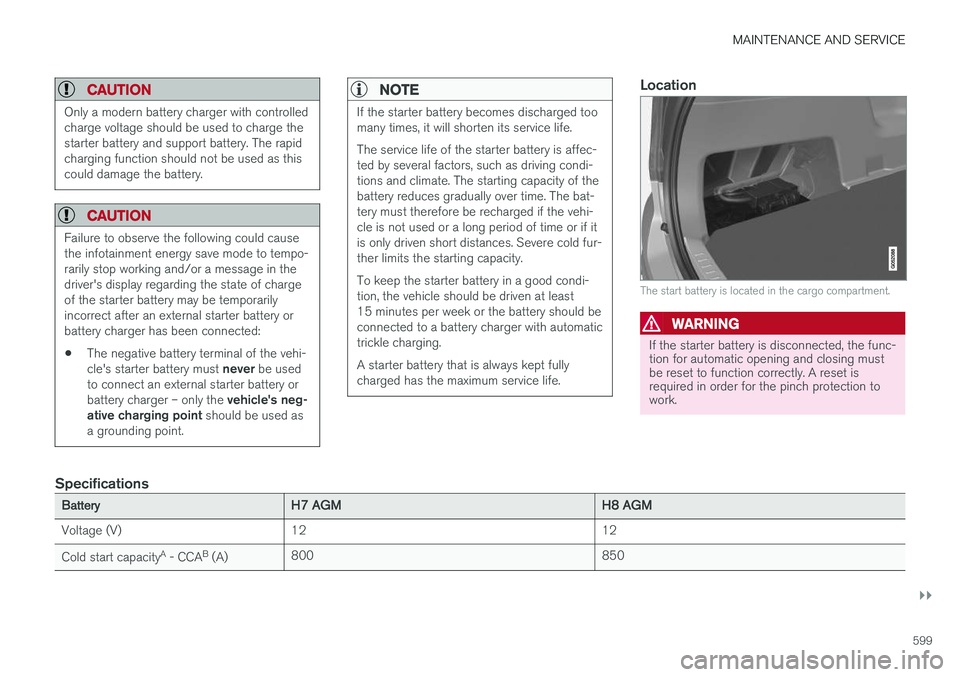
Location
The start battery is located in the cargo compartment.
WARNING
If the starter battery is disconnected, the func- tion for automatic opening and closing mustbe reset to function correctly. A reset isrequired in order for the pinch protection towork.
Specifications
BatteryH7 AGMH8 AGM
Voltage (V) 12 12
Cold start capacity A
- CCA B
(A) 800
850
Page 602 of 666
||
MAINTENANCE AND SERVICE
600
BatteryH7 AGMH8 AGM
Dimensions, L×W×H 315×175×190 mm (12.4×6.9×7.5 inches) 353×175×190 mm (13.9×6.9×7.5 inches)
Capacity (Ah) 80 95
A
According to EN standard.
B Cold Cranking Amperes.
Volvo recommends that batteries are replaced by an authorized Volvo workshop.
CAUTION
When replacing the starter battery or support battery, an AGM 19
battery must be installed.
CAUTION
If replacing the starter battery, make sure you replace it with a battery with the same coldstart capacity and type as the original battery(see the decal on the battery).
NOTE
The size of the starter battery should conform to the dimensions of the original battery.
Related information
• Battery symbols (p. 602)
• Support battery (p. 601) •
Jump starting using another battery (p. 447)
19
Absorbed Glass Mat.
Page 603 of 666
MAINTENANCE AND SERVICE
}}
601
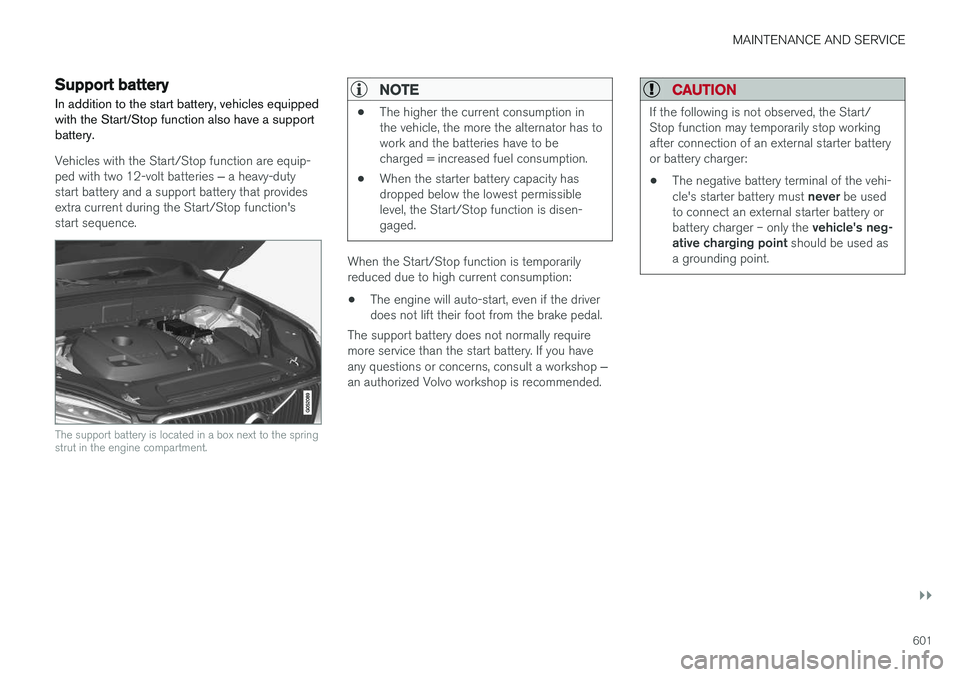
Support battery In addition to the start battery, vehicles equipped with the Start/Stop function also have a supportbattery.
Vehicles with the Start/Stop function are equip- ped with two 12-volt batteries ‒ a heavy-duty
start battery and a support battery that provides extra current during the Start/Stop function'sstart sequence.
The support battery is located in a box next to the spring strut in the engine compartment.
NOTE
• The higher the current consumption in the vehicle, the more the alternator has towork and the batteries have to becharged = increased fuel consumption.
• When the starter battery capacity hasdropped below the lowest permissiblelevel, the Start/Stop function is disen-gaged.
When the Start/Stop function is temporarily reduced due to high current consumption:
• The engine will auto-start, even if the driverdoes not lift their foot from the brake pedal.
The support battery does not normally requiremore service than the start battery. If you have any questions or concerns, consult a workshop ‒
an authorized Volvo workshop is recommended.
CAUTION
If the following is not observed, the Start/ Stop function may temporarily stop workingafter connection of an external starter batteryor battery charger: • The negative battery terminal of the vehi- cle's starter battery must
never be used
to connect an external starter battery orbattery charger – only the vehicle's neg-
ative charging point should be used as
a grounding point.
Page 604 of 666
||
MAINTENANCE AND SERVICE
602
NOTE
If the starter battery is discharged to the extent that the vehicle does not have normalelectrical functions and the engine must thenbe jump-started with an external battery or abattery charger, the Start/Stop function mayremain activated. If the Start/Stop functionshortly thereafter auto-stops the engine, thereis a huge risk that auto-start of the engine willfail due to insufficient battery capacity sincethe battery had not had time to recharge. If the vehicle has been jump-started or if there has not been enough time for the bat-tery to be charged with a battery charger, it isadvisable to temporarily deactivate theStart/Stop function until the battery has beenrecharged by the vehicle. At an ambient tem-perature of about +15°C (about 60°F), thebattery must be charged by the vehicle for atleast one hour. At lower ambient tempera-tures, the charging time can increase to3-4 hours. It is advisable to charge the batterywith an external battery charger.
Specifications
Voltage (V) 12 Cold start capacityA
-
CCA B
(A) 170
Dimensions, L×W×H150×90×130 mm
(5.9×3.5×5.1 inches)
Capacity (Ah) 10
A According to EN standard.
B Cold Cranking Amperes.
CAUTION
When replacing the starter battery or support battery, an AGM 20
battery must be installed.
Related information
• Start battery (p. 598)
• Start/Stop function (p. 428)
• Battery symbols (p. 602)
Battery symbols
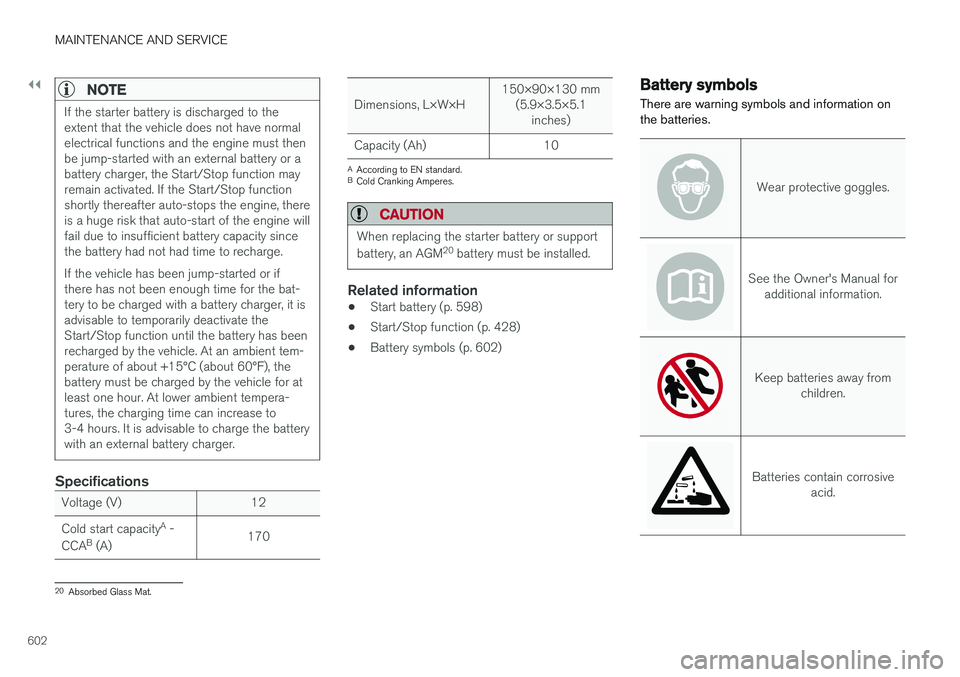
There are warning symbols and information on the batteries.
Wear protective goggles.
See the Owner's Manual for additional information.
Keep batteries away from children.
Batteries contain corrosive acid.
20Absorbed Glass Mat.
Page 605 of 666
MAINTENANCE AND SERVICE
603
Avoid smoking, open
flames, and/or sparks.
Risk of explosion.
Recycle properly.
NOTE
A used start battery or backup battery con- tains lead and must be recycled in an environ-mentally responsible manner.
Related information
• Start battery (p. 598)
• Support battery (p. 601)
Fuses and fuseboxes
All electrical functions and components are pro- tected by a number of fuses in order to protectthe vehicle's electrical system from damage byshort circuiting or overloading.
WARNING
Never use a foreign object or a fuse with a higher amperage than that specified toreplace a fuse. This could cause significantdamage to the electrical system and possiblylead to a fire.
If any electrical component or function is not responding, the component may have blown afuse due to temporary overload. If the same fuseblows repeatedly, there may be a problem withthe component. Volvo recommends contacting anauthorized Volvo workshop to have the compo-nent checked.
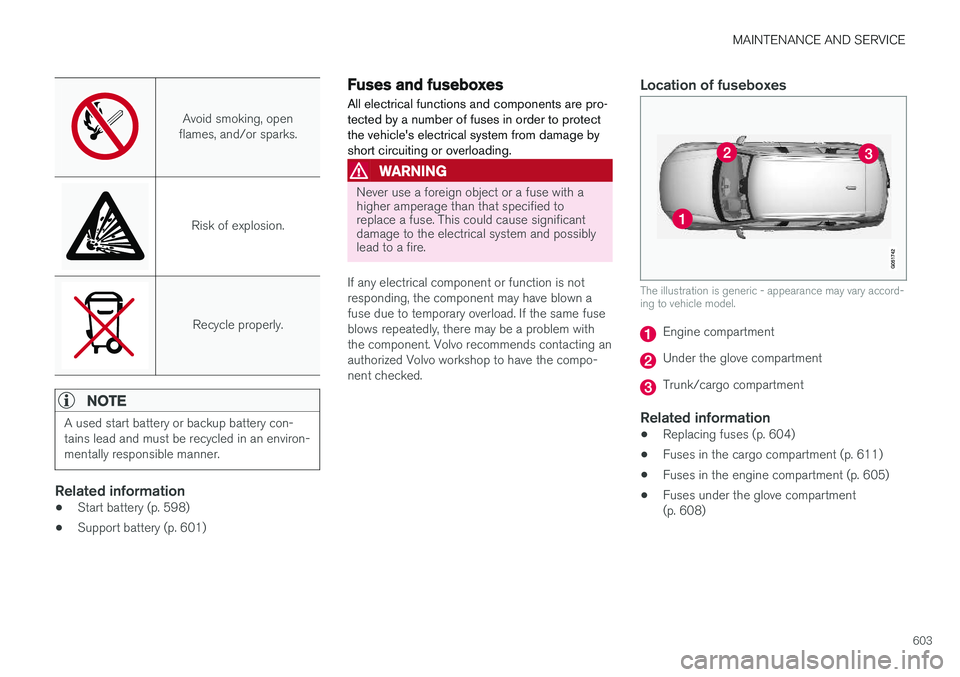
Location of fuseboxes
The illustration is generic - appearance may vary accord- ing to vehicle model.
Engine compartment
Under the glove compartment
Trunk/cargo compartment
Related information
• Replacing fuses (p. 604)
• Fuses in the cargo compartment (p. 611)
• Fuses in the engine compartment (p. 605)
• Fuses under the glove compartment (p. 608)
Page 652 of 666
INDEX
650
B
Backrestfront seat, adjusting 188, 189, 192, 193 , 194
rear seat, adjusting 200, 201
rear seat, folding 196, 201, 202
Battery jump-start 447
Maintenance 598
start 598
support 601
symbols on the battery 602
warning symbols 602
BLIS 346, 347, 348, 349 Blower adjusting 228, 229
air distribution 212
air vents 213
Bluetooth connect 491
connecting vehicle to Internet 509
phone 498
settings 507
Book service and repair 580
Booster cushions 71 Brake assist after collision 417
Brake fluid
grade 645
Brake functions 408
Brake light 163
Brakes 409 anti-lock brakes, ABS 409
automatic when stationary 415
Brake Assist System, BAS 410
brake lights 163
brake system 408
emergency brake lights 163
handbrake 411
Maintenance 411
on salted roads 411
on wet roads 410
brake system fluid 645
C
Camera sensor 342
Camera unit 329
Capacity weight 556, 641
Cargo compartment 564
attachment points 567
cargo net 571
electrical outlet 560, 562
Lighting 166
Cargo compartment cover 567, 568
cargo net 571
Car wash 620, 621, 623, 624, 625, 626
Catalytic converter 445 recovery 453
CD player 489
Cell phone, see Phone 499
Center console 559Center display change appearance 133
cleaning 615
climate controls 217
Function view 124
keyboard 128
messages 142, 143, 144
operation 114, 117, 121, 126
overview 111
settings 134, 135, 136
switch off and change volume 133
symbols in status bar 126
views 117
Central locking 255
Change of owner 136
Changing a wheel 542
Checking engine oil level 589
Page 658 of 666
INDEX
656Lighting, replacing bulbs 591
daytime running lights/front parking
lights 596
front turn signals 597
high beams 595
low beams 595
remove plastic cover 593
removing rectangular cover 593
Limp home 417 Load anchoring eyelets cargo compartment 567
Load anchoring hooks 566
Load carriers 566
Load index 532Loading general 564
load anchoring eyelets 567
long load 565
Lock indication 236 setting 237
Locking/unlocking Tailgate 241, 254
Locking wheel bolts 543 Locks Locking 239
unlocking 239
Low battery charge level
start battery 447
Low beams 157
Lower the rear end 565
Low oil level 588
Low-speed driving 435 activate with function button 436
M
Maintenance 576
corrosion protection 626
Max. axle weight 641
Max. roof load 641
Media player 485, 486, 487 compatible file formats 514, 515
voice control 150
Messages and symbols Adaptive Cruise Control 307
Collision warner with auto-brake 344
Messages in BLIS 350
Messages in display 106, 142 handling 107, 143
saved 109, 144
Mileage 89
Misting condensation in headlights 620, 623
Mood lighting 166, 167
N
Net cargo compartment 571
O
Occupant safety 43
Occupant weight sensor 56
Octane rating 443
Oil, see also Engine oil 644
On-board diagnostics 576
On-board Diagnostic socket 36
Option/accessory 21
Outside temperature gauge 94
Overheating 446, 449
Owner's information 16
OWNER'S MANUAL 21
environmental labeling 23
in cellular phone 20
in the center display 17, 18
Page 660 of 666
INDEX
658
R
Radar sensor 296, 324limitations 325
Radar unit 324
Radio 468 changing radio waveband and radio sta-
tion 469
HD radio 472
RBDS 472
search radio station 470
settings 471 SiriusXM ®
Satellite radio 476, 477, 478
start 469
voice control 150
Radio favorites 471
Rain sensor 181, 182
Rain sensor's memory function 182
Raise the rear end 565
Rear camera 384, 385, 386, 388, 389, 391, 392
Rear door sun shade 173
Rear seat adjusting backrest tilt 200
blower 229
climate 217
folding backrest 196, 202
getting in/getting out 201
head restraint 198
heating 220
moving forward/rearward 199
temperature 231
Rear sensors 379, 380, 381, 382, 383 Rearview/door mirrors dimming 174
heating 227
interior 173
Rearview mirror 173 dimming 174
Rear window heating 227
washers 184, 185
wipers 184, 185
Recalls 45
Recommendations when driving 439
Recommendations when loading 564
Recovery 455
Red Key 246 settings 247
Refrigerant 586 climate system 646
Refueling filling 442
fuel filler door, fuel flap 441Remote immobilizer 250
Remote key 237battery replacement 242
connecting to driver profile 141
detachable key blade 248
loss 246
Range 241
Remote updates 579
Reporting safety defects 44
Resetting door mirrors 175
Resetting settings 137 change of owner 136
Driver profile 141
Resetting trip odometer 92
Road Sign Information 355, 356, 357 limitations 359
operation 356, 357, 358, 359
Road trip 439
Roll Stability Control 271
Roof load, max. weight 641
RSC (Roll Stability Control) 271
Run-off Mitigation 371, 372