drive belt VOLVO XC90 2018 Owner´s Manual
[x] Cancel search | Manufacturer: VOLVO, Model Year: 2018, Model line: XC90, Model: VOLVO XC90 2018Pages: 666, PDF Size: 11.32 MB
Page 3 of 666
VÄLKOMMEN!
We hope your Volvo will give you many years of happy motoring. The vehicle is designed for the safety and comfort of you and your passen-gers. Volvo strives to be one of the world's safest passenger vehicles.Your Volvo is also designed to meet applicable safety and environmentalrequirements. To increase your enjoyment of your Volvo, we recommend that you read the instructions and maintenance information contained in this owner'smanual. The owner's manual is also available as a mobile app (VolvoManual) and on Volvo Cars support page (support.volvocars.com). We also encourage everyone to always use seat belts in this and other vehicles. You should also not drive if you are under the influence of alco-hol or medicines or if your ability to drive is for some other reasonimpaired.
Page 4 of 666
2
OWNER'S INFORMATION
Owner's information16
Owner's Manual in the center display 17
Navigate in the Owner's Manual in the center display 18
Owner's manual in mobile devices 20
Volvo Cars support site 20
Using the Owner's Manual 21
The Owner's Manual and the envi-ronment 23
YOUR VOLVO
Contacting Volvo
26
Volvo ID 26
Creating and registering a Volvo ID 27
Drive-E ‒ purer driving pleasure
27
IntelliSafe - driver support 28
Sensus - connection and entertainment 30
Software Updates 33
Data recording 33
Terms & Conditions for Services 34
Customer Privacy Policy 34
Important information on accessories and extra equipment 35
Accessory installation 36
Connecting equipment to the vehi-cle's data link connector 36
Technician certification 37
Viewing the Vehicle IdentificationNumber (VIN) 38
Volvo Structural Parts Statement 38
Driver distraction 39
SAFETY
Safety42
Safety during pregnancy 43
Occupant safety 43
Reporting safety defects 44
Recall information 45
Whiplash Protection System 46
Seat belts 47
Buckling and unbuckling seat belts 48
Seat belt tensioners 50
Resetting the electric seat belt ten- sioners 51
Door and seat belt reminders 51
Airbags 52
Driver/passenger-side airbags 53
Occupant weight sensor 56
Side airbags 60
Inflatable curtain 60
Safety mode 61
Starting and moving the vehiclewhen it is in safety mode 62
Child safety 63
Child restraints 65
Infant seats 67
Convertible seats 69
Booster cushions 71
TABLE OF CONTENTS
Page 31 of 666
YOUR VOLVO
29
possible collision and help the driver act in time to prevent it. If the driver does not react to thewarning and the risk of collision is determined tobe imminent, City Safety can automatically applythe brakes. Lane assistance (LKA) is another example of a function that can help prevent accidents by help-ing the driver - on expressways and similar largerroads - to reduce the risk of the car accidentallyleaving its own lane. The function
Steering aid during increased
collision risk can help the driver reduce the risk
of the car leaving its lane unintentionally and/or colliding with another vehicle or obstacle byactively steering the car back into its lane and/orswerving.
ProtectionTo help protect the driver and passengers, thevehicle is equipped with seat belt tensioners thatpull the seat belts taut in collisions and other crit-ical situations. The vehicle also has airbags, inflat-able curtains and the Whiplash ProtectionSystem (WHIPS), which helps prevent whiplashinjuries.
Related information
• Driver support systems (p. 270)
• Active high beam (p. 159)
• Safety (p. 42)
• Seat belts (p. 47) •
Airbags (p. 52)
• Whiplash Protection System (p. 46)
Page 35 of 666
YOUR VOLVO
}}
33
Software Updates
So that you as a Volvo customer shall have the best possible experience from your car, Volvo iscontinuously developing the systems in the carsand the services that you are offered.
You can update the software in your Volvo to the latest version when your car is serviced at anauthorized Volvo dealer. The latest softwareupdate gives you access to new functions andimprovements, as well as previous improvementsincluded with previous software updates. For more information about released updates and answers to frequently asked questions, please go to support.volvocars.com.
NOTE
Functionality after updating may vary depend- ing on market, model, model year and options.
Related information
• Sensus - connection and entertainment (p. 30)
• Handling system updates via Download Cen-ter (p. 579)
Data recording
As part of Volvo's commitment to safety and quality, certain information is recorded regardingvehicle operation, functionality and incidents.
This vehicle is equipped with an event data recorder (EDR). The main purpose of an EDR isto record, in certain crash or near crash-like sit-uations, such as an airbag deployment or hittinga road obstacle, data that will assist in under-standing how a vehicle's systems performed. TheEDR is designed to record data related to vehicledynamics and safety systems for a short period oftime, typically 30 seconds or less. The EDR inthis vehicle is designed to record such data as:
• How various systems in your vehicle wereoperating;
• Whether or not the driver and passengersafety belts were buckled/fastened;
• How far (if at all) the driver was depressingthe accelerator and/or brake pedal; and,
• How fast the vehicle was traveling.
These data can help provide a better understand-ing of the circumstances in which crashes andinjuries occur. EDR data is only recorded by the vehicle if a more serious collision situation occurs. No data isrecorded by the EDR under normal driving condi-tions and the EDR never registers who is drivingthe vehicle or the location of a crash or a nearcrash-like situation. However, other parties, such as law enforcement, could combine the EDR datawith the type of personally identifying data rou-tinely acquired during a crash investigation. Toread data recorded by an EDR, special equipmentis required, and access to the vehicle or the EDRis needed. Furthermore, your vehicle is equipped with a number of computers whose task is to continu-ously control and monitor the vehicle's operation.They can also register some of this informationduring normal driving conditions, most importantlyif they detect a fault relating to the vehicle'soperation and functionality or upon activation ofthe vehicle's active safety systems (e.g. CitySafety and the auto-brake function). Some of theregistered information is required by technicianswhen carrying out service and maintenance toenable them to diagnose and rectify any faultsthat have occurred in the vehicle and to enableVolvo to fulfill legal and other regulatory require-ments. Information thus registered in the vehicleis registered in the vehicle's computers until thevehicle is serviced or repaired. In addition to theabove, the registered information may - on anaggregated basis - be used for research andproduct development purposes in order to contin-uously improve the safety and quality of Volvovehicles. For additional information, please contact Volvo.
Page 37 of 666
YOUR VOLVO
35
Important information onaccessories and extra equipment
Incorrectly connected or installed accessories or extra equipment may have an adverse effect onthe vehicle's electronics.
We strongly recommend that Volvo owners use only genuine, Volvo-approved accessories, andthat accessory installations be performed only bya trained and qualified Volvo service technician.Certain accessories only work when the associ-ated software is installed in the vehicle's com-puter system. The equipment described in the Owner's Manual is not available in all vehicles. Vehicles may beequipped differently depending on marketrequirements and national or local laws and regu-lations. Optional or accessory equipment may not be available in all countries or markets. Please notethat some vehicles may be equipped differently,depending on special legal requirements. Formore information on which equipment is standardand which is an option or accessory, please con-tact your Volvo retailer.
NOTE
Do not export your Volvo to another country before investigating that country's applicablesafety and exhaust emission requirements. Insome cases it may be difficult or impossibleto comply with these requirements. Modifica-tions to the emission control system(s) mayrender your Volvo not certifiable for legaloperation in the U.S., Canada and other coun-tries.
WARNING
CALIFORNIA proposition 65 Engine exhaust, some of its constituents, and certain vehicle components contain or emitchemicals known to the state of California tocause cancer, and birth defects or otherreproductive harm. In addition, certain fluidscontained in vehicles and certain products ofcomponent wear contain or emit chemicalsknown to the State of California to cause can-cer, and birth defects or other reproductiveharm.
WARNING
Certain of the vehicle's components, such as airbag modules, seat belt tensioners, adjusta-ble steering wheel columns and button cellbatteries, may contain perchlorate materials.Special handling may apply for service or vehi-cle end of life disposal. See www.dtsc.ca.gov/hazardouswaste/ perchlorate.
WARNING
The driver is always responsible for operating the vehicle in a safe manner and for comply-ing with current statutes and regulations. It is also essential to maintain and service the vehicle according to Volvo's recommendationsas stated in the owner's information and theservice and warranty booklet. If the on-board information differs from the printed owner's manual, the printed informa-tion always takes precedence.
Related information
• Accessory installation (p. 36)
• Connecting equipment to the vehicle's data link connector (p. 36)
• Using the Owner's Manual (p. 21)
Page 44 of 666
SAFETY
42
Safety
The vehicle is equipped with a number of safety systems that work together to help protect thevehicle's driver and passengers in the event ofan accident.
The vehicle is equipped with a number of sensors that may react in the event of an accident andactivate different safety systems, such as the air-bag system and seat belt tensioners. Dependingon the specific conditions of the accident, e.g.collisions at certain angles, overturning or swerv-ing, the systems react differently to help providethe best protection. There are also mechanical safety systems such as the Whiplash Protection System. The vehicle is also built so that a large part of the force of a collision is distributed to the vehicle's members,pillars, floor, roof and other parts of the body. After an accident, the vehicle's safety mode may be activated if any important function in the vehi-cle has been damaged.
Warning symbol in the instrument panelThe warning symbol in the instrumentpanel illuminates when the vehicle's electrical system is in ignition mode II.
The symbol will go out after approx. 6
seconds if no faults are detected in the vehicle's safety systems.
WARNING
If the warning symbol remains illuminated or switches on while driving and the message
SRS airbag Service urgent Drive to
workshop is displayed in the instrument
panel, this indicates that something in the safety system is not functioning properly.Volvo recommends contacting an authorizedVolvo workshop for repairs as soon as possi-ble.
WARNING
Never attempt to alter or repair any of the vehicle's safety systems yourself. Incorrectlyperformed repairs to any system could impairfunction and lead to serious injury. Volvo rec-ommends contacting an authorized Volvoworkshop.
If this dedicated warning symbol is not functioning, the general warning sym-bol will illuminate instead and the samemessage will be displayed in the instru-
ment panel.
Related information
• Safety during pregnancy (p. 43)
• Occupant safety (p. 43)
• Reporting safety defects (p. 44)
• Recall information (p. 45)
• Seat belts (p. 47) •
Airbags (p. 52)
• Whiplash Protection System (p. 46)
• Safety mode (p. 61)
• Child safety (p. 63)
Page 45 of 666
SAFETY
}}
* Option/accessory.43
Safety during pregnancy It is important that seat belts are worn correctly during pregnancy and that pregnant driversadjust their seating position accordingly.
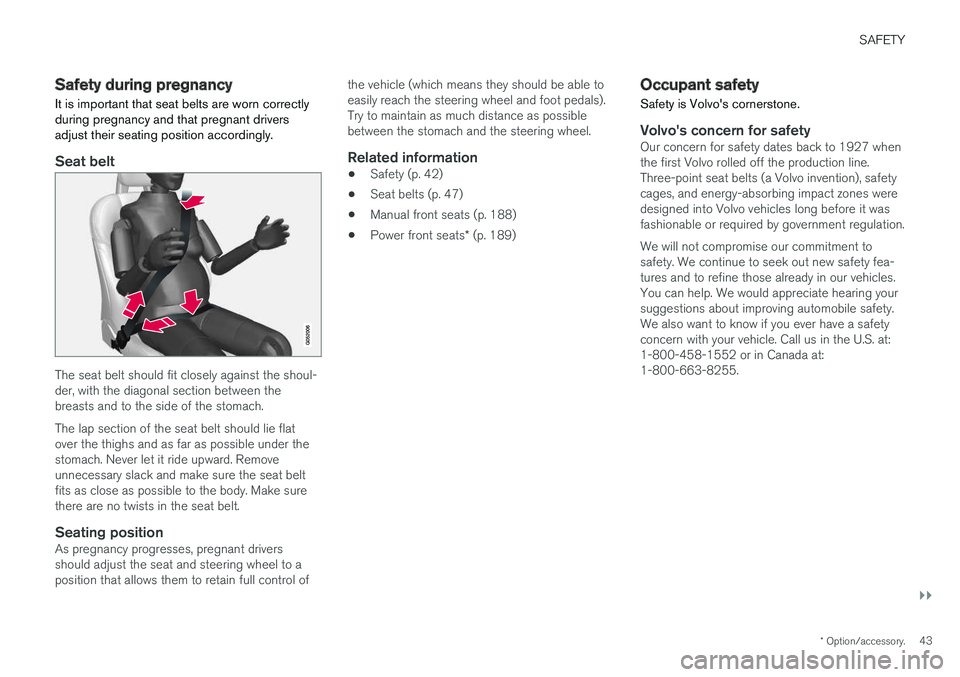
Seat belt
The seat belt should fit closely against the shoul- der, with the diagonal section between thebreasts and to the side of the stomach. The lap section of the seat belt should lie flat over the thighs and as far as possible under thestomach. Never let it ride upward. Removeunnecessary slack and make sure the seat beltfits as close as possible to the body. Make surethere are no twists in the seat belt.
Seating positionAs pregnancy progresses, pregnant driversshould adjust the seat and steering wheel to aposition that allows them to retain full control of the vehicle (which means they should be able toeasily reach the steering wheel and foot pedals).Try to maintain as much distance as possiblebetween the stomach and the steering wheel.
Related information
•
Safety (p. 42)
• Seat belts (p. 47)
• Manual front seats (p. 188)
• Power front seats
* (p. 189)
Occupant safety Safety is Volvo's cornerstone.
Volvo's concern for safetyOur concern for safety dates back to 1927 when the first Volvo rolled off the production line.Three-point seat belts (a Volvo invention), safetycages, and energy-absorbing impact zones weredesigned into Volvo vehicles long before it wasfashionable or required by government regulation. We will not compromise our commitment to safety. We continue to seek out new safety fea-tures and to refine those already in our vehicles. You can help. We would appreciate hearing your suggestions about improving automobile safety. We also want to know if you ever have a safety concern with your vehicle. Call us in the U.S. at: 1-800-458-1552 or in Canada at: 1-800-663-8255.
Page 48 of 666
||
SAFETY
46
Related information
•Safety (p. 42)
• Reporting safety defects (p. 44)
• Occupant safety (p. 43)
Whiplash Protection System The Whiplash Protection System (WHIPS) is designed to help reduce the risk of whiplash-type injuries. The system consists of energyabsorbing backrests and seat cushions as wellas specially designed head restraints in the frontseats.
WHIPS is activated in the event of a rear-end collision and adapted to the angle and speed ofthe collision and to the characteristics of the col-liding vehicle. When WHIPS is activated, the front seat back- rests move rearward and the seat cushions movedownward to change the seating positions of thedriver and front seat passenger. This movementhelps absorb some of the forces that could resultin whiplash.
WARNING
WHIPS is a supplement to the seat belt. Always wear your seat belt.
WARNING
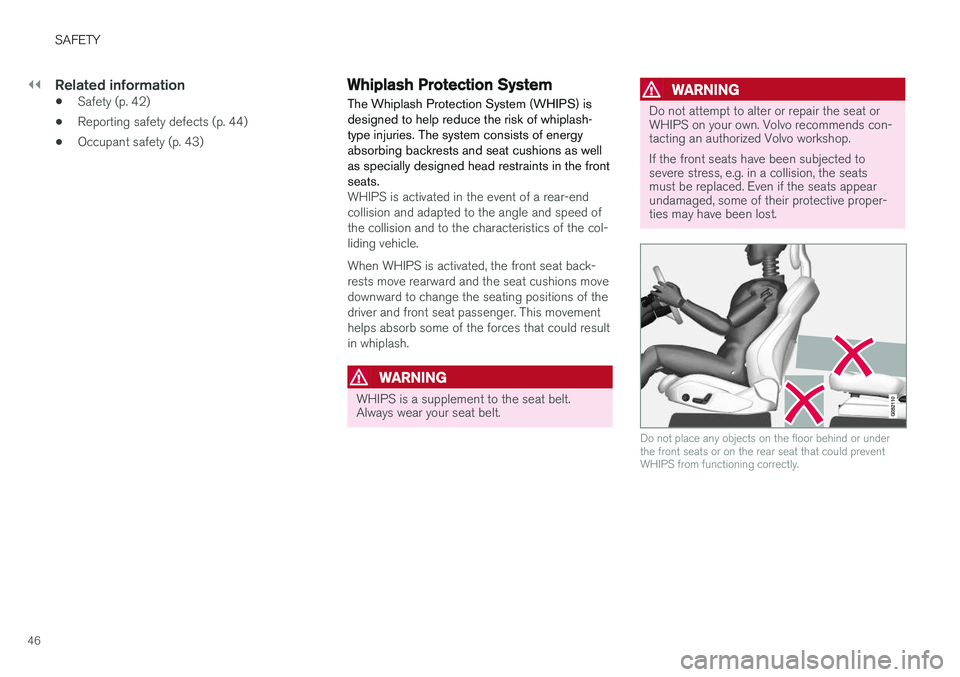
Do not attempt to alter or repair the seat or WHIPS on your own. Volvo recommends con-tacting an authorized Volvo workshop. If the front seats have been subjected to severe stress, e.g. in a collision, the seatsmust be replaced. Even if the seats appearundamaged, some of their protective proper-ties may have been lost.
Do not place any objects on the floor behind or under the front seats or on the rear seat that could preventWHIPS from functioning correctly.
Page 49 of 666
SAFETY
}}
* Option/accessory.47
WARNING
Do not squeeze box-like cargo between the rear seat cushion and the front seat backrest. If the rear seat backrests are folded down, cargo must be secured to prevent it from slid-ing forward against the front seat backrests inthe event of a collision.
WARNING
If a rear seat backrest is folded down or if a rear-facing child restraint is being used in therear seat, the seat in front must be moved for-ward so that it does not come into contactwith the backrest or child restraint.
Seating positionFor WHIPS to provide optimal protection, the driver and passenger must be seated correctlyand the system's function must not be impededin any way. Set the front seat to the correct seating position before starting to drive. The driver and the front seat passenger should sit in the center of the seat with their heads asclose as possible to the head restraints.
Related information
•Safety (p. 42)
• Manual front seats (p. 188)
• Power front seats
* (p. 189) •
Rear Collision Warning (p. 345)
Seat belts
Seat belts should always be worn by all occu- pants in your vehicle. Children should be prop-erly restrained using an infant seat, adjustablechild seat or booster cushion as determined byage, weight and height.
Most states and provinces make it mandatory for occupants of a vehicle to use seat belts.
Seat belt maintenanceCheck periodically that the seat belts are in goodcondition. Use water and a mild detergent forcleaning. Check the seat belt mechanism's func-tion as follows: attach the seat belt and pull rap-idly on the strap.
Page 50 of 666
||
SAFETY
48
WARNING
•Never repair the belt yourself. Repairs should only be performed by a trainedand qualified Volvo service technician.
• Any device used to induce slack into theshoulder belt portion of the three-pointbelt system will have a detrimental effecton the amount of protection available inthe event of a collision.
• The seat back should not be tilted too farback. The shoulder belt must be taut inorder to function properly.
• Do not use any type of child restraint inthe front passenger seat. We recommendthat children who have outgrown thesedevices sit in the rear seat with the seatbelt properly fastened.
Related information
• Safety (p. 42)
• Seat belt tensioners (p. 50)
• Buckling and unbuckling seat belts (p. 48)
• Door and seat belt reminders (p. 51)
Buckling and unbuckling seat belts
Make sure that all passengers have buckled their seat belts before starting to drive.Buckling seat belts1. Pull out the belt slowly and make sure it is not twisted or damaged. If the seat belt in the second row center seating position is used, make sure it is prop-erly positioned in the correct seat belt guide.
NOTE
Each seat belt is equipped with a retractor that will lock up in the following situations:
• if the belt is pulled out rapidly
• during braking and acceleration
• if the vehicle is leaning excessively
• when driving in turns
• if the automatic locking retractor/emer-gency locking retractor (ALR/ELR) is acti-vated. Each seat belt (except for the driv-er's) is equipped with an ALR function,which is designed to keep the seat belttaut when installing a child restraint. ALRis activated when the seat belt is pulledout as far as possible. If this is done, asound from the seat belt retractor will beaudible, which is normal. The seat belt cannow only be fed into the retractor, notpulled out. This function is automaticallydisabled when the seat belt is unbuckledand fully retracted.