ECO mode VOLVO XC90 T8 2018 Owner´s Manual
[x] Cancel search | Manufacturer: VOLVO, Model Year: 2018, Model line: XC90 T8, Model: VOLVO XC90 T8 2018Pages: 686, PDF Size: 11.51 MB
Page 610 of 686
||
MAINTENANCE AND SERVICE
* Option/accessory.
608
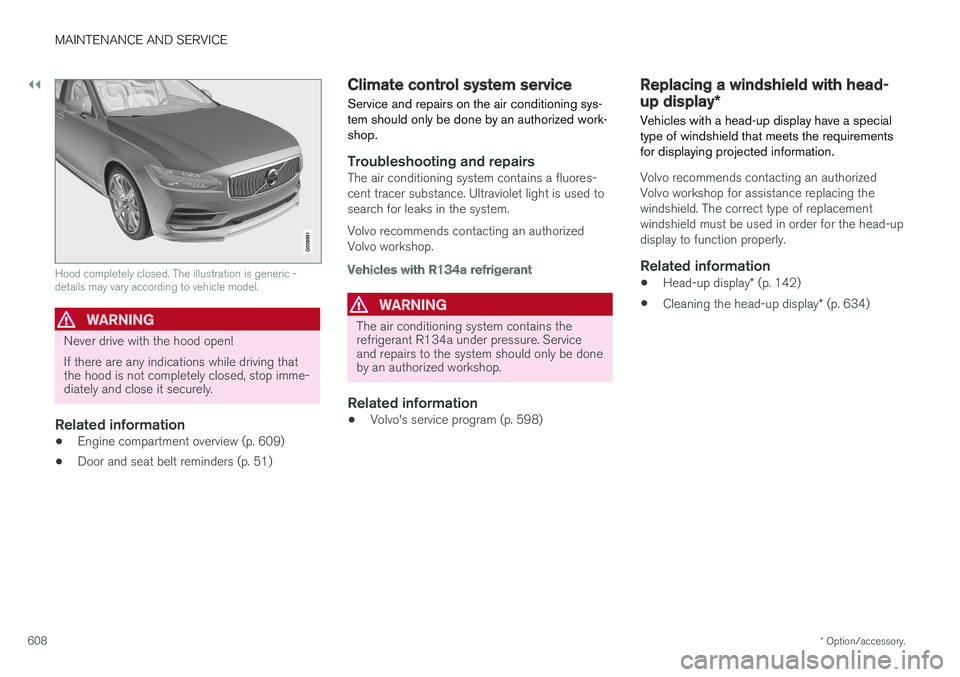
Hood completely closed. The illustration is generic - details may vary according to vehicle model.
WARNING
Never drive with the hood open! If there are any indications while driving that the hood is not completely closed, stop imme-diately and close it securely.
Related information
• Engine compartment overview (p. 609)
• Door and seat belt reminders (p. 51)
Climate control system service Service and repairs on the air conditioning sys- tem should only be done by an authorized work-shop.
Troubleshooting and repairsThe air conditioning system contains a fluores- cent tracer substance. Ultraviolet light is used tosearch for leaks in the system. Volvo recommends contacting an authorized Volvo workshop.
Vehicles with R134a refrigerant
WARNING
The air conditioning system contains the refrigerant R134a under pressure. Serviceand repairs to the system should only be doneby an authorized workshop.
Related information
•Volvo's service program (p. 598)
Replacing a windshield with head-
up display
*
Vehicles with a head-up display have a special type of windshield that meets the requirementsfor displaying projected information.
Volvo recommends contacting an authorized Volvo workshop for assistance replacing thewindshield. The correct type of replacementwindshield must be used in order for the head-updisplay to function properly.
Related information
• Head-up display
* (p. 142)
• Cleaning the head-up display
* (p. 634)
Page 611 of 686
MAINTENANCE AND SERVICE
609
Engine compartment overview
This overview shows some service-related com- ponents.
Some of the components included in the vehi- cle's electric drive system are located in theengine compartment. Exercise caution whenaccessing the engine compartment and onlytouch what is required for normal maintenance.
WARNING
Orange wiring may only be handled by quali- fied personnel.
WARNING
Several components in the vehicle work with high voltage that can be hazardous in case ofan incorrect procedure.
• Do not touch anything that is not clearly described in this Owner's Manual.
• Be careful when checking/filling fluids inthe engine compartment.
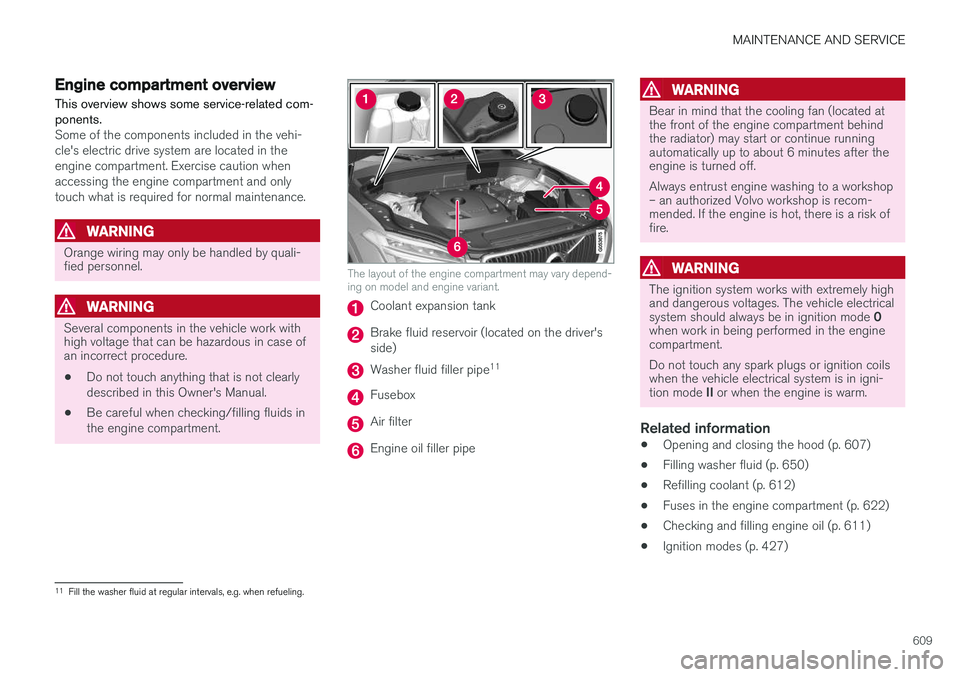
The layout of the engine compartment may vary depend- ing on model and engine variant.
Coolant expansion tank
Brake fluid reservoir (located on the driver's side)
Washer fluid filler pipe 11
Fusebox
Air filter
Engine oil filler pipe
WARNING
Bear in mind that the cooling fan (located at the front of the engine compartment behindthe radiator) may start or continue runningautomatically up to about 6 minutes after theengine is turned off. Always entrust engine washing to a workshop – an authorized Volvo workshop is recom-mended. If the engine is hot, there is a risk offire.
WARNING
The ignition system works with extremely high and dangerous voltages. The vehicle electrical system should always be in ignition mode
0
when work in being performed in the engine compartment. Do not touch any spark plugs or ignition coils when the vehicle electrical system is in igni- tion mode II or when the engine is warm.
Related information
• Opening and closing the hood (p. 607)
• Filling washer fluid (p. 650)
• Refilling coolant (p. 612)
• Fuses in the engine compartment (p. 622)
• Checking and filling engine oil (p. 611)
• Ignition modes (p. 427)
11
Fill the washer fluid at regular intervals, e.g. when refueling.
Page 614 of 686
||
MAINTENANCE AND SERVICE
612
NOTE
If the conditions for measuring oil level are not properly fulfilled (time after engine shut-down, vehicle inclination, ambient tempera- ture, etc.) the message
No value availablewill be shown in the center display. This does not mean that anything is wrong in the vehi-
cle systems.
Related information
• Engine oil (p. 610)
• Engine oil specifications (p. 662)
• Ignition modes (p. 427)
• Vehicle status (p. 602)
Refilling coolant
Coolant helps keep the combustion engine at the right operating temperature. The heat trans-ferred from the engine to the coolant can beused to warm the passenger compartment.
When refilling coolant, follow the instructions on the package. Never fill the cooling system withonly water. The risk of freezing is increased withtoo low or too high amounts of coolant. If there is coolant under the vehicle, smoke from the cooling system, or if more than 2 liters (about2 quarts) of coolant has been added to the sys-tem, there could be something wrong with thecooling system and starting the vehicle coulddamage the engine. Call a tow truck and do notattempt to start the engine.
WARNING
The coolant may be very hot. Never unscrew the cap when the coolant is hot. If coolantmust be filled, unscrew the expansion tankcap slowly to relieve overpressure.
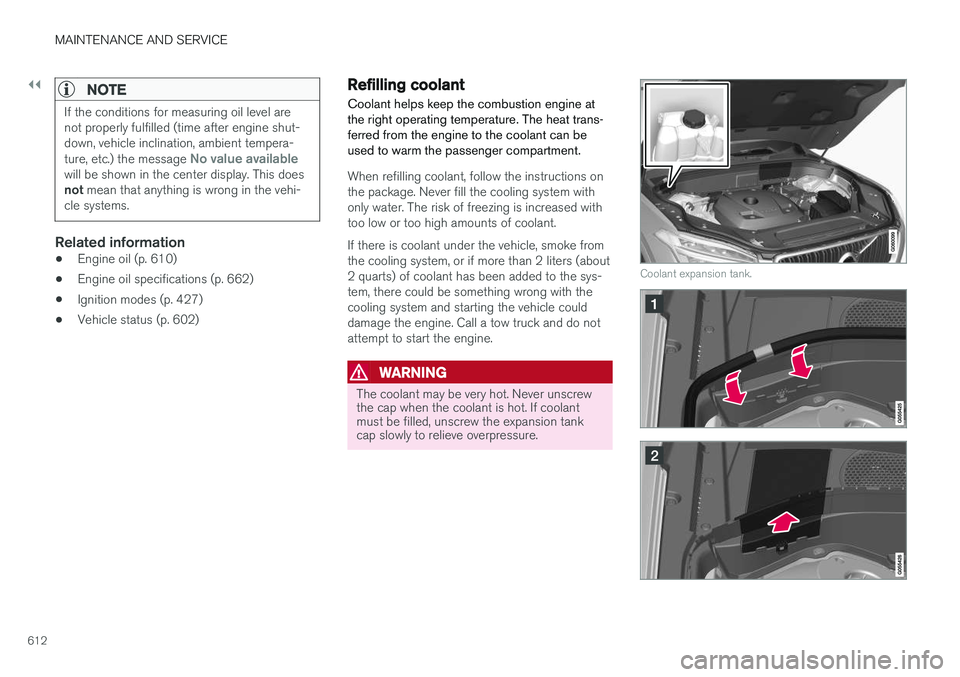
Coolant expansion tank.
Page 618 of 686
||
MAINTENANCE AND SERVICE
616
CAUTION
Only a modern battery charger with controlled charge voltage should be used to charge thestarter battery. The rapid charging functionshould not be used as this could damage thebattery.
NOTE
If both the starter battery and the hybrid bat- tery are discharged, both batteries must be
charged. In such cases, it is not possible to charge only the hybrid battery first. The starter battery must have a certain level of charge for it to be possible to charge thehybrid battery.
CAUTION
Failure to observe the following could cause the infotainment energy save mode to tempo-rarily stop working and/or a message in thedriver's display regarding the state of chargeof the starter battery may be temporarilyincorrect after an external starter battery orbattery charger has been connected:
• The negative battery terminal of the vehi- cle's starter battery must
never be used
to connect an external starter battery orbattery charger – only the vehicle's neg-
ative charging point should be used as
a grounding point.
NOTE
If the starter battery becomes discharged too many times, it will shorten its service life. The service life of the starter battery is affec- ted by several factors, such as driving condi-tions and climate. The starting capacity of thebattery reduces gradually over time. The bat-tery must therefore be recharged if the vehi-cle is not used or a long period of time or if itis only driven short distances. Severe cold fur-ther limits the starting capacity. To keep the starter battery in a good condi- tion, the vehicle should be driven at least15 minutes per week or the battery should beconnected to a battery charger with automatictrickle charging. A starter battery that is always kept fully charged has the maximum service life.
Page 619 of 686
MAINTENANCE AND SERVICE
}}
617
Location
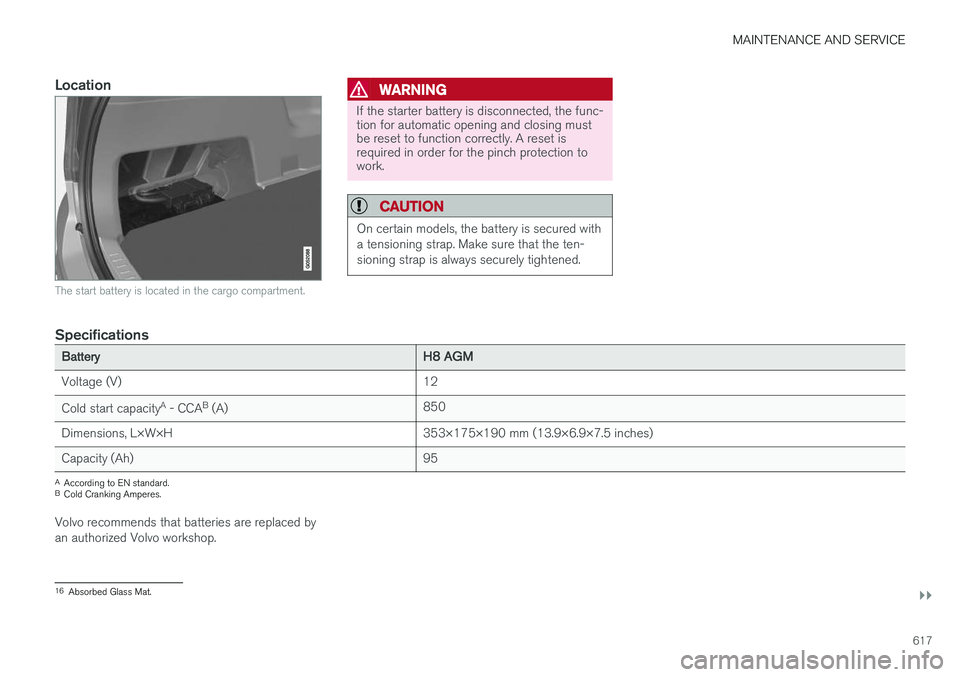
The start battery is located in the cargo compartment.
WARNING
If the starter battery is disconnected, the func- tion for automatic opening and closing mustbe reset to function correctly. A reset isrequired in order for the pinch protection towork.
CAUTION
On certain models, the battery is secured with a tensioning strap. Make sure that the ten-sioning strap is always securely tightened.
Specifications
BatteryH8 AGM
Voltage (V) 12
Cold start capacity A
- CCA B
(A) 850
Dimensions, L×W×H 353×175×190 mm (13.9×6.9×7.5 inches)
Capacity (Ah) 95
A
According to EN standard.
B Cold Cranking Amperes.
Volvo recommends that batteries are replaced by an authorized Volvo workshop.
16 Absorbed Glass Mat.
Page 643 of 686
MAINTENANCE AND SERVICE
641
Automatic car washes The vehicle should be washed as soon as it becomes dirty. This makes the vehicle easier toclean because dirt does not attach as strongly. Italso reduces the risk of scratches and keeps thevehicle looking new.
Automatic car washesAn automatic car wash is a fast and easy way to keep your vehicle clean, but it does not reach allareas of the vehicle. For best results, Volvo rec-ommends hand washing your vehicle or supple-menting automatic car washes with a hand wash.
NOTE
Volvo recommends not washing the vehicle in an automatic car wash during the first fewmonths; the paintwork on new vehicles takessome time to fully harden.
CAUTION
Before driving the vehicle into a car wash, deactivate the Automatic Braking when Sta-tionary and Automatic Parking Brake Applica-tion functions. If the functions are not deacti-vated, the brake system will seize when thevehicle is stationary and the vehicle will not beable to roll.
CAUTION
For automatic car washes in which the vehicle is pulled forward on rolling wheels:
1. Before washing the vehicle, make surethat the automatic rain sensor is deacti- vated. If it is not deactivated and inadver-tently starts, the wiper arms could bedamaged.
2. To help prevent damage from the auto- matic car wash machinery, make surethat the door mirrors are folded in, anten-nas retracted or removed, and any auxili-ary lights secured.
3. Drive into the automatic car wash.
4. Turn off the "Automatic Braking when Stationary" function using the switch in the tunnel console.
5. Turn off the "Automatic Parking Brake Application" function in the center dis-play's Top view.
6. Turn off the engine by turning the start knob in the tunnel console clockwise.Hold the knob in position for at least2 seconds.
The vehicle is now ready for the automatic carwash.
CAUTION
The system will automatically change to P
mode if the above steps are not followed. In P
mode, the wheels are locked, which they should not be when the vehicle is beingwashed in a car wash.
Related information
• Cleaning the exterior (p. 638)
• Polishing and waxing (p. 639)
• Hand washing (p. 639)
• High-pressure washing (p. 642)
• Cleaning the wiper blades (p. 642)
• Cleaning exterior plastic, rubber and trim components (p. 643)
• Cleaning rims (p. 644)
• Corrosion protection (p. 644)
Page 646 of 686
MAINTENANCE AND SERVICE
644
Cleaning rims The vehicle should be washed as soon as it becomes dirty. This makes the vehicle easier toclean because dirt does not attach as strongly. Italso reduces the risk of scratches and keeps thevehicle looking new. Wash the vehicle in a carwash or garage with an oil separator. Use a carwashing detergent.
RimsOnly use rim cleaning products recommended by Volvo. Strong rim cleaning agents could damage the surface and stain the chromed aluminum rims.
Related information
•Cleaning the exterior (p. 638)
• Polishing and waxing (p. 639)
• Hand washing (p. 639)
• Automatic car washes (p. 641)
• High-pressure washing (p. 642)
• Cleaning exterior plastic, rubber and trimcomponents (p. 643)
• Cleaning rims (p. 644)
• Corrosion protection (p. 644)
Corrosion protection
Your vehicle is constructed with effective protec- tion against corrosion.
Corrosion protection for the body consists of modern metallic protective coatings on the sheetmetal, a high-quality painting process, corrosion-protected and minimized metal overlap, andshielding plastic components, abrasion protectionand supplemental rust inhibitor in exposed areas.In the chassis, exposed components of the wheelsuspension are made of corrosion-resistant castaluminum.
Inspection and maintenanceThe corrosion protection does not normallyrequire maintenance, but keeping the vehicleclean is always a good way to further reduce therisk of corrosion. The use of strong alkaline oracidic cleaning fluids should always be avoidedon shiny body components. Any stone chips inthe paint should be touched up as soon as theyare discovered.
Related information
• Cleaning the exterior (p. 638)
• Polishing and waxing (p. 639)
• Hand washing (p. 639)
• Automatic car washes (p. 641)
• High-pressure washing (p. 642)
• Cleaning the wiper blades (p. 642) •
Cleaning exterior plastic, rubber and trimcomponents (p. 643)
• Cleaning rims (p. 644)
Page 660 of 686
||
SPECIFICATIONS
658
Dimensionsmminches
I Wheel track, rear G 1667
H
1675 I 65.6
H
65.9 I
Wheel track, rear J 1671
H
1679 I 65.8
H
66.1 I
J Load width, floor 1192 46.9
K Width 1923K
1931 L
1958 M 75.7
K
76.0 L
77.1 M
L Width incl. rearview mir- rors 2140 84.3
M Width incl. folded rear-view mirrors 2008 79.1
A
At curb weight + 2 people. Varies slightly depending on tire dimensions, chassis, etc.)
B Does not apply to vehicles with 4 seats.
C From the second row of seats in 7-seat models. *
D Vehicles with 4 seats.
E Vehicles with 5 seats.
F Vehicles with 7 seats.
G Vehicles without pneumatic suspension.
H Vehicles with 19-inch wheels.
I Vehicles with 20, 21 and 22-inch wheels.
J Vehicles with pneumatic suspension.
K Chassis width.
L Width for vehicles with 19-inch wheels.
M Width for vehicles with 20, 21 and 22-inch wheels.
Related information
• Weights (p. 659)
Page 672 of 686
INDEX
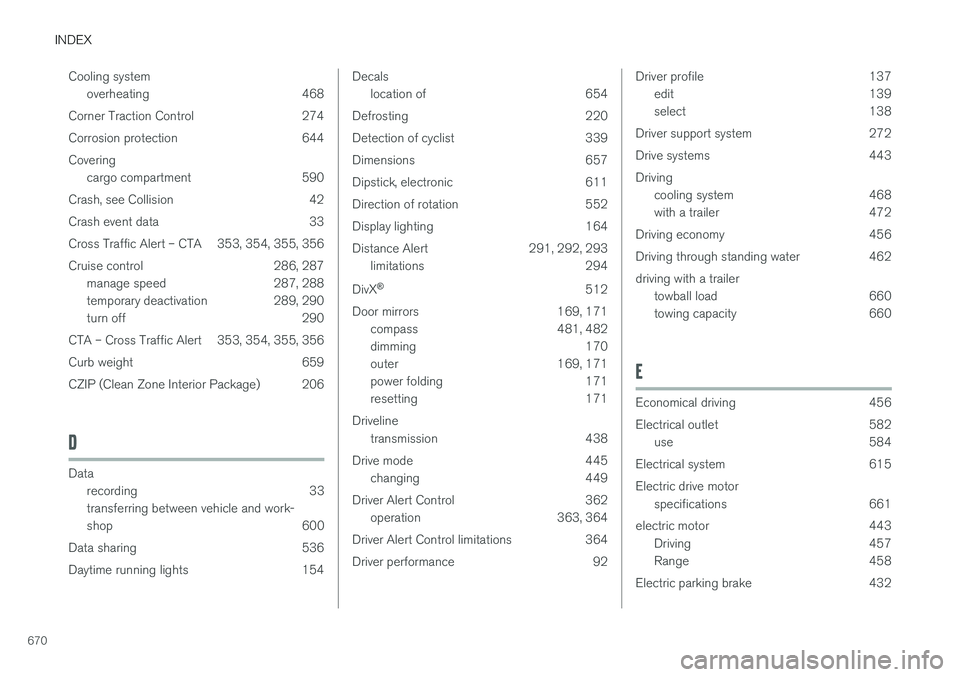
670Cooling system
overheating 468
Corner Traction Control 274
Corrosion protection 644Covering cargo compartment 590
Crash, see Collision 42
Crash event data 33
Cross Traffic Alert – CTA 353, 354, 355, 356
Cruise control 286, 287 manage speed 287, 288
temporary deactivation 289, 290
turn off 290
CTA – Cross Traffic Alert 353, 354, 355, 356
Curb weight 659
CZIP (Clean Zone Interior Package) 206
D
Data recording 33 transferring between vehicle and work-
shop 600
Data sharing 536
Daytime running lights 154
Decals location of 654
Defrosting 220
Detection of cyclist 339
Dimensions 657
Dipstick, electronic 611
Direction of rotation 552
Display lighting 164
Distance Alert 291, 292, 293 limitations 294
DivX ®
512
Door mirrors 169, 171 compass 481, 482
dimming 170
outer 169, 171
power folding 171
resetting 171
Driveline transmission 438
Drive mode 445 changing 449
Driver Alert Control 362 operation 363, 364
Driver Alert Control limitations 364
Driver performance 92Driver profile 137 edit 139
select 138
Driver support system 272
Drive systems 443Driving cooling system 468
with a trailer 472
Driving economy 456
Driving through standing water 462 driving with a trailer towball load 660
towing capacity 660
E
Economical driving 456
Electrical outlet 582
use 584
Electrical system 615 Electric drive motor specifications 661
electric motor 443 Driving 457
Range 458
Electric parking brake 432
Page 674 of 686
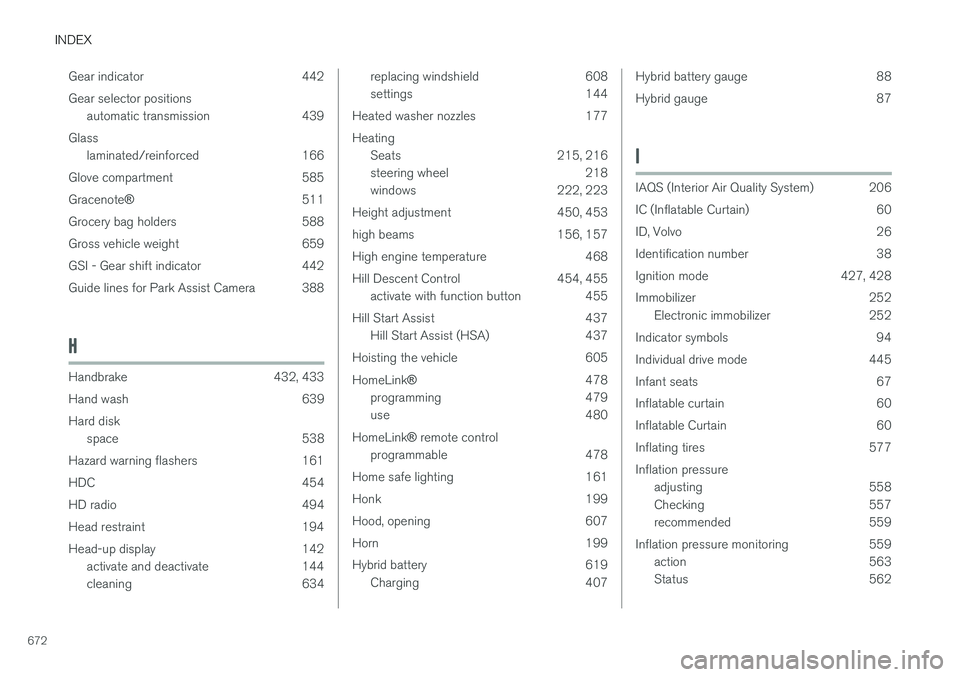
INDEX
672Gear indicator 442 Gear selector positions
automatic transmission 439
Glass laminated/reinforced 166
Glove compartment 585 Gracenote ® 511
Grocery bag holders 588
Gross vehicle weight 659
GSI - Gear shift indicator 442
Guide lines for Park Assist Camera 388
H
Handbrake 432, 433
Hand wash 639 Hard disk space 538
Hazard warning flashers 161
HDC 454
HD radio 494
Head restraint 194
Head-up display 142 activate and deactivate 144
cleaning 634
replacing windshield 608
settings 144
Heated washer nozzles 177 Heating Seats 215, 216
steering wheel 218
windows 222, 223
Height adjustment 450, 453
high beams 156, 157
High engine temperature 468
Hill Descent Control 454, 455 activate with function button 455
Hill Start Assist 437 Hill Start Assist (HSA) 437
Hoisting the vehicle 605 HomeLink ® 478
programming 479
use 480
HomeLink ® remote control
programmable 478
Home safe lighting 161
Honk 199
Hood, opening 607
Horn 199
Hybrid battery 619 Charging 407Hybrid battery gauge 88
Hybrid gauge 87
I
IAQS (Interior Air Quality System) 206
IC (Inflatable Curtain) 60
ID, Volvo 26
Identification number 38
Ignition mode 427, 428
Immobilizer 252Electronic immobilizer 252
Indicator symbols 94
Individual drive mode 445
Infant seats 67
Inflatable curtain 60
Inflatable Curtain 60
Inflating tires 577 Inflation pressure adjusting 558
Checking 557
recommended 559
Inflation pressure monitoring 559 action 563
Status 562