lock VOLVO XC90 TWIN ENGINE 2018 Owners Manual
[x] Cancel search | Manufacturer: VOLVO, Model Year: 2018, Model line: XC90 TWIN ENGINE, Model: VOLVO XC90 TWIN ENGINE 2018Pages: 686, PDF Size: 17 MB
Page 574 of 686
||WHEELS AND TIRES
572
CAUTION
Snow chains can be used on the vehicle, with
the following restrictions:
• Volvo recommends not using snow
chains on wheel dimensions larger than
19 inches.
• Always follow the manufacturer's installa-
tion instructions carefully. Install chains
as tightly as possible and retighten peri-
odically.
• Only put snow chains on the front wheels
(also applies to all-wheel drive vehicles).
• If accessory, aftermarket or "custom"
tires and wheels with different dimen-
sions than the original tires and wheels
are used, snow chains in some cases
may NOT be used. Sufficient distance
between the chains and brakes, suspen-
sion and body components must be
maintained.
• Check local regulations regarding the use
of snow chains before installing.
• Never exceed the snow chain manufac-
turer's specified maximum speed limit.
Under no circumstances should you
exceed 50 km/h (30 mph).
• Avoid bumps, holes or sharp turns when
driving with snow chains. •
Avoid driving on surfaces without snow as
this wears out both the snow chains and
the tires.
• The handling of the vehicle can be
adversely affected when driving with
chains. Avoid fast or sharp turns as well
as locked wheel braking.
• Some types of strap-on chains affect
brake components and therefore must
NOT be used. Consult a Volvo retailer for more information
about snow chains.
Related information
•
Winter driving (p. 461) Tire sealing system
13
The temporary tire sealing system can be used
to seal a puncture in a tire or to check and
adjust the pressure in the tire.
Models equipped with a spare wheel 14
do not
have the tire sealing system.
The tire sealing system consists of a compressor
and a bottle containing sealing compound. The
sealing functions as a temporary repair.
NOTE The sealing compound effectively seals tires
with punctures in the tread but may not be
able to fully seal tires with punctures in the
sidewall. Do not use the tire sealing system
on tires with large tears, cracks or similar
damage.
NOTE
The compressor is intended for temporary tire
sealing and is approved by Volvo.
LocationThe tire sealing system is located in a foam block
under the floor of the cargo compartment.
Page 586 of 686

LOADING, STORAGE AND PASSENGER COMPARTMENT
* Option/accessory.
584 Using the electrical outlets
The 12 V outlet can be used for devices
intended for this such as MP3 players, coolers
and cellular phones.
The high-voltage outlet* can be used for devices
intended for this, such as chargers, laptops, etc. The ignition must be in at least mode I for the
outlets to supply current. The outlets will then be
active as long as there is sufficient charge in the
start battery.
If the engine is turned off and the vehicle is
locked, the outlets will be deactivated. If the
engine is turned off and the vehicle remains
unlocked, the sockets will remain active for up to
7 minutes.
NOTE Bear in mind that using the electrical outlets
when the engine is off could cause the starter
battery to have too low of a charge level,
which could limit other functionality.
Accessories connected to the electrical out-
lets can be activated even when the vehicle
electrical system is off or if preconditioning is
used. For this reason, disconnect plugs when
they are not in use to prevent the starter bat-
tery from becoming discharged.
WARNING •
Do not use accessories with large or
heavy plugs – they could damage the out-
let or come loose while you are driving.
• Do not use accessories that could cause
disruptions to e.g. the vehicle's radio
receiver or electrical system.
• Position the accessory so that there is no
risk of it injuring the driver or passengers
in the event of heavy braking or a colli-
sion.
• Pay attention to connected accessories
as they can generate heat that could burn
passengers or the interior.
Using 12 V outlets1. Remove the stopper (tunnel console) or fold
down the cover (trunk/cargo compartment)
over the socket and plug in the device.
2. Unplug the device and put the stopper back in (tunnel console) or fold up the cover
(trunk/cargo compartment) when the socket
is not in use or left unattended.
CAUTION The maximum power is 120 W (10 A) per
outlet.
Using high-voltage outletsThe ignition must be in at least mode I for outlets
to supply current. The outlets will then be active
as long as there is sufficient charge in the start
battery.
1. Slide down the cover over the outlet and plug
in the device.
>
The LED 2
light on the outlet will indicate
its status.
2. The outlet is supplying electrical current when the light is glowing steadily green.
3. Disconnect the device by pulling out the plug (do not pull on the cord).
Pull up the cover when the outlet is not in
use or is left unattended.
CAUTION The maximum power is 150 W.
WARNING
Do not attempt to alter or repair the high-volt-
age outlet on your own. Volvo recommends
contacting an authorized Volvo workshop.
2
LED (Light Emitting Diode)
Page 587 of 686

LOADING, STORAGE AND PASSENGER COMPARTMENT
585
WARNING•
Only use accessories that are not dam-
aged or malfunctioning. The accessories
must be designed for 120 V and 60 Hz,
with plugs intended for the outlet. The
accessories must be CE marked, UL
marked or have an equivalent safety
marking.
• New let outlets, plugs or accessories
come into contact with water or another
fluid. Do not touch or use the outlet if it
appears damaged or has been in contact
with water or another fluid.
• Do not connect power strips, adapters or
extension cords to the outlet has this
could cause the outlet's safety functions
to malfunction.
• The outlet is equipped with a pet guard.
Make sure that no one picks at or dam-
ages the outlet in such a way that the
guard is disabled. Children should not be
left unsupervised in the vehicle when the
outlet is active.
Failure to follow the above could lead to
severe or fatal electrical shocks.
Related information
• Electrical outlets (p. 582)
• Passenger compartment interior (p. 580) Using the glove compartment
The glove compartment is located on the pas-
senger side. The glove compartment can be
used to store the Owner's Manual, maps, etc.
There is also room for a pen and a card holder. Glove compartment and opening button on the center
console.
The glove compartment is opened by pressing
the opening button in the center console.
Locking and unlocking the glove box
The glove compartment can be locked ("private
locking") when the vehicle is left at a workshop,
hotel, etc. When private locking is activated, the
tailgate is also locked.
Using the glove box as a cooled area
The glove compartment can be used to cool e.g.
drinks or food. Cooling is possible when the cli-
mate system is active (i.e. when the ignition is in
mode II or when the engine is running). The illustration is generic – the design may vary.
Activate cooling
Deactivate cooling
– Activate or deactivate cooling by moving the
control as far as possible toward the passen-
ger compartment/glove compartment.
Related information
•
Passenger compartment interior (p. 580)
• Private Locking (p. 266)
Page 596 of 686

||LOADING, STORAGE AND PASSENGER COMPARTMENT
594
WARNING
Objects in the cargo compartment must
always be securely anchored, even with a cor-
rectly installed cargo net.
Installing the cargo net
WARNING
All of the cargo net's upper consoles, hooks
and straps must be securely mounted and
attached before the net is used.
Never use the net if it is damaged.
NOTE
With front mounting, the cargo net is most
easily installed via a rear door.
1. Fold out the cargo net and make sure that
the upper rod folds out and locks into posi-
tion.
2.
Insert one of the net's hooks into the front or
rear ceiling mounting point with the strap
lock facing you. 3. Insert the other upper hook into the ceiling
mounting point on the opposite side. The
telescopic spring-loaded hooks make mount-
ing easier.
Make sure that the net's hooks are pushed
forward as far as possible into their respec-
tive mounting points. 4. Rear mounting: With the cargo net hooked
into the rear ceiling mounting points, attach
the net's straps into the front floor eyelets in
the cargo compartment. Rear mounting.
Front mounting: With the cargo net mounted
in the front ceiling mounting points, hook the
straps into the outer eyelets on the front seat
rails behind the seats. Attaching the net is
easier if the seat backrests are upright and
the seats are moved slightly forward.
Page 597 of 686

LOADING, STORAGE AND PASSENGER COMPARTMENT
595Front mounting.
Move the seat or backrest only until it
touches the net. Moving it with too much
force or applying too much pressure to the
net could lead to damage.
CAUTION If a seat or backrest is pressed with too much
force back against the cargo net, the net and
its ceiling brackets could be damaged.
5. Pull the straps until the cargo net is taut.
Removing the cargo netThe cargo net can be easily removed and folded
up.
1. Loosen the cargo net by pressing the button
on the strap locks on each side and pulling
to allow some slack.
2. Press in the catches and release both of the strap hooks.
3. Unhook the upper hooks and remove the net from the ceiling mounting points.
4. Press the red button on the rod so that it can be folded. Fold and roll up the net. Store the
net in its case.
Related information
• Loading recommendations (p. 586)
• Load anchoring eyelets (p. 589)
Page 602 of 686

||MAINTENANCE AND SERVICE
600
Monthly:
•
Check cold tire pressure in all tires. Inspect
the tires for wear.
• Check that engine coolant and other fluid
levels are between the indicated "min" and
"max" markings.
• Clean interior glass surfaces with a glass
cleaner and soft paper towels.
• Wipe driver information displays with a soft
cloth.
• Visually inspect battery terminals for corro-
sion. Corrosion may indicate a loose terminal
connector, or a battery near the end of its
useful service life. Consult your Volvo retailer
for additional information.
As needed:
Wash the car, including the undercarriage, to
reduce wear that can be caused by a buildup of
dirt, and corrosion that can be caused by salt res-
idues.
Clean leaves and twigs from air intake vents at
the base of the windshield, and from other places
where they may collect.
NOTE Complete service information for qualified
technicians is available online for purchase or
subscription at www.volvotechinfo.com.
Related information
•
Vehicle status (p. 602)
• Scheduling service and repairs (p. 603)
• Connecting equipment to the vehicle's data
link connector (p. 36)
• Technician certification (p. 37)
• Climate control system service (p. 608)
• Maintenance of the brake system (p. 432)
• Engine compartment overview (p. 609) Data transfer between vehicle and
workshop over Wi-Fi
Volvo workshops have a designated Wi-Fi net-
work for secure data transfer between your vehi-
cle and the workshop. Your visit to the workshop
will be easier and more effective when diagnos-
tics information and software can be transferred
over the workshop's network.
When you arrive at the workshop, your technician
can connect your vehicle to the workshop's Wi-Fi
network to perform troubleshooting and down-
load software. For this type of communication,
the vehicle only connects to the workshop's net-
work. The vehicle can only be connected to the
designated workshop networks, not to any other
network, e.g. your home network.
Manual connection to workshop Wi-FiManual connection is usually performed by a
service technician. Because the technician uses
the buttons on your remote key to connect the
vehicle, it is important that you bring a key with
buttons when taking the vehicle in to a workshop.
Pressing the lock button on the remote key three
times will connect the vehicle to the workshop's
Wi-Fi network.
When the car is connected to a Wi-Fi network,
the symbol appears in the center display.
Page 609 of 686
MAINTENANCE AND SERVICE
}}
607
Opening and closing the hood
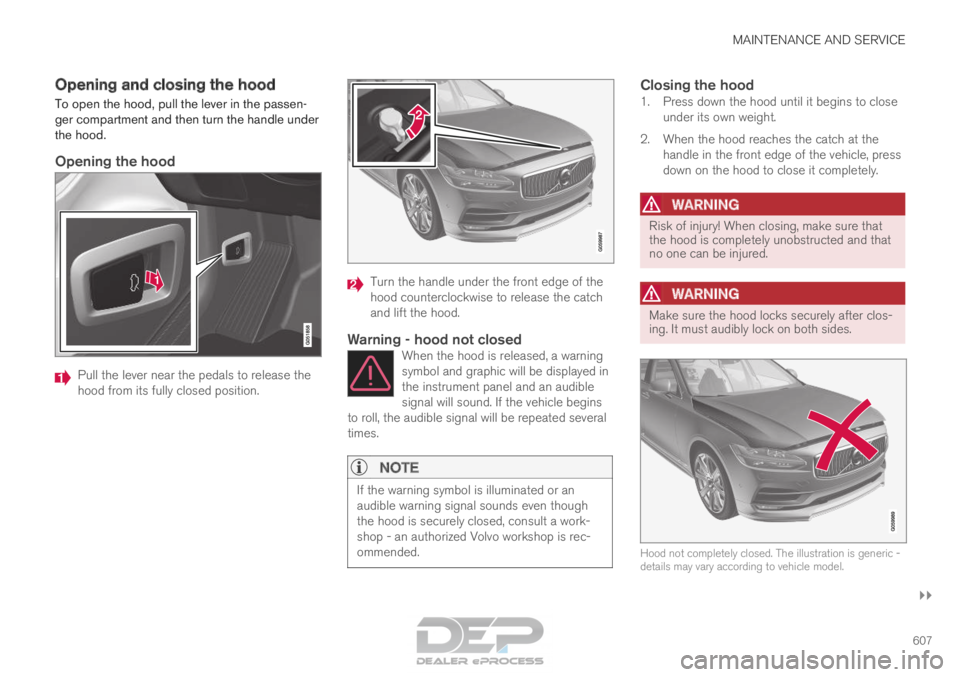
To open the hood, pull the lever in the passen-
ger compartment and then turn the handle under
the hood.
Opening the hood
Pull the lever near the pedals to release the
hood from its fully closed position. Turn the handle under the front edge of the
hood counterclockwise to release the catch
and lift the hood.
Warning - hood not closedWhen the hood is released, a warning
symbol and graphic will be displayed in
the instrument panel and an audible
signal will sound. If the vehicle begins
to roll, the audible signal will be repeated several
times.
NOTE If the warning symbol is illuminated or an
audible warning signal sounds even though
the hood is securely closed, consult a work-
shop - an authorized Volvo workshop is rec-
ommended.
Closing the hood1. Press down the hood until it begins to close
under its own weight.
2. When the hood reaches the catch at the handle in the front edge of the vehicle, press
down on the hood to close it completely.
WARNING Risk of injury! When closing, make sure that
the hood is completely unobstructed and that
no one can be injured.
WARNING
Make sure the hood locks securely after clos-
ing. It must audibly lock on both sides.
Hood not completely closed. The illustration is generic -
details may vary according to vehicle model.
Page 641 of 686
MAINTENANCE AND SERVICE
}}
639
Polishing and waxing
Polish and wax the vehicle when the paint is
matte or to provide extra protection. The vehicle
does not need to be polished until it is at least a
year old. However, it can be waxed during the
first year. Do not polish or wax the vehicle in
direct sunlight. The surface of the vehicle should
not be warmer than approximately 45 °C
(113 °F).
• Wash and dry the vehicle very carefully
before polishing or waxing. Remove asphalt
and tar stains with asphalt remover or paint
thinner. More stubborn stains can be
removed with a grinding paste designed for
vehicle paint.
• Use polish first and then liquid or paste wax.
Follow the instructions on the package care-
fully. Many products contain both polish and
wax.
• A wide range of polymer-based waxes can
be purchased today. These waxes are easy to
use and produce a long-lasting, high-gloss
finish that protects the bodywork against oxi-
dation, road dirt and fading.
CAUTION Avoid waxing and polishing plastic and rubber.
If using degreaser on plastic and rubber, only
rub (if necessary) with slight pressure. Use a
soft sponge.
Polishing glossy trim moldings can wear away
or damage the glossy surface layer.
Polish containing abrasives must not be used.
CAUTION
Only use paintwork treatments recommended
by Volvo. Other treatments, such as preserva-
tion, sealing, protection, luster sealing or simi-
lar, could damage the paintwork. Paintwork
damage caused by such treatments are not
covered by Volvo's warranty.
Related information
•
Cleaning the exterior (p. 638)
• Hand washing (p. 639)
• Automatic car washes (p. 641)
• High-pressure washing (p. 642)
• Cleaning the wiper blades (p. 642)
• Cleaning exterior plastic, rubber and trim
components (p. 643)
• Cleaning rims (p. 644)
• Corrosion protection (p. 644) Hand washing
The vehicle should be washed as soon as it
becomes dirty. This makes the vehicle easier to
clean because dirt does not attach as strongly. It
also reduces the risk of scratches and keeps the
vehicle looking new. Wash the vehicle in a car
wash or garage with an oil separator. Use a car
washing detergent.
Hand washingKeep the following points in mind when washing
the vehicle:
• Avoid washing the vehicle in direct sunlight.
This could cause the detergent or wax to dry
out and become abrasive.
• Remove bird droppings from paintwork as
soon as possible. They contain chemicals
that affect and discolor paint very quickly.
Use e.g. soft paper or a sponge soaked in
lots of water. Consult an authorized Volvo
workshop for assistance removing discolora-
tion.
• Hose down the underbody, including the
wheel housings and bumper.
• Hose down the entire vehicle and remove
any loose dirt, droppings etc. to reduce the
risk of scratches from washing. Do not spray
directly onto locks.
• If necessary, use cold degreaser on heavily
soiled surfaces. Note that in such cases the
surfaces must not be hot from the sun.
Page 643 of 686

MAINTENANCE AND SERVICE
641
Automatic car washes
The vehicle should be washed as soon as it
becomes dirty. This makes the vehicle easier to
clean because dirt does not attach as strongly. It
also reduces the risk of scratches and keeps the
vehicle looking new.
Automatic car washesAn automatic car wash is a fast and easy way to
keep your vehicle clean, but it does not reach all
areas of the vehicle. For best results, Volvo rec-
ommends hand washing your vehicle or supple-
menting automatic car washes with a hand wash.
NOTE
Volvo recommends not washing the vehicle in
an automatic car wash during the first few
months; the paintwork on new vehicles takes
some time to fully harden.
CAUTION
Before driving the vehicle into a car wash,
deactivate the Automatic Braking when Sta-
tionary and Automatic Parking Brake Applica-
tion functions. If the functions are not deacti-
vated, the brake system will seize when the
vehicle is stationary and the vehicle will not be
able to roll.
CAUTION For automatic car washes in which the vehicle
is pulled forward on rolling wheels:
1.
Before washing the vehicle, make sure
that the automatic rain sensor is deacti-
vated. If it is not deactivated and inadver-
tently starts, the wiper arms could be
damaged.
2. To help prevent damage from the auto- matic car wash machinery, make sure
that the door mirrors are folded in, anten-
nas retracted or removed, and any auxili-
ary lights secured.
3. Drive into the automatic car wash.
4. Turn off the "Automatic Braking when Stationary" function using the switch in
the tunnel console.
5. Turn off the "Automatic Parking Brake Application" function in the center dis-
play's Top view.
6. Turn off the engine by turning the start knob in the tunnel console clockwise.
Hold the knob in position for at least
2 seconds.
The vehicle is now ready for the automatic car
wash.
CAUTION The system will automatically change to P
mode if the above steps are not followed. In P
mode, the wheels are locked, which they
should not be when the vehicle is being
washed in a car wash.
Related information
•
Cleaning the exterior (p. 638)
• Polishing and waxing (p. 639)
• Hand washing (p. 639)
• High-pressure washing (p. 642)
• Cleaning the wiper blades (p. 642)
• Cleaning exterior plastic, rubber and trim
components (p. 643)
• Cleaning rims (p. 644)
• Corrosion protection (p. 644)
Page 644 of 686
MAINTENANCE AND SERVICE
642High-pressure washing
The vehicle should be washed as soon as it
becomes dirty. This makes the vehicle easier to
clean because dirt does not attach as strongly. It
also reduces the risk of scratches and keeps the
vehicle looking new. Wash the vehicle in a car
wash or garage with an oil separator. Use a car
washing detergent.
High-pressure washingIf washing the vehicle with a high-pressure wash,
use sweeping movements and keep the nozzle at
least 30 cm (13 in.) from the vehicle. Do not
spray directly onto locks.
Related information
• Cleaning the exterior (p. 638)
• Polishing and waxing (p. 639)
• Hand washing (p. 639)
• Automatic car washes (p. 641)
• Cleaning the wiper blades (p. 642)
• Cleaning exterior plastic, rubber and trim
components (p. 643)
• Cleaning rims (p. 644)
• Corrosion protection (p. 644) Cleaning the wiper blades
The vehicle should be washed as soon as it
becomes dirty. This makes the vehicle easier to
clean because dirt does not attach as strongly. It
also reduces the risk of scratches and keeps the
vehicle looking new. Wash the vehicle in a car
wash or garage with an oil separator. Use a car
washing detergent.
Wiper bladesAsphalt, dust and salt residue on wiper blades, as
well as insects, ice etc. on the windshield, shorten
the service life of wiper blades.
When cleaning, put the wiper blades in the serv-
ice position.
NOTE
Wash the wiper blades and windshield regu-
larly with a lukewarm soap solution or vehicle
shampoo. Do not use strong solvents.
Related information
•
Cleaning the exterior (p. 638)
• Polishing and waxing (p. 639)
• Hand washing (p. 639)
• Automatic car washes (p. 641)
• High-pressure washing (p. 642)
• Cleaning exterior plastic, rubber and trim
components (p. 643) •
Cleaning rims (p. 644)
• Corrosion protection (p. 644)