weight VOLVO XC90 TWIN ENGINE 2018 Owners Manual
[x] Cancel search | Manufacturer: VOLVO, Model Year: 2018, Model line: XC90 TWIN ENGINE, Model: VOLVO XC90 TWIN ENGINE 2018Pages: 686, PDF Size: 17 MB
Page 4 of 686
2
OWNER'S INFORMATION
Owner's information16
Owner's Manual in the center display17
Navigate in the Owner's Manual inthe center display18
Owner's manual in mobile devices20
Volvo Cars support site20
Using the Owner's Manual21
The Owner's Manual and the envi-ronment23
YOUR VOLVO
Contacting Volvo26
Volvo ID26
Creating and registering a Volvo ID27
Drive-E ‒ purer driving pleasure27
IntelliSafe - driver support28
Sensus - connection and entertainment30
Software Updates33
Data recording33
Terms & Conditions for Services34
Customer Privacy Policy34
Important information on accessoriesand extra equipment35
Accessory installation36
Connecting equipment to the vehi-cle's data link connector36
Technician certification37
Viewing the Vehicle IdentificationNumber (VIN)38
Volvo Structural Parts Statement38
Driver distraction39
SAFETY
Safety42
Safety during pregnancy43
Occupant safety43
Reporting safety defects44
Recall information45
Whiplash Protection System46
Seat belts47
Buckling and unbuckling seat belts48
Seat belt tensioners50
Resetting the electric seat belt ten-sioners51
Door and seat belt reminders51
Airbags52
Driver/passenger-side airbags53
Occupant weight sensor56
Side airbags60
Inflatable curtain60
Safety mode61
Starting and moving the vehiclewhen it is in safety mode62
Child safety63
Child restraints65
Infant seats67
Convertible seats69
Booster cushions71
TABLE OF CONTENTS
Page 14 of 686
12
Sharing Internet from the vehicle viaWi-Fi hotspot (tethering)533
No or poor Internet connection534
Deleting Wi-Fi networks535
Wi-Fi technology and security535
Terms of use and data sharing536
Activating and deactivating data sharing536
Compatible file formats for media536
Technical specifications for USB devices537
Hard disk storage space538
License agreement for audio and media539
WHEELS AND TIRES
Tires550
Tire direction of rotation552
Tread wear indicator553
Tire terminology553
Tire sidewall designations554
Uniform Tire Quality Grading556
Checking tire pressure557
Adjusting tire pressure558
Recommended tire pressure559
Tire pressure monitoring system*559
Calibrating the tire pressure monitor-ing system*561
Viewing tire pressure status in thecenter display*562
Action when warned of low tire pressure563
When changing wheels564
Tool kit564
Jack*565
Wheel bolts565
Removing a wheel566
Installing a wheel568
Spare wheel569
Accessing the spare wheel570
Snow tires571
Snow chains571
Tire sealing system572
Using the tire sealing system573
Inflate tires with the compressorincluded in the tire sealing system577
Determining the vehicle's permittedweight578
Page 16 of 686
14
Touching up minor paint damage645
Color codes646
Changing rear window wipers647
Replacing windshield wiper blades648
Windshield wipers in the service position649
Filling washer fluid650
SPECIFICATIONS
Type designations654
Dimensions657
Weights659
Towing capacity and tongue weight660
Engine specifications661
Engine oil specifications662
Coolant specifications663
Transmission fluid specifications663
Brake fluid specifications663
Fuel tank volume664
Air conditioning specifications664
Approved tire pressure665
INDEX
Index667
Page 49 of 686
SAFETY
}}
* Option/accessory.47
WARNING
Do not squeeze box-like cargo between therear seat cushion and the front seat backrest.
If the rear seat backrests are folded down,cargo must be secured to prevent it from slid-ing forward against the front seat backrests inthe event of a collision.
WARNING
If a rear seat backrest is folded down or if arear-facing child restraint is being used in therear seat, the seat in front must be moved for-ward so that it does not come into contactwith the backrest or child restraint.
Seating position
For WHIPS to provide optimal protection, thedriver and passenger must be seated correctlyand the system's function must not be impededin any way.
Set the front seat to the correct seating positionbefore starting to drive.
The driver and the front seat passenger shouldsit in the center of the seat with their heads asclose as possible to the head restraints.
Related information
•Safety (p. 42)
•Manual front seats (p. 184)
•Power front seats* (p. 185)
•Rear Collision Warning (p. 347)Seat belts
Seat belts should always be worn by all occu-pants in your vehicle. Children should be prop-erly restrained using an infant seat, adjustablechild seat or booster cushion as determined byage, weight and height.Most states and provinces make it mandatory foroccupants of a vehicle to use seat belts.
Seat belt maintenance
Check periodically that the seat belts are in goodcondition. Use water and a mild detergent forcleaning. Check the seat belt mechanism's func-tion as follows: attach the seat belt and pull rap-idly on the strap.
Page 57 of 686

SAFETY
}}
55
NOTE
•Deployment of front airbags occurs onlyone time during an accident. In a collisionwhere deployment occurs, the airbagsand seat belt pretensioners activate.Some noise occurs and a small amountof powder is released. The release of thepowder may appear as smoke-like matter.This is a normal characteristic and doesnot indicate fire.
•Volvo's front airbags use special sensorsthat are integrated into the front seat beltbuckles. The point at which the airbagdeploys is determined by whether or notthe seat belt is being used, as well as theseverity of the collision.
•Collisions can occur where only one ofthe airbags deploys. If the impact is lesssevere, but severe enough to present aclear injury risk, the airbags are triggeredat partial capacity. If the impact is moresevere, the airbags are triggered at fullcapacity.
WARNING
•Do not use child safety seats or childbooster cushions/backrests in the frontpassenger's seat. We also recommendthat occupants under 140 cm (4 feet7 inches) in height who have outgrownthese devices sit in the rear seat with theseat belt fastened. See also the Occu-pant Weight Sensor information.
•Never drive with the airbags deployed.The fact that they hang out can impair thesteering of your vehicle. Other safety sys-tems can also be damaged.
•The smoke and dust formed when theairbags are deployed can cause skin andeye irritation in the event of prolongedexposure.
Should you have questions about any componentin the SRS system, please contact a trained andqualified Volvo service technician or Volvo cus-tomer support:
In the United States
Volvo Car USA, LLC
Customer Care Center
1 Volvo Drive
P.O. Box 914
Rockleigh, New Jersey 07647
1-800-458-1552
www.volvocars.com/us
In Canada
Volvo Car Canada Ltd.
Customer Care Centre
9130 Leslie Street, Suite 101
Richmond Hill, Ontario L4B 0B9
1-800-663-8255
www.volvocars.com/ca
Airbag decals
Airbag decal on the outside of both sun visors
Page 58 of 686
||
SAFETY
56
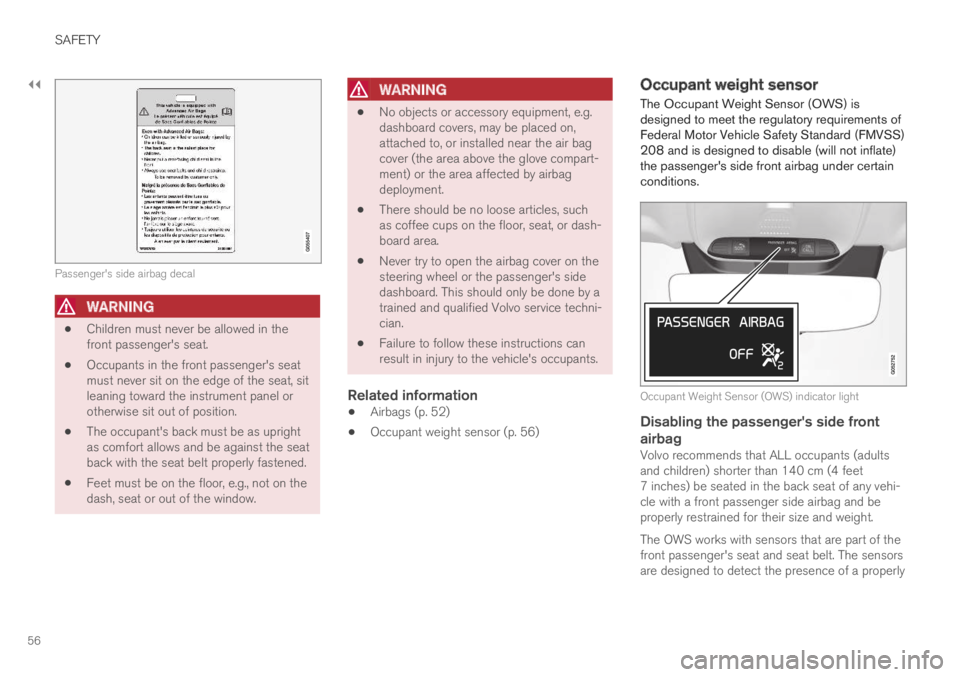
Passenger's side airbag decal
WARNING
•Children must never be allowed in thefront passenger's seat.
•Occupants in the front passenger's seatmust never sit on the edge of the seat, sitleaning toward the instrument panel orotherwise sit out of position.
•The occupant's back must be as uprightas comfort allows and be against the seatback with the seat belt properly fastened.
•Feet must be on the floor, e.g., not on thedash, seat or out of the window.
WARNING
•No objects or accessory equipment, e.g.dashboard covers, may be placed on,attached to, or installed near the air bagcover (the area above the glove compart-ment) or the area affected by airbagdeployment.
•There should be no loose articles, suchas coffee cups on the floor, seat, or dash-board area.
•Never try to open the airbag cover on thesteering wheel or the passenger's sidedashboard. This should only be done by atrained and qualified Volvo service techni-cian.
•Failure to follow these instructions canresult in injury to the vehicle's occupants.
Related information
•Airbags (p. 52)
•Occupant weight sensor (p. 56)
Occupant weight sensor
The Occupant Weight Sensor (OWS) isdesigned to meet the regulatory requirements ofFederal Motor Vehicle Safety Standard (FMVSS)208 and is designed to disable (will not inflate)the passenger's side front airbag under certainconditions.
Occupant Weight Sensor (OWS) indicator light
Disabling the passenger's side front
airbag
Volvo recommends that ALL occupants (adultsand children) shorter than 140 cm (4 feet7 inches) be seated in the back seat of any vehi-cle with a front passenger side airbag and beproperly restrained for their size and weight.
The OWS works with sensors that are part of thefront passenger's seat and seat belt. The sensorsare designed to detect the presence of a properly
Page 59 of 686
SAFETY
}}
57
seated occupant and determine if the passeng-er's side front airbag should be enabled (mayinflate) or disabled (will not inflate).
The OWS will disable (will not inflate) the pas-senger's side front airbag when:
•the front passenger's seat is unoccupied, orhas small/medium objects in the front seat,
•the system determines that an infant is pres-ent in a rear-facing infant seat that is instal-led according to the manufacturer's instruc-tions,
•the system determines that a small child ispresent in a forward-facing child restraintthat is installed according to the manufactur-er's instructions,
•the system determines that a small child ispresent in a booster seat,
•a front passenger takes his/her weight off ofthe seat for a period of time,
•a child or a small person occupies the frontpassenger's seat.
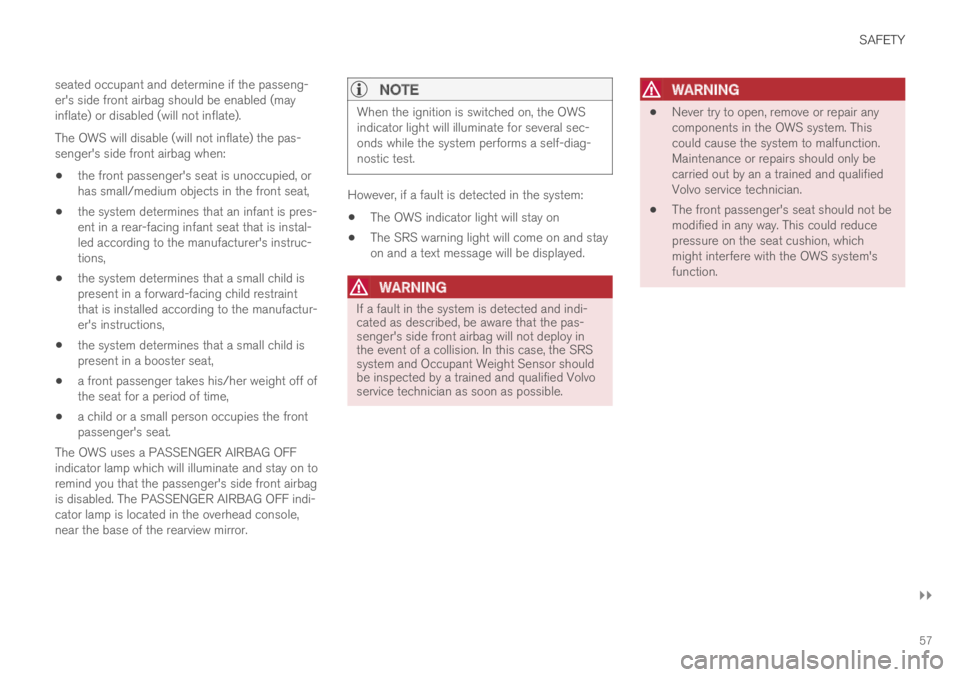
The OWS uses a PASSENGER AIRBAG OFFindicator lamp which will illuminate and stay on toremind you that the passenger's side front airbagis disabled. The PASSENGER AIRBAG OFF indi-cator lamp is located in the overhead console,near the base of the rearview mirror.
NOTE
When the ignition is switched on, the OWSindicator light will illuminate for several sec-onds while the system performs a self-diag-nostic test.
However, if a fault is detected in the system:
•The OWS indicator light will stay on
•The SRS warning light will come on and stayon and a text message will be displayed.
WARNING
If a fault in the system is detected and indi-cated as described, be aware that the pas-senger's side front airbag will not deploy inthe event of a collision. In this case, the SRSsystem and Occupant Weight Sensor shouldbe inspected by a trained and qualified Volvoservice technician as soon as possible.
WARNING
•Never try to open, remove or repair anycomponents in the OWS system. Thiscould cause the system to malfunction.Maintenance or repairs should only becarried out by an a trained and qualifiedVolvo service technician.
•The front passenger's seat should not bemodified in any way. This could reducepressure on the seat cushion, whichmight interfere with the OWS system'sfunction.
Page 60 of 686
||
SAFETY
58
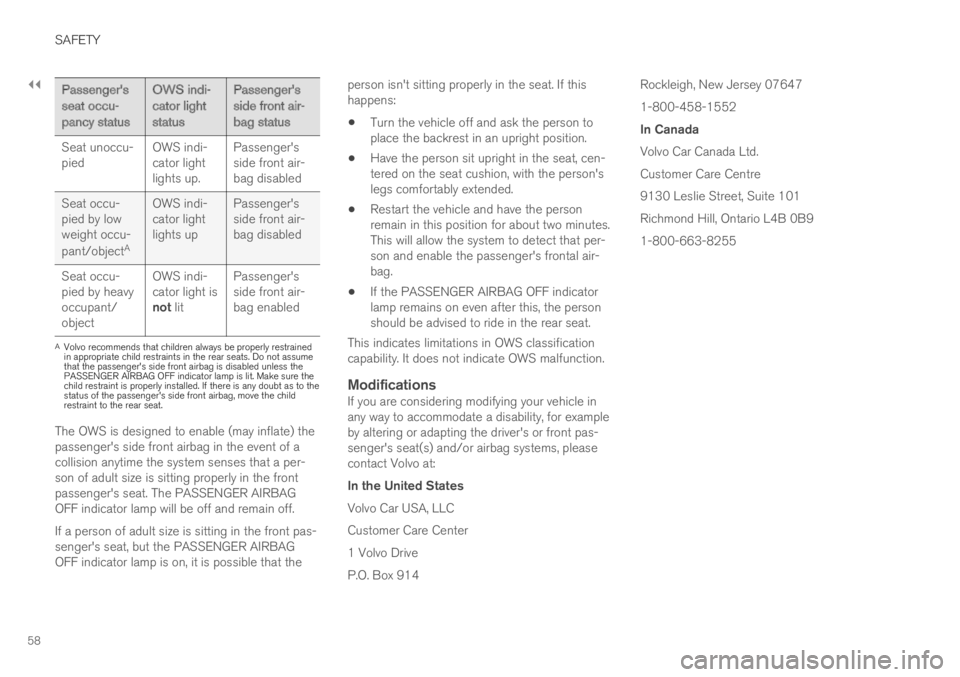
Passenger'sseat occu-pancy status
OWS indi-cator lightstatus
Passenger'sside front air-bag status
Seat unoccu-piedOWS indi-cator lightlights up.
Passenger'sside front air-bag disabled
Seat occu-pied by lowweight occu-
pant/objectA
OWS indi-cator lightlights up
Passenger'sside front air-bag disabled
Seat occu-pied by heavyoccupant/object
OWS indi-cator light isnot lit
Passenger'sside front air-bag enabled
AVolvo recommends that children always be properly restrainedin appropriate child restraints in the rear seats. Do not assumethat the passenger's side front airbag is disabled unless thePASSENGER AIRBAG OFF indicator lamp is lit. Make sure thechild restraint is properly installed. If there is any doubt as to thestatus of the passenger's side front airbag, move the childrestraint to the rear seat.
The OWS is designed to enable (may inflate) thepassenger's side front airbag in the event of acollision anytime the system senses that a per-son of adult size is sitting properly in the frontpassenger's seat. The PASSENGER AIRBAGOFF indicator lamp will be off and remain off.
If a person of adult size is sitting in the front pas-senger's seat, but the PASSENGER AIRBAGOFF indicator lamp is on, it is possible that the
person isn't sitting properly in the seat. If thishappens:
•Turn the vehicle off and ask the person toplace the backrest in an upright position.
•Have the person sit upright in the seat, cen-tered on the seat cushion, with the person'slegs comfortably extended.
•Restart the vehicle and have the personremain in this position for about two minutes.This will allow the system to detect that per-son and enable the passenger's frontal air-bag.
•If the PASSENGER AIRBAG OFF indicatorlamp remains on even after this, the personshould be advised to ride in the rear seat.
This indicates limitations in OWS classificationcapability. It does not indicate OWS malfunction.
Modifications
If you are considering modifying your vehicle inany way to accommodate a disability, for exampleby altering or adapting the driver's or front pas-senger's seat(s) and/or airbag systems, pleasecontact Volvo at:
In the United States
Volvo Car USA, LLC
Customer Care Center
1 Volvo Drive
P.O. Box 914
Rockleigh, New Jersey 07647
1-800-458-1552
In Canada
Volvo Car Canada Ltd.
Customer Care Centre
9130 Leslie Street, Suite 101
Richmond Hill, Ontario L4B 0B9
1-800-663-8255
Page 61 of 686
SAFETY
59
WARNING
•No objects that add to the total weight onthe seat should be placed on the frontpassenger's seat. If a child is seated inthe front passenger's seat with any addi-tional weight, this extra weight couldcause the OWS system to enable the air-bag, which might cause it to deploy in theevent of a collision, thereby injuring thechild.
•The seat belt should never be wrappedaround an object on the front passeng-er's seat. This could interfere with theOWS system's function.
•The front passenger's seat belt shouldnever be used in a way that exerts morepressure on the passenger than normal.This could increase the pressure exertedon the weight sensor by a child, andcould result in the airbag being enabled,which might cause it to deploy in theevent of a collision, thereby injuring thechild.
WARNING
•Keep the following points in mind withrespect to the OWS system. Failure tofollow these instructions could adverselyaffect the system's function and result inserious injury to the occupant of the frontpassenger's seat:
•The full weight of the front seat passen-ger should always be on the seat cushion.The passenger should never lift him/herself off the seat cushion using thearmrest in the door or the center console,by pressing the feet on the floor, by sit-ting on the edge of the seat cushion, orby pressing against the backrest in a waythat reduces pressure on the seat cush-ion. This could cause OWS to disable thefront, passenger's side airbag.
WARNING
•Do not place any type of object on thefront passenger's seat in such a way thatjamming, pressing, or squeezing occursbetween the object and the front seat,other than as a direct result of the correctuse of the Automatic Locking Retractor/Emergency Locking Retractor (ALR/ELR)seat belt.
•No objects should be placed under thefront passenger's seat. This could inter-fere with the OWS system's function.
Related information
•Driver/passenger-side airbags (p. 53)
Page 63 of 686
SAFETY
}}61
WARNING Volvo recommends contacting an authorized
Volvo workshop for repair. Incorrectly per-
formed repairs to the inflatable curtain system
could impair function and lead to serious
injury.
WARNING
Never hang or attach heavy objects in the
handle in the ceiling. The hooks are only
intended for lightweight garments (not for
hard objects such as umbrellas).
Never screw or mount anything to the vehi-
cle's headlining, door pillars or side panels.
This could impair the intended protective
properties. Volvo recommends only using
Volvo original parts that are approved for
placement in these areas.
WARNING
If objects are loaded higher than the upper
edge of the side windows, leave a 10 cm (4
in.) space between the objects and the win-
dow. Objects placed closer to this could
impede the function of the inflatable curtain
concealed inside the headlining.
WARNING
The inflatable curtain is a supplement to the
seat belt. Always wear your seat belt.
Related information
•
Airbags (p. 52) Safety mode
Safety mode is a feature that is triggered after a
collision if there is potential damage to an impor-
tant function in the vehicle, such as the fuel
lines, sensors for one of the safety systems, the
brake system, etc.
If the vehicle has been involved in a collision, the
text
Safety mode See Owner's manual may
appear in the instrument panel along with the
warning symbol if the panel is undamaged and
the vehicle's electrical system is intact. The mes-
sage indicates that one or more of the vehicle's
functions may be reduced.
WARNING Never attempt to restart the vehicle if you
smell fuel fumes when the message
Safety
mode See Owner's manual is displayed in the instrument panel. Leave the vehicle imme-
diately.
If safety mode has been set, it may be possible to
reset the system in order to start and move the
vehicle a short distance, for example, if it is block-
ing traffic.