light VOLVO XC90 TWIN ENGINE 2018 Owners Manual
[x] Cancel search | Manufacturer: VOLVO, Model Year: 2018, Model line: XC90 TWIN ENGINE, Model: VOLVO XC90 TWIN ENGINE 2018Pages: 686, PDF Size: 17 MB
Page 638 of 686

||MAINTENANCE AND SERVICE
* Option/accessory.
636
WARNING •
Never use more than one inlay mat at a
time on the driver's floor. If any other type
of floor mat is used, remove the original
mat from the driver's seat floor before
driving. All types of mats must be securely
anchored in the attachment points in the
floor. Make sure the floor mat does not
impede the movement of the brake pedal
or accelerator pedal in any way, as this
could be a serious safety hazard.
• Volvo's floor mats are specially manufac-
tured for your vehicle. They must be prop-
erly secured in the attachment points in
the floor to help ensure they cannot slide
and become trapped under the pedals.
After vacuuming, a specially designed textile
cleaning agent should be used to remove stains
on floor mats. Floor mats should be cleaned with
products recommended by Volvo retailers.
Related information
• Cleaning the interior (p. 633)
• Cleaning the center display (p. 633)
• Cleaning fabric upholstery and ceiling liner
(p. 635)
• Cleaning the seat belt (p. 635)
• Cleaning leather upholstery (p. 636) •
Cleaning the leather steering wheel
(p. 637)
• Cleaning interior plastic, metal and wood sur-
faces (p. 638) Cleaning leather upholstery
Only use cleaning agents and car care products
recommended by Volvo. Clean regularly and
treat stains immediately for best results. It is
important to vacuum before using a cleaning
agent.
Leather upholstery*Volvo's leather upholstery is treated to protect its
original appearance. Over time, sunlight, grease,
dirt, etc. could break down the protective layer.
This could result in scratches and cracking.
Leather upholstery is a natural product that
changes and acquires a beautiful patina over
time. Regular cleaning and treatments are
required to preserve the qualities and color of the
leather. Volvo offers a comprehensive product,
Volvo Leather Care Kit/Wipes, for cleaning and
treating leather upholstery that, when used as
directed, preserves the leather's protective coa-
ting.
For best results, Volvo recommends cleaning and
applying protective cream one to four times a
year (or more as needed). Volvo Leather Care Kit
951 0251 and Volvo Leather Softener 943
7429 are available for purchase at Volvo retailers.
Page 639 of 686

MAINTENANCE AND SERVICE
637
Cleaning the leather upholstery
1. Apply the leather cleaner to a damp spongeand squeeze it until the cleaner foams.
2. Move the sponge in circular motions to apply the foam to the stain.
3. Dampen the stain thoroughly with the sponge. Let the sponge absorb the stain and
do not rub.
4. Dry the stain using a soft towel and let the leather dry completely.
Protecting the leather upholstery
1. Apply a small amount of leather protector toa cloth and then apply the protector to the
leather using light circular movements.
2. Let it dry for approximately 20 minutes.
Protecting the leather upholstery makes it better
able to withstand sunlight's harmful UV rays.
Related information
• Cleaning the interior (p. 633)
• Cleaning the center display (p. 633)
• Cleaning fabric upholstery and ceiling liner
(p. 635)
• Cleaning the seat belt (p. 635)
• Cleaning floor mats and inlay mats (p. 635)
• Cleaning the leather steering wheel
(p. 637)
• Cleaning interior plastic, metal and wood sur-
faces (p. 638) Cleaning the leather steering wheel
Only use cleaning agents and car care products
recommended by Volvo. Clean regularly and
treat stains immediately for best results. It is
important to vacuum before using a cleaning
agent.
Leather steering wheelLeather needs to breathe. Never cover the
leather steering wheel with a plastic protector.
Volvo Leather Care Kit 951 0251 and Leather
Softener 943 7429 are recommended for clean-
ing the leather steering wheel. First, remove dirt,
dust, etc. with a damp sponge or cloth.
CAUTION Sharp objects such as rings could damage
the leather on the steering wheel.
If there are stains on the steering wheel:
Type 1(ink, wine, coffee, milk, sweat or blood)
–
Use a soft cloth or sponge. Wipe the steering
wheel using a solution of 5% ammonia. For
blood stains, mix approximately 2 dl(1 cup) of
water with 25 g (one ounce) of salt and wipe
the stain.
Type 2(grease, oil, sauces or chocolate)
1.
Same procedure as for Type 1 stains.
2. Finish by wiping the wheel with an absorbent paper or towel. Type 3(dry dirt or dust)
1. Remove the dirt/dust using a soft brush.
2. Same procedure as for Type 1 stains.
Related information
•
Cleaning the interior (p. 633)
• Cleaning the center display (p. 633)
• Cleaning fabric upholstery and ceiling liner
(p. 635)
• Cleaning the seat belt (p. 635)
• Cleaning floor mats and inlay mats (p. 635)
• Cleaning leather upholstery (p. 636)
• Cleaning interior plastic, metal and wood sur-
faces (p. 638)
Page 640 of 686

MAINTENANCE AND SERVICE
638Cleaning interior plastic, metal and
wood surfaces
Only use cleaning agents and car care products
recommended by Volvo. Clean regularly and
treat stains immediately for best results.
Interior plastic, metal and wood
surfaces
A lightly dampened microfiber cloth is recom-
mended for cleaning interior details and surfaces.
These cloths are available for purchase at Volvo
retailers.
Never scrape or rub a stain. Never use strong
stain removers.
CAUTION
Do not use solvent containing alcohol to
clean the instrument panel glass.
CAUTION
Keep in mind that glossy surfaces can be
easily scratched. Wipe these surfaces with a
clean and dry microfiber cloth using small, cir-
cular motions. If necessary, moisten the cloth
lightly with clean water.
Related information
•
Cleaning the interior (p. 633)
• Cleaning the center display (p. 633) •
Cleaning fabric upholstery and ceiling liner
(p. 635)
• Cleaning the seat belt (p. 635)
• Cleaning floor mats and inlay mats (p. 635)
• Cleaning leather upholstery (p. 636)
• Cleaning the leather steering wheel (p. 637) Cleaning the exterior
The vehicle should be washed as soon as it
becomes dirty. This makes the vehicle easier to
clean because dirt does not attach as strongly. It
also reduces the risk of scratches and keeps the
vehicle looking new. Wash the vehicle in a car
wash or garage with an oil separator. Use a car
washing detergent.
Related information
• Cleaning the exterior (p. 638)
• Polishing and waxing (p. 639)
• Hand washing (p. 639)
• Automatic car washes (p. 641)
• High-pressure washing (p. 642)
• Cleaning the wiper blades (p. 642)
• Cleaning exterior plastic, rubber and trim
components (p. 643)
• Cleaning rims (p. 644)
• Corrosion protection (p. 644)
Page 641 of 686
MAINTENANCE AND SERVICE
}}
639
Polishing and waxing
Polish and wax the vehicle when the paint is
matte or to provide extra protection. The vehicle
does not need to be polished until it is at least a
year old. However, it can be waxed during the
first year. Do not polish or wax the vehicle in
direct sunlight. The surface of the vehicle should
not be warmer than approximately 45 °C
(113 °F).
• Wash and dry the vehicle very carefully
before polishing or waxing. Remove asphalt
and tar stains with asphalt remover or paint
thinner. More stubborn stains can be
removed with a grinding paste designed for
vehicle paint.
• Use polish first and then liquid or paste wax.
Follow the instructions on the package care-
fully. Many products contain both polish and
wax.
• A wide range of polymer-based waxes can
be purchased today. These waxes are easy to
use and produce a long-lasting, high-gloss
finish that protects the bodywork against oxi-
dation, road dirt and fading.
CAUTION Avoid waxing and polishing plastic and rubber.
If using degreaser on plastic and rubber, only
rub (if necessary) with slight pressure. Use a
soft sponge.
Polishing glossy trim moldings can wear away
or damage the glossy surface layer.
Polish containing abrasives must not be used.
CAUTION
Only use paintwork treatments recommended
by Volvo. Other treatments, such as preserva-
tion, sealing, protection, luster sealing or simi-
lar, could damage the paintwork. Paintwork
damage caused by such treatments are not
covered by Volvo's warranty.
Related information
•
Cleaning the exterior (p. 638)
• Hand washing (p. 639)
• Automatic car washes (p. 641)
• High-pressure washing (p. 642)
• Cleaning the wiper blades (p. 642)
• Cleaning exterior plastic, rubber and trim
components (p. 643)
• Cleaning rims (p. 644)
• Corrosion protection (p. 644) Hand washing
The vehicle should be washed as soon as it
becomes dirty. This makes the vehicle easier to
clean because dirt does not attach as strongly. It
also reduces the risk of scratches and keeps the
vehicle looking new. Wash the vehicle in a car
wash or garage with an oil separator. Use a car
washing detergent.
Hand washingKeep the following points in mind when washing
the vehicle:
• Avoid washing the vehicle in direct sunlight.
This could cause the detergent or wax to dry
out and become abrasive.
• Remove bird droppings from paintwork as
soon as possible. They contain chemicals
that affect and discolor paint very quickly.
Use e.g. soft paper or a sponge soaked in
lots of water. Consult an authorized Volvo
workshop for assistance removing discolora-
tion.
• Hose down the underbody, including the
wheel housings and bumper.
• Hose down the entire vehicle and remove
any loose dirt, droppings etc. to reduce the
risk of scratches from washing. Do not spray
directly onto locks.
• If necessary, use cold degreaser on heavily
soiled surfaces. Note that in such cases the
surfaces must not be hot from the sun.
Page 642 of 686
||MAINTENANCE AND SERVICE
640
•
Wash using a sponge, car washing detergent
and plenty of lukewarm water.
• Clean the wiper blades with lukewarm soap
solution or car washing detergent.
• Dry the vehicle using a clean, soft chamois or
a squeegee. Try not to let drops of water dry
in strong sunlight. This could cause water
drying stains that may need to be polished
out.
• In areas with heavy industrial emissions,
more frequent washing of the vehicle's exte-
rior is recommended.
• Tar spots from asphalt may remain even after
washing. Use a tar remover to remove these
spots after washing the vehicle.
WARNING Always entrust engine washing to a workshop.
If the engine is hot, there is a risk of fire.
CAUTION
Dirty headlights do not work as well. Clean
them regularly, e.g. when refueling.
Do not use corrosive cleaners. Use water and
a non-abrasive sponge.
NOTE Exterior lighting such as headlights and tail-
lights may develop temporary condensation
on the inside of the lens. This is normal. All
exterior lighting is designed to resist this.
Condensation is normally vented out of the
lamp housing once the light has been lit for
some period of time.
CAUTION
•
Make sure that the panoramic roof and
sun shade are closed before washing the
vehicle.
• Never use abrasive polishing agents on
the panoramic roof.
• Never use wax on the rubber seals
around the panoramic roof.
CAUTION Remember to remove dirt from the drain
holes in the doors and sills after washing the
vehicle.
Related information
•
Cleaning the exterior (p. 638)
• Polishing and waxing (p. 639)
• Automatic car washes (p. 641)
• High-pressure washing (p. 642) •
Cleaning the wiper blades (p. 642)
• Cleaning exterior plastic, rubber and trim
components (p. 643)
• Cleaning rims (p. 644)
• Corrosion protection (p. 644)
Page 643 of 686

MAINTENANCE AND SERVICE
641
Automatic car washes
The vehicle should be washed as soon as it
becomes dirty. This makes the vehicle easier to
clean because dirt does not attach as strongly. It
also reduces the risk of scratches and keeps the
vehicle looking new.
Automatic car washesAn automatic car wash is a fast and easy way to
keep your vehicle clean, but it does not reach all
areas of the vehicle. For best results, Volvo rec-
ommends hand washing your vehicle or supple-
menting automatic car washes with a hand wash.
NOTE
Volvo recommends not washing the vehicle in
an automatic car wash during the first few
months; the paintwork on new vehicles takes
some time to fully harden.
CAUTION
Before driving the vehicle into a car wash,
deactivate the Automatic Braking when Sta-
tionary and Automatic Parking Brake Applica-
tion functions. If the functions are not deacti-
vated, the brake system will seize when the
vehicle is stationary and the vehicle will not be
able to roll.
CAUTION For automatic car washes in which the vehicle
is pulled forward on rolling wheels:
1.
Before washing the vehicle, make sure
that the automatic rain sensor is deacti-
vated. If it is not deactivated and inadver-
tently starts, the wiper arms could be
damaged.
2. To help prevent damage from the auto- matic car wash machinery, make sure
that the door mirrors are folded in, anten-
nas retracted or removed, and any auxili-
ary lights secured.
3. Drive into the automatic car wash.
4. Turn off the "Automatic Braking when Stationary" function using the switch in
the tunnel console.
5. Turn off the "Automatic Parking Brake Application" function in the center dis-
play's Top view.
6. Turn off the engine by turning the start knob in the tunnel console clockwise.
Hold the knob in position for at least
2 seconds.
The vehicle is now ready for the automatic car
wash.
CAUTION The system will automatically change to P
mode if the above steps are not followed. In P
mode, the wheels are locked, which they
should not be when the vehicle is being
washed in a car wash.
Related information
•
Cleaning the exterior (p. 638)
• Polishing and waxing (p. 639)
• Hand washing (p. 639)
• High-pressure washing (p. 642)
• Cleaning the wiper blades (p. 642)
• Cleaning exterior plastic, rubber and trim
components (p. 643)
• Cleaning rims (p. 644)
• Corrosion protection (p. 644)
Page 645 of 686
MAINTENANCE AND SERVICE
* Option/accessory.643
Cleaning exterior plastic, rubber and
trim components
The vehicle should be washed as soon as it
becomes dirty. This makes the vehicle easier to
clean because dirt does not attach as strongly. It
also reduces the risk of scratches and keeps the
vehicle looking new. Wash the vehicle in a car
wash or garage with an oil separator. Use a car
washing detergent.
Exterior plastic, rubber and trim
components
A special cleaning agent available from Volvo
retailers is recommended for the cleaning and
care of colored plastic parts, rubber and trim
components, e.g. glossy trim. Follow the usage
instructions for the cleaning agent carefully.
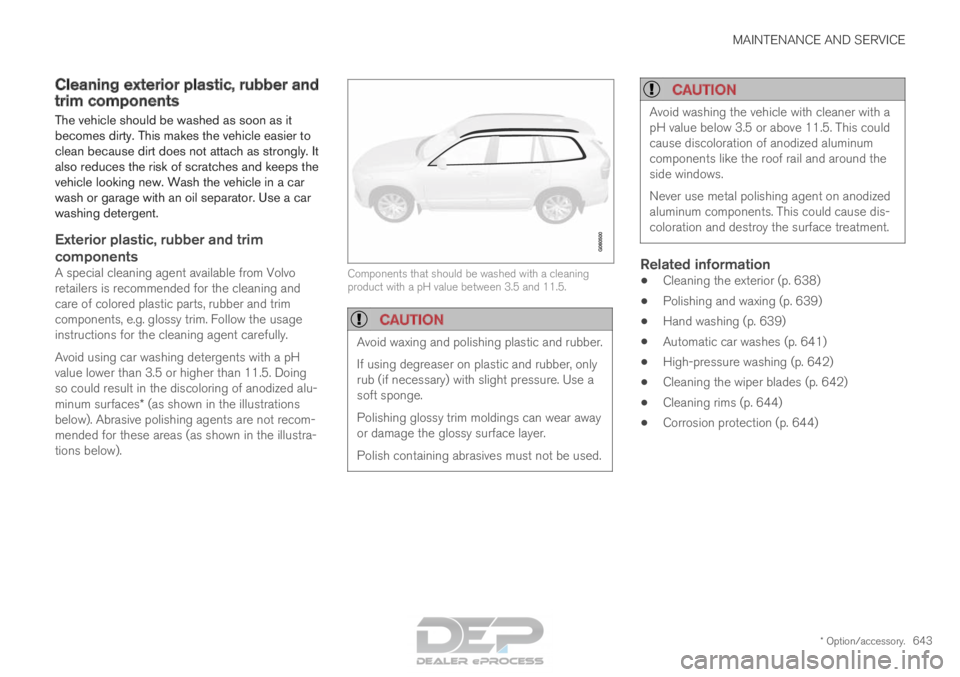
Avoid using car washing detergents with a pH
value lower than 3.5 or higher than 11.5. Doing
so could result in the discoloring of anodized alu-
minum surfaces* (as shown in the illustrations
below). Abrasive polishing agents are not recom-
mended for these areas (as shown in the illustra-
tions below). Components that should be washed with a cleaning
product with a pH value between 3.5 and 11.5.
CAUTION
Avoid waxing and polishing plastic and rubber.
If using degreaser on plastic and rubber, only
rub (if necessary) with slight pressure. Use a
soft sponge.
Polishing glossy trim moldings can wear away
or damage the glossy surface layer.
Polish containing abrasives must not be used.
CAUTION Avoid washing the vehicle with cleaner with a
pH value below 3.5 or above 11.5. This could
cause discoloration of anodized aluminum
components like the roof rail and around the
side windows.
Never use metal polishing agent on anodized
aluminum components. This could cause dis-
coloration and destroy the surface treatment.
Related information
•
Cleaning the exterior (p. 638)
• Polishing and waxing (p. 639)
• Hand washing (p. 639)
• Automatic car washes (p. 641)
• High-pressure washing (p. 642)
• Cleaning the wiper blades (p. 642)
• Cleaning rims (p. 644)
• Corrosion protection (p. 644)
Page 648 of 686
||MAINTENANCE AND SERVICE
646
1. Place a strip of masking tape over the dam-
aged surface. Pull the tape off so that any
loose flakes of paint adhere to it.
If the damage goes down to the bare metal,
you may need to use primer first. If the paint
damage is on a plastic surface, an adhesive
primer should be used for better results.
Spray the primer into the lid of the spray can
and brush on thinly.
2. Light sanding with a very fine-grained sand- paper or similar may be required before
painting (e.g. if there are uneven edges).
Clean the area carefully and let it dry.
3. Thoroughly mix the primer and apply it with a small brush, toothpick or similar. When the
primer is dry, apply one or more coats of
paint and then a clear coat, letting the paint
dry between each application.
If there is a longer scratch, follow the same pro-
cedure as above, but first mask off the surround-
ing area to protect the undamaged paint.
Touch-up pens and spray paints are available at
Volvo retailers.
NOTE If the stone chip has not gone down to the
bare metal and an undamaged coat of paint
remains, apply base coat and clear coat
immediately after cleaning the surface.
Related information
•
Paintwork (p. 645)
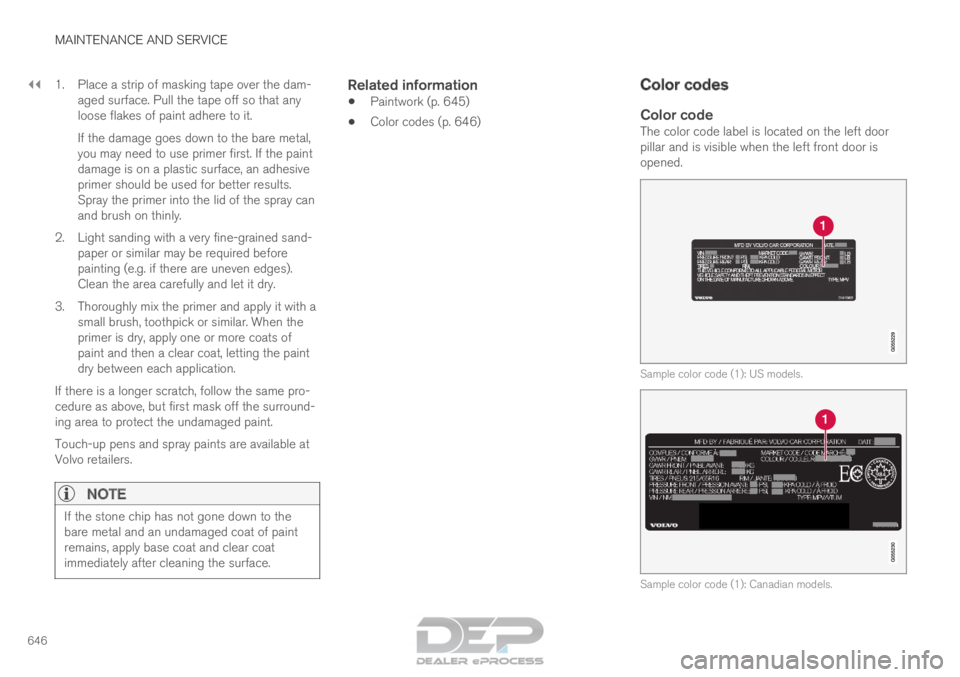
• Color codes (p. 646) Color codesColor codeThe color code label is located on the left door
pillar and is visible when the left front door is
opened. Sample color code (1): US models.
Sample color code (1): Canadian models.
Page 649 of 686

MAINTENANCE AND SERVICE
}}
647
It is important to use the right color.
Related information
•
Paintwork (p. 645)
• Touching up minor paint damage (p. 645) Changing rear window wipers
The wiper blades help remove water from the
windshield and rear window. Along with the
washer fluid, they clean the glass and help
improve visibility while driving. The windshield
and rear window wiper blades can be replaced.
Changing rear window wipers Lift the wiper arm from the window and pull the lower
section of the blade to the right.1. Grasp the center of the wiper blade and
lift it from the window to the stop position.
NOTE When the wiper arm is halfway folded out, it
will stop in a locking position that helps pre-
vent the arm from falling back onto the rear
window. The wiper arm must be pulled past
the locking position stop in order to change
the wiper blade.
2. Grip the lower part of the blade and pull
to the right until the blade loosens from the
arm.
3.
Press the new wiper blade until it clicks into
place. Check to make sure the blade is
securely in place.
4. Fold the wiper arm back toward the window.
CAUTION Check the blades regularly. Neglected main-
tenance shortens the life of the blades.
Related information
•
Using the rain sensor (p. 177)
• Using the windshield and headlight washers
(p. 179)
• Using automatic rear window wiping when
backing up (p. 181)
Page 651 of 686

MAINTENANCE AND SERVICE
}}
* Option/accessory. 649
NOTEThe wiper blades are different lengths. The
blade on the driver's side is longer than the
one on the passenger side.
Related information
•
Using the rain sensor (p. 177)
• Using the windshield and headlight washers
(p. 179)
• Using automatic rear window wiping when
backing up (p. 181)
• Heated windshield washer nozzles* (p. 177)
• Using the rain sensor's memory function
(p. 178)
• Using the rear window wiper/washer
(p. 180)
• Filling washer fluid (p. 650)
• Windshield wipers in the service position
(p. 649)
• Changing rear window wipers (p. 647)
• Using the windshield wipers (p. 176) Windshield wipers in the service
position
The windshield wiper blades must be in the serv-
ice (vertical) position when performing certain
operations, e.g. replacing the blades. Windshield wipers in the service position.
The windshield wipers must be in the service
position when replacing, washing or lifting the
blades (e.g. to scrape ice or snow from the wind-
shield).
CAUTION Before placing the wipers in service position,
ensure that they have not frozen to the wind-
shield.
Activating/deactivating service positionThe service position can be activated/deactivated
when the vehicle is stationary and the windshield
wipers are switched off. Service position is acti-
vated/deactivated via Function view in the center
display:
Tap the Wiper ServicePosition button. The indicator
light in the button will illuminate
when service position is acti-
vated. The windshield wipers
will move to the vertical posi-
tion when service position is
activated. To deactivate the service position, tap
Wiper Service Position once. The indicator light
in the button will go out when service position is
deactivated.