transmission VOLVO XC90 TWIN ENGINE 2018 User Guide
[x] Cancel search | Manufacturer: VOLVO, Model Year: 2018, Model line: XC90 TWIN ENGINE, Model: VOLVO XC90 TWIN ENGINE 2018Pages: 686, PDF Size: 17 MB
Page 441 of 686

STARTING AND DRIVING
}}
439
Gear selector positions for
automatic transmissions
In vehicles with an automatic transmission, the
system selects the optimal gear for the current
driving conditions. The transmission also has a
manual mode.
The instrument panel shows which gear is cur-
rently in use:
P
, R, N, D or B.
For manual shifting, the gear indicator in the
instrument panel displays the gear currently
being used (1-8).
Selecting gearsThe gear selector is a shift-by-wire selector,
where shifting is done electronically instead of
mechanically. This makes shifting easier and the
gear positions more distinct. Select gears by moving the spring-loaded, non-
locking gear selector forward or backward.
Gear selector positions
Park - P
Park is activated using the P button located next
to the gear selector. Select P when the vehicle is parked or when star-
ting the engine. The vehicle must be stationary
when Park is selected.
To move to another gear from Park, the brake
pedal must be depressed and the ignition in
mode II.
When parking – apply the parking brake before
shifting to Park.
WARNING Always apply the parking brake when parking
on an incline. Selecting a gear or putting the
automatic transmission in P may not be suffi-
cient to keep the vehicle stationary in all sit-
uations.
NOTE The gear selector must be in the P position
before the vehicle can be locked and the
alarm set.
Page 442 of 686

||STARTING AND DRIVING
* Option/accessory.
440 Help functions
The system will automatically shift to P:
• if the ignition is switched off while D or R is
selected.
• if the driver unbuckles the seat belt and
opens the driver's door while the vehicle is
running with the gear selector in a gear other
than P.
To park a vehicle with an unbuckled seat belt and
open door – end P mode by shifting to R or D
again.
Reverse - R
Select R when backing up. The vehicle must be
stationary when Reverse is selected.
Neutral - N
No gear is selected and the engine can be
started. Apply the parking brake if the vehicle is
stationary with the gear selector in N.
To move the gear selector from Neutral to
another gear, the brake pedal must be depressed
and the ignition in mode II.
D drive mode
D is the normal driving gear position. The trans-
mission shifts up or down automatically depend-
ing on acceleration and speed. The vehicle must
be stationary when the gear selector is moved
from R to D.
Brake - B
B can be selected at any time during a drive. In B
mode, the engine braking function is activated
when the accelerator pedal is released, which
helps charge the hybrid battery. This offers addi-
tional opportunities to recharge the hybrid bat-
tery, since the battery is charged even when the
brake pedal is not depressed. B mode in the instrument panel.
From B mode, it is possible to manually shift to
lower gears. The currently selected gear (1-8) will
be displayed in the instrument panel.
• Pull the gear selector backward once to shift
down one gear.
• Pull the gear selector backward again to shift
down to lower gears.
To shift manually to a higher gear, the vehicle
must be equipped with steering wheel paddles*. •
Push the gear selector forward to return to D
mode.
For smooth shifting and engine performance, the
transmission will shift down automatically if the
vehicle's speed becomes too low for the selected
gear.
Related information
• Shiftlock (p. 442)
• Using the steering wheel paddles* to shift
(p. 441)
• The kickdown function (p. 442)
• Gear indicator* (p. 442)
Page 443 of 686

STARTING AND DRIVING
* Option/accessory.441
Using the steering wheel paddles*
to shift
The steering wheel paddles are a supplement to
the gear selector and make it possible to shift
manually without removing your hands from the
steering wheel.
Activating the steering wheel paddlesIn order to shift gears using the paddles, they
must first be activated:
– Pull one of the paddles toward the steering
wheel.
>
A number in the instrument panel indi-
cates the current gear being used. Instrument panel when the paddles are activated for
shifting.
ChangeTo shift one gear: –
Pull one of the paddles toward the steering
wheel and then release. "-": Shift down one gear.
"+": Shift up one gear.
As long as the engine speed (rpm) is within the
permissible range for the selected gear, a gear
shift will take place each time a paddle is pulled.
After each gear shift, a number indicating the
current gear will be displayed in the instrument
panel.
Turning off Start/Stop
Manual deactivation in gear D and B
– Deactivate the paddles by pulling the right
paddle (+) toward the steering wheel and
holding it until the number of the current
gear is no longer displayed in the instrument
panel.
> The transmission will revert to gear D or B
depending on which gear was selected
before the paddles were activated.
Automatic deactivation
In gear position D, the steering wheel paddles
are deactivated after a short period of time if they
are not used. The number of the current gear will
no longer be displayed in the instrument panel.
In gear position B, the paddles will not activate
automatically.
Related information
• Gear selector positions for automatic trans-
missions (p. 439)
• Gear indicator* (p. 442)
Page 444 of 686

STARTING AND DRIVING
* Option/accessory.
442 Shiftlock
The automatic transmission's shiftlock function
helps prevent inadvertently moving the gear
selector between different positions.
Automatic shiftlockThe automatic shiftlock has a separate safety
system.
From Park - P
To move the gear selector from the P position,
the brake pedal must be depressed and the igni-
tion in mode II.
From Neutral - N
If the gear selector is in N and the vehicle has
been stationary for at least 3 seconds (with or
without the engine running), the gear selector will
be locked in that position.
To move the gear selector from N to another
gear, the brake pedal must be depressed and the
ignition in mode II.
Messages in the instrument panelIf the gear selector is locked in position, a mes-
sage will appear in the instrument panel, e.g.
Gear lever Press brake pedal to activate
gear lever.
There is no mechanical shiftlock function.
Related information
• Gear selector positions for automatic trans-
missions (p. 439) The kickdown function
Kickdown is used when maximum acceleration is
needed, e.g. when passing. When the accelerator pedal is depressed all the
way to the floor (past the normal full accelerator
position), the transmission will automatically
engage kickdown, i.e. immediately shift down to a
lower gear.
If the accelerator pedal is released from the kick-
down position, the transmission will automatically
shift up again.
Safety function
The transmission control module is equipped with
a downshift protection feature to help prevent the
engine from overheating.
In some conditions, the transmission will prevent
downshifting/kickdown if this would lead to such
high engine speed (rpm) that the engine could
be damaged. If the driver still attempts downshift-
ing or kickdown at a high rpm, nothing will hap-
pen and the original gear will remain selected.
With kickdown, the vehicle can downshift one or
more steps at a time depending on the engine
speed. The vehicle upshifts when the engine rea-
ches its maximum rpm to prevent engine dam-
age.
Related information
• Gear selector positions for automatic trans-
missions (p. 439) Gear indicator*
The gear indicator in the instrument panel shows
the gear currently being used for manual shifting
and indicates when another gear should be
selected to optimize fuel economy. For eco-friendly driving when manually shifting, it
is important to use the correct gear and to shift
gears in good time.
The gear indicator in the instrument panel shows
the gear currently being used and indicates with
an upward-facing arrow if a higher gear should
be selected. The gear indicator is shown in gear
B. Gear indicator in instrument panel
2
.
Related information
• Gear selector positions for automatic trans-
missions (p. 439)
Page 445 of 686
STARTING AND DRIVING
}}
443
All Wheel Drive (AWD)
All-wheel drive, All Wheel Drive (AWD), also
called four-wheel drive, means that power is dis-
tributed to all four wheels, which improves trac-
tion.
The electric motor that powers the rear wheels
enables electronic all-wheel drive functionality.
To achieve the best traction, power is automati-
cally directed to the wheels that have the best
grip. The system continuously calculates the
need for torque to the rear wheels, and can
immediately redistribute up to half of the engine's
torque to the rear wheels.
All-wheel drive also has a stabilizing effect at
higher speeds. In normal driving conditions, most
of the engine's power is directed to the front
wheels. When the vehicle is stationary, all-wheel
drive is always activated in preparation for maxi-
mum traction during acceleration.
All-wheel drive reacts differently depending on
which drive mode is selected.
Related information
• Drive modes (p. 445)
• Low Speed Control (p. 453)
• Transmission (p. 438) Drive systems
Volvo Twin Engine combines a combustion
engine for the front wheels and an electric motor
for the rear wheels.
Two drive systemsDepending on the selected drive mode and
power available in the electric motor, the drive
systems can either be used separately or in tan-
dem.
The electric motor gets its energy from a hybrid
battery located under the tunnel console. The
hybrid can be charged from a wall outlet or in a
special charging station. The combustion engine
can also charge the hybrid battery using a special
high-voltage generator.
Both the combustion engine and the electric
motor can generate power directly to the wheels.
An advanced control system coordinates both the
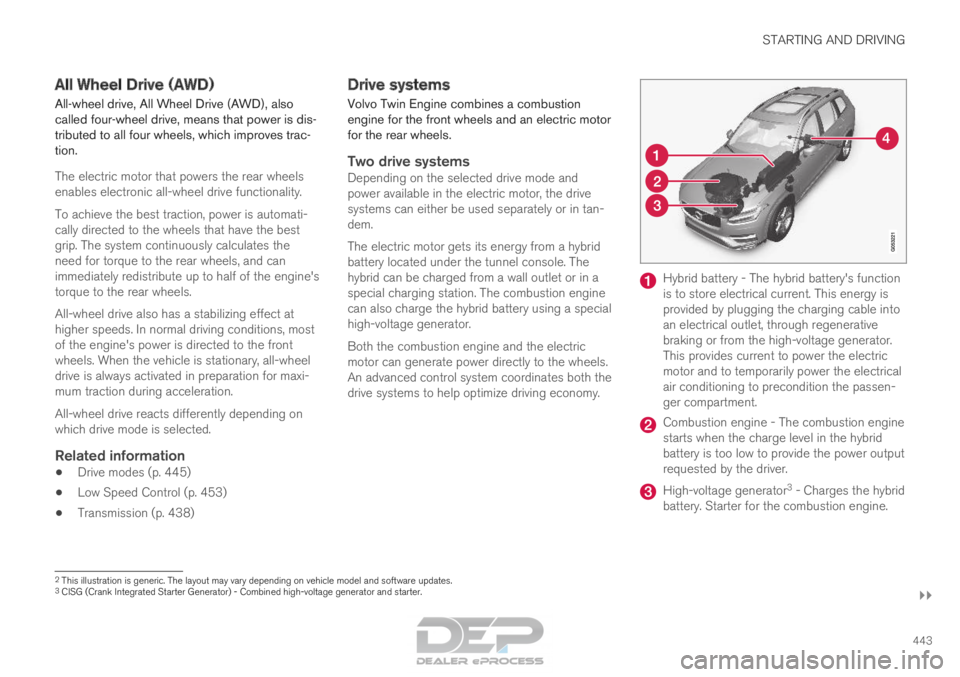
drive systems to help optimize driving economy. Hybrid battery - The hybrid battery's function
is to store electrical current. This energy is
provided by plugging the charging cable into
an electrical outlet, through regenerative
braking or from the high-voltage generator.
This provides current to power the electric
motor and to temporarily power the electrical
air conditioning to precondition the passen-
ger compartment.
Combustion engine - The combustion engine
starts when the charge level in the hybrid
battery is too low to provide the power output
requested by the driver.
High-voltage generator
3
- Charges the hybrid
battery. Starter for the combustion engine. 2
This illustration is generic. The layout may vary depending on vehicle m\
odel and software updates.
3 CISG (Crank Integrated Starter Generator) - Combined high-voltage gene\
rator and starter.
Page 446 of 686
||STARTING AND DRIVING
444
Can provide the combustion engine with
extra electrical current.
Electric motor - Powers the vehicle using
electricity. Can provide extra torque and
power during acceleration. Provides electrical
all-wheel drive functionality. Regenerates
braking energy into electrical current.
Related information
•
General information about Twin Engine
(p. 406)
• Starting and stopping the combustion engine
in Twin Engine vehicles (p. 444)
• Drive modes (p. 445)
• Transmission (p. 438)
• Factors affecting electric motor range
(p. 458) Starting and stopping the
combustion engine in Twin Engine
vehicles
An advanced control system determines the dis-
tance that the vehicle can be driven on the com-
bustion engine, electric motor, or both at the
same time. When driving on only the electric
motor, the vehicle may automatically start the
combustion engine due to outside circumstan-
ces, e.g. low ambient temperatures. This is com-
pletely normal. The combustion engine will also
always start when the hybrid battery is nearly
fully discharged.
Climate settings at low temperaturesAt low ambient temperatures, the combustion
engine will sometimes start automatically to help
achieve the desired passenger compartment
temperature and air quality. The amount of time
the combustion engine is running can be affec-
ted by:
• lowering the temperature
• reducing blower speed
• activating Pure drive mode.
Using the electric motor in hot or cold
weather
At very low or high ambient temperatures, the
electric motor's driving range and power may be
reduced and affect how often the combustion
engine automatically starts.
Emission control systemTo help ensure that the emission control system
functions optimally, the combustion engine will
run for several minutes after it is started. The
amount of time the combustion engine needs to
be used varies depending on the temperature of
the three-way catalytic converter.
Related information
• Drive systems (p. 443)
• Economical driving (p. 456)
• Using the electric motor only (p. 457)
• Drive modes (p. 445)
Page 447 of 686

STARTING AND DRIVING
}}
* Option/accessory. 445
Drive modes
Drive modes affect the vehicle's driving charac-
teristics in different ways to enhance and sim-
plify the driving experience in certain types of sit-
uations. Drive modes enable easy access to the vehicle's
many functions and settings in different driving
situations. The following systems are adapted to
help optimize driving characteristics in each drive
mode:
• Steering
• Engine/transmission/all-wheel drive
• Brakes
• Pneumatic suspension* and shock absorbers
• Instrument panel
• Climate control settings
Select the drive mode that is best suited to the
current driving conditions. Keep in mind that not
all drive modes are available in all situations.
Available drive modes
WARNING Keep in mind that the vehicle does not emit
any engine noise when using the electric
motor and may therefore be difficult to detect
for children, pedestrians, cyclists or animals.
This is particularly true at low speeds, e.g. in
parking lots.
WARNING
Do not leave the vehicle in an unventilated
area with a drive mode activated and the com-
bustion engine switched off. The engine will
start automatically if the charge level in the
hybrid battery is low and the resulting exhaust
gases can be very harmful to people and ani-
mals.
HYBRID
•
This is the default mode in which the electric
motor and combustion engine work together.
The vehicle starts in Hybrid mode. The control
system uses both the electric motor and the gas-
oline engine - separately or in tandem - and cal-
culates optimal utilization with regard to perform-
ance, fuel consumption and comfort. At high
speeds, ground clearance is automatically low-
ered 4
to reduce air resistance. Driving capacity on
the electric motor alone is determined by factors such as the hybrid battery's charge level, the
need for heat/cooling in the passenger compart-
ment, etc.
If there is sufficient charge in the battery, it is
possible to drive solely on electric power. When
the accelerator pedal is pressed, only the electric
motor will be activated until the battery reaches a
certain charge level. Above this level, the current
in the battery cannot supply the power requested
by the accelerator pedal and the combustion
engine will start.
When the hybrid battery's charge level is low, the
combustion engine will start more frequently to
save the remaining current in the battery. Charge
the hybrid battery from a 120-240 volt outlet
using a charging cable, or activate
Charge in
Function view to reset the option of only using
the electric motor.
This drive mode is designed for low energy con-
sumption with an optimized mix between the
electric motor and gasoline engine, without com-
promising on climate comfort or driving experi-
ence. When faster acceleration is requested by
the driver, the electric driveline will be utilized to
help provide maximum additional power. The
vehicle also monitors the driving conditions and
automatically engages all-wheel drive if neces-
sary. All-wheel drive and extra electric power are
always available regardless of the battery's
charging status. 4
For vehicles with pneumatic suspension.
Page 449 of 686
STARTING AND DRIVING
}}
447
OFF ROAD
• Maximizes the vehicle's ability to traverse dif-
ficult terrain or poor roads.
In this mode, ground clearance 4
is high, steering
is light, and all-wheel drive and Hill Descent
Control are activated.
This drive mode is only available at low speeds,
up to 40 km/h (25 mph). If this speed is excee-
ded, Off road mode will be cancelled and AWD
mode will be activated instead.
All-wheel drive requires both the combustion and
electric motor to be in continuous operation,
which results in higher fuel consumption.
In Off road mode, a compass will be displayed
between the speedometer and the tachometer in
the instrument panel. The permissible speed
range will be shown in the speedometer.
This drive mode is optimized for maximum control
when driving at low speeds on very poor roads or
difficult terrain. It raises the chassis 4
, reduces
driveline throttle response, and locks the vehicle
in all-wheel drive. The Hill Descent Control func-
tion facilitates controlled driving on steep down-
grades.NOTE This drive mode is not designed to be used
for normal street driving.
NOTE
Due to the increased ground clearance, if the
OFF ROAD mode was selected when the
engine was switched off, the suspension will
lower when the engine is restarted.
CAUTION
Do not use the OFF ROAD drive mode when
towing a trailer without an electrical connec-
tion. This could result in damage to the pneu-
matic suspension system's bellows.
AWD
•
Improves the vehicle's traction and handling
by increasing all-wheel drive.
This drive mode locks the vehicle in all-wheel
drive. An optimal distribution between front and
rear axle torque helps provide the best possible
control, stability and traction, e.g. on slippery
roads or when towing a heavy trailer or another
vehicle. The AWD drive mode is always available
regardless of the hybrid battery's charge status. Both the combustion engine and the electric
motor are engaged to enable all-wheel drive,
which results in higher fuel consumption.
In the other drive modes, the vehicle automati-
cally adapts the need for all-wheel drive accord-
ing to the road surface, and can activate the elec-
tric motor or start the combustion engine as nee-
ded.
POWER
•
Power mode is designed to provide sportier
driving characteristics and a faster accelera-
tion response.
This drive mode maximizes the combined power
from the combustion engine and the electric
motor by providing power to both the front and
rear wheels. Gear shifting will be faster and more
distinct and the transmission will prioritize gears
with a higher traction force. Steering response is
faster, suspension is stiffer and ground clearance
is lower 4
to help reduce body roll when cornering.
Both the combustion engine and the electric
motor are engaged to enable all-wheel drive,
which results in higher fuel consumption.
This drive mode is optimized for maximum per-
formance and throttle response. It changes the
throttle response, gear shifting program and
turbo boost system. Chassis settings and steer-
ing and brake response are also optimized. The
Power drive mode is always available regardless
of the hybrid battery's charge status. 4
For vehicles with pneumatic suspension.
Page 464 of 686
STARTING AND DRIVING
462Driving through standing water
Driving the vehicle through a deep pool of stand-
ing water on a water-covered roadway is called
fording. This must be done with great caution. To prevent damage to the vehicle when driving
through water (e.g. on flooded roads):
• Do not drive in water higher than the floor of
the vehicle. If possible, check the depth of
the water at its deepest point before driving
through it. Be particularly careful when driv-
ing through flowing water.
• Always select the Off Road drive mode
before driving in water to ensure the gasoline
engine is running.
• Do not drive faster than walking speed.
• Do not stop the vehicle in the water. Drive
carefully forward or back the vehicle out of
the water.
• Remember that waves created by passing
vehicles could cause the water level to rise
above the vehicle's floor level.
• Avoid driving through salt water to help avoid
the risk of corrosion.
CAUTION Parts of the vehicle (e.g. engine, transmission,
driveline, electrical components, etc.) can be
damaged if the vehicle is driven through water
higher than its floor level. Damage to any
components caused by flooding, vapor lock or
insufficient oil is not covered under warranty.
If the engine stalls while the vehicle is in
water, do not attempt to restart it. Have the
vehicle towed on the bed of a tow truck to a
workshop - an authorized Volvo workshop is
recommended.
When you have passed the water, press lightly on
the brake pedal and check that the brakes are
functioning properly. Water, mud, slush, etc. can
make the brake linings slippery, resulting in
delayed braking effect.
If the vehicle is equipped with a trailer coupling
contact, clean the contact after driving in water or
mud.
Related information
•
Recovery (p. 477)
• Low Speed Control (p. 453) Opening/closing the fuel filler door
A button on the instrument panel is used to
unlock the fuel filler door.
An arrow next to the fuel pump
symbol in the instrument panel
indicates the side of the vehicle
on which the fuel filler door is
located.
Page 470 of 686

STARTING AND DRIVING
* Option/accessory.
468 Overheating of engine and
transmission
In demanding driving conditions, such as driving
in mountainous areas or hot weather, there is a
risk of the engine or transmission overheating,
especially when carrying heavy loads.
• Engine power may be temporarily limited.
• Remove any auxiliary lights mounted in front
of the grille when driving in hot weather.
• If the temperature in the engine's cooling
system becomes too high, a warning symbol
will appear in the instrument panel along with
the message Engine temperature High
temperature Stop safely. Pull over to a safe location and let the engine idle for a few
minutes to cool down.
• If the message
Engine temperature High
temperature Turn off engine or Engine
coolant Level low, turn off engine is dis- played, stop the vehicle and turn off the
engine.
• If the transmission begins to overheat, an
alternative gear shifting program will be
selected. An integrated protective function
will also be activated, the warning symbol will
illuminate and the message Transmission
warm
Reduce speed to lower
temperature or Transmission hot Stop
safely, wait for cooling will be displayed in the instrument panel. Follow the recommen-
dations given by reducing speed or stopping the vehicle safely and letting the engine idle
for a few minutes to let the transmission
cool.
• If the vehicle begins to overheat, the air con-
ditioning may be temporarily switched off.
• After a prolonged period of driving in
demanding conditions, do not turn off the
engine immediately after stopping.
NOTE It is normal for the engine's cooling fan to
operate for a short time after the engine is
switched off.
Symbols in the instrument panel
Symbol
Meaning High engine temperature. Follow
the recommendations provided.
Low coolant level. Follow the rec-
ommendations provided.
Transmission hot/overheated/cool-
ing. Follow the recommendations
provided.
Related information
•
Refilling coolant (p. 612)
• Driving with a trailer (p. 472)
• Preparing for a long trip (p. 460)
• Gear indicator* (p. 442)