warning light VOLVO XC90 TWIN ENGINE 2018 Manual PDF
[x] Cancel search | Manufacturer: VOLVO, Model Year: 2018, Model line: XC90 TWIN ENGINE, Model: VOLVO XC90 TWIN ENGINE 2018Pages: 686, PDF Size: 17 MB
Page 571 of 686
WHEELS AND TIRES
}}
* Option/accessory. 569
1.
Clean the contact surfaces between the
wheel and the wheel hub.
2. Lift the wheel into place. Tighten the wheel bolts securely.
Do not grease the wheel bolt threads.
3. Lower the vehicle so that the wheel cannot rotate.
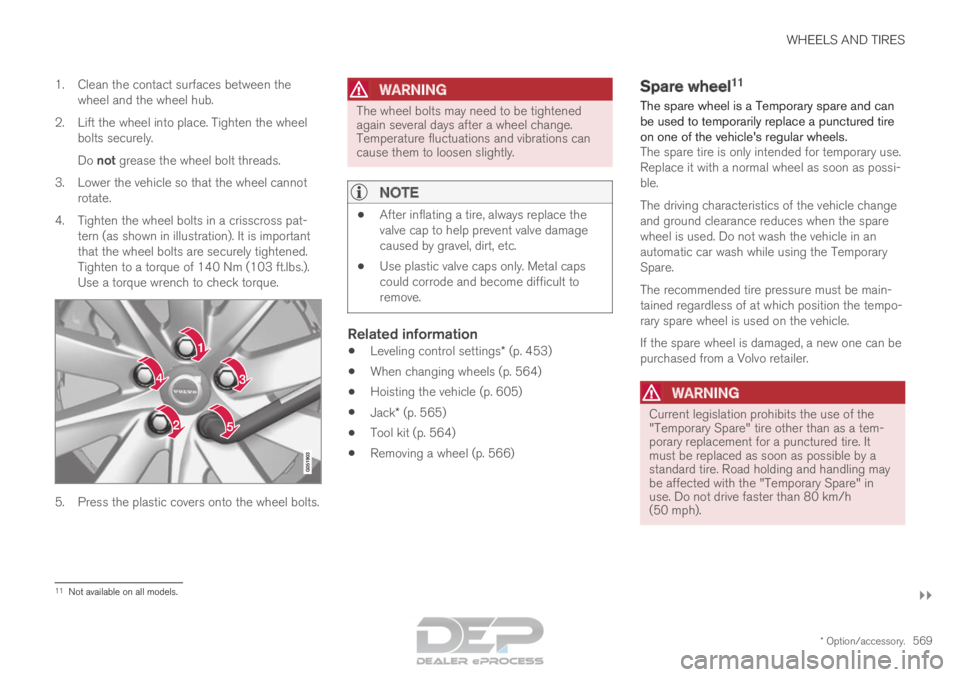
4. Tighten the wheel bolts in a crisscross pat- tern (as shown in illustration). It is important
that the wheel bolts are securely tightened.
Tighten to a torque of 140 Nm (103 ft.lbs.).
Use a torque wrench to check torque. 5. Press the plastic covers onto the wheel bolts.
WARNING The wheel bolts may need to be tightened
again several days after a wheel change.
Temperature fluctuations and vibrations can
cause them to loosen slightly.
NOTE
•
After inflating a tire, always replace the
valve cap to help prevent valve damage
caused by gravel, dirt, etc.
• Use plastic valve caps only. Metal caps
could corrode and become difficult to
remove.
Related information
•
Leveling control settings* (p. 453)
• When changing wheels (p. 564)
• Hoisting the vehicle (p. 605)
• Jack* (p. 565)
• Tool kit (p. 564)
• Removing a wheel (p. 566) Spare wheel
11
The spare wheel is a Temporary spare and can
be used to temporarily replace a punctured tire
on one of the vehicle's regular wheels. The spare tire is only intended for temporary use.
Replace it with a normal wheel as soon as possi-
ble.
The driving characteristics of the vehicle change
and ground clearance reduces when the spare
wheel is used. Do not wash the vehicle in an
automatic car wash while using the Temporary
Spare.
The recommended tire pressure must be main-
tained regardless of at which position the tempo-
rary spare wheel is used on the vehicle.
If the spare wheel is damaged, a new one can be
purchased from a Volvo retailer.
WARNING Current legislation prohibits the use of the
"Temporary Spare" tire other than as a tem-
porary replacement for a punctured tire. It
must be replaced as soon as possible by a
standard tire. Road holding and handling may
be affected with the "Temporary Spare" in
use. Do not drive faster than 80 km/h
(50 mph).
11
Not available on all models.
Page 586 of 686

LOADING, STORAGE AND PASSENGER COMPARTMENT
* Option/accessory.
584 Using the electrical outlets
The 12 V outlet can be used for devices
intended for this such as MP3 players, coolers
and cellular phones.
The high-voltage outlet* can be used for devices
intended for this, such as chargers, laptops, etc. The ignition must be in at least mode I for the
outlets to supply current. The outlets will then be
active as long as there is sufficient charge in the
start battery.
If the engine is turned off and the vehicle is
locked, the outlets will be deactivated. If the
engine is turned off and the vehicle remains
unlocked, the sockets will remain active for up to
7 minutes.
NOTE Bear in mind that using the electrical outlets
when the engine is off could cause the starter
battery to have too low of a charge level,
which could limit other functionality.
Accessories connected to the electrical out-
lets can be activated even when the vehicle
electrical system is off or if preconditioning is
used. For this reason, disconnect plugs when
they are not in use to prevent the starter bat-
tery from becoming discharged.
WARNING •
Do not use accessories with large or
heavy plugs – they could damage the out-
let or come loose while you are driving.
• Do not use accessories that could cause
disruptions to e.g. the vehicle's radio
receiver or electrical system.
• Position the accessory so that there is no
risk of it injuring the driver or passengers
in the event of heavy braking or a colli-
sion.
• Pay attention to connected accessories
as they can generate heat that could burn
passengers or the interior.
Using 12 V outlets1. Remove the stopper (tunnel console) or fold
down the cover (trunk/cargo compartment)
over the socket and plug in the device.
2. Unplug the device and put the stopper back in (tunnel console) or fold up the cover
(trunk/cargo compartment) when the socket
is not in use or left unattended.
CAUTION The maximum power is 120 W (10 A) per
outlet.
Using high-voltage outletsThe ignition must be in at least mode I for outlets
to supply current. The outlets will then be active
as long as there is sufficient charge in the start
battery.
1. Slide down the cover over the outlet and plug
in the device.
>
The LED 2
light on the outlet will indicate
its status.
2. The outlet is supplying electrical current when the light is glowing steadily green.
3. Disconnect the device by pulling out the plug (do not pull on the cord).
Pull up the cover when the outlet is not in
use or is left unattended.
CAUTION The maximum power is 150 W.
WARNING
Do not attempt to alter or repair the high-volt-
age outlet on your own. Volvo recommends
contacting an authorized Volvo workshop.
2
LED (Light Emitting Diode)
Page 588 of 686

LOADING, STORAGE AND PASSENGER COMPARTMENT
* Option/accessory.
586 Sun visors
In the ceiling in front of the driver and front pas-
senger, there are sun visors that can be lowered
and angled to the side as necessary.
The illustration is generic – the design may vary.
The mirror lighting* comes on automatically when
the cover is lifted up.
The mirror frame has a holder for e.g. cards or
tickets.
Related information
• Passenger compartment interior (p. 580) Cargo compartment
The vehicle has a flexible cargo compartment
that makes it possible to carry and secure large
objects.
The cargo compartment capacity can be consid-
erably increased by folding down the backrests in
the second and third rows* of seats. To make
loading and unloading easier, the rear section of
the vehicle can be raised and lowered using the
level control function*. Use the load anchoring
eyelets or grocery bag holders to help secure
objects in place, and the retractable cargo com-
partment cover* to help conceal objects in the
cargo compartment.
If the vehicle is equipped with a temporary spare
tire, this is secured to the cargo compartment
floor under the cover. The towing eyelet and tire
sealing system are located under the cargo com-
partment floor.
Related information
• Loading recommendations (p. 586)
• Grocery bag holders (p. 588)
• Load anchoring eyelets (p. 589)
• Installing and removing the cargo compart-
ment cover* (p. 589) Loading recommendations
There are a number of things to consider when
carrying loads in or on the vehicle. Load-carrying capacity is determined by the vehi-
cle's curb weight. The total weight of all passen-
gers and any installed accessories reduces the
vehicle's load-carrying capacity by the corres-
ponding amount.
WARNING The vehicle's driving characteristics change
depending on the weight and position of the
load.
Loading in the trunk and cargo
compartment
•
Position objects so they are pressing against
the rear seat backrests.
• Distribute the load evenly.
• Heavy objects should be positioned as low
as possible. Avoid placing heavy objects on
folded-down seat backrests.
• Cover sharp corners with a soft cloth or simi-
lar to help prevent damage to the upholstery.
• Use the load anchoring eyelets and tension-
ing straps or similar to secure all objects.
Page 593 of 686

LOADING, STORAGE AND PASSENGER COMPARTMENT
* Option/accessory.591
Loading modeFrom the fully retracted position - grasp the
handle and pull the cover up and over the
side panels in the cargo compartment. Pull to
the end position and press the attaching pins
at the end of the cover into the grooves in
the side panels of the vehicle. (If the cover is
already fully open, see next section.)
From the fully open position - grasp the han-
dle and press the cover's attaching pins
down into the grooves in the side panels and
then release.
>
Retract the cover until it stops in the parti-
ally retracted position. If your hands are full: In the fully open position, push the cover's
handle slightly upward with e.g. your elbow.
>
The cover will retract until it stops in
the partially retracted position.
To fully open the cover from the partially retrac-
ted position:
1.
Grasp the handle and pull the cover out as
far as possible.
2. Let the cover retract slightly and press the handle slightly downward.
> The cover will be secured in the fully openposition.
CAUTION Do not place objects on top of the cargo
compartment cover.
WARNING In 7-seat models - never have a cargo com-
partment cover mounted when there are pas-
sengers in the rear seats. This could lead to
serious injury in the event of a collision.
Retracting the cover
1. From the fully opened position:
Lift the cover's handle and pull it rearward to
release the cover's attaching pins from the
grooves. Let the cover retract.
From the partially retracted position:
Grasp the handle and pull the cover out of
the groves to the fully open position. Lift the
handle and pull it rearward to release the
cover's attaching pins from the grooves. Let
the cover retract.
2. Let the cover retract with its attaching pins above the side panels until it stops in the
fully retracted position.
Related information
• Installing and removing the cargo compart-
ment cover* (p. 589)
Page 596 of 686

||LOADING, STORAGE AND PASSENGER COMPARTMENT
594
WARNING
Objects in the cargo compartment must
always be securely anchored, even with a cor-
rectly installed cargo net.
Installing the cargo net
WARNING
All of the cargo net's upper consoles, hooks
and straps must be securely mounted and
attached before the net is used.
Never use the net if it is damaged.
NOTE
With front mounting, the cargo net is most
easily installed via a rear door.
1. Fold out the cargo net and make sure that
the upper rod folds out and locks into posi-
tion.
2.
Insert one of the net's hooks into the front or
rear ceiling mounting point with the strap
lock facing you. 3. Insert the other upper hook into the ceiling
mounting point on the opposite side. The
telescopic spring-loaded hooks make mount-
ing easier.
Make sure that the net's hooks are pushed
forward as far as possible into their respec-
tive mounting points. 4. Rear mounting: With the cargo net hooked
into the rear ceiling mounting points, attach
the net's straps into the front floor eyelets in
the cargo compartment. Rear mounting.
Front mounting: With the cargo net mounted
in the front ceiling mounting points, hook the
straps into the outer eyelets on the front seat
rails behind the seats. Attaching the net is
easier if the seat backrests are upright and
the seats are moved slightly forward.
Page 610 of 686
||MAINTENANCE AND SERVICE
* Option/accessory.
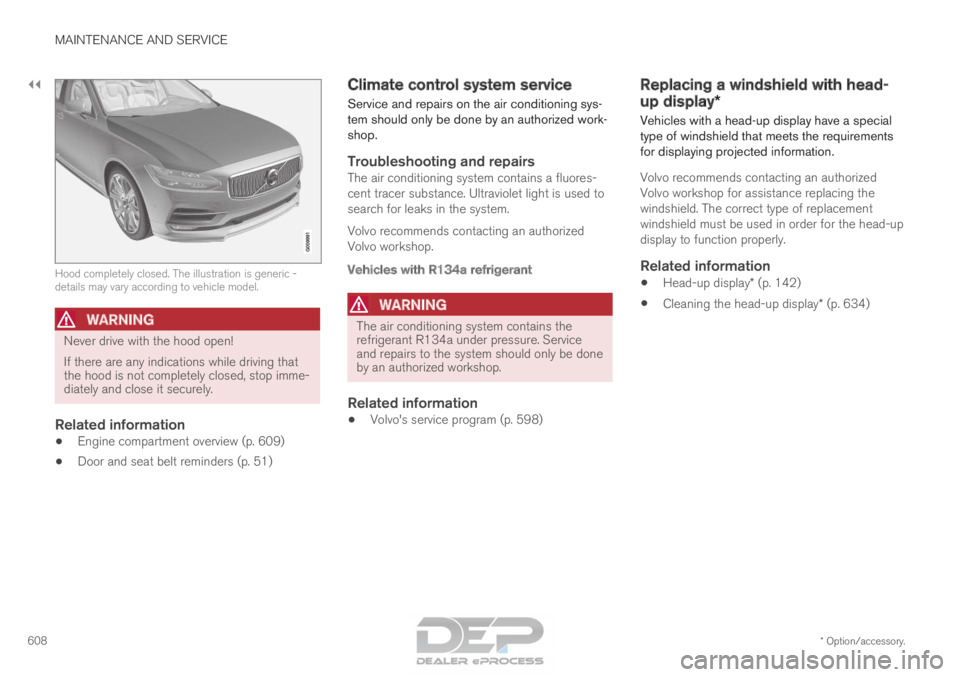
608 Hood completely closed. The illustration is generic -
details may vary according to vehicle model.
WARNING
Never drive with the hood open!
If there are any indications while driving that
the hood is not completely closed, stop imme-
diately and close it securely.
Related information
•
Engine compartment overview (p. 609)
• Door and seat belt reminders (p. 51) Climate control system service
Service and repairs on the air conditioning sys-
tem should only be done by an authorized work-
shop.
Troubleshooting and repairsThe air conditioning system contains a fluores-
cent tracer substance. Ultraviolet light is used to
search for leaks in the system.
Volvo recommends contacting an authorized
Volvo workshop.
Vehicles with R134a refrigerant
WARNING
The air conditioning system contains the
refrigerant R134a under pressure. Service
and repairs to the system should only be done
by an authorized workshop.
Related information
•
Volvo's service program (p. 598) Replacing a windshield with head-
up display*
Vehicles with a head-up display have a special
type of windshield that meets the requirements
for displaying projected information.
Volvo recommends contacting an authorized
Volvo workshop for assistance replacing the
windshield. The correct type of replacement
windshield must be used in order for the head-up
display to function properly.
Related information
•
Head-up display* (p. 142)
• Cleaning the head-up display* (p. 634)
Page 638 of 686

||MAINTENANCE AND SERVICE
* Option/accessory.
636
WARNING •
Never use more than one inlay mat at a
time on the driver's floor. If any other type
of floor mat is used, remove the original
mat from the driver's seat floor before
driving. All types of mats must be securely
anchored in the attachment points in the
floor. Make sure the floor mat does not
impede the movement of the brake pedal
or accelerator pedal in any way, as this
could be a serious safety hazard.
• Volvo's floor mats are specially manufac-
tured for your vehicle. They must be prop-
erly secured in the attachment points in
the floor to help ensure they cannot slide
and become trapped under the pedals.
After vacuuming, a specially designed textile
cleaning agent should be used to remove stains
on floor mats. Floor mats should be cleaned with
products recommended by Volvo retailers.
Related information
• Cleaning the interior (p. 633)
• Cleaning the center display (p. 633)
• Cleaning fabric upholstery and ceiling liner
(p. 635)
• Cleaning the seat belt (p. 635)
• Cleaning leather upholstery (p. 636) •
Cleaning the leather steering wheel
(p. 637)
• Cleaning interior plastic, metal and wood sur-
faces (p. 638) Cleaning leather upholstery
Only use cleaning agents and car care products
recommended by Volvo. Clean regularly and
treat stains immediately for best results. It is
important to vacuum before using a cleaning
agent.
Leather upholstery*Volvo's leather upholstery is treated to protect its
original appearance. Over time, sunlight, grease,
dirt, etc. could break down the protective layer.
This could result in scratches and cracking.
Leather upholstery is a natural product that
changes and acquires a beautiful patina over
time. Regular cleaning and treatments are
required to preserve the qualities and color of the
leather. Volvo offers a comprehensive product,
Volvo Leather Care Kit/Wipes, for cleaning and
treating leather upholstery that, when used as
directed, preserves the leather's protective coa-
ting.
For best results, Volvo recommends cleaning and
applying protective cream one to four times a
year (or more as needed). Volvo Leather Care Kit
951 0251 and Volvo Leather Softener 943
7429 are available for purchase at Volvo retailers.
Page 642 of 686
||MAINTENANCE AND SERVICE
640
•
Wash using a sponge, car washing detergent
and plenty of lukewarm water.
• Clean the wiper blades with lukewarm soap
solution or car washing detergent.
• Dry the vehicle using a clean, soft chamois or
a squeegee. Try not to let drops of water dry
in strong sunlight. This could cause water
drying stains that may need to be polished
out.
• In areas with heavy industrial emissions,
more frequent washing of the vehicle's exte-
rior is recommended.
• Tar spots from asphalt may remain even after
washing. Use a tar remover to remove these
spots after washing the vehicle.
WARNING Always entrust engine washing to a workshop.
If the engine is hot, there is a risk of fire.
CAUTION
Dirty headlights do not work as well. Clean
them regularly, e.g. when refueling.
Do not use corrosive cleaners. Use water and
a non-abrasive sponge.
NOTE Exterior lighting such as headlights and tail-
lights may develop temporary condensation
on the inside of the lens. This is normal. All
exterior lighting is designed to resist this.
Condensation is normally vented out of the
lamp housing once the light has been lit for
some period of time.
CAUTION
•
Make sure that the panoramic roof and
sun shade are closed before washing the
vehicle.
• Never use abrasive polishing agents on
the panoramic roof.
• Never use wax on the rubber seals
around the panoramic roof.
CAUTION Remember to remove dirt from the drain
holes in the doors and sills after washing the
vehicle.
Related information
•
Cleaning the exterior (p. 638)
• Polishing and waxing (p. 639)
• Automatic car washes (p. 641)
• High-pressure washing (p. 642) •
Cleaning the wiper blades (p. 642)
• Cleaning exterior plastic, rubber and trim
components (p. 643)
• Cleaning rims (p. 644)
• Corrosion protection (p. 644)
Page 669 of 686
INDEX
667
1, 2, 3 ... 4WD
443
A ABS
anti-lock brakes
429
AC (Air conditioning) 228
ACC - Adaptive Cruise Control 295, 298, 299, 300, 301, 302, 304, 305, 306, 307, 309
Accessories and extra equipment 35 installation 36
Accessory installation warning 36
Active Bending Lights 159
Adapting driving characteristics 272, 445
Adaptive Cruise Control 295, 298, 299, 300, 301, 302, 304, 305, 306, 307, 309
change cruise control functionality 307
function 295
manage speed 299, 300
pass 304, 305
radar sensor 326
set time interval 301, 302
troubleshooting 307
Adjusting the steering wheel 199 Airbag
52
activation/deactivation
56
driver's side 53
passenger side 53, 56
Air bag, see Airbag 52
Air conditioning 228
Air conditioning, fluid volume and grade 664
Air distribution 207
air vents 207, 209
changing 208
defrosting 220
recirculation 219
table showing options 210
Air quality 204, 206
allergy and asthma 206
passenger compartment filter 207
Air recirculation 219
Alarm 268
deactivating 269
Allergy and asthma-inducing substances 206
All Wheel Drive, AWD 443
All Wheel Drive (AWD) 443
All Wheel Drive (four-wheel drive) 443
Android Auto 518, 520
Antenna location 257 Apple CarPlay
515, 517
Approach lighting 161
Apps 487
Assistance at risk of collision 372, 373, 374, 375, 376, 377, 378, 380
Audio and media 486
Audio system HD digital radio 497
SiriusXM® Satellite radio 498, 499, 500
Auto-climate 219
Auto hold 436
Auto-hold brakes 436
activate and deactivate 436
after collision 437
Automatic car wash 641
Automatic high beam 157
Automatic locking 261
Automatic relocking 241, 254
Automatic Speed Limiter 282, 284, 285
Automatic transmission 439
kickdown 442
oil 663
Trailer 472
INDEX
Page 670 of 686

INDEX
668B Backrest
front seat, adjusting
184, 185, 188,
189, 190
rear seat, adjusting 196, 197
rear seat, folding 192, 197, 198
Battery Hybrid 619
jump-start 469
Maintenance 615
start 615
symbols on the battery 620
warning symbols 620
BLIS 348, 349, 350, 351
Blower adjusting 224, 225
air distribution 208
air vents 209
Bluetooth connect 513
connecting vehicle to Internet 531
phone 520
settings 529
Book service and repair 603
Booster cushions 71
Brake assist after collision 437 Brake fluid
grade
663
Brake functions 429
Brake light 160
Brake position 439
Brakes 429
anti-lock brakes, ABS 429
automatic when stationary 436
Brake Assist System, BAS 431
brake lights 160
brake system 429
emergency brake lights 160
handbrake 432
Maintenance 432
on salted roads 431
on wet roads 431
brake system fluid 663
C Camera sensor
344
Camera unit
331
Capacity weight 578, 659
Cargo compartment 586 attachment points 589
cargo net 593 electrical outlet
582, 584
Lighting
163
Cargo compartment cover 589, 590
cargo net 593
Car wash 638, 639, 641, 642, 643, 644
Catalytic converter 467
recovery 476
CD player 511
Cell phone, see Phone 521
Center console 581
Center display change appearance 131
cleaning 633
climate controls 213
Function view 122
keyboard 126
messages 140, 141, 142
operation 112, 115, 119, 124
overview 109
settings 132, 133, 134
switch off and change volume 131
symbols in status bar 124
views 115
Central locking 257
Change of owner 134
Changing a wheel 564