door lock VOLVO XC90 TWIN ENGINE 2018 Owners Manual
[x] Cancel search | Manufacturer: VOLVO, Model Year: 2018, Model line: XC90 TWIN ENGINE, Model: VOLVO XC90 TWIN ENGINE 2018Pages: 686, PDF Size: 17 MB
Page 8 of 686
6
Activating and deactivating climatecontrol for the third-row seats*229
Parking climate230
Preconditioning230
Starting and stopping preconditioning231
Preconditioning timer settings232
Adding and editing timer setting forpreconditioning233
Activating and deactivating precondi-tioning timer settings233
Deleting preconditioning timer settings234
Climate comfort retaining function234
Switching on and off the climateretaining function when parking234
Parking climate symbols and messages236
KEY, LOCKS AND ALARM
Lock indication238
Lock confirmation settings239
Remote key239
Locking and unlocking using theremote key241
Settings for remote and inside doorunlock242
Unlocking the tailgate using theremote key243
Remote key range243
Replacing the remote key's battery244
Ordering additional remote keys248
Red Key - restricted remote key*248
Red Key* settings249
Detachable key blade250
Locking and unlocking with detacha-ble key blade251
Electronic immobilizer252
Start and lock system type designations252
Keyless and touch-sensitive surfaces*253
Keyless locking and unlocking*254
Keyless unlock settings*256
Keyless tailgate unlock*256
Antenna locations for the start andlock system257
Locking and unlocking from insidethe vehicle257
Unlocking the tailgate from insidethe vehicle259
Activating and deactivating childsafety locks259
Automatic locking when driving261
Opening and closing the power tailgate*261
Setting a maximum height for thepower tailgate*264
Foot movement tailgate operation*265
Private Locking266
Activating and deactivating privatelocking267
Alarm268
Arming and disarming the alarm269
Foreign Component Detection*270
Page 12 of 686
10
STARTING AND DRIVING
Starting the vehicle424
Switching off the vehicle426
Ignition modes427
Selecting ignition mode428
Brake functions429
Brakes429
Brake Assist System431
Braking on wet roads431
Braking on salted roads431
Maintenance of the brake system432
Parking brake432
Activating and deactivating the park-ing brake433
Settings for automatically activatingthe parking brake434
Parking on a hill434
Parking brake malfunction435
Auto-hold brakes436
Activating and deactivating Auto-hold at a standstill436
Hill Start Assist437
Braking assist after a collision437
Transmission438
Gear selector positions for automatictransmissions439
Using the steering wheel paddles* toshift441
Shiftlock442
The kickdown function442
Gear indicator*442
All Wheel Drive (AWD)443
Drive systems443
Starting and stopping the combus-tion engine in Twin Engine vehicles444
Drive modes445
Changing drive mode449
Leveling control* and suspension450
Leveling control settings*453
Low Speed Control453
Activating and deactivating LowSpeed Control using the function button454
Hill Descent Control454
Activating and deactivating HillDescent Control using the functionbutton
455
Economical driving456
Using the electric motor only457
Factors affecting electric motor range458
"Hold" and "Charge" functions459
Preparing for a long trip460
Winter driving461
Driving through standing water462
Opening/closing the fuel filler door462
Refueling463
Fuel464
Octane rating465
Emission controls467
Overheating of engine and transmission468
Battery drain469
Jump starting using another battery469
Detachable towbar*471
Driving with a trailer472
Trailer Stability Assist*474
Checking trailer lights475
Towing using a towline476
Attaching and removing the towing eyelet476
Recovery477
HomeLink®*478
Programming HomeLink®*479
Using HomeLink480
Type approval for HomeLink®*481
Compass481
Activating and deactivating the compass482
Calibrating the compass482
Page 50 of 686
||
SAFETY
48
WARNING
•Never repair the belt yourself. Repairsshould only be performed by a trainedand qualified Volvo service technician.
•Any device used to induce slack into theshoulder belt portion of the three-pointbelt system will have a detrimental effecton the amount of protection available inthe event of a collision.
•The seat back should not be tilted too farback. The shoulder belt must be taut inorder to function properly.
•Do not use any type of child restraint inthe front passenger seat. We recommendthat children who have outgrown thesedevices sit in the rear seat with the seatbelt properly fastened.
Related information
•Safety (p. 42)
•Seat belt tensioners (p. 50)
•Buckling and unbuckling seat belts (p. 48)
•Door and seat belt reminders (p. 51)
Buckling and unbuckling seat belts
Make sure that all passengers have buckledtheir seat belts before starting to drive.
Buckling seat belts
1. Pull out the belt slowly and make sure it isnot twisted or damaged.
If the seat belt in the second row centerseating position is used, make sure it is prop-erly positioned in the correct seat belt guide.
NOTE
Each seat belt is equipped with a retractorthat will lock up in the following situations:
•if the belt is pulled out rapidly
•during braking and acceleration
•if the vehicle is leaning excessively
•when driving in turns
•if the automatic locking retractor/emer-gency locking retractor (ALR/ELR) is acti-vated. Each seat belt (except for the driv-er's) is equipped with an ALR function,which is designed to keep the seat belttaut when installing a child restraint. ALRis activated when the seat belt is pulledout as far as possible. If this is done, asound from the seat belt retractor will beaudible, which is normal. The seat belt cannow only be fed into the retractor, notpulled out. This function is automaticallydisabled when the seat belt is unbuckledand fully retracted.
Page 61 of 686
SAFETY
59
WARNING
•No objects that add to the total weight onthe seat should be placed on the frontpassenger's seat. If a child is seated inthe front passenger's seat with any addi-tional weight, this extra weight couldcause the OWS system to enable the air-bag, which might cause it to deploy in theevent of a collision, thereby injuring thechild.
•The seat belt should never be wrappedaround an object on the front passeng-er's seat. This could interfere with theOWS system's function.
•The front passenger's seat belt shouldnever be used in a way that exerts morepressure on the passenger than normal.This could increase the pressure exertedon the weight sensor by a child, andcould result in the airbag being enabled,which might cause it to deploy in theevent of a collision, thereby injuring thechild.
WARNING
•Keep the following points in mind withrespect to the OWS system. Failure tofollow these instructions could adverselyaffect the system's function and result inserious injury to the occupant of the frontpassenger's seat:
•The full weight of the front seat passen-ger should always be on the seat cushion.The passenger should never lift him/herself off the seat cushion using thearmrest in the door or the center console,by pressing the feet on the floor, by sit-ting on the edge of the seat cushion, orby pressing against the backrest in a waythat reduces pressure on the seat cush-ion. This could cause OWS to disable thefront, passenger's side airbag.
WARNING
•Do not place any type of object on thefront passenger's seat in such a way thatjamming, pressing, or squeezing occursbetween the object and the front seat,other than as a direct result of the correctuse of the Automatic Locking Retractor/Emergency Locking Retractor (ALR/ELR)seat belt.
•No objects should be placed under thefront passenger's seat. This could inter-fere with the OWS system's function.
Related information
•Driver/passenger-side airbags (p. 53)
Page 63 of 686
SAFETY
}}61
WARNING Volvo recommends contacting an authorized
Volvo workshop for repair. Incorrectly per-
formed repairs to the inflatable curtain system
could impair function and lead to serious
injury.
WARNING
Never hang or attach heavy objects in the
handle in the ceiling. The hooks are only
intended for lightweight garments (not for
hard objects such as umbrellas).
Never screw or mount anything to the vehi-
cle's headlining, door pillars or side panels.
This could impair the intended protective
properties. Volvo recommends only using
Volvo original parts that are approved for
placement in these areas.
WARNING
If objects are loaded higher than the upper
edge of the side windows, leave a 10 cm (4
in.) space between the objects and the win-
dow. Objects placed closer to this could
impede the function of the inflatable curtain
concealed inside the headlining.
WARNING
The inflatable curtain is a supplement to the
seat belt. Always wear your seat belt.
Related information
•
Airbags (p. 52) Safety mode
Safety mode is a feature that is triggered after a
collision if there is potential damage to an impor-
tant function in the vehicle, such as the fuel
lines, sensors for one of the safety systems, the
brake system, etc.
If the vehicle has been involved in a collision, the
text
Safety mode See Owner's manual may
appear in the instrument panel along with the
warning symbol if the panel is undamaged and
the vehicle's electrical system is intact. The mes-
sage indicates that one or more of the vehicle's
functions may be reduced.
WARNING Never attempt to restart the vehicle if you
smell fuel fumes when the message
Safety
mode See Owner's manual is displayed in the instrument panel. Leave the vehicle imme-
diately.
If safety mode has been set, it may be possible to
reset the system in order to start and move the
vehicle a short distance, for example, if it is block-
ing traffic.
Page 84 of 686
DISPLAYS AND VOICE CONTROL
* Option/accessory.
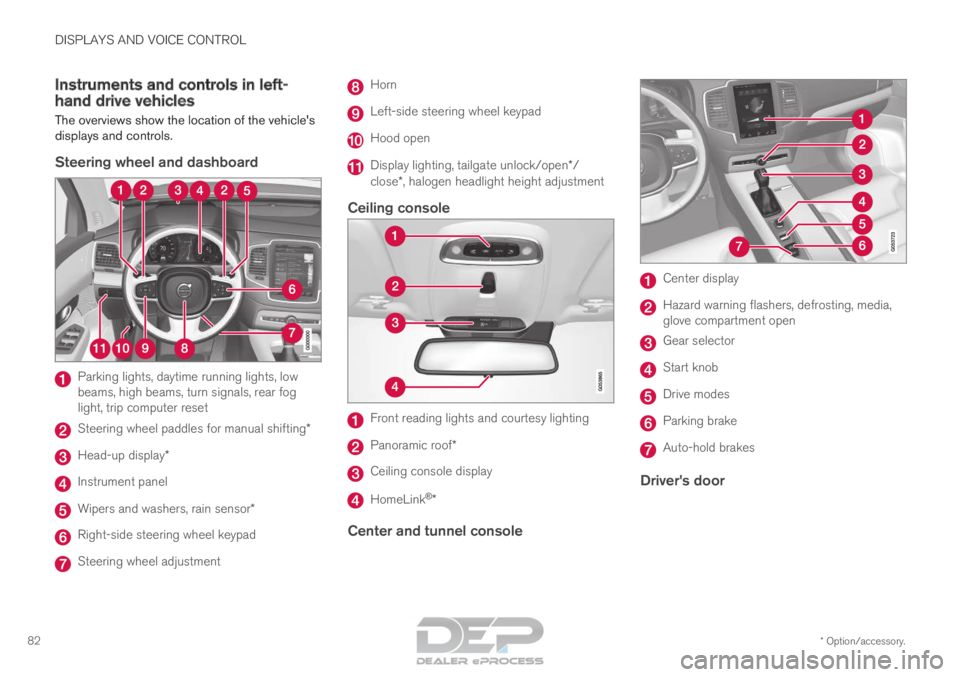
82 Instruments and controls in left-
hand drive vehicles
The overviews show the location of the vehicle's
displays and controls.
Steering wheel and dashboard Parking lights, daytime running lights, low
beams, high beams, turn signals, rear fog
light, trip computer reset
Steering wheel paddles for manual shifting*
Head-up display*
Instrument panel
Wipers and washers, rain sensor*
Right-side steering wheel keypad
Steering wheel adjustment Horn
Left-side steering wheel keypad
Hood open
Display lighting, tailgate unlock/open*/
close*, halogen headlight height adjustment
Ceiling console Front reading lights and courtesy lighting
Panoramic roof*
Ceiling console display
HomeLink
®
*
Center and tunnel console Center display
Hazard warning flashers, defrosting, media,
glove compartment open
Gear selector
Start knob
Drive modes
Parking brake
Auto-hold brakes
Driver's door
Page 85 of 686
DISPLAYS AND VOICE CONTROL
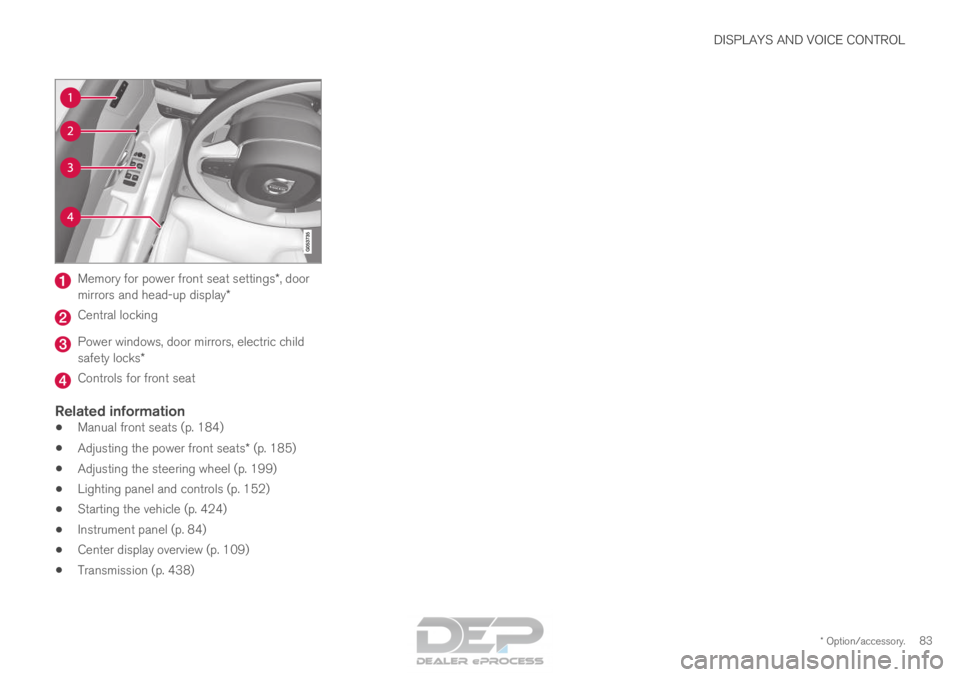
* Option/accessory.83Memory for power front seat settings*, door
mirrors and head-up display* Central locking
Power windows, door mirrors, electric child
safety locks*
Controls for front seat
Related information
•
Manual front seats (p. 184)
• Adjusting the power front seats* (p. 185)
• Adjusting the steering wheel (p. 199)
• Lighting panel and controls (p. 152)
• Starting the vehicle (p. 424)
• Instrument panel (p. 84)
• Center display overview (p. 109)
• Transmission (p. 438)
Page 86 of 686
DISPLAYS AND VOICE CONTROL
* Option/accessory.
84 Instrument panel
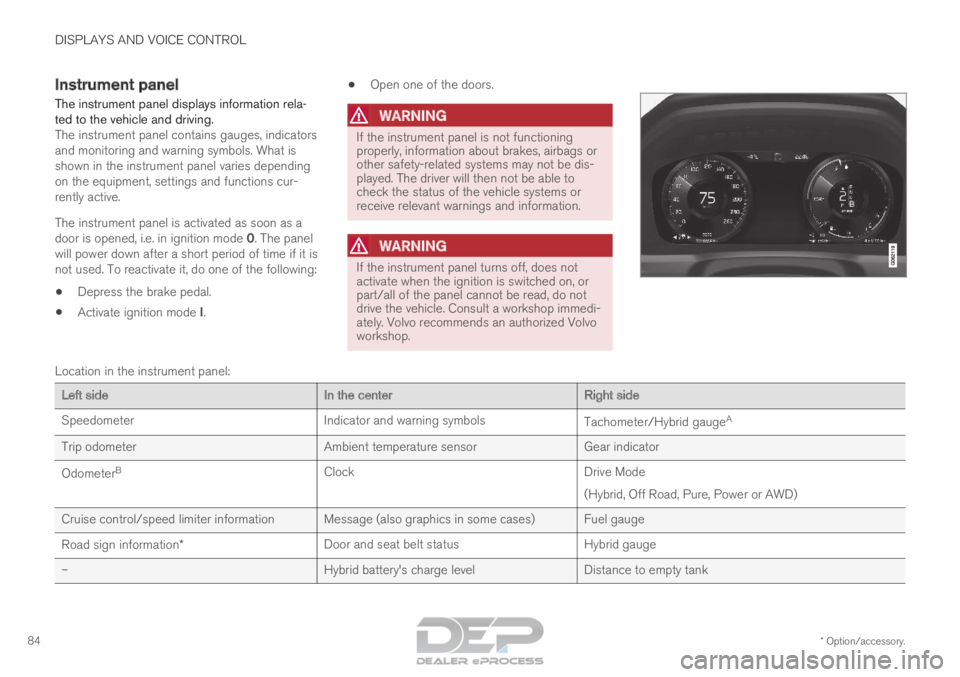
The instrument panel displays information rela-
ted to the vehicle and driving. The instrument panel contains gauges, indicators
and monitoring and warning symbols. What is
shown in the instrument panel varies depending
on the equipment, settings and functions cur-
rently active.
The instrument panel is activated as soon as a
door is opened, i.e. in ignition mode 0. The panel
will power down after a short period of time if it is
not used. To reactivate it, do one of the following:
• Depress the brake pedal.
• Activate ignition mode I. •
Open one of the doors.
WARNING If the instrument panel is not functioning
properly, information about brakes, airbags or
other safety-related systems may not be dis-
played. The driver will then not be able to
check the status of the vehicle systems or
receive relevant warnings and information.
WARNING
If the instrument panel turns off, does not
activate when the ignition is switched on, or
part/all of the panel cannot be read, do not
drive the vehicle. Consult a workshop immedi-
ately. Volvo recommends an authorized Volvo
workshop.
Location in the instrument panel:
Left side
In the centerRight side
Speedometer
Indicator and warning symbols Tachometer/Hybrid gaugeA
Trip odometer Ambient temperature sensorGear indicator
Odometer B
Clock Drive Mode
(Hybrid, Off Road, Pure, Power or AWD)
Cruise control/speed limiter information Message (also graphics in some cases) Fuel gauge
Road sign information* Door and seat belt status
Hybrid gauge
– Hybrid battery's charge levelDistance to empty tank
Page 163 of 686
LIGHTING
* Option/accessory.161
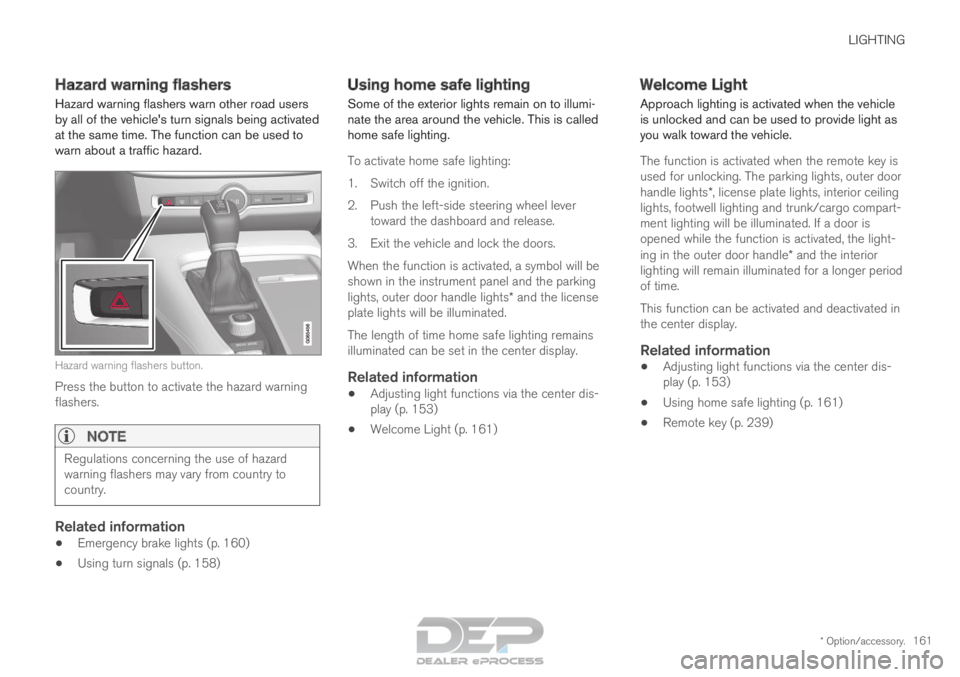
Hazard warning flashers
Hazard warning flashers warn other road users
by all of the vehicle's turn signals being activated
at the same time. The function can be used to
warn about a traffic hazard. Hazard warning flashers button.
Press the button to activate the hazard warning
flashers.
NOTE Regulations concerning the use of hazard
warning flashers may vary from country to
country.
Related information
•
Emergency brake lights (p. 160)
• Using turn signals (p. 158) Using home safe lighting
Some of the exterior lights remain on to illumi-
nate the area around the vehicle. This is called
home safe lighting.
To activate home safe lighting:
1.
Switch off the ignition.
2. Push the left-side steering wheel lever toward the dashboard and release.
3. Exit the vehicle and lock the doors.
When the function is activated, a symbol will be
shown in the instrument panel and the parking
lights, outer door handle lights* and the license
plate lights will be illuminated.
The length of time home safe lighting remains
illuminated can be set in the center display.
Related information
• Adjusting light functions via the center dis-
play (p. 153)
• Welcome Light (p. 161) Welcome Light
Approach lighting is activated when the vehicle
is unlocked and can be used to provide light as
you walk toward the vehicle.
The function is activated when the remote key is
used for unlocking. The parking lights, outer door
handle lights*, license plate lights, interior ceiling
lights, footwell lighting and trunk/cargo compart-
ment lighting will be illuminated. If a door is
opened while the function is activated, the light-
ing in the outer door handle* and the interior
lighting will remain illuminated for a longer period
of time.
This function can be activated and deactivated in
the center display.
Related information
• Adjusting light functions via the center dis-
play (p. 153)
• Using home safe lighting (p. 161)
• Remote key (p. 239)
Page 164 of 686
LIGHTING
162Interior Lighting
The interior is equipped with several different
types of lighting to improve the experience. This
includes reading lamps, glove box lighting and
ground lighting. All lighting in the passenger compartment can be
turned on and off manually within 5 minutes
after:
• the engine has been switched off and the
ignition is in mode 0.
• the vehicle is unlocked but the engine has
not been started.
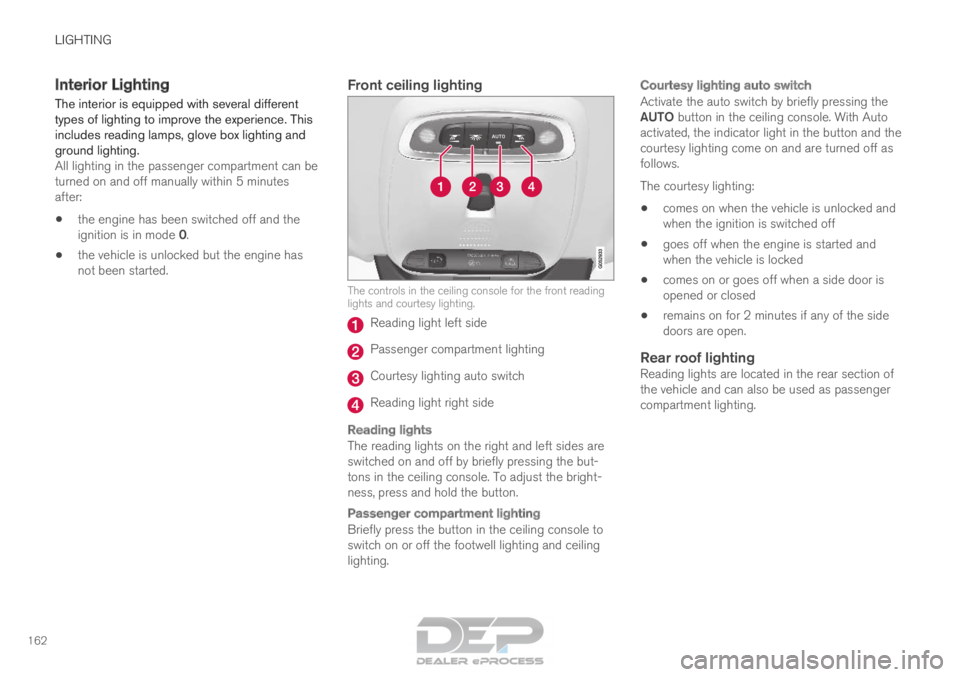
Front ceiling lighting The controls in the ceiling console for the front reading
lights and courtesy lighting.
Reading light left side
Passenger compartment lighting
Courtesy lighting auto switch
Reading light right side
Reading lights
The reading lights on the right and left sides are
switched on and off by briefly pressing the but-
tons in the ceiling console. To adjust the bright-
ness, press and hold the button.
Passenger compartment lighting
Briefly press the button in the ceiling console to
switch on or off the footwell lighting and ceiling
lighting.
Courtesy lighting auto switch
Activate the auto switch by briefly pressing the
AUTO button in the ceiling console. With Auto
activated, the indicator light in the button and the
courtesy lighting come on and are turned off as
follows.
The courtesy lighting:
•
comes on when the vehicle is unlocked and
when the ignition is switched off
• goes off when the engine is started and
when the vehicle is locked
• comes on or goes off when a side door is
opened or closed
• remains on for 2 minutes if any of the side
doors are open.
Rear roof lightingReading lights are located in the rear section of
the vehicle and can also be used as passenger
compartment lighting.