tire type VOLVO XC90 TWIN ENGINE 2018 Owners Manual
[x] Cancel search | Manufacturer: VOLVO, Model Year: 2018, Model line: XC90 TWIN ENGINE, Model: VOLVO XC90 TWIN ENGINE 2018Pages: 686, PDF Size: 17 MB
Page 16 of 686
14
Touching up minor paint damage645
Color codes646
Changing rear window wipers647
Replacing windshield wiper blades648
Windshield wipers in the service position649
Filling washer fluid650
SPECIFICATIONS
Type designations654
Dimensions657
Weights659
Towing capacity and tongue weight660
Engine specifications661
Engine oil specifications662
Coolant specifications663
Transmission fluid specifications663
Brake fluid specifications663
Fuel tank volume664
Air conditioning specifications664
Approved tire pressure665
INDEX
Index667
Page 36 of 686
||
YOUR VOLVO
34
Related information
•Contacting Volvo (p. 26)
•Volvo Structural Parts Statement (p. 38)
Terms & Conditions for Services
Volvo offers services to help make driving yourVolvo as safe and comfortable as possible.These services comprise everything from assis-tance in emergencies to navigation and variousmaintenance services.
Before using the services, it is important to readthe Terms and Conditions for the services atsupport.volvocars.com.
Related information
•Customer Privacy Policy (p. 34)
Customer Privacy Policy
Volvo respects and safeguards the personal pri-vacy of everyone who visits our websites.This policy refers to the handling of customerdata and personal information. The purpose is togive current, past and potential customers a gen-eral understanding of:
•The circumstances in which we collect andprocess your personal data.
•The types of personal data we collect.
•Why we collect your personal data.
•How we process your personal data.
The policy can be read in its entirety atsupport.volvocars.com.
Related information
•Terms of use and data sharing (p. 536)
•Terms & Conditions for Services (p. 34)
•Data recording (p. 33)
Page 53 of 686
SAFETY
}}
51
When a critical situation has passed, the seat beltand the electric seat belt tensioner are resetautomatically. However, they can also be resetmanually.
WARNING
Never attempt to alter or repair the seat belton your own. Volvo recommends contactingan authorized Volvo workshop.
If the seat belt has been exposed to extremeforces, e.g. in conjunction with a collision, theentire seat belt must be replaced. Even if theseat belt appears undamaged, some of itsprotective properties may have been lost. Alsoreplace the seat belt if it is worn or damaged.The new seat belt must be type approved andintended for the same seating position as thereplaced seat belt.
Related information
•Seat belts (p. 47)
•Buckling and unbuckling seat belts (p. 48)
•Resetting the electric seat belt tensioners(p. 51)
•City Safety™ (p. 335)
•Rear Collision Warning (p. 347)
Resetting the electric seat belttensioners
The electric seat belt tensioners are designed tobe reset automatically, but if the seat beltremains taut it can be reset manually.1. Stop the vehicle in a safe location.
2.Unbuckle the seat belt and then rebuckle it.
> The seat belt and the electric seat belttensioner will be reset.
WARNING
Never attempt to alter or repair the seat belton your own. Volvo recommends contactingan authorized Volvo workshop.
If the seat belt has been exposed to extremeforces, e.g. in conjunction with a collision, theentire seat belt must be replaced. Even if theseat belt appears undamaged, some of itsprotective properties may have been lost. Alsoreplace the seat belt if it is worn or damaged.The new seat belt must be type approved andintended for the same seating position as thereplaced seat belt.
Related information
•Seat belt tensioners (p. 50)
•Seat belts (p. 47)
Door and seat belt reminders
This system is intended to remind occupants tobuckle their seat belts and to alert the driver if adoor or the hood, tailgate or fuel filler door isopen.
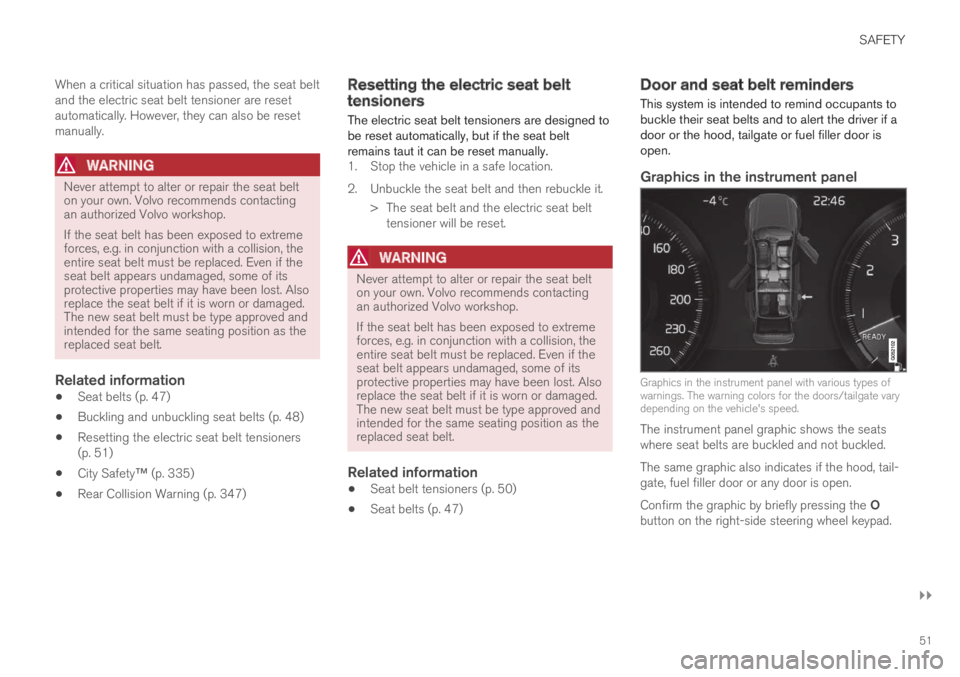
Graphics in the instrument panel
Graphics in the instrument panel with various types ofwarnings. The warning colors for the doors/tailgate varydepending on the vehicle's speed.
The instrument panel graphic shows the seatswhere seat belts are buckled and not buckled.
The same graphic also indicates if the hood, tail-gate, fuel filler door or any door is open.
Confirm the graphic by briefly pressing the Obutton on the right-side steering wheel keypad.
Page 103 of 686

DISPLAYS AND VOICE CONTROL
}}
101
on the FreeType code, not just the
unmodified files. If you use our work, you
must acknowledge us. However, no fee need
be paid to us.
3.
Advertising The names of FreeType's authors
and contributors may not be used to endorse
or promote products derived from this
software without specific prior written
permission. We suggest, but do not require,
that you use one or more of the following
phrases to refer to this software in your
documentation or advertising materials:
`FreeType Project', `FreeType Engine',
`FreeType library', or `FreeType Distribution'.
4. Contacts There are two mailing lists related to FreeType: o [email protected]
Discusses general use and applications of
FreeType, as well as future and wanted
additions to the library and distribution. If you
are looking for support, start in this list if you
haven't found anything to help you in the
documentation. o [email protected]
Discusses bugs, as well as engine internals,
design issues, specific licenses, porting, etc.
o http://www.freetype.org Holds the current
FreeType web page, which will allow you to
download our latest development version and
read online documentation. You can also
contact us individually at: David Turner
Lemberg <
[email protected] >
Libpng License
This copy of the libpng notices is provided for
your convenience. In case of any discrepancy
between this copy and the notices in the file
png.h that is included in the libpng distribution,
the latter shall prevail.
COPYRIGHT NOTICE, DISCLAIMER, and
LICENSE:
If you modify libpng you may insert additional
notices immediately following this sentence.
libpng versions 1.0.7, July 1, 2000, through
1.0.13, April 15, 2002, are Copyright (c)
2000-2002 Glenn Randers-Pehrson and are
distributed according to the same disclaimer and
license as libpng-1.0.6 with the following
individuals added to the list of Contributing
Authors
Simon-Pierre Cadieux
Eric S. Raymond
Gilles Vollant
and with the following additions to the disclaimer:
There is no warranty against interference with
your enjoyment of the library or against
infringement. There is no warranty that our efforts
or the library will fulfill any of your particular
purposes or needs. This library is provided with all
faults, and the entire risk of satisfactory quality,
performance, accuracy, and effort is with the user. libpng versions 0.97, January 1998, through
1.0.6, March 20, 2000, are Copyright (c) 1998,
1999 Glenn Randers-Pehrson, and are
distributed according to the same disclaimer and
license as libpng-0.96, with the following
individuals added to the list of Contributing
Authors:
Tom Lane
Glenn Randers-Pehrson
Willem van Schaik
libpng versions 0.89, June 1996, through 0.96,
May 1997, are Copyright (c) 1996, 1997
Andreas Dilger Distributed according to the same
disclaimer and license as libpng-0.88, with the
following individuals added to the list of
Contributing Authors:
John Bowler
Kevin Bracey
Sam Bushell
Magnus Holmgren
Greg Roelofs
Tom Tanner
libpng versions 0.5, May 1995, through 0.88,
January 1996, are Copyright (c) 1995, 1996 Guy
Eric Schalnat, Group 42, Inc.
Page 331 of 686
DRIVER SUPPORT
329
High temperaturesIf the temperature in the passenger compartment
is very high, the camera/radar sensor will switch
off temporarily for approx. 15 minutes after the
engine is started to protect its electronic compo-
nents. When the temperature has cooled suffi-
ciently, the camera/radar sensor will automati-
cally restart.Damaged windshield
CAUTIONIf there are cracks, scratches or stone chips
on the windshield in front of any of the cam-
era and radar unit "windows" and this covers
an area of about 0.5 × 3.0 mm
(0.02 × 0.12 in.) or more, contact a workshop
to have the windshield replaced – an author-
ized Volvo workshop is recommended.
Failure to take action could result in reduced
performance for the driver support systems
that use the camera and radar unit.
It could cause functions to be reduced, deac-
tivated completely or produce an incorrect
function response.
To avoid the risk of loss of function, malfunc-
tion or reduced function of the driver support
systems that use the radar unit, the following
also apply:
• Volvo advises against repairing cracks,
scratches or stone chips in the area in
front of the camera and radar unit – the
entire windshield should instead be
replaced.
• Before replacing the windshield, contact
an authorized Volvo workshop to verify
that the right windshield has been
ordered and installed. •
The same type of windshield wipers or
wipers approved by Volvo should be used
for replacement.
CAUTION If the windshield is replaced, the camera and
radar unit must be recalibrated by a workshop
to help ensure proper functioning of all of the
vehicle's camera and radar-based systems –
an authorized Volvo workshop is recom-
mended.
Related information
•
Radar sensor (p. 326)
Page 403 of 686
DRIVER SUPPORT
* Option/accessory.401
NOTEDirt, ice and snow covering the sensors
reduce their function and can make measure-
ment impossible.
Driver responsibilityThe driver should keep in mind that PAP is a
parking aid ‒ not an infallible fully automatic sys-
tem. The driver must always be prepared to take
control and cancel a parking sequence if neces-
sary.
There are a number of things to keep in mind
when parking, including:
• The driver is always responsible for determin-
ing if the space suggested by PAP is suita-
ble for parking.
• Do not use PAP when using snow chains or
a temporary spare tire.
• Do not use PAP if there are any objects pro-
truding from the vehicle.
• Heavy rain or snowfall may inhibit PAP's abil-
ity to accurately measure a parking space.
• While searching and measuring the parking
space, PAP may be unable to detect objects
located far into the space.
• PAP may not suggest parking spaces on
narrow streets if it does not detect sufficient
space for maneuvering the vehicle. •
Use approved tires 128
inflated to the correct
tire pressure because this affects PAP's abil-
ity to provide parking assistance.
• PAP's function is based on the way the vehi-
cles are parked behind and in front of your
parking space. If they are, for example,
parked too close to the curb, there is a risk
that your vehicle's tires or wheel rims could
be damaged by the curb during the parking
procedure.
• Perpendicular parking spaces may not be
detected or may be suggested unnecessarily
if a parked vehicle is sticking out more than
other parked vehicles.
• PAP is intended to provide parking assis-
tance on straight streets, not sections of
street with sharp curves or bends. Always
make sure that your vehicle is parallel to rel-
evant parking spaces when PAP is measur-
ing the parking space.
CAUTION Switching to another approved wheel and/or
tire dimension could change the tire circum-
ference, which would then require the PAP
system to be updated. Consult a workshop –
an authorized Volvo workshop is recom-
mended.
Related information
•
Park Assist Pilot* (p. 395)
• Speed-dependent steering wheel resistance
(p. 272) 128
"Approved tires" refers to tires of the same type and make as the vehicl\
e's original, factory-installed tires.
Page 459 of 686
STARTING AND DRIVING
}}
457
Driving
• Choose the Pure drive mode to help mini-
mize electric power consumption.
• Maintain a steady speed and a generous fol-
lowing distance to traffic ahead to minimize
braking. This drive mode has the lowest
power consumption.
• Balance energy requirements using the
accelerator pedal. Use the indicator on the
instrument panel to see available electric
power and avoid starting the combustion
engine unnecessarily. The electric motor is
more effective than the combustion engine,
especially at low speeds.
• When braking is necessary, brake gently
using the brake pedal. This will recharge the
hybrid battery. A regenerative function is
integrated in the brake pedal and can be
augmented by the electric motor's braking
capacity when the gear selector is in mode
B.
• Higher speeds increase energy consumption
- air resistance increases with speed.
• Activate the
Hold function in the Function
view at high speeds when traveling farther
than is possible using the hybrid battery's
capacity.
• Whenever possible, avoid using the Charge
function to charge the hybrid battery. Charg-
ing the battery using the combustion engine increases fuel consumption and carbon diox-
ide emissions.
• In a cold climate, reduce heating of the wind-
shield/rear window, mirrors, seats and the
steering wheel.
• Maintain the correct pressure in the tires and
check pressure regularly.
• The type of tires used could affect energy
consumption - consult a retailer for advice on
suitable tires.
• Remove unnecessary items from the vehicle
- the heavier the load, the higher the fuel
consumption.
• Roof loads increase air resistance and
increase fuel consumption. Remove roof
boxes, ski racks, etc. that are not in use.
• Avoid driving with the windows open.
• Do not keep the vehicle still on an upward
gradient by using the accelerator pedal. Use
the brakes instead.
Related information
•
Drive-E
‒
purer driving pleasure (p. 27)
• Factors affecting electric motor range
(p. 458)
• Using the electric motor only (p. 457)
• Hybrid gauge (p. 87)
• Checking tire pressure (p. 557) Using the electric motor only
When using the electric motor, Volvo Twin
Engine provides a combination of good fuel
economy, low emissions and high performance.
For energy-efficient driving:
• Select the Pure drive mode to help maximize
driving range using only the electric motor.
• Balance energy requirements using the
accelerator pedal. Use the indicator on the
instrument panel's hybrid gauge to see avail-
able electric power and avoid starting the
combustion engine unnecessarily.
• When braking is necessary, brake gently
using the brake pedal. This will recharge the
hybrid battery.
• Activate the
Hold function in the Function
view at high speeds when traveling farther
than is possible using the hybrid battery's
capacity.
• Reduce current consumption in the passen-
ger compartment by reducing e.g. fan speed,
electric heating, or air conditioning use.
Also follow the general economical driving advice
regarding speed, tires and load to maximize
range.
Related information
• General information about Twin Engine
(p. 406)
• Economical driving (p. 456)
Page 463 of 686
STARTING AND DRIVING
461
•
Speed limiter (p. 278)
• Tire sealing system (p. 572) Winter driving
It is important to check the vehicle before driving
in cold/snowy conditions to make sure it can be
driven safely.
Before the cold season arrives:• Make sure the engine coolant contains 50%
antifreeze. This mixture helps protect the
engine from frost erosion down to
approx. -35 °C (-31 °F). Do not mix different
types of antifreeze as this could pose a
health risk.
• Keep the fuel tank well filled to prevent con-
densation from forming.
• Check the viscosity of the engine oil. Oil with
low viscosity (thinner oil) improves cold-
weather starting and reduces fuel consump-
tion when driving with a cold engine.
CAUTION Low-viscosity oil should not be used with hard
driving or in hot weather.
•
Check the condition and charge level of the
start battery. Cold weather places greater
demands on the start battery and reduces its
capacity.
• Use washer fluid containing antifreeze to
help prevent ice from forming in the washer
fluid reservoir.
Slippery driving conditionsFor optimal traction and roadholding, Volvo rec-
ommends using snow tires on all wheels when-
ever there is a risk of snow or ice on the road.
NOTE Certain countries require use of winter tires
by law. Not all countries permit the use of
studded tires.
Practice driving on slippery surfaces under con-
trolled conditions to learn how the vehicle reacts.
Related information
•
Snow tires (p. 571)
• Snow chains (p. 571)
• Braking on salted roads (p. 431)
• Braking on wet roads (p. 431)
• Filling washer fluid (p. 650)
• Start battery (p. 615)
• Replacing windshield wiper blades (p. 648)
• Changing rear window wipers (p. 647)
• Refilling coolant (p. 612)
Page 552 of 686
WHEELS AND TIRES
550Tires
The function of the tires is to carry loads, provide
traction on road surfaces, reduce vibrations and
protect the wheels from wear. The tires significantly influence the vehicle's driv-
ing characteristics. The type, dimensions, tire
pressure and speed rating have a considerable
impact on how the vehicle performs.
Your vehicle is equipped with tires according to
the vehicle's tire information placard on the B-pil-
lar (the structural member at the side of the vehi-
cle, at the rear of the driver's door opening).
WARNING A damaged tire could cause the driver to lose
control of the vehicle.
CAUTION Some Volvo models are equipped with an
Ultra High Performance tire and wheel com-
bination designed to provide maximum dry
pavement performance with consideration for
hydroplaning resistance. They may be more
susceptible to road hazard damage and,
depending on driving conditions, may achieve
a tread life of less than 30,000 km (20,000
miles). Even if this vehicle is equipped with
Volvo's advanced AWD or stability system,
these tires are not designed for winter driving,
and should be replaced with winter tires when
weather conditions dictate.
The tires have good road holding characteristics
and offer good handling on dry and wet surfaces.
It should be noted however that the tires have
been developed to give these features on snow/
ice-free surfaces.
Most models are equipped with "all-season" tires,
which provide a somewhat higher degree of road-
holding on slippery road surfaces than tires with-
out the "all-season" rating. However, for optimal
roadholding on icy or snow-covered roads, we
recommend snow tires on all four wheels.
When replacing tires, be sure that the new tires
are the same size designation, type (radial) and
preferably from the same manufacturer, on allfour wheels. Otherwise there is a risk of altering
the vehicle's roadholding and handling characte-
ristics.
Recommended tiresOn delivery, the car is equipped with Volvo origi-
nal tires that have the VOL
1
marking on the side
of the tires. These tires have been designed spe-
cifically for your vehicle. It is therefore important
when replacing tires that the new tires have this
same marking to help maintain the vehicle's driv-
ing characteristics, comfort and fuel consumption.
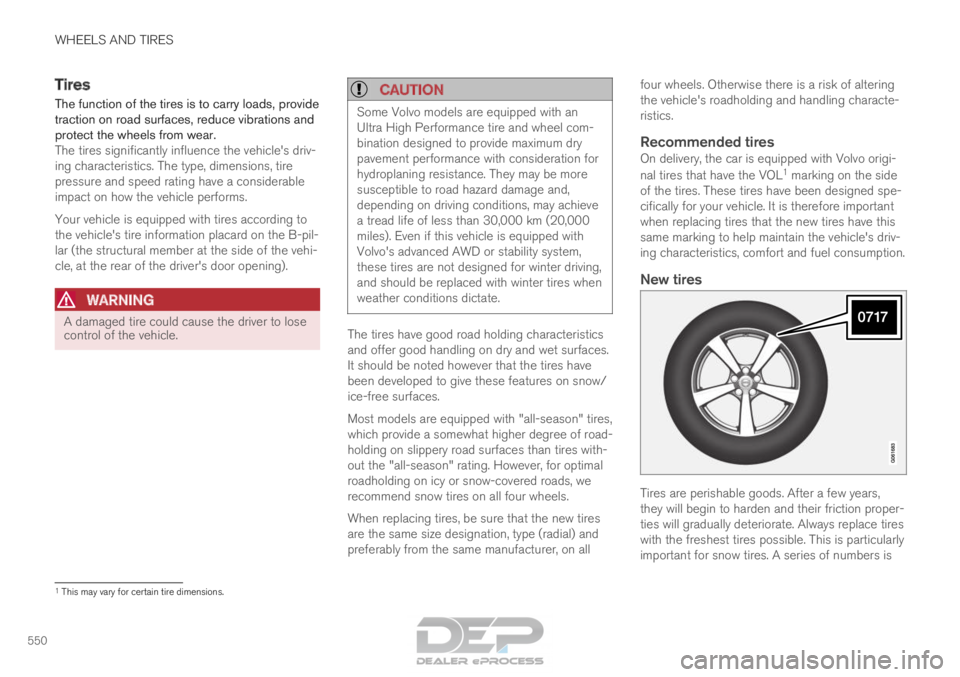
New tires Tires are perishable goods. After a few years,
they will begin to harden and their friction proper-
ties will gradually deteriorate. Always replace tires
with the freshest tires possible. This is particularly
important for snow tires. A series of numbers is
1
This may vary for certain tire dimensions.
Page 554 of 686
||WHEELS AND TIRES
* Option/accessory.
552
WARNING •
The wheel and tire sizes for your Volvo
are specified to meet stringent stability
and handling requirements. Unapproved
wheel/tire size combinations can nega-
tively affect your vehicle's stability and
handling.
• Any damage caused by installation of
unapproved wheel/tire size combinations
will not be covered by your new vehicle
warranty. Volvo assumes no responsibility
for death, injury, or expenses that may
result from such installations.
Related information
•Checking tire pressure (p. 557)
• Tire direction of rotation (p. 552)
• Tread wear indicator (p. 553)
• Tire pressure monitoring system* (p. 559)
• Tire sealing system (p. 572)
• Uniform Tire Quality Grading (p. 556)
• Tire terminology (p. 553)
• Tire sidewall designations (p. 554)
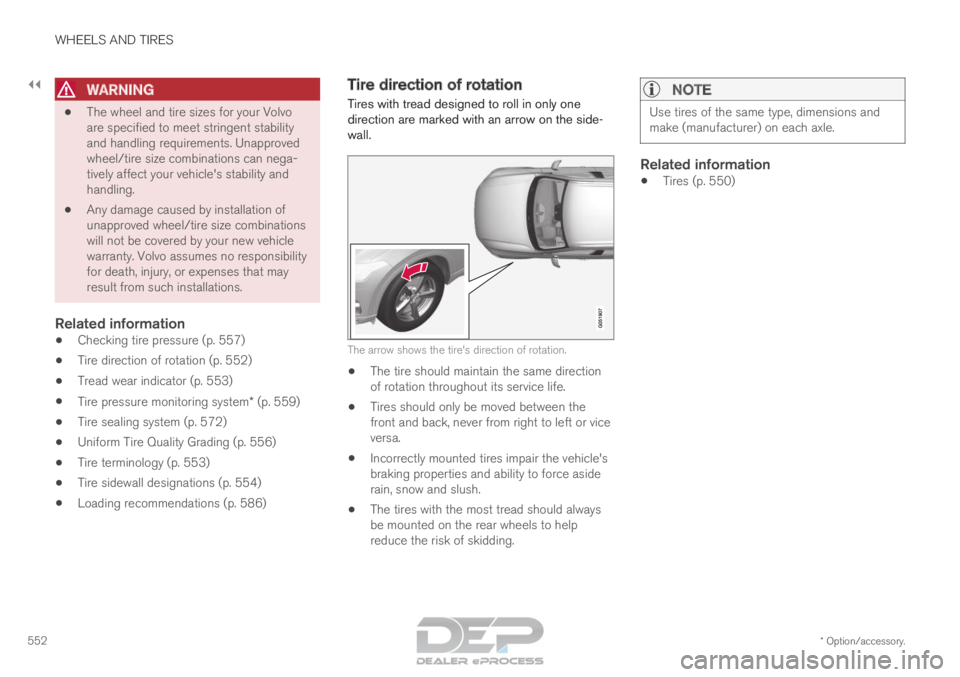
• Loading recommendations (p. 586) Tire direction of rotation
Tires with tread designed to roll in only one
direction are marked with an arrow on the side-
wall. The arrow shows the tire's direction of rotation.
• The tire should maintain the same direction
of rotation throughout its service life.
• Tires should only be moved between the
front and back, never from right to left or vice
versa.
• Incorrectly mounted tires impair the vehicle's
braking properties and ability to force aside
rain, snow and slush.
• The tires with the most tread should always
be mounted on the rear wheels to help
reduce the risk of skidding.
NOTE Use tires of the same type, dimensions and
make (manufacturer) on each axle.
Related information
•
Tires (p. 550)