tire type VOLVO XC90 TWIN ENGINE 2018 User Guide
[x] Cancel search | Manufacturer: VOLVO, Model Year: 2018, Model line: XC90 TWIN ENGINE, Model: VOLVO XC90 TWIN ENGINE 2018Pages: 686, PDF Size: 17 MB
Page 555 of 686
WHEELS AND TIRES
}}
553
Tread wear indicator
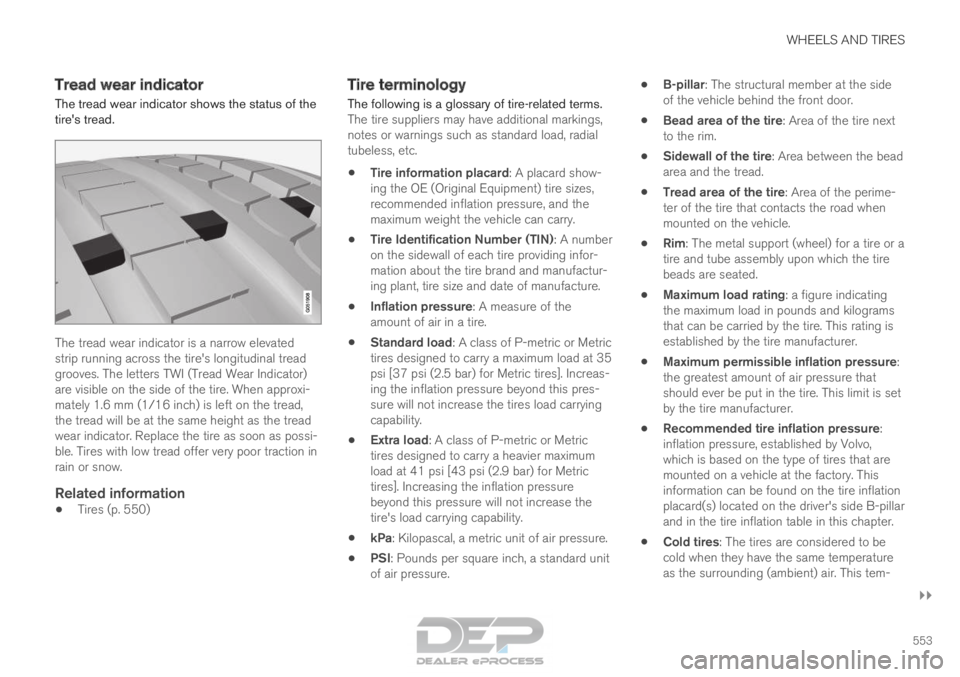
The tread wear indicator shows the status of the
tire's tread. The tread wear indicator is a narrow elevated
strip running across the tire's longitudinal tread
grooves. The letters TWI (Tread Wear Indicator)
are visible on the side of the tire. When approxi-
mately 1.6 mm (1/16 inch) is left on the tread,
the tread will be at the same height as the tread
wear indicator. Replace the tire as soon as possi-
ble. Tires with low tread offer very poor traction in
rain or snow.
Related information
•
Tires (p. 550) Tire terminology
The following is a glossary of tire-related terms.
The tire suppliers may have additional markings,
notes or warnings such as standard load, radial
tubeless, etc.
• Tire information placard: A placard show-
ing the OE (Original Equipment) tire sizes,
recommended inflation pressure, and the
maximum weight the vehicle can carry.
• Tire Identification Number (TIN): A number
on the sidewall of each tire providing infor-
mation about the tire brand and manufactur-
ing plant, tire size and date of manufacture.
• Inflation pressure: A measure of the
amount of air in a tire.
• Standard load: A class of P-metric or Metric
tires designed to carry a maximum load at 35
psi [37 psi (2.5 bar) for Metric tires]. Increas-
ing the inflation pressure beyond this pres-
sure will not increase the tires load carrying
capability.
• Extra load: A class of P-metric or Metric
tires designed to carry a heavier maximum
load at 41 psi [43 psi (2.9 bar) for Metric
tires]. Increasing the inflation pressure
beyond this pressure will not increase the
tire's load carrying capability.
• kPa: Kilopascal, a metric unit of air pressure.
• PSI: Pounds per square inch, a standard unit
of air pressure. •
B-pillar: The structural member at the side
of the vehicle behind the front door.
• Bead area of the tire: Area of the tire next
to the rim.
• Sidewall of the tire: Area between the bead
area and the tread.
• Tread area of the tire: Area of the perime-
ter of the tire that contacts the road when
mounted on the vehicle.
• Rim: The metal support (wheel) for a tire or a
tire and tube assembly upon which the tire
beads are seated.
• Maximum load rating: a figure indicating
the maximum load in pounds and kilograms
that can be carried by the tire. This rating is
established by the tire manufacturer.
• Maximum permissible inflation pressure:
the greatest amount of air pressure that
should ever be put in the tire. This limit is set
by the tire manufacturer.
• Recommended tire inflation pressure:
inflation pressure, established by Volvo,
which is based on the type of tires that are
mounted on a vehicle at the factory. This
information can be found on the tire inflation
placard(s) located on the driver's side B-pillar
and in the tire inflation table in this chapter.
• Cold tires: The tires are considered to be
cold when they have the same temperature
as the surrounding (ambient) air. This tem-
Page 573 of 686
WHEELS AND TIRES
}}
571
Snow tires
Snow tires are designed for winter driving.
Volvo recommends snow tires with specific
dimensions. The tire dimensions vary depending
on engine type. When driving with snow tires, the
correct type of tires must be mounted on all four
wheels.
NOTE Contact a Volvo dealer for advice on the best
choice of rims and tires.
Tips for changing snow tiresWhen switching between regular tires and snow
tires, mark the tires according to which side they
were mounted on, e.g. L for left and R for right.
Studded tiresStudded tires should be broken in by driving
500–1000 km (300–600 miles) slowly and gen-
tly to help the studs settle properly in the tires.
This gives the tire, and especially the studs, a
longer service life.
NOTE
Regulations regarding the use of studded
tires vary from country to country.
Tread depthRoad conditions with ice, slush and low tempera-
tures place considerably higher demands on tires
than summer conditions. Volvo therefore recom-
mends not driving on snow tires that have a tread
depth of less than 4 mm (0.15 inch).
Related information
•
When changing wheels (p. 564)
• Winter driving (p. 461)
• Tread wear indicator (p. 553) Snow chains
Using snow chains and/or snow tires can help
improve traction in winter driving conditions.
WARNING Use Volvo genuine snow chains or equivalent
snow chains that are suitable for the vehicle
model and the tire and wheel sizes. Only one-
sided snow chains are permitted.
If uncertain about snow chains, Volvo recom-
mends contacting an authorized Volvo work-
shop. Use of the wrong snow chains could
cause serious damage to the vehicle and
result in an accident.
12
The backrest in the third row of seats* must be folded down.
Page 574 of 686
||WHEELS AND TIRES
572
CAUTION
Snow chains can be used on the vehicle, with
the following restrictions:
• Volvo recommends not using snow
chains on wheel dimensions larger than
19 inches.
• Always follow the manufacturer's installa-
tion instructions carefully. Install chains
as tightly as possible and retighten peri-
odically.
• Only put snow chains on the front wheels
(also applies to all-wheel drive vehicles).
• If accessory, aftermarket or "custom"
tires and wheels with different dimen-
sions than the original tires and wheels
are used, snow chains in some cases
may NOT be used. Sufficient distance
between the chains and brakes, suspen-
sion and body components must be
maintained.
• Check local regulations regarding the use
of snow chains before installing.
• Never exceed the snow chain manufac-
turer's specified maximum speed limit.
Under no circumstances should you
exceed 50 km/h (30 mph).
• Avoid bumps, holes or sharp turns when
driving with snow chains. •
Avoid driving on surfaces without snow as
this wears out both the snow chains and
the tires.
• The handling of the vehicle can be
adversely affected when driving with
chains. Avoid fast or sharp turns as well
as locked wheel braking.
• Some types of strap-on chains affect
brake components and therefore must
NOT be used. Consult a Volvo retailer for more information
about snow chains.
Related information
•
Winter driving (p. 461) Tire sealing system
13
The temporary tire sealing system can be used
to seal a puncture in a tire or to check and
adjust the pressure in the tire.
Models equipped with a spare wheel 14
do not
have the tire sealing system.
The tire sealing system consists of a compressor
and a bottle containing sealing compound. The
sealing functions as a temporary repair.
NOTE The sealing compound effectively seals tires
with punctures in the tread but may not be
able to fully seal tires with punctures in the
sidewall. Do not use the tire sealing system
on tires with large tears, cracks or similar
damage.
NOTE
The compressor is intended for temporary tire
sealing and is approved by Volvo.
LocationThe tire sealing system is located in a foam block
under the floor of the cargo compartment.
Page 602 of 686

||MAINTENANCE AND SERVICE
600
Monthly:
•
Check cold tire pressure in all tires. Inspect
the tires for wear.
• Check that engine coolant and other fluid
levels are between the indicated "min" and
"max" markings.
• Clean interior glass surfaces with a glass
cleaner and soft paper towels.
• Wipe driver information displays with a soft
cloth.
• Visually inspect battery terminals for corro-
sion. Corrosion may indicate a loose terminal
connector, or a battery near the end of its
useful service life. Consult your Volvo retailer
for additional information.
As needed:
Wash the car, including the undercarriage, to
reduce wear that can be caused by a buildup of
dirt, and corrosion that can be caused by salt res-
idues.
Clean leaves and twigs from air intake vents at
the base of the windshield, and from other places
where they may collect.
NOTE Complete service information for qualified
technicians is available online for purchase or
subscription at www.volvotechinfo.com.
Related information
•
Vehicle status (p. 602)
• Scheduling service and repairs (p. 603)
• Connecting equipment to the vehicle's data
link connector (p. 36)
• Technician certification (p. 37)
• Climate control system service (p. 608)
• Maintenance of the brake system (p. 432)
• Engine compartment overview (p. 609) Data transfer between vehicle and
workshop over Wi-Fi
Volvo workshops have a designated Wi-Fi net-
work for secure data transfer between your vehi-
cle and the workshop. Your visit to the workshop
will be easier and more effective when diagnos-
tics information and software can be transferred
over the workshop's network.
When you arrive at the workshop, your technician
can connect your vehicle to the workshop's Wi-Fi
network to perform troubleshooting and down-
load software. For this type of communication,
the vehicle only connects to the workshop's net-
work. The vehicle can only be connected to the
designated workshop networks, not to any other
network, e.g. your home network.
Manual connection to workshop Wi-FiManual connection is usually performed by a
service technician. Because the technician uses
the buttons on your remote key to connect the
vehicle, it is important that you bring a key with
buttons when taking the vehicle in to a workshop.
Pressing the lock button on the remote key three
times will connect the vehicle to the workshop's
Wi-Fi network.
When the car is connected to a Wi-Fi network,
the symbol appears in the center display.
Page 667 of 686
SPECIFICATIONS
665
Approved tire pressure
The following tire pressures are recommended
by Volvo for your vehicle. Refer to the tire infla- tion placard for information specific to the tires
installed on your vehicle at the factory.Tire dimensions
Cold tire pressure for up to seven people (depending on number of seats\
)
Front
psi (kPa) Rear
psi (kPa)
235/55 R19
275/45 R20
275/40 R21
275/35 R22 42 (290)
42 (290)
Temporary spare tire N/AN/A
Related information
•Type designations (p. 654)
• Checking tire pressure (p. 557)
Page 679 of 686
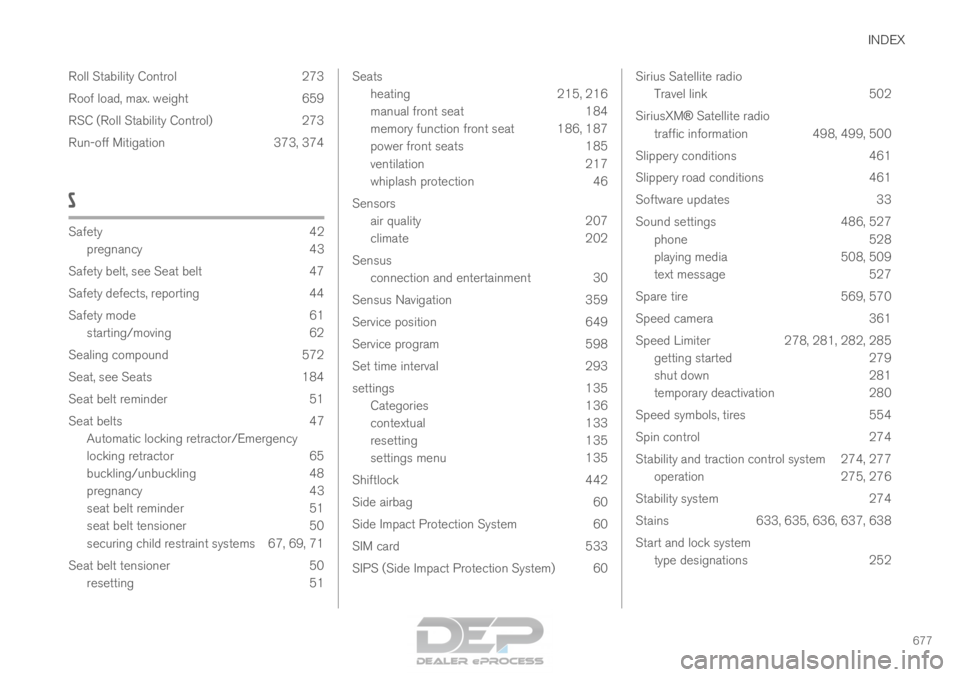
INDEX
677
Roll Stability Control 273
Roof load, max. weight 659
RSC (Roll Stability Control) 273
Run-off Mitigation 373, 374
S Safety
42
pregnancy
43
Safety belt, see Seat belt 47
Safety defects, reporting 44
Safety mode 61 starting/moving 62
Sealing compound 572
Seat, see Seats 184
Seat belt reminder 51
Seat belts 47 Automatic locking retractor/Emergency
locking retractor 65
buckling/unbuckling 48
pregnancy 43
seat belt reminder 51
seat belt tensioner 50
securing child restraint systems 67, 69, 71
Seat belt tensioner 50 resetting 51 Seats
heating
215, 216
manual front seat 184
memory function front seat 186, 187
power front seats 185
ventilation 217
whiplash protection 46
Sensors air quality 207
climate 202
Sensus connection and entertainment 30
Sensus Navigation 359
Service position 649
Service program 598
Set time interval 293
settings 135
Categories 136
contextual 133
resetting 135
settings menu 135
Shiftlock 442
Side airbag 60
Side Impact Protection System 60
SIM card 533
SIPS (Side Impact Protection System) 60 Sirius Satellite radio
Travel link 502
SiriusXM® Satellite radio traffic information 498, 499, 500
Slippery conditions 461
Slippery road conditions 461
Software updates 33
Sound settings 486, 527
phone 528
playing media 508, 509
text message 527
Spare tire 569, 570
Speed camera 361
Speed Limiter 278, 281, 282, 285
getting started 279
shut down 281
temporary deactivation 280
Speed symbols, tires 554
Spin control 274
Stability and traction control system 274, 277 operation 275, 276
Stability system 274
Stains 633, 635, 636, 637, 638
Start and lock system type designations 252
Page 681 of 686
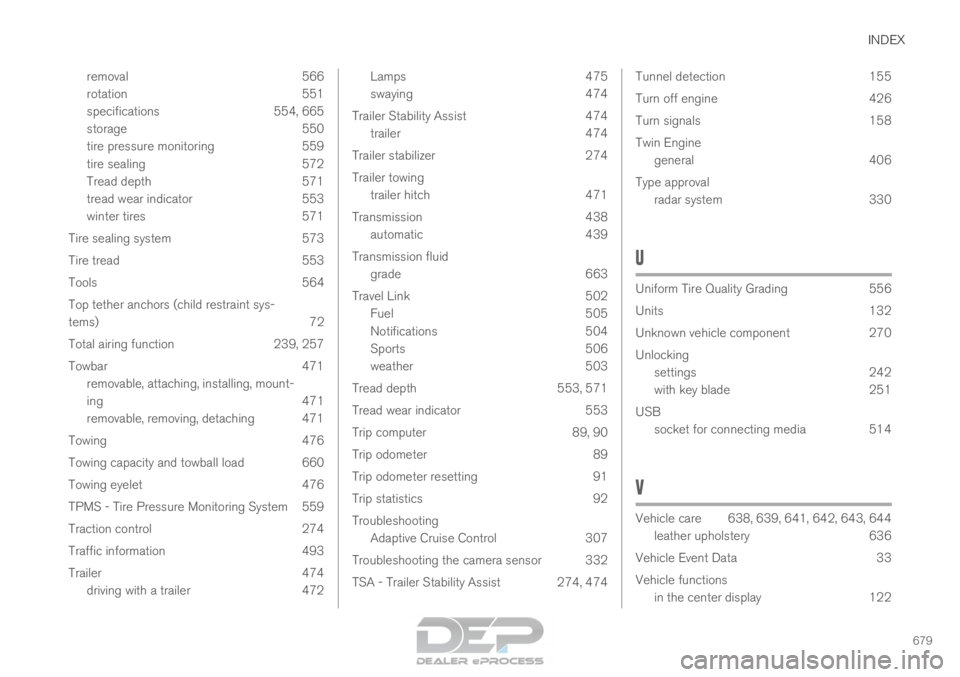
INDEX
679
removal 566
rotation 551
specifications 554, 665
storage 550
tire pressure monitoring 559
tire sealing 572
Tread depth 571
tread wear indicator 553
winter tires 571
Tire sealing system 573
Tire tread 553
Tools 564
Top tether anchors (child restraint sys-
tems) 72
Total airing function 239, 257
Towbar 471 removable, attaching, installing, mount-
ing 471
removable, removing, detaching 471
Towing 476
Towing capacity and towball load 660
Towing eyelet 476
TPMS - Tire Pressure Monitoring System 559
Traction control 274
Traffic information 493
Trailer 474 driving with a trailer 472 Lamps
475
swaying
474
Trailer Stability Assist 474
trailer 474
Trailer stabilizer 274
Trailer towing trailer hitch 471
Transmission 438
automatic 439
Transmission fluid grade 663
Travel Link 502
Fuel 505
Notifications 504
Sports 506
weather 503
Tread depth 553, 571
Tread wear indicator 553
Trip computer 89, 90
Trip odometer 89
Trip odometer resetting 91
Trip statistics 92
Troubleshooting Adaptive Cruise Control 307
Troubleshooting the camera sensor 332
TSA - Trailer Stability Assist 274, 474 Tunnel detection
155
Turn off engine 426
Turn signals 158
Twin Engine general 406
Type approval radar system 330
U Uniform Tire Quality Grading
556
Units
132
Unknown vehicle component 270
Unlocking settings 242
with key blade 251
USB socket for connecting media 514
V Vehicle care 638, 639, 641, 642, 643, 644
leather upholstery
636
Vehicle Event Data 33
Vehicle functions in the center display 122