warning VOLVO XC90 TWIN ENGINE 2019 Owners Manual
[x] Cancel search | Manufacturer: VOLVO, Model Year: 2019, Model line: XC90 TWIN ENGINE, Model: VOLVO XC90 TWIN ENGINE 2019Pages: 697, PDF Size: 10.33 MB
Page 432 of 697
HYBRID INFORMATION
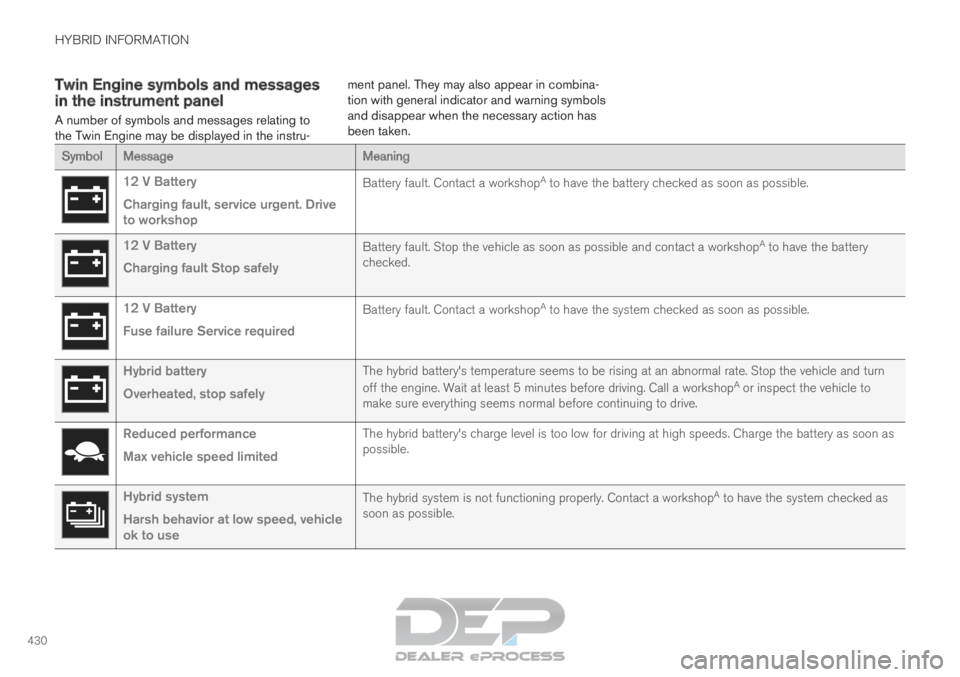
430Twin Engine symbols and messages
in the instrument panel
A number of symbols and messages relating to
the Twin Engine may be displayed in the instru-
ment panel. They may also appear in combina-
tion with general indicator and warning symbols
and disappear when the necessary action has
been taken.Symbol
Message Meaning12 V Battery
Charging fault, service urgent. Drive
to workshop
Battery fault. Contact a workshop
A
to have the battery checked as soon as possible. 12 V Battery
Charging fault Stop safely
Battery fault. Stop the vehicle as soon as possible and contact a worksh\
op
A
to have the battery
checked. 12 V Battery
Fuse failure Service required
Battery fault. Contact a workshop
A
to have the system checked as soon as possible. Hybrid battery
Overheated, stop safely
The hybrid battery's temperature seems to be rising at an abnormal ra\
te. Stop the vehicle and turn
off the engine. Wait at least 5 minutes before driving. Call a workshop
A
or inspect the vehicle to
make sure everything seems normal before continuing to drive. Reduced performance
Max vehicle speed limited
The hybrid battery's charge level is too low for driving at high spee\
ds. Charge the battery as soon as
possible.Hybrid system
Harsh behavior at low speed, vehicle
ok to use
The hybrid system is not functioning properly. Contact a workshop
A
to have the system checked as
soon as possible.
Page 433 of 697

HYBRID INFORMATION
431Symbol
Message MeaningHybrid system failure
Service required
The hybrid system is not functioning. Contact a workshop
A
to have the system checked as soon as
possible. Charge cable
Remove before start
Displayed when the driver attempts to start the vehicle with the chargin\
g cable still connected.
Remove the charging cable and close the charger cover.Charge cable
Removed? Turn and hold start knob
7s
Displayed when the driver again attempts to start the vehicle with the c\
harging cable connected.
Disconnect the charging cable or verify that the cable is completely dis\
connected and the charger
cover is closed.A
An authorized Volvo workshop is recommended.
Related information
Initiating hybrid battery charging (p. 423)
Stopping hybrid battery charging (p. 429)
Charging the hybrid battery (p. 417)
Warning symbols in the instrument panel
(p. 97)
Indicator symbols in the instrument panel
(p. 94)
Hybrid gauge (p. 87)
Hybrid gauge (p. 88)
Page 436 of 697
STARTING AND DRIVING
* Option/accessory.
434 Starting the vehicle
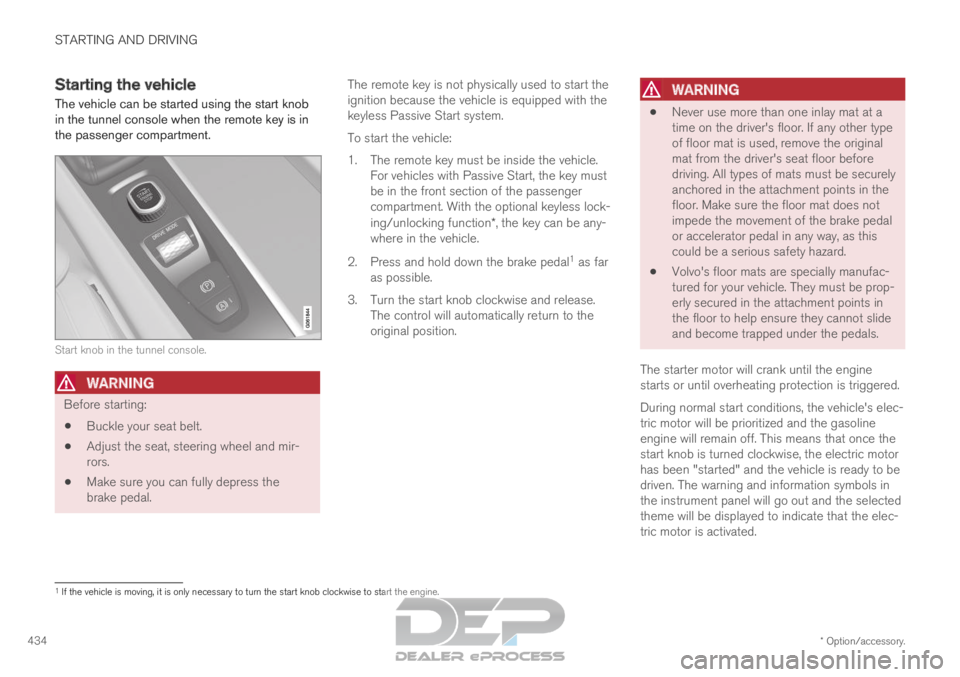
The vehicle can be started using the start knob
in the tunnel console when the remote key is in
the passenger compartment. Start knob in the tunnel console.
WARNING
Before starting:
Buckle your seat belt.
Adjust the seat, steering wheel and mir-
rors.
Make sure you can fully depress the
brake pedal. The remote key is not physically used to start the
ignition because the vehicle is equipped with the
keyless Passive Start system.
To start the vehicle:
1.
The remote key must be inside the vehicle.
For vehicles with Passive Start, the key must
be in the front section of the passenger
compartment. With the optional keyless lock-
ing/unlocking function*, the key can be any-
where in the vehicle.
2. Press and hold down the brake pedal 1
as far
as possible.
3. Turn the start knob clockwise and release. The control will automatically return to the
original position.
WARNING
Never use more than one inlay mat at a
time on the driver's floor. If any other type
of floor mat is used, remove the original
mat from the driver's seat floor before
driving. All types of mats must be securely
anchored in the attachment points in the
floor. Make sure the floor mat does not
impede the movement of the brake pedal
or accelerator pedal in any way, as this
could be a serious safety hazard.
Volvo's floor mats are specially manufac-
tured for your vehicle. They must be prop-
erly secured in the attachment points in
the floor to help ensure they cannot slide
and become trapped under the pedals.
The starter motor will crank until the engine
starts or until overheating protection is triggered.
During normal start conditions, the vehicle's elec-
tric motor will be prioritized and the gasoline
engine will remain off. This means that once the
start knob is turned clockwise, the electric motor
has been "started" and the vehicle is ready to be
driven. The warning and information symbols in
the instrument panel will go out and the selected
theme will be displayed to indicate that the elec-
tric motor is activated. 1
If the vehicle is moving, it is only necessary to turn the start knob cl\
ockwise to start the engine.
Page 437 of 697

STARTING AND DRIVING
}}
435
In some situations, such as in cold weather or if
the hybrid battery's charge level is too low, the
gasoline engine will start instead.
The vehicle should not be started with the charg-
ing cable connected. However, if the cable can-
not be pulled out or if the vehicle incorrectly
detects a cable that is not connected, the vehicle
can be started using an override procedure:
1.
Press the brake pedal and turn the start
knob clockwise.
2. Charge cable Remove before start will
appear in the instrument panel.
3.
Turn the start knob clockwise again.
4. Removed? Turn and hold start knob 7s
will appear. Turn the knob clockwise and hold
it for 7 seconds to start the vehicle. Location of the backup reader in the tunnel console. If the
Vehicle key not found message is shown
in the instrument panel at start, place the remote
key at the backup reader and then make a new
start attempt.
NOTE When the remote key is placed in the backup
reader, make sure that no other vehicle keys,
metal objects or electronic devices (e.g. cellu-
lar phones, tablets, laptops or chargers) are in
the backup reader. Multiple vehicle keys close
to each other in the backup reader can dis-
rupt their functionality.
If Vehicle start System check, wait is dis-
played in the instrument panel while attempting
to start the vehicle, wait until the message disap-
pears and try again to start the vehicle.
CAUTION If the engine has not responded after 3
attempts – wait for 3 minutes before starting
a new attempt. Starting capability increases if
the starter battery is given time to recover.
NOTE
The vehicle cannot be started if the hybrid
battery is discharged.
WARNING Never remove the remote control key from
the vehicle while driving.
WARNING
Always remove the remote key from the
passenger compartment when you leave
the vehicle and make sure the ignition is
in mode 0.
Always put the gear selector in P and
apply the parking brake before leaving
the vehicle. Never leave the vehicle unsu-
pervised while the engine is running.
Always open the garage door fully and
make sure that ventilation is very good
before starting the engine in a garage.
The exhaust fumes produced by the vehi-
cle contain carbon monoxide, which is
invisible and odorless but very toxic.
NOTE With a cold start, idling speed may be consid-
erably higher than normal for certain engine
types. This is done to get the emissions sys-
tem up to normal operating temperature as
quickly as possible, which minimizes exhaust
emissions and protects the environment.
Page 439 of 697
STARTING AND DRIVING
* Option/accessory.437
Ignition modes
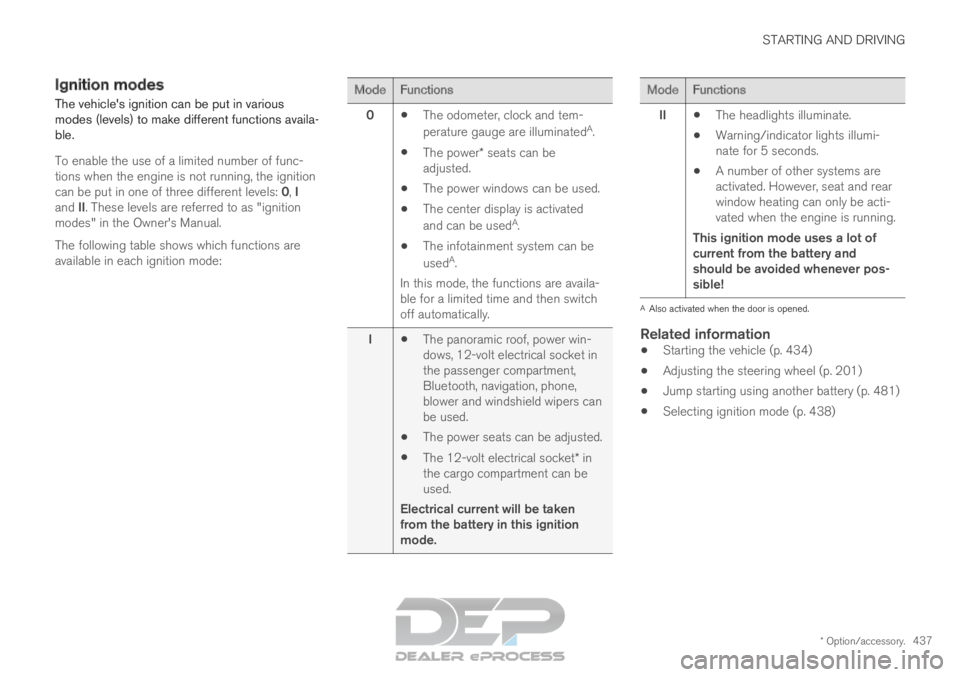
The vehicle's ignition can be put in various
modes (levels) to make different functions availa-
ble.
To enable the use of a limited number of func-
tions when the engine is not running, the ignition
can be put in one of three different levels: 0, I
and II. These levels are referred to as "ignition
modes" in the Owner's Manual.
The following table shows which functions are
available in each ignition mode: Mode
Functions
0 The odometer, clock and tem-
perature gauge are illuminated A
.
The power* seats can be
adjusted.
The power windows can be used.
The center display is activated
and can be used A
.
The infotainment system can be
used A
.
In this mode, the functions are availa-
ble for a limited time and then switch
off automatically.
I The panoramic roof, power win-
dows, 12-volt electrical socket in
the passenger compartment,
Bluetooth, navigation, phone,
blower and windshield wipers can
be used.
The power seats can be adjusted.
The 12-volt electrical socket* in
the cargo compartment can be
used.
Electrical current will be taken
from the battery in this ignition
mode. Mode
Functions
II The headlights illuminate.
Warning/indicator lights illumi-
nate for 5 seconds.
A number of other systems are
activated. However, seat and rear
window heating can only be acti-
vated when the engine is running.
This ignition mode uses a lot of
current from the battery and
should be avoided whenever pos-
sible! A
Also activated when the door is opened.
Related information
Starting the vehicle (p. 434)
Adjusting the steering wheel (p. 201)
Jump starting using another battery (p. 481)
Selecting ignition mode (p. 438)
Page 441 of 697
STARTING AND DRIVING
}}
439
Brakes
The brake pedal is used to apply the vehicle's
regular brakes, which are part of the brake sys-
tem.
The vehicle is equipped with two brake circuits. If
one brake circuit is damaged, the brake pedal will
go down further when depressed. More pressure
will then be required from the driver for normal
braking effect.
WARNING
The power brakes only work when the electric
motor or combustion engine is running.
If the brake pedal is used when the engine is
switched off, greater pressure must be applied to
brake the vehicle.
In very hilly areas or when driving with a heavy
load, gear position B can be used to augment the
brakes with engine braking.
Use the Off Road drive mode to increase the
engine braking effect when driving on steep
downgrades at low speeds.
Anti-lock brakesThe vehicle is equipped with an Anti-lock Braking
System (ABS), which helps prevent the wheels
from locking and helps maintain steering control
when braking. Vibrations may be felt from the brake pedal when ABS is operating, which is nor-
mal.
After the vehicle is started, a brief test of the
ABS system is automatically performed when the
driver releases the brake pedal. An additional
automatic test of the system may be performed
when the vehicle is traveling at a low speed. Dur-
ing the test, the brake pedal may feel as though it
is pulsating.
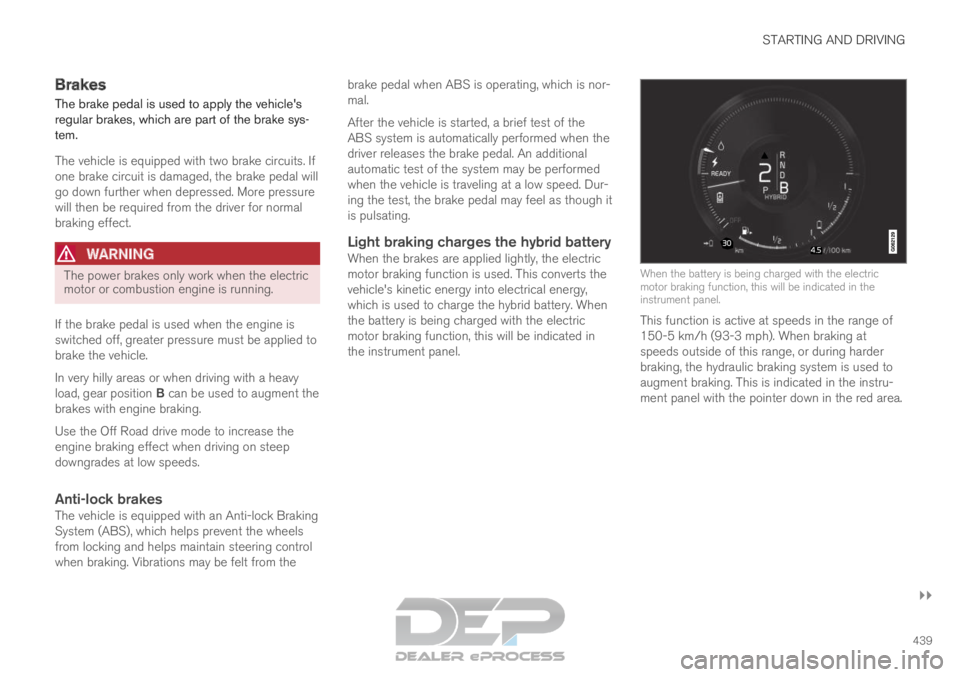
Light braking charges the hybrid batteryWhen the brakes are applied lightly, the electric
motor braking function is used. This converts the
vehicle's kinetic energy into electrical energy,
which is used to charge the hybrid battery. When
the battery is being charged with the electric
motor braking function, this will be indicated in
the instrument panel.
When the battery is being charged with the electric
motor braking function, this will be indicated in the
instrument panel.
This function is active at speeds in the range of
150-5 km/h (93-3 mph). When braking at
speeds outside of this range, or during harder
braking, the hydraulic braking system is used to
augment braking. This is indicated in the instru-
ment panel with the pointer down in the red area.
Page 442 of 697
||STARTING AND DRIVING
440
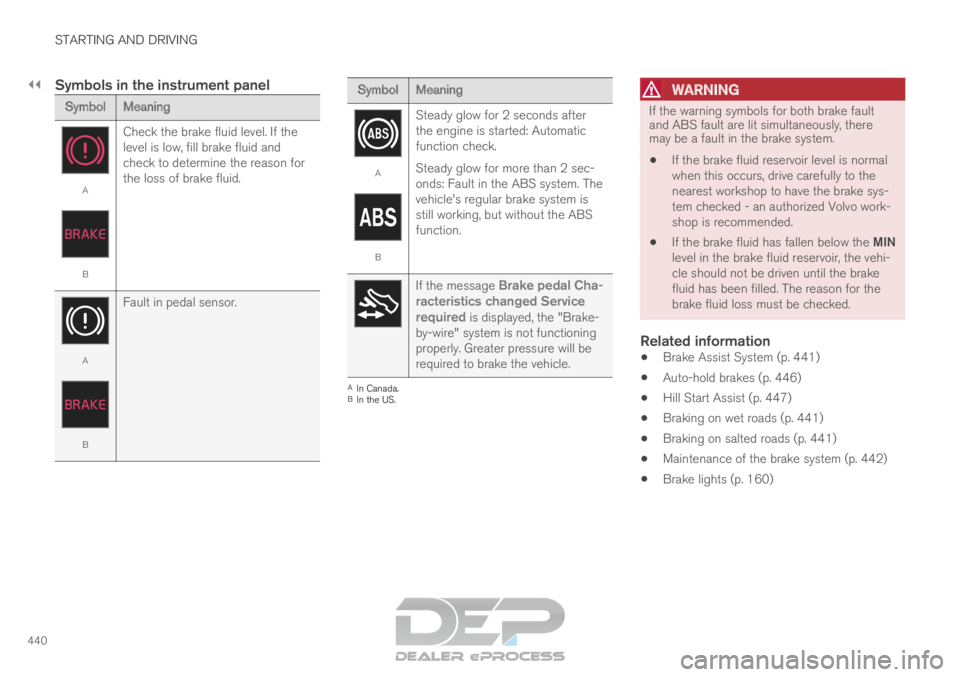
Symbols in the instrument panel
Symbol
Meaning A
B
Check the brake fluid level. If the
level is low, fill brake fluid and
check to determine the reason for
the loss of brake fluid. A
B
Fault in pedal sensor. Symbol
Meaning A
B
Steady glow for 2 seconds after
the engine is started: Automatic
function check.
Steady glow for more than 2 sec-
onds: Fault in the ABS system. The
vehicle's regular brake system is
still working, but without the ABS
function. If the message Brake pedal Cha-
racteristics changed Service
required is displayed, the "Brake-
by-wire" system is not functioning
properly. Greater pressure will be
required to brake the vehicle. A
In Canada.
B In the US.WARNING If the warning symbols for both brake fault
and ABS fault are lit simultaneously, there
may be a fault in the brake system.
If the brake fluid reservoir level is normal
when this occurs, drive carefully to the
nearest workshop to have the brake sys-
tem checked - an authorized Volvo work-
shop is recommended.
If the brake fluid has fallen below the MIN
level in the brake fluid reservoir, the vehi-
cle should not be driven until the brake
fluid has been filled. The reason for the
brake fluid loss must be checked.
Related information
Brake Assist System (p. 441)
Auto-hold brakes (p. 446)
Hill Start Assist (p. 447)
Braking on wet roads (p. 441)
Braking on salted roads (p. 441)
Maintenance of the brake system (p. 442)
Brake lights (p. 160)
Page 446 of 697
||STARTING AND DRIVING
444
Deactivating automatically
1. Fasten your seat belt.
2. Depress the brake pedal firmly.
3. Start the vehicle.
4.
Move the gear selector to D or R and press
the accelerator pedal.
> The parking brake will release and the symbol in the instrument panel will go out.
NOTE When the vehicle is initially started, the park-
ing brake could disengage automatically even
if the driver's seat belt is not buckled.
Related information
Settings for automatically activating the park-
ing brake (p. 444)
Parking brake malfunction (p. 445)
Parking brake (p. 442)
Parking on a hill (p. 444) Settings for automatically activating
the parking brake
Choose whether the parking brake should be
activated automatically when the vehicle is
switched off.
This selection is made in the Settings menu in
the center display.
1. Tap Settings in the Top view.
2.
Tap My Car Parking Brake and
Suspension and select or deselect the
Auto Activate Parking Brake function.
Related information
Activating and deactivating the parking brake
(p. 443)
Parking brake (p. 442) Parking on a hill
Always use the parking brake when parking on a
hill.
WARNING Always apply the parking brake when parking
on an incline. Selecting a gear or putting the
automatic transmission in P may not be suffi-
cient to keep the vehicle stationary in all sit-
uations.
If the vehicle is pointing uphill: Turn the front wheels so they are pointing
away from the curb.
If the vehicle is pointing downhill:
Turn the front wheels so they are pointing
toward the curb.
Heavy load uphill
Heavy loads, such as a trailer, could cause the
vehicle to roll backward when the parking brake
is released automatically on steep uphill gradi-
ents. To help avoid this, pull the control upward
while you are driving away. Release the control
when the vehicle gains traction.
Related information
Activating and deactivating the parking brake
(p. 443)
Page 447 of 697
STARTING AND DRIVING
445
Parking brake malfunction
If you are unable to deactivate or activate the
parking brake after several attempts, contact an
authorized Volvo workshop.
A audible warning signal will sound if the parking
brake is applied while the vehicle is being driven.
If the vehicle must be parked before the problem
is rectified, turn the wheels as when parking on
an incline and put the gear selector in P.
Low battery charge levelIf the battery charge level is too low, it will not be
possible to apply or release the parking brake.
Connect an auxiliary battery to the vehicle if the
battery is discharged.
Replacing brake padsDue to the design of the electric parking brake,
the rear brake pads must be replaced by a work-
shop. An authorized Volvo workshop is recom-
mended.
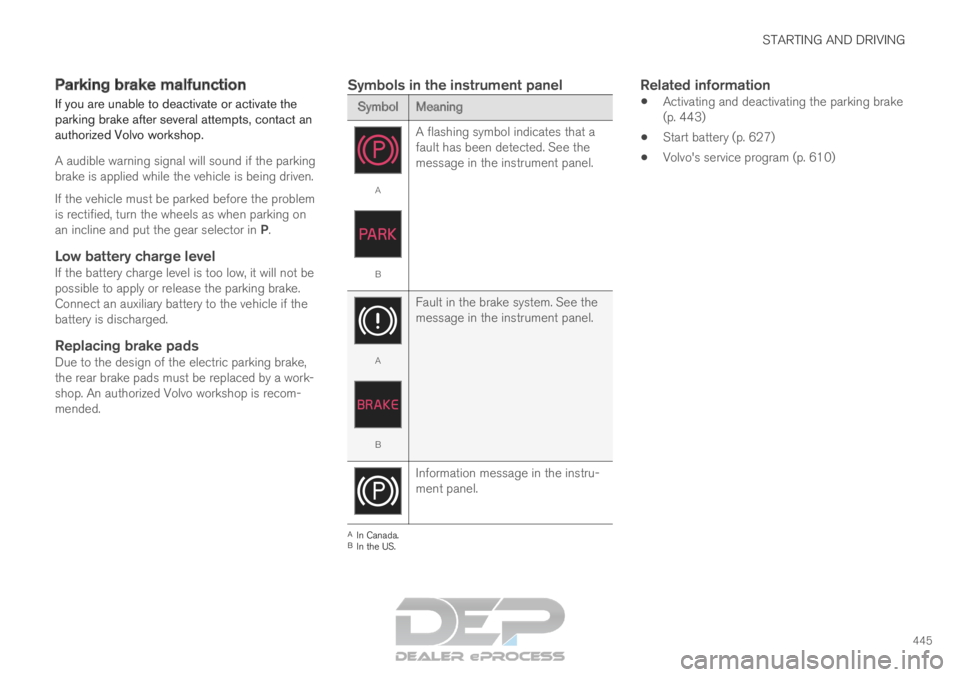
Symbols in the instrument panel Symbol
Meaning A
B
A flashing symbol indicates that a
fault has been detected. See the
message in the instrument panel. A
B
Fault in the brake system. See the
message in the instrument panel. Information message in the instru-
ment panel.
A
In Canada.
B In the US.Related information
Activating and deactivating the parking brake
(p. 443)
Start battery (p. 627)
Volvo's service program (p. 610)
Page 449 of 697
STARTING AND DRIVING
}}
447
When shutting off
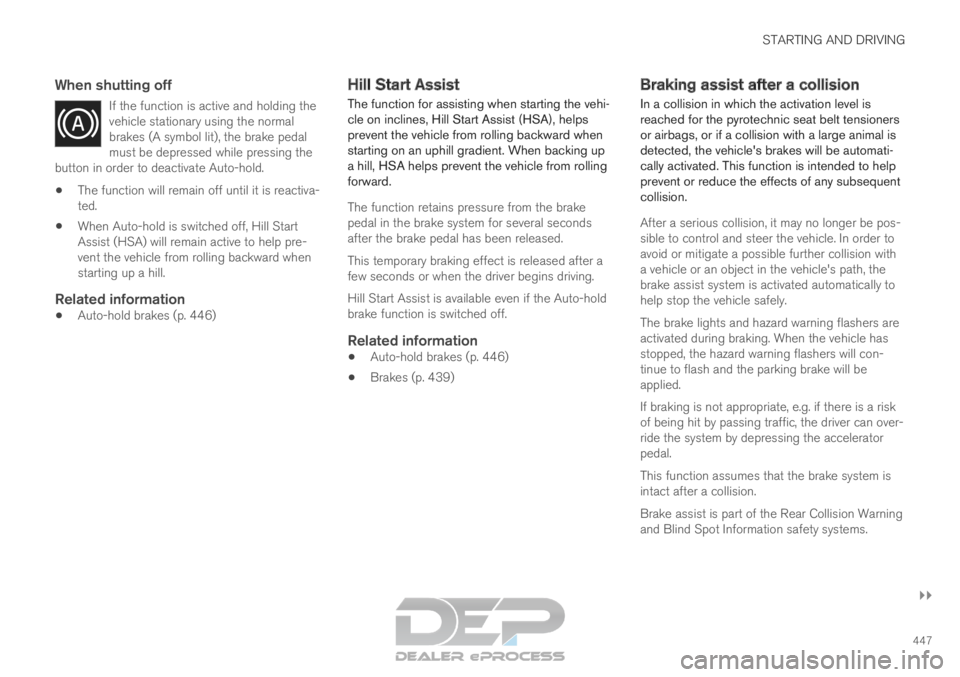
If the function is active and holding the
vehicle stationary using the normal
brakes (A symbol lit), the brake pedal
must be depressed while pressing the
button in order to deactivate Auto-hold.
The function will remain off until it is reactiva-
ted.
When Auto-hold is switched off, Hill Start
Assist (HSA) will remain active to help pre-
vent the vehicle from rolling backward when
starting up a hill.
Related information
Auto-hold brakes (p. 446) Hill Start Assist
The function for assisting when starting the vehi-
cle on inclines, Hill Start Assist (HSA), helps
prevent the vehicle from rolling backward when
starting on an uphill gradient. When backing up
a hill, HSA helps prevent the vehicle from rolling
forward.
The function retains pressure from the brake
pedal in the brake system for several seconds
after the brake pedal has been released.
This temporary braking effect is released after a
few seconds or when the driver begins driving.
Hill Start Assist is available even if the Auto-hold
brake function is switched off.
Related information
Auto-hold brakes (p. 446)
Brakes (p. 439) Braking assist after a collision
In a collision in which the activation level is
reached for the pyrotechnic seat belt tensioners
or airbags, or if a collision with a large animal is
detected, the vehicle's brakes will be automati-
cally activated. This function is intended to help
prevent or reduce the effects of any subsequent
collision.
After a serious collision, it may no longer be pos-
sible to control and steer the vehicle. In order to
avoid or mitigate a possible further collision with
a vehicle or an object in the vehicle's path, the
brake assist system is activated automatically to
help stop the vehicle safely.
The brake lights and hazard warning flashers are
activated during braking. When the vehicle has
stopped, the hazard warning flashers will con-
tinue to flash and the parking brake will be
applied.
If braking is not appropriate, e.g. if there is a risk
of being hit by passing traffic, the driver can over-
ride the system by depressing the accelerator
pedal.
This function assumes that the brake system is
intact after a collision.
Brake assist is part of the Rear Collision Warning
and Blind Spot Information safety systems.