automatic transmission VOLVO XC90 TWIN ENGINE 2019 User Guide
[x] Cancel search | Manufacturer: VOLVO, Model Year: 2019, Model line: XC90 TWIN ENGINE, Model: VOLVO XC90 TWIN ENGINE 2019Pages: 697, PDF Size: 10.33 MB
Page 454 of 697
STARTING AND DRIVING
452Shiftlock
The automatic transmission's shiftlock function
helps prevent inadvertently moving the gear
selector between different positions.
Automatic shiftlockThe automatic shiftlock has a separate safety
system.
From Park - P
To move to another gear from P (Park), the brake
pedal must be depressed and the ignition in
mode II.
From Neutral - N
If the gear selector is in N and the vehicle has
been stationary for at least 3 seconds (with or
without the engine running), the gear selector will
be locked in that position.
To move the gear selector from N to another
gear, the brake pedal must be depressed and the
ignition in mode II.
Messages in the instrument panelIf the gear selector is locked in position, a mes-
sage will appear in the instrument panel, e.g.
Gear lever Press brake pedal to activate
gear lever.
There is no mechanical shiftlock function.
Related information
Gear selector positions for automatic trans-
missions (p. 449) The kickdown function
Kickdown is used when maximum acceleration is
needed, e.g. when passing.
When the accelerator pedal is depressed all the
way to the floor (past the normal full accelerator
position), the transmission will automatically
engage kickdown, i.e. immediately shift down to a
lower gear.
If the accelerator pedal is released from the kick-
down position, the transmission will automatically
shift up again.
Safety function
The transmission control module is equipped with
a downshift protection feature to help prevent the
engine from overheating.
In some conditions, the transmission will prevent
downshifting/kickdown if this would lead to such
high engine speed (rpm) that the engine could
be damaged. If the driver still attempts downshift-
ing or kickdown at a high rpm, nothing will hap-
pen and the original gear will remain selected.
With kickdown, the vehicle can downshift one or
more steps at a time depending on the engine
speed. The vehicle upshifts when the engine rea-
ches its maximum rpm to prevent engine dam-
age.
Related information
Gear selector positions for automatic trans-
missions (p. 449) All Wheel Drive (AWD)
All-wheel drive, All Wheel Drive (AWD), also
called four-wheel drive, means that power is dis-
tributed to all four wheels, which improves trac-
tion.
The electric motor that powers the rear wheels
enables electronic all-wheel drive functionality.
All-wheel drive reacts differently depending on
which drive mode is selected.
Related information
Drive modes (p. 454)
Low Speed Control (p. 464)
Transmission (p. 448)
Page 456 of 697
STARTING AND DRIVING
* Option/accessory.
454 Starting and stopping the
combustion engine in Twin Engine
vehicles
An advanced control system determines the dis-
tance that the vehicle can be driven on the com-
bustion engine, electric motor, or both at the
same time. When driving on only the electric
motor, the vehicle may automatically start the
combustion engine due to outside circumstan-
ces, e.g. low ambient temperatures. This is com-
pletely normal. The combustion engine will also
always start when the hybrid battery is nearly
fully discharged.
Climate settings at low temperaturesAt low ambient temperatures, the combustion
engine will sometimes start automatically to help
achieve the desired passenger compartment
temperature and air quality. The amount of time
the combustion engine is running can be affec-
ted by:
lowering the temperature
reducing blower speed
activating Pure drive mode.
Using the electric motor in hot or cold
weather
At very low or high ambient temperatures, the
electric motor's driving range and power may be
reduced and affect how often the combustion
engine automatically starts.
Emission control systemTo help ensure that the emission control system
functions optimally, the combustion engine will
run for several minutes after it is started. The
amount of time the combustion engine needs to
be used varies depending on the temperature of
the three-way catalytic converter.
WARNING California Proposition 65
Operating, servicing and maintaining a pas-
senger vehicle can expose you to chemicals
including engine exhaust, carbon monoxide,
phthalates, and lead, which are known to the
State of California to cause cancer and birth
defects or other reproductive harm. To mini-
mize exposure, avoid breathing exhaust, do
not idle the engine except as necessary, serv-
ice your vehicle in a well ventilated area and
wear gloves or wash your hands frequently
when servicing your vehicle. For more infor-
mation go to www.P65Warnings.ca.gov/
passenger-vehicle.
Related information
Drive systems (p. 453)
Economical driving (p. 467)
Using the electric motor only (p. 469)
Drive modes (p. 454) Drive modes
Drive modes affect the vehicle's driving charac-
teristics in different ways to enhance and sim-
plify the driving experience in certain types of sit-
uations.
Drive modes enable easy access to the vehicle's
many functions and settings in different driving
situations. The following systems are adapted to
help optimize driving characteristics in each drive
mode:
Steering
Engine/transmission/all-wheel drive
Brakes
Pneumatic suspension* and shock absorbers
Instrument panel
Climate control settings
Select the drive mode that is best suited to the
current driving conditions. Keep in mind that not
all drive modes are available in all situations.
Page 487 of 697
STARTING AND DRIVING
}}
* Option/accessory. 485
The automatic transmission selects the optimal
gear for the current load and engine speed.
Steep inclines
Do not lock the automatic transmission into a
higher gear than what the engine can handle ‒ it
is not always preferable to drive in high gears at
low rpm.
Parking on a hill
1. Depress the brake pedal.
2. Apply the parking brake.
3. Put the gear selector in P.
4. Release the brake pedal.
Put chocks behind the wheels when the vehicle
is parked on a hill with a trailer attached.
Starting on a hill
1. Depress the brake pedal.
2. Put the gear selector in D.
3. Release the parking brake.
4. Release the brake pedal and start driving.
Related information
Trailer Stability Assist* (p. 485)
Checking trailer lights (p. 486)
Towing capacity and tongue weight (p. 670)
Overheating of engine and transmission
(p. 479) Trailer Stability Assist*
Trailer Stability Assist (TSA 8
) is a function
designed to help stabilize a vehicle that is tow-
ing a trailer when the vehicle and trailer have
begun to sway. The function is part of the Elec-
tronic Stability Control system ESC 9
.
Reasons for swayingA vehicle towing a trailer may begin to sway for
various reasons. Normally this only occurs at high
speeds. However, if the trailer is overloaded or
unevenly distributed, e.g. too far back, there is a
risk of swaying even at low speeds.
Swaying may be caused by factors such as:
The vehicle and trailer are hit by a sudden,
strong crosswind.
The vehicle and trailer are traveling on an
uneven road or over a bump.
Sudden movements of the steering wheel.
Once swaying has begun, it can be difficult or
impossible to stop it. This makes the vehicle and
trailer difficult to control and there is a risk of
swerving into oncoming traffic or driving off the
road.
Trailer Stability Assist functionTrailer Stability Assist continuously monitors the
vehicle's movements, particularly lateral move- ments. If swaying is detected, the brakes are
applied individually on the front wheels, which has
a stabilizing effect on the vehicle and trailer. This
is often enough to enable the driver to regain
control of the vehicle.
If the Trailer Stability Assist function's first
attempt is not adequate to stop the swaying
motion, the brakes are applied on all wheels and
engine power is temporarily reduced. As the
swaying motion begins to decrease and the vehi-
cle and trailer have once again become stable,
TSA stops regulating the brakes/engine power
and the driver regains control of the vehicle.
NOTE
Trailer Stability Assist is deactivated if the
driver selects the sport mode by deactivating
ESC in the center display's menu system. Trailer Stability Assist may not intervene if the
driver tries to compensate for the swaying motion
by moving the steering wheel rapidly, because
the system will then not be able to determine if it
is the trailer or the driver causing the swaying.
8
Trailer Stability Assist
9 Electronic Stability Control
Page 637 of 697
MAINTENANCE AND SERVICE
}}
635
Fuse pliers are provided on the inside of the fuse
box cover to assist in removing and inserting
fuses.
There are also spaces for several extra fuses in
the fusebox.
PositionsThere is a decal with a diagram of the locations
of the fuses on the inside of the cover.
Fuses 1–13, 18–30, 35–37 and 46–70 are
"Micro" fuses.
Fuses 14–17, 31–34, 38–45 and 71–78 are
"MCase" fuses and should only be replaced
by a workshop 16
. Function
Ampere–
––
––
–Control module for actuator
for engaging/changing gears,
automatic transmission
5High-voltage coolant heater
control module
5 Function
Ampere Control module for A/C; heat
exchanger cut-off valve; cut-
off valve for coolant through
the climate system
5 Hybrid battery control module;
high-voltage converter for
combined high-voltage gener-
ator/starter motor with 500
V–12 V voltage converter
5 –
– Converter for controlling feed
to rear axle electric motor
10 Hybrid battery control module;
high-voltage converter for
combined high-voltage gener-
ator/starter motor with 500
V–12 V voltage converter
10 Charge module
5 Cut-off valve for hybrid battery
coolant; coolant pump 1 for
hybrid battery
10 Coolant pump for electric drive
system
10 Function
Ampere Hybrid component cooling fan 25
–
– –
– –
– –
– –
– –
– –
– –
– –
– 12 V outlet in tunnel console,
front
15 12 V outlet in tunnel console
between second-row seats
A
12 V outlet in tunnel console,
between rear seats B
; USB
ports in tunnel console
between rear seats B15
16
An authorized Volvo workshop is recommended.
Page 675 of 697
SPECIFICATIONS
673
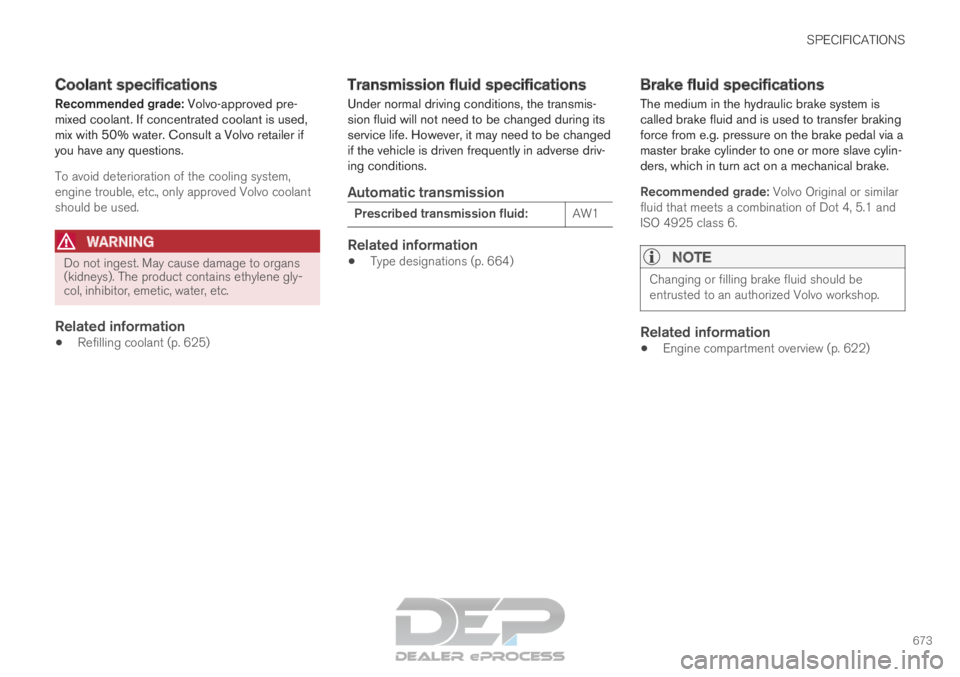
Coolant specifications
Recommended grade: Volvo-approved pre-
mixed coolant. If concentrated coolant is used,
mix with 50% water. Consult a Volvo retailer if
you have any questions.
To avoid deterioration of the cooling system,
engine trouble, etc., only approved Volvo coolant
should be used.
WARNING Do not ingest. May cause damage to organs
(kidneys). The product contains ethylene gly-
col, inhibitor, emetic, water, etc.
Related information
Refilling coolant (p. 625) Transmission fluid specifications
Under normal driving conditions, the transmis-
sion fluid will not need to be changed during its
service life. However, it may need to be changed
if the vehicle is driven frequently in adverse driv-
ing conditions.
Automatic transmission Prescribed transmission fluid:
AW1
Related information
Type designations (p. 664) Brake fluid specifications
The medium in the hydraulic brake system is
called brake fluid and is used to transfer braking
force from e.g. pressure on the brake pedal via a
master brake cylinder to one or more slave cylin-
ders, which in turn act on a mechanical brake.
Recommended grade: Volvo Original or similar
fluid that meets a combination of Dot 4, 5.1 and
ISO 4925 class 6.NOTE Changing or filling brake fluid should be
entrusted to an authorized Volvo workshop.
Related information
Engine compartment overview (p. 622)
Page 679 of 697
INDEX
677
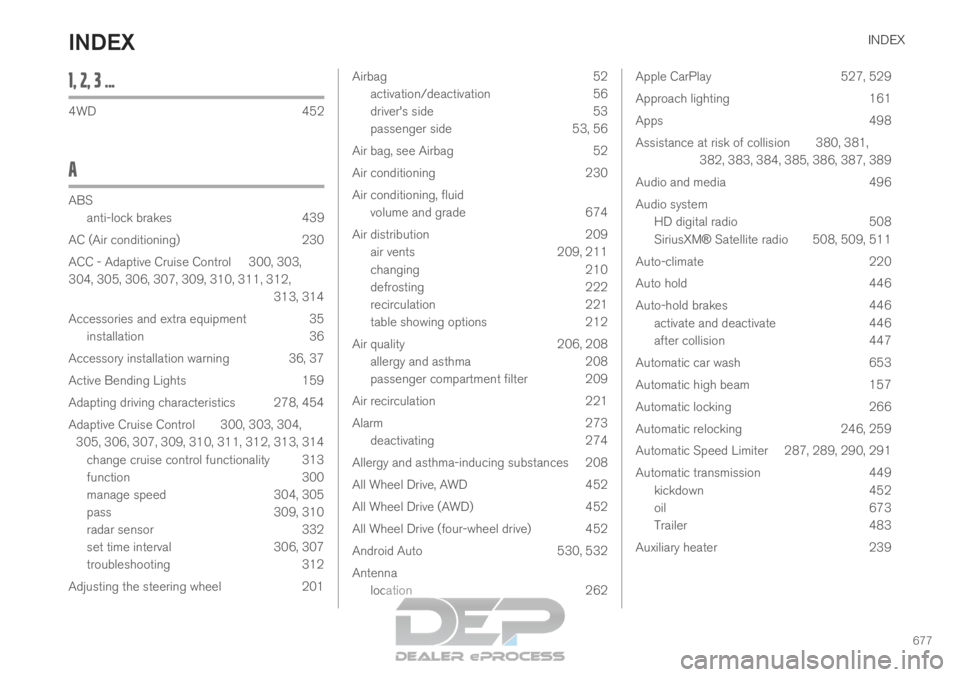
1, 2, 3 ... 4WD
452
A ABS
anti-lock brakes
439
AC (Air conditioning) 230
ACC - Adaptive Cruise Control 300, 303,
304, 305, 306, 307, 309, 310, 311, 312, 313, 314
Accessories and extra equipment 35 installation 36
Accessory installation warning 36, 37
Active Bending Lights 159
Adapting driving characteristics 278, 454
Adaptive Cruise Control 300, 303, 304, 305, 306, 307, 309, 310, 311, 312, 313, 314 change cruise control functionality 313
function 300
manage speed 304, 305
pass 309, 310
radar sensor 332
set time interval 306, 307
troubleshooting 312
Adjusting the steering wheel 201 Airbag
52
activation/deactivation
56
driver's side 53
passenger side 53, 56
Air bag, see Airbag 52
Air conditioning 230
Air conditioning, fluid volume and grade 674
Air distribution 209
air vents 209, 211
changing 210
defrosting 222
recirculation 221
table showing options 212
Air quality 206, 208
allergy and asthma 208
passenger compartment filter 209
Air recirculation 221
Alarm 273
deactivating 274
Allergy and asthma-inducing substances 208
All Wheel Drive, AWD 452
All Wheel Drive (AWD) 452
All Wheel Drive (four-wheel drive) 452
Android Auto 530, 532
Antenna location 262 Apple CarPlay
527, 529
Approach lighting 161
Apps 498
Assistance at risk of collision 380, 381, 382, 383, 384, 385, 386, 387, 389
Audio and media 496
Audio system HD digital radio 508
SiriusXM® Satellite radio 508, 509, 511
Auto-climate 220
Auto hold 446
Auto-hold brakes 446
activate and deactivate 446
after collision 447
Automatic car wash 653
Automatic high beam 157
Automatic locking 266
Automatic relocking 246, 259
Automatic Speed Limiter 287, 289, 290, 291
Automatic transmission 449
kickdown 452
oil 673
Trailer 483
Auxiliary heater 239
INDEX
Page 684 of 697
INDEX
682G Gasoline grade
476
Gauge fuel gauge
87
Gear selector positions automatic transmission 449
Glass laminated/reinforced 166
Glove compartment 597
Gracenote® 521
Grocery bag holders 600
Gross vehicle weight 669
Guide lines for Park Assist Camera 399
H Handbrake
442, 443
Hand wash
651
Hard disk space 548
Hazard warning flashers 161
HDC 466
HD radio 505
Head restraint 195 Head-up display
142
activate and deactivate
143
cleaning 646
replacing windshield 621
settings 144
store position 144, 186, 187
Heated washer nozzles 176
Heater 239
auxiliary heater 239
parking heater 239
Heating Seats 217, 218
steering wheel 219, 220
windows 223, 225
Height adjustment 461, 464
high beams 156, 157
High engine temperature 479
Hill Descent Control 465, 466, 467
activate with function button 467
Hill Start Assist 447
Hill Start Assist (HSA) 447
Hoisting the vehicle 618
Hold vehicle function 471
HomeLink® 489
programming 490
use 491 HomeLink® remote control
programmable 489
Home safe lighting 161
Honk 200
Hood, opening 620
Horn 200
Hybrid battery 631
Charging 417
Hybrid battery gauge 88
Hybrid gauge 87
Hybrid mode 454, 460
I IAQS (Interior Air Quality System) 208
IC (Inflatable Curtain)
60
ID, Volvo 26
Identification number 38
Ignition mode 437, 438
Immobilizer 257
Electronic immobilizer 257
Indicator symbols 94
Individual drive mode 454
Infant seats 67
Inflatable curtain 60
Page 691 of 697
INDEX
689
Temperature
adjusting 228, 229
perceived 205
Temperature monitoring 422
Temporary spare spare tire 579
Temporary tire sealing system execution, checking 583
Inflating tires 587
location 582
overview 582
sealing compound 582
Terms and conditions services 35
users 548
Tire dimensions 564, 574
Tire pressure monitoring calibrating 571
Tires 560 direction of rotation 562
glossary of terms 563
inflation pressure table 675
mounting 578
pressure 675
removal 576
rotation 561
specifications 564, 675
storage 560
tire pressure monitoring 569 tire sealing
582
Tread depth
581
tread wear indicator 563
winter tires 581
Tire sealing system 583
Tire tread 563
Tools 574
Top tether anchors (child restraint sys-
tems) 72
Top view 132
Total airing function 243
Towbar 482 removable, attaching, installing, mount-
ing 482
removable, removing, detaching 482
Towing 487
Towing capacity and towball load 670
Towing eyelet 488
TPMS - Tire Pressure Monitoring System 569
Traction control 279
Traffic information 504
Trailer 485 driving with a trailer 483
Lamps 486
swaying 485 Trailer Stability Assist
485
trailer 485
Trailer stabilizer 280
Trailer towing trailer hitch 482
Transmission 448 automatic 449
Transmission fluid grade 673
Travel Link 512 Fuel 516
Notifications 515
Sports 517
weather 514
Tread depth 563, 581
Tread wear indicator 563
Trip computer 89, 91
Trip odometer 89
Trip odometer resetting 92
Trip statistics 92
Troubleshooting Adaptive Cruise Control 312
Troubleshooting the camera sensor 338, 341
TSA - Trailer Stability Assist 280, 485
Tunnel detection 155
Turn off engine 436