fuel type VOLVO XC90 TWIN ENGINE 2019 User Guide
[x] Cancel search | Manufacturer: VOLVO, Model Year: 2019, Model line: XC90 TWIN ENGINE, Model: VOLVO XC90 TWIN ENGINE 2019Pages: 697, PDF Size: 10.33 MB
Page 613 of 697
MAINTENANCE AND SERVICE
}}
611
Periodic maintenance helps minimize
emissions
NOTE
Refer to your Service and Warranty Book-
let for a comprehensive service and main-
tenance schedule up to 240,000 km
(150,000 miles). This program contains
inspections and services necessary for
the proper function of your vehicle and
includes components that affect vehicle
emissions.
The Warranty and Service Records Infor-
mation booklet also contains detailed
information concerning the warranties
that apply to your vehicle.
On-board Diagnostic SystemOBD II is part of your vehicle's computerized
engine management system. It stores diagnostic
information about your vehicle's emission con-
trols. It can light the Check Engine light (MIL) if it
detects an emission control "fault." A "fault" is a
component or system that is not performing
within an expected range. A fault may be perma-
nent or temporary. OBD II will store a message
about any fault.
Emission inspection readiness
How do states use OBD II for emission
inspections?
Many states connect a computer directly to a
vehicle's OBD II system. The inspector can then
read "faults." In some states, this type of inspec-
tion has replaced the tailpipe emission test.
How can my vehicle fail OBD II emission
inspection?
Your vehicle can fail OBD II emission inspection
for any of the following reasons:
If your Check Engine (MIL) light is lit, your
vehicle may fail inspection.
If your vehicle's Check Engine light was lit,
but went out without any action on your part,
OBD II will still have a recorded fault. Your
vehicle may pass or fail, depending on the
inspection practices in your area.
If you had recent service that required dis-
connecting the battery, OBD II diagnostic
information may be incomplete and "not
ready" for inspection. A vehicle that is not
ready may fail inspection.
How can I prepare for my next
OBD II
emission inspection?
If your Check Engine (MIL) light is lit or was
lit but went out without service, have your vehicle diagnosed and, if necessary, serviced
by a qualified Volvo technician.
If you recently had service for a lit Check
Engine light, or if you had service that
required disconnecting the battery, a period
of driving is necessary to bring the OBD II
system to "ready" for inspection. Two half-
hour trips of mixed stop-and-go/highway
driving are typically needed to allow OBD II to
reach readiness. Your Volvo retailer can pro-
vide you with more information on planning a
trip.
Maintain your vehicle in accordance with your
vehicle's maintenance schedule.
Owner maintenancePeriodic maintenance requirements and intervals
are described in your vehicle's Warranty and
Service Records Information booklet.
The following points can be carried out between
the normally scheduled maintenance services.
Each time the car is refueled:
Check the engine oil level.
Clean the windshield, windshield wipers,
headlights, and taillights.
Page 625 of 697
MAINTENANCE AND SERVICE
623
Engine oil
For the recommended service intervals and war-
ranties to be applied, an approved engine oil
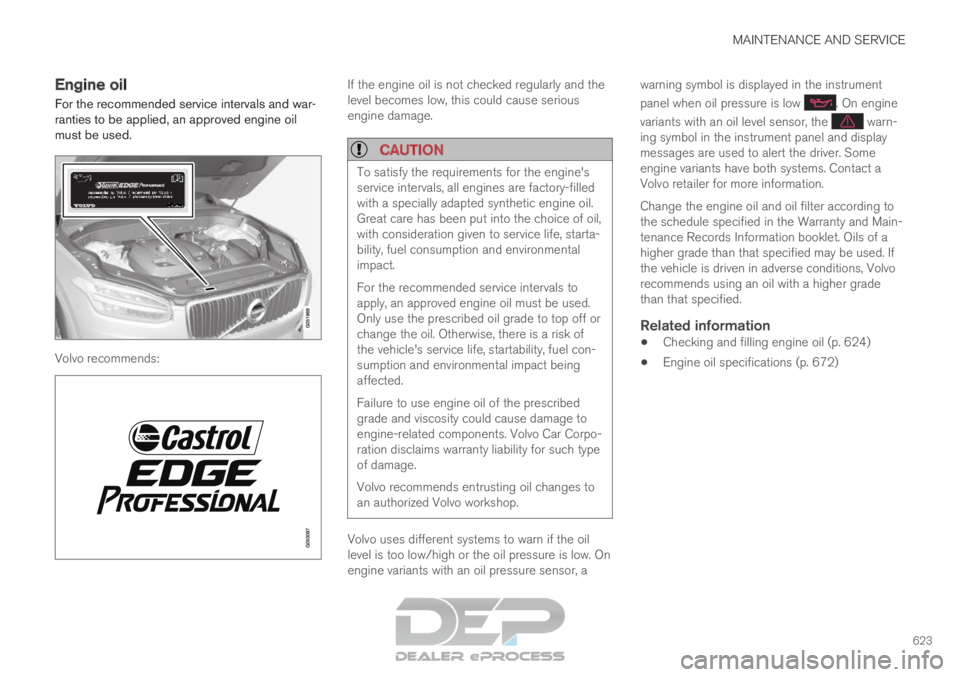
must be used. Volvo recommends: If the engine oil is not checked regularly and the
level becomes low, this could cause serious
engine damage.
CAUTION
To satisfy the requirements for the engine's
service intervals, all engines are factory-filled
with a specially adapted synthetic engine oil.
Great care has been put into the choice of oil,
with consideration given to service life, starta-
bility, fuel consumption and environmental
impact.
For the recommended service intervals to
apply, an approved engine oil must be used.
Only use the prescribed oil grade to top off or
change the oil. Otherwise, there is a risk of
the vehicle's service life, startability, fuel con-
sumption and environmental impact being
affected.
Failure to use engine oil of the prescribed
grade and viscosity could cause damage to
engine-related components. Volvo Car Corpo-
ration disclaims warranty liability for such type
of damage.
Volvo recommends entrusting oil changes to
an authorized Volvo workshop.
Volvo uses different systems to warn if the oil
level is too low/high or the oil pressure is low. On
engine variants with an oil pressure sensor, awarning symbol is displayed in the instrument
panel when oil pressure is low . On engine
variants with an oil level sensor, the warn-
ing symbol in the instrument panel and display
messages are used to alert the driver. Some
engine variants have both systems. Contact a
Volvo retailer for more information.
Change the engine oil and oil filter according to
the schedule specified in the Warranty and Main-
tenance Records Information booklet. Oils of a
higher grade than that specified may be used. If
the vehicle is driven in adverse conditions, Volvo
recommends using an oil with a higher grade
than that specified.
Related information
Checking and filling engine oil (p. 624)
Engine oil specifications (p. 672)
Page 633 of 697
MAINTENANCE AND SERVICE
631
Hybrid battery
The vehicle's electric motor is powered by a
rechargeable, maintenance-free, lithium-ion
hybrid battery.
NOTE The vehicle cannot be started if the hybrid
battery is discharged.
NOTE
If both the starter battery and the hybrid bat-
tery are discharged, both batteries must be
charged. In such cases, it is not possible to
charge only the hybrid battery first.
The starter battery must have a certain level
of charge for it to be possible to charge the
hybrid battery.
WARNING
Hybrid battery replacement may only be per-
formed by a workshop – an authorized Volvo
workshop is recommended.
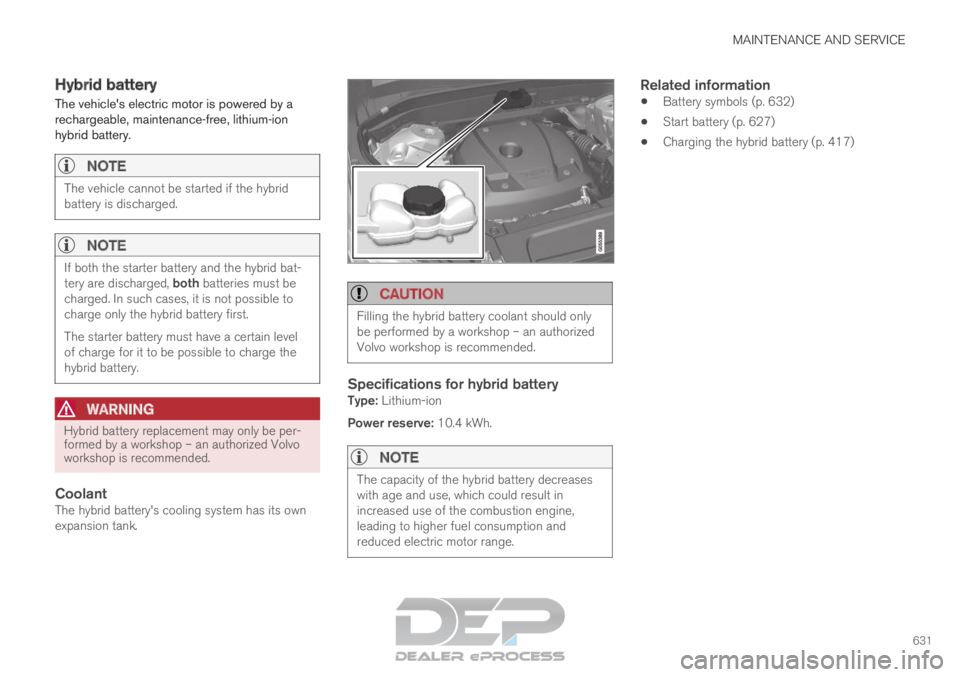
CoolantThe hybrid battery's cooling system has its own
expansion tank.
CAUTION Filling the hybrid battery coolant should only
be performed by a workshop – an authorized
Volvo workshop is recommended.
Specifications for hybrid batteryType: Lithium-ion
Power reserve: 10.4 kWh.
NOTE
The capacity of the hybrid battery decreases
with age and use, which could result in
increased use of the combustion engine,
leading to higher fuel consumption and
reduced electric motor range.
Related information
Battery symbols (p. 632)
Start battery (p. 627)
Charging the hybrid battery (p. 417)
Page 674 of 697
SPECIFICATIONS
672Engine oil specifications
Fully synthetic engine oil of at least
ACEA A5/B5 must be used. Lower oil grades
may not offer the same fuel economy, engine
performance or engine protection.
Volvo recommends:
GeneralSee the Service and warranty booklet for infor-
mation about oil change intervals.
NOTE This vehicle is delivered from the factory with
synthetic oil.
Do not use oil additives.
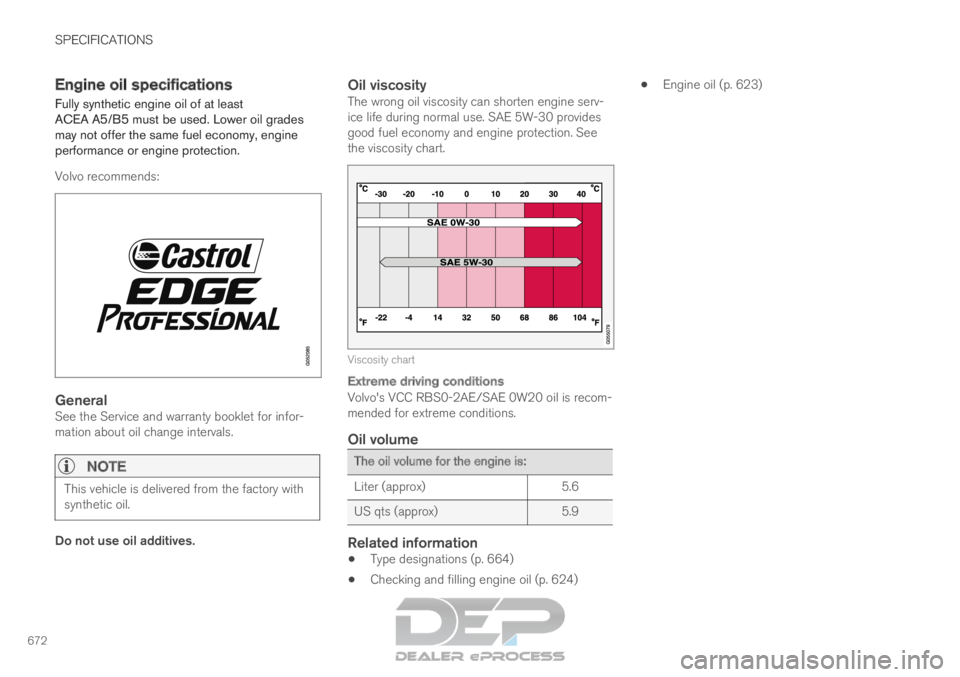
Oil viscosityThe wrong oil viscosity can shorten engine serv-
ice life during normal use. SAE 5W-30 provides
good fuel economy and engine protection. See
the viscosity chart. Viscosity chart
Extreme driving conditions
Volvo's VCC RBS0-2AE/SAE 0W20 oil is recom-
mended for extreme conditions.
Oil volume
The oil volume for the engine is:
Liter (approx)
5.6
US qts (approx) 5.9
Related information
Type designations (p. 664)
Checking and filling engine oil (p. 624)
Engine oil (p. 623)